Mirrors
General safety precautions
Using the outside mirrors and the interior rearview mirror, the driver can observe traffic and adjust their driving based on traffic.
For driving safety, it is important that the driver adjusts the outside mirrors and the interior rearview mirror correctly before starting to drive.
It is not possible to oversee the entire side and rear area of the vehicle by looking in the outside and interior rearview mirrors. These areas that are not visible are called blind spots. Other road users and objects could be in the blind spot.
 WARNING
Adjusting the outside mirrors and interior rearview mirror while driving can distract the driver. This can cause accidents and serious injuries.
-
Only adjust the outside mirror and interior rearview mirror when the vehicle is stationary.
-
When parking, changing lanes, passing, and turning, always pay attention to your surroundings, because other road users and objects could be within the blind spot.
-
Always make sure that the mirrors are adjusted correctly and visibility to the rear is not limited by ice, snow, fog, or other objects.
WARNING
Inaccurate prediction of distance to vehicles behind you can cause accidents and serious injuries.
-
Curved mirror surfaces (convex or aspheric) enlarge the field of vision and allow objects in the mirror to appear smaller and farther away.
-
Using the curved mirrors to estimate the distance from vehicles behind you when changing lanes is imprecise and may cause accidents and serious injuries.
-
Use the interior rearview mirror as much as possible to more accurately determine the distance to vehicles or other objects behind you.
-
Make sure there is sufficient visibility of the area behind the vehicle.
WARNING
An automatic dimming rearview mirror contains an electrolyte fluid that can leak out if the mirror glass breaks.
-
The leaking electrolyte fluid can irritate the skin, eyes, and respiratory organs, especially in individuals with asthma or similar illnesses. Immediately try to exit the vehicle to get fresh air. If this is not possible, open all the windows and doors.
-
If the electrolyte fluid comes into contact with eyes or skin, wash the affected area immediately for at least 15 minutes with plenty of water and seek medical assistance.
-
If the electrolyte fluid comes into contact with your shoes or clothing, wash it for at least 15 minutes with plenty of water. Clean the shoes and clothing thoroughly before wearing them again.
-
If electrolyte fluid is swallowed, rinse out the mouth immediately for at least 15 minutes with plenty of water. Do not induce vomiting unless it ordered to do so by a doctor. Call for medical assistance immediately.
 NOTICE
If the glass on an automatic dimming mirror breaks, electrolyte fluid can leak out. This fluid damages plastic surfaces.
-
Remove any leaking fluid as soon as possible, for instance using a wet sponge.
Interior rearview mirror

Fig. 84 On the windshield: automatic dimming interior rearview mirror.
 Front sensor.
 Rear sensor.

Fig. 85 On the windshield: manual dimming interior rearview mirror.
Automatic dimming interior rearview mirror
When the ignition is on, the sensors measure the amount of light entering from the rear fig. 84 and from the front .
Depending on the measured values, the interior rearview mirror will dim automatically.
If the amount of light entering the sensors is limited or interrupted, for example by a sunshade or attachment, the automatic dimming interior rearview mirror may not function or may malfunction. Mobile navigation devices on the windshield or near the automatic dimming interior rearview mirror can also affect the sensors ⇒  .
.
Automatic dimming will be deactivated in some situations, for example when reverse gear is engaged.
Manual dimming interior rearview mirror
-
Base position: lever on the lower edge of the mirror points forward toward the windshield.
-
To dim, pull the lever back fig. 85.
WARNING
The illuminated display on a mobile navigation device can cause the automatic dimming interior rearview mirror to malfunction, which can result in accidents and serious injuries.
-
If the automatic dimming function malfunctions, it may not be possible to use the interior rearview mirror to evaluate the exact distance to vehicles or other objects behind the vehicle.
Outside mirrors
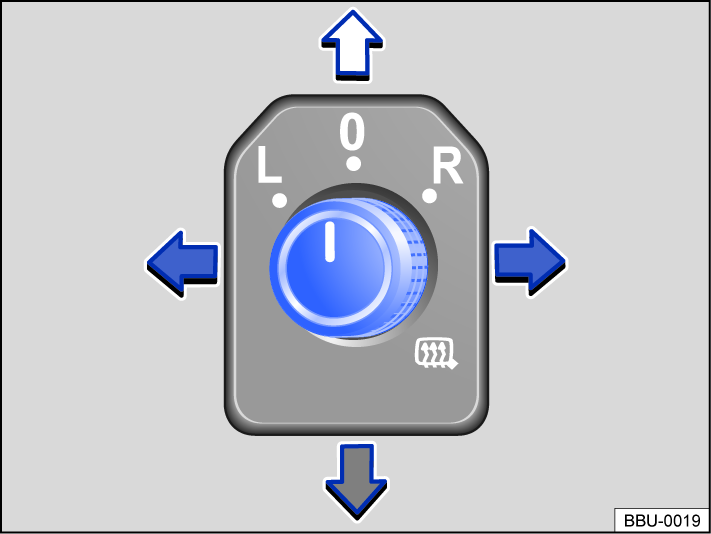
Fig. 86 In the driver door: knob for the outside mirrors.
Adjusting outside mirrors
-
Switch the ignition on.
-
Turn the knob in the driver door to the preferred symbol fig. 86.
-
Press the knob forward, back, right, or left in the direction of the arrow to adjust the outside mirror.
- Switch on the outside mirror heating. The exterior mirror heating only works when the ambient temperature is below approx. 20 °C (around 68 °F) and provides the most heat when it first turns on. After about two minutes, the mirrors will be heated depending on the ambient temperature.

- Adjusts the left outside mirror.

- Adjusts the right outside mirror.

- Neutral position. The outside mirror cannot be adjusted and all functions are switched off.
Activating outside mirror functions
The following outside mirror functions must be activated in the vehicle settings in the Infotainment system before they are used for the first time ⇒ Vehicle settings menu.
Synchronized mirror adjustment
Depending on vehicle equipment, it may be possible to adjust both outside mirrors at the same time.
-
Turn rotary knob to position
. -
Adjusts the left outside mirror. The right outside mirror will be adjusted the same way (synchronized).
-
To correct the adjustment of the right outside mirror, if necessary, turn the knob to the
position and adjust the right outside mirror.
Save the passenger-side outside mirror settings when reversing
-
Unlock the vehicle using the key, to which the setting is allocated.
-
Set the electronic parking brake.
-
Switch the ignition on.
-
Shift the transmission to neutral.
-
Select the reverse gear.
-
Adjust the front passenger outside mirror so that, for example, the edge of the curb can be seen clearly.
-
Shift the transmission to neutral.
-
Switch the ignition off.
The selected mirror position will be stored and assigned to the vehicle key.
Opening the front passenger outside mirror settings for driving in reverse
-
Turn rotary knob for the outside mirrors to the relevant position for adjusting the front passenger outside mirror.
-
With the ignition switched on, select reverse gear. The front passenger outside mirror will adjust to the stored position.
The front passenger outside mirror will exit the position stored for driving in reverse when you begin driving forward faster than about 15 km/h (about 9 mph) or when the knob is turned to any other position.
WARNING
Inattentively folding the outside mirrors out and in can cause injuries.
-
Do not fold the outside mirrors out or in if there are any obstacles in the path.
-
Always make sure your fingers do not get pinched between the outside mirror and the mirror base when moving the mirror.
NOTICE
If outside mirrors are not folded in when driving through a car wash, they can get damaged.
-
Always fold in the outside mirrors.

Leave the outside mirror heating on only as long as it is needed. Otherwise fuel will be used unnecessarily.
 If there is a malfunction in the power outside mirror, you can adjust the position of the mirror manually by hand by pushing on the edge of the mirror surface.
Download Manual