Manual transmission
Manual transmission: Engaging a gear
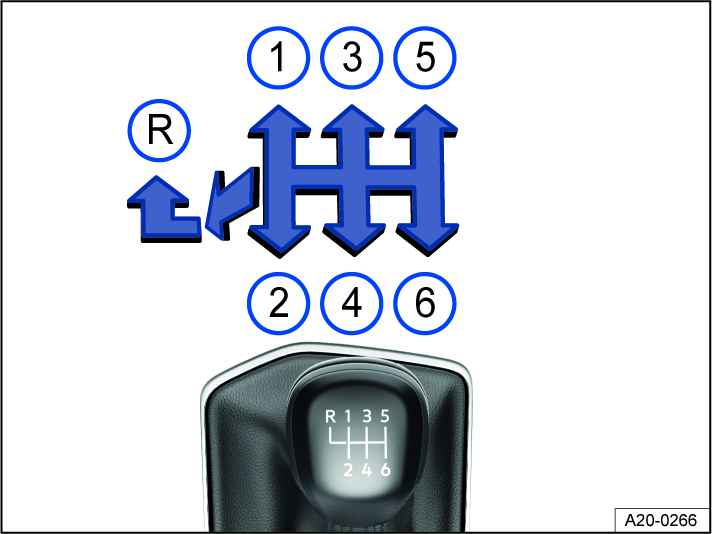
Fig. 100 Gear shift pattern for 6-speed manual transmission. Your vehicle may be equipped with a 5-speed manual transmission.
Engaging forward gear
The positions of the individual gears are depicted on the gear lever.
-
Fully depress the clutch pedal and hold.
-
Move the gearshift lever into the preferred position fig. 100
 .
. -
Release the clutch pedal to engage the clutch.
In some countries the clutch pedal must be fully depressed to start the engine.
Engaging reverse gear
Only select reverse gear when the vehicle is stationary.
-
Fully depress the clutch pedal and hold.
-
Move the gearshift lever to the neutral position and push it down.
-
Push the gearshift lever all the way to the left and then forward into the reverse gear position fig. 100
 .
. -
Release the clutch pedal to engage the clutch.
Downshifting
You should always downshift gear-by-gear when driving, i.e. into the next gear down, and at engine speeds that are not too high. At high speeds or engine speeds, skipping a gear or several gears when downshifting can result in damage to the clutch or transmission, even if the clutch is not engaged when doing so.
 WARNING
Incorrectly downshifting into gears that are too low can result in loss of vehicle control as well as accidents and serious injuries.
WARNING
Fast acceleration can cause traction loss and sliding, especially on slippery roads. This could cause loss in vehicle control, accidents, and serious injuries.
-
Only accelerate quickly when the visibility, weather, road, and traffic conditions allow it, and when other road users will not be endangered by the vehicle's acceleration and driving style.
-
Always adapt your driving style to the flow of traffic.
-
If you switch off the traction control system, the drive gears may spin, especially on wet, icy or dirty roads. This can cause the vehicle to become out of control or difficult to steer.
WARNING
When the engine is running, the vehicle immediately begins to move as soon as a gear is engaged and the clutch pedal has been released. This applies even if the electronic parking brake is switched on.
-
Never engage reverse gear when the vehicle is in motion.
 NOTICE
If the gearshift lever is shifted to a gear that is too low at high speeds or high engine speeds, it can result in significant damage to the clutch and transmission. This also applies when the clutch pedal remains pressed and the clutch is not engaged.
NOTICE
Follow the points below to avoid damage and premature wear:
-
Do not rest your hand on the gearshift lever while driving. The pressure from your hand is transmitted to the selector forks in the transmission.
-
Ensure that the vehicle is completely stationary before engaging reverse gear.
-
Always fully depress the clutch pedal when shifting gears.
-
Do not hold your vehicle stationary on inclines by “slipping” the clutch while the engine is running.

Early upshifting helps to save fuel and reduces operating noise.
Troubleshooting
 Clutch “slips”
The yellow indicator light turns on.
The clutch does not transmit the full engine torque.
-
Take foot from clutch pedal if required.
Clutch overheats
The yellow indicator light comes on, an audible warning may sound, and additional warning lights and a message may be shown in the display of the instrument cluster.
The clutch may, for example, overheat upon frequent starting.
-
It is possible to continue driving.
Faulty clutch
The yellow indicator light turns on.
The clutch is faulty.
Drive on carefully.
-
Immediately contact an authorized Volkswagen dealer or authorized Volkswagen Service Facility to have the system checked. Otherwise the clutch may become severely damaged. Volkswagen recommends contacting an authorized Volkswagen dealer or authorized Volkswagen Service Facility.
Download Manual