Safety information
Correct driving posture
Drive with a good posture as follows:
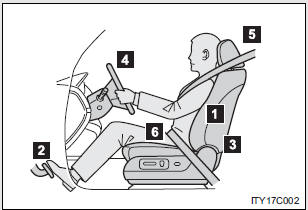
- Sit upright and well back in the seat.
- Adjust the position of the seat forward or backward to ensure the pedals can be reached and easily depressed to the extent required.
- Adjust the seatback so that the controls are easily operable.
- Adjust the tilt and telescopic positions of the steering wheel downward so the airbag is facing your chest.
- Lock the head restraint in place with the center of the head restraint closest to the top of your ears.
- Wear the seat belt correctly.
| CAUTION
Fingers or hands may become jammed in the seat mechanism. |
SRS airbags
The SRS airbags inflate when the vehicle is subjected to certain types of severe impacts that may cause significant injury to the occupants. They work together with the seat belts to help reduce the risk of death or serious injury.
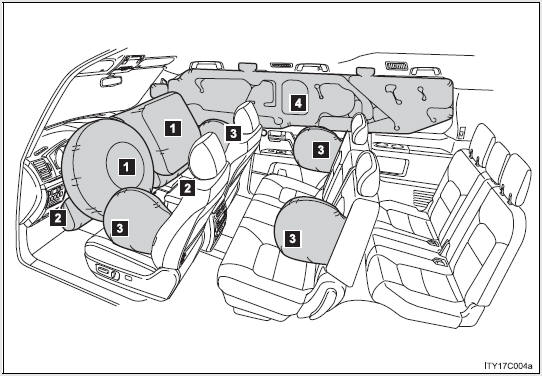
- Front airbags
- Driver airbag/front passenger airbag
Can help protect the head and chest of the driver and front passenger from impact with interior components.
- Knee airbags
Can help provide driver and front passenger protection.
- Side and curtain shield airbags
- Side airbags
Can help protect the torso of the front and second outboard seat occupants.
- Curtain shield airbags
Can help protect primarily the head of front seat occupants, second and third outboard seat occupants.
Airbag system components
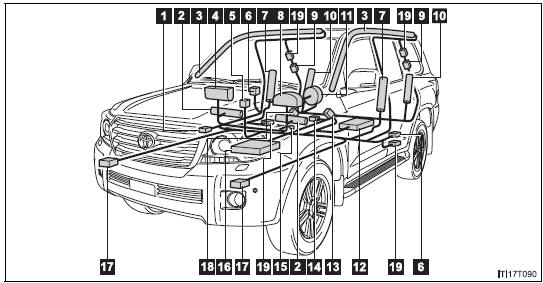
- Front passenger occupant classification system (ECU & sensors)
- Knee airbags
- Curtain shield airbags
- Front passenger airbag
- “AIR BAG ON” and “AIR BAG OFF” indicator lights
- Side impact sensors (front door)
- Side airbags (front seats)
- SRS warning light and “RSCA OFF” indicator light
- Side impact sensors (rear)
- Side airbags (second outboard seats)
- Driver airbag
- Driver’s seat position sensor
- Driver’s seat belt buckle switch
- Safing sensor (rear)
- Roll sensing of curtain shield airbags off switch
- Airbag sensor assembly
- Front impact sensors
- Front passenger’s seat belt buckle switch
- Seat belt pretensioners
Your vehicle is equipped with ADVANCED AIRBAGS designed based on the US motor vehicle safety standards (FMVSS208). The airbag sensor assembly (ECU) controls airbag deployment based on information obtained from the sensors etc. shown in the system components diagram above. This information includes crash severity and occupant information. As the airbags deploy, a chemical reaction in the inflators quickly fills the airbags with nontoxic gas to help restrain the motion of the occupants.
- If the SRS airbags deploy (inflate)
- Bruising and slight abrasions may result from contact with a deploying (inflating) SRS airbag.
- A loud noise and white powder will be emitted.
- Parts of the airbag module (steering wheel hub, airbag cover and inflator) as well as the front seats, second seats, and parts of the front, side and rear pillars, and roof side rail, may be hot for several minutes. The airbag itself may also be hot.
- The windshield may crack.
- For Safety Connect subscribers, if the SRS airbags deploy or in the event of a severe rear-end collision, the system is designed to send an emergency call to the response center, notifying them of the vehicle’s location (without needing to push the “SOS” button) and an agent will attempt to speak with the occupants to ascertain the level of emergency and assistance required. If the occupants are unable to communicate, the agent automatically treats the call as an emergency and helps to dispatch the necessary emergency services.
- SRS airbag deployment conditions (SRS front airbags)
- The SRS front airbag will deploy in the event of an impact that exceeds the set threshold level (the level of force corresponding to an approximately 12 - 18 mph [20 - 30 km/h] frontal collision with a fixed wall that does not move or deform).
However, this threshold velocity will be considerably higher in the following situations:
- If the vehicle strikes an object, such as a parked vehicle or sign pole, which can move or deform on impact
- If the vehicle is involved in an underride collision, such as a collision in which the front of the vehicle “underrides”, or goes under, the bed of a truck
- Depending on the type of collision, it is possible that only the seat belt pretensioners will activate.
- The SRS front airbags for the front passenger will not activate if there is not passenger sitting in the front passenger seat. However, the front airbags for the front passenger may deploy if luggage is put in the seat, even if the seat is unoccupied.
- SRS airbag deployment conditions (SRS side airbags and SRS curtain shield airbags)
- The SRS side airbags and SRS curtain shield airbags will deploy in the event of an impact that exceeds the set threshold level (the level of force corresponding to the impact force produced by an approximately 3300 lb.
[1500 kg] vehicle colliding with the vehicle cabin from a direction perpendicular to the vehicle orientation at an approximate speed of 12 - 18 mph [20 - 30 km/h]).
- The SRS curtain shield airbags will deploy in the event of vehicle rollover.
- Conditions under which the SRS airbags may deploy (inflate), other than a collision
The SRS front airbags may also deploy if a serious impact occurs to the underside of your vehicle. Some examples are shown in the illustration.
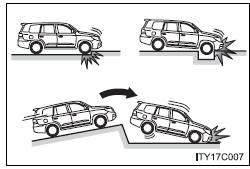
- Hitting a curb, edge of pavement or hard surface
- Falling into or jumping over a deep hole
- Landing hard or falling
The SRS curtain shield airbags may also deploy under the situations shown in the illustration.
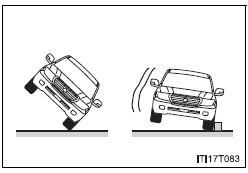
- The angle of vehicle tip-up is marginal.
- The vehicle skids and hits a curb stone.
- Types of collisions that may not deploy the SRS airbag (front airbags)
The SRS front airbags do not generally inflate if the vehicle is involved in a side or rear collision, if it rolls over, or if it is involved in a low-speed frontal collision. But, whenever a collision of any type causes sufficient forward deceleration of the vehicle, deployment of the SRS front airbags may occur.
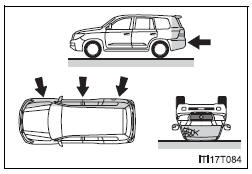
- Collision from the side
- Collision from the rear
- Vehicle rollover
- Types of collisions that may not deploy the SRS airbag (side and curtain shield airbags)
The SRS side airbag and curtain shield airbag may not activate if the vehicle is subjected to a collision from the side at certain angles, or a collision to the side of the vehicle body other than the passenger compartment.
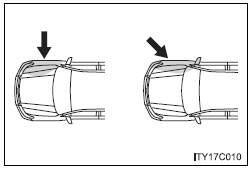
- Collision from the side to the vehicle body other than the passenger compartment
- Collision from the side at an angle
The SRS side airbags do not generally inflate if the vehicle is involved in a frontal or rear collision, if it rolls over, or if it is involved in a low-speed side collision.
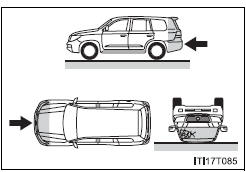
- Collision from the front
- Collision from the rear
- Vehicle rollover
The SRS curtain shield airbags do not generally inflate if the vehicle is involved in a frontal or rear collision, if it pitches end over end, or if it is involved in a low-speed side collision.
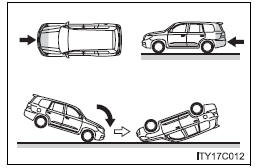
- Collision from the front
- Collision from the rear
- Pitching end over end
- When to contact your Toyota dealer
In the following cases, contact your Toyota dealer as soon as possible.
- Any of the SRS airbags have been inflated.
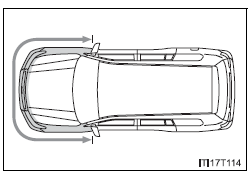
- The front of the vehicle is damaged or deformed, or the vehicle was involved in an accident that was not severe enough to cause the SRS front airbags to inflate.
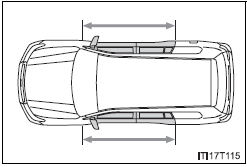
- A portion of the doors is damaged or deformed, or the vehicle was involved in an accident that was not severe enough to cause the SRS side and curtain shield airbags to inflate.
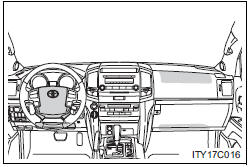
- The pad section of the steering wheel, dashboard near the front passenger airbag or lower portion of the instrument panel is scratched, cracked or otherwise damaged.
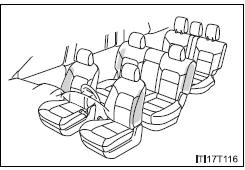
- The surface of the seats with the side airbag is scratched, cracked, or otherwise damaged.
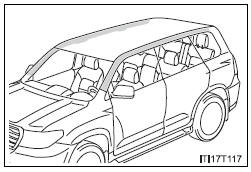
- The portion of the front, side and rear pillars or roof side rail garnishes (padding) containing the curtain shield airbags is inside scratched, cracked, or otherwise damaged.
| CAUTION
Observe the following precautions regarding the SRS airbags. Failure to do so may cause death or serious injury.
The National Highway Traffic Safety Administration (“NHTSA”) advises: Since the risk zone for driver airbag is the first 2 - 3 in. (50 - 75 mm) of inflation, placing yourself 10 in. (250 mm) from your driver airbag provides you with a clear margin of safety. This distance is measured from the center of the steering wheel to your breastbone. If you sit less than 10 in. (250 mm) away now, you can change your driving position in several ways:
Although vehicle designs vary, many drivers can achieve the 10 in. (250 mm) distance, even with the driver seat all the way forward, simply by reclining the back of the seat somewhat. If reclining the back of your seat makes it hard to see the road, raise yourself by using a firm, non-slippery cushion, or raise the seat if your vehicle has that feature.
The seat should be adjusted as recommended by NHTSA above, while still maintaining control of the foot pedals, steering wheel, and your view of the instrument panel controls. |
| CAUTION
|
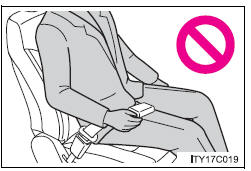
| CAUTION
Do not sit on the edge of the seat or lean against the dashboard.
|
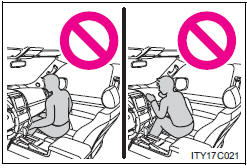
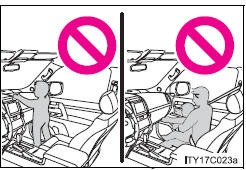
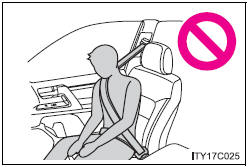
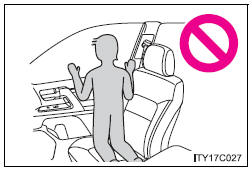
| CAUTION
|
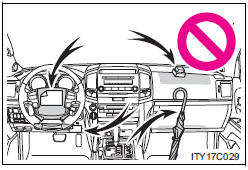
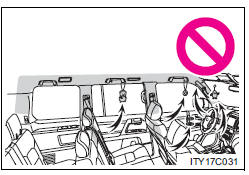
| CAUTION
|
| CAUTION
Do not dispose of your vehicle or perform any of the following modifications without consulting your Toyota dealer. The SRS airbag may malfunction or deploy (inflate) accidentally, causing death or serious injury.
|
Deactivating the curtain shield airbags in a vehicle rollover
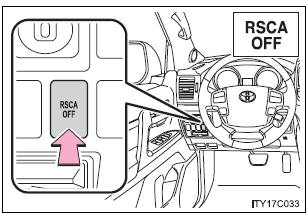
ON/OFF (hold for a few seconds)
The RSCA OFF indicator turns on (only when the “ENGINE START STOP” switch is in IGNITION ON mode.) The roll sensing function for the curtain shield airbags and seat belt pretensioners will turn back on automatically each time the “ENGINE START STOP” switch is turned to IGNITION ON mode.
- This switch only should be used
In a situation where the inflation is not desired (such as during extreme off road driving).
- Operating conditions when the RSCA OFF indicator is on
- The curtain shield airbag and seat belt pretensioner will not activate in a vehicle rollover.
- The curtain shield airbag will activate in a severe side impact.
- The pretensioner will activate in a severe frontal collision.
| CAUTION
Make sure the RSCA OFF indicator is not turned on. If it is left on, the curtain shield airbag will not activate in the event of an accident, which may result in death or serious injury. |
Front passenger occupant classification system
Your vehicle is equipped with a front passenger occupant classification system. This system detects the conditions of the front passenger seat and activates or deactivates the devices for front passenger.
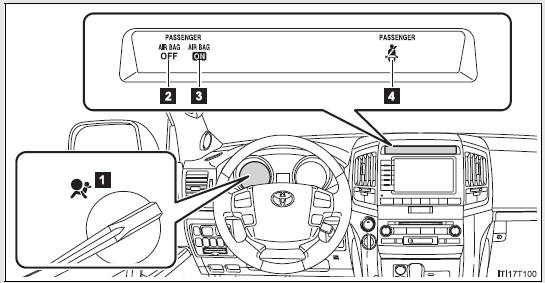
- SRS warning light
- AIR BAG OFF indicator light
- AIR BAG ON indicator light
- Front passenger’s seat belt reminder light
Condition and operation in the front passenger occupant classification system
- Adult*1
| Indicator/ warning light | AIR BAG ON and AIR BAG OFF indicator lights | “AIR BAG ON” |
| SRS warning light | Off | |
| Front passenger’s seat belt reminder light | Flashing*2 | |
| Devices | Front passenger airbag and knee airbag | Activated |
| Side airbag in the front passenger seat | ||
| Curtain shield airbag on the front passenger side | ||
| Front passenger’s seat belt preten |
- Child*3 or child restraint system*4
| Indicator/ warning light | AIR BAG ON and AIR BAG OFF indicator lights | “AIR BAG OFF”*5 |
| SRS warning light | Off | |
| Front passenger’s seat belt reminder light | Flashing*2 | |
| Devices | Front passenger airbag and knee airbag | Deactivated |
| Side airbag in the front passenger seat | Activated | |
| Curtain shield airbag on the front passenger | ||
| Front passenger’s seat belt prete |
- Unoccupied
| Indicator/ warning light | AIR BAG ON and AIR BAG OFF indicator lights | Not illuminated |
| SRS warning light | Off | |
| Front passenger’s seat belt reminder light | ||
| Devices | Front passenger airbag and knee airbag | Deactivated |
| Side airbag in the front passenger seat | Activated | |
| Curtain shield airbag on the front passenger side | ||
| Front passenger’s seat belt pret | Deactivated |
- System malfunction
| Indicator/ warning light | AIR BAG ON and AIR BAG OFF indicator lights | “AIR BAG OFF” |
| SRS warning light | On | |
| Front passenger’s seat belt reminder light | Off | |
| Devices | Front passenger airbag and knee airbag | Deactivated |
| Side airbag in the front passenger seat | Activated | |
| Curtain shield airbag on the front passenger side | ||
| Front passenger’s seat belt pretensioner |
*1: The system judges a person of adult size as an adult. When a smaller adult sits in the front passenger seat, the system may recognize him/her as a child depending on his/her physique and posture.
*2: In the event the front passenger does not wear a seat belt.
*3: When a larger child who has outgrown a child restraint system sits in the front passenger seat, the system may recognize him/her as an adult depending on his/her physique or posture.
*4: Never install a rear-facing child restraint system on the front passenger seat. A forward-facing child restraint system should only be installed on the front passenger seat when it is unavoidable.
*5: In case the indicator is not illuminated, consult this manual as for installing the child restraint system properly.
| CAUTION
Observe the following precautions regarding front passenger occupant classification system. Failure to do so may cause death or serious injury.
|
| CAUTION
|
Child restraint systems
A child restraint system for a small child or baby must itself be properly restrained on the seat with the lap portion of the lap/shoulder belt.
The laws of all 50 states of the U.S.A. now require the use of child restraint systems.
Points to remember
Studies have shown that installing a child restraint on a rear seat is much safer than installing one to the front passenger seat.
- Choose a child restraint system that suits your vehicle and is appropriate to the age and size of the child.
- For installation details, follow the instructions provided with the child restraint system.
General installation instructions are provided in this manual.
Types of child restraints
Child restraint systems are classified into the following 3 types according to the age and size of the child.
- Rear facing—Infant seat/convertible seat
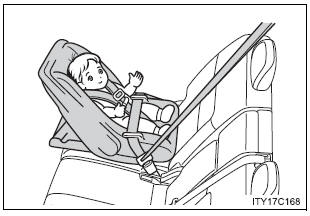
- Forward facing—Convertible seat
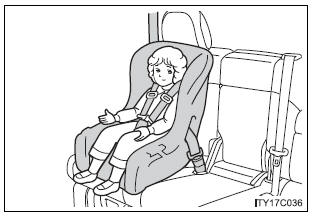
- Booster seat
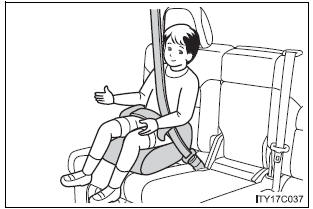
- When installing the child restraint system on the front passenger seat
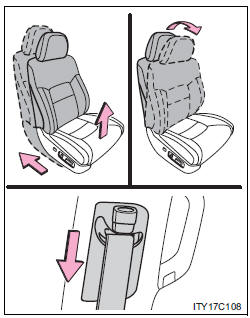
When you have to use a child restraint system on the front passenger seat, adjust the following:
- The seatback to the most upright position
- The seat cushion to the fully rearward and highest position
- The seat belt height to the lowest position
- Selecting an appropriate child restraint system
- Use a child restraint system appropriate for the child until the child becomes large enough to properly wear the vehicle’s seat belt.
- If a child is too large for a child restraint system, sit the child on a rear seat and use the vehicle’s seat belt.
| CAUTION
The use of a child restraint system not suitable for the vehicle may not properly secure the infant or child, resulting in serious injury or even death.
|
| CAUTION
Do not allow children to play with the seat belt. If the seat belt becomes twisted around a child’s neck, it may lead to choking or other serious injuries that could result in death. If this occurs and the buckle cannot be unfastened, scissors should be used to cut the belt.
|
Installing child restraints
Follow the child restraint system manufacturer’s instructions. Firmly secure the child restraints using the LATCH anchors or a seat belt.
Attach the top tether strap when installing a child restraint.
The lap/shoulder belt can be used if your child restraint system is not compatible with the LATCH (Lower Anchors and Tethers for Children) system.
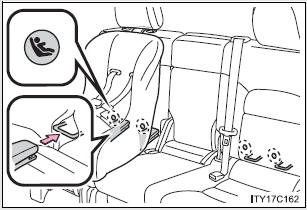
Child restraint LATCH anchors
LATCH anchors are provided for the outside second seat.
(Buttons displaying the location of the anchors are attached to the seats.)
Seat belts equipped with a child restraint locking mechanism (ALR/ELR belts except driver’s seat belt)
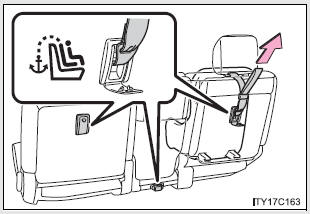
Anchor bracket (for top tether strap)
Anchor brackets are provided for all second seats.
Installation with LATCH system
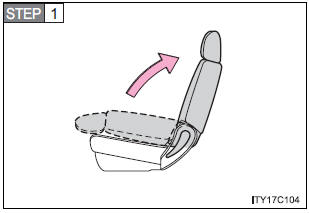
Fold the seatback forward and then adjust it as upright as possible.
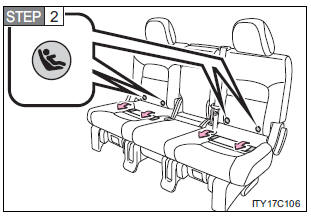
Take off the covers between the seat cushion and seatback, then confirm the position of the LATCH anchors below the symbol in the seatback.
- Type A
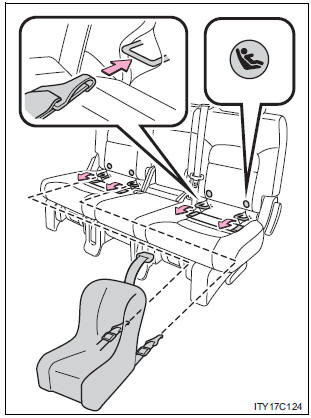
STEP 3
Latch the hooks of the lower straps onto the LATCH anchors.
STEP 4
If the child restraint has a top tether strap, the top tether strap should be latched onto the top tether strap anchor.
- Type B
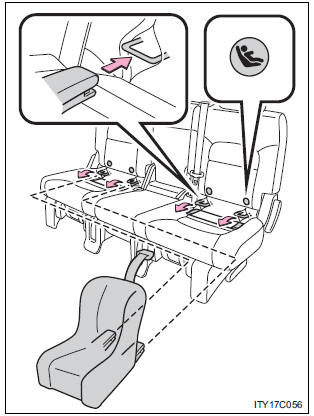
STEP 3
Latch the buckles onto the LATCH anchors.
STEP 4
If the child restraint has a top tether strap, the top tether strap should be latched onto the top tether strap anchor.
Installing child restraints using a seat belt (child restraint lock function belt)
- Rear-facing - Infant seat/convertible seat
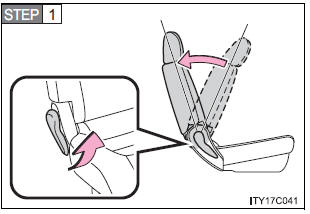
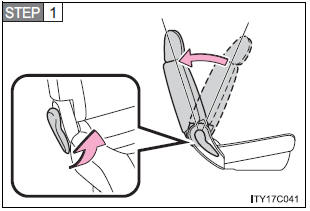
Fold the seatback while pulling the seatback angle lever.
Return the seatback and secure it at the first lock position.
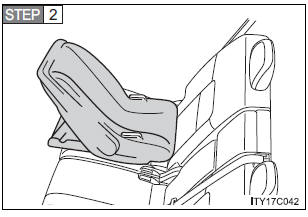
Place the child restraint system on the second or third seat facing the rear of the vehicle.
Run the seat belt through the child restraint system and insert the plate into the buckle. Make sure that the belt is not twisted.
Fully extend the shoulder belt and then allow it to retract slightly in order to activate the ALR lock mode.
Lock mode allows the seat belt to retract only.
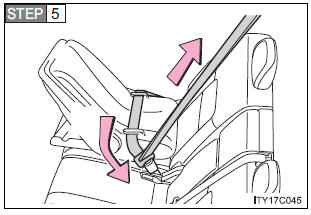
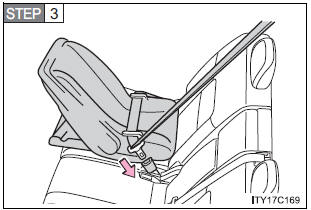
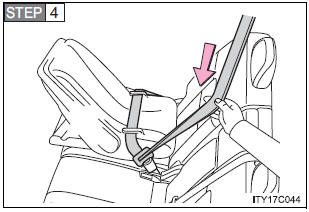
While pushing the child restraint system down into the seat, allow the shoulder belt to retract until the child restraint system is securely in place.
After the shoulder belt has retracted to a point where there is no slack in the belt, pull the belt to check that it cannot be extended.
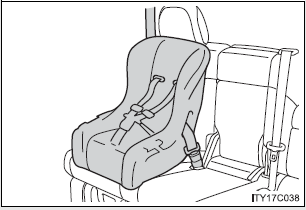
- Forward-facing - Convertible seat
Fold the seatback while pulling the seatback angle lever.
Return the seatback and secure it at the first lock position.
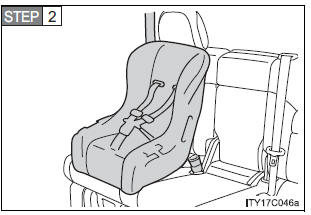
Place the child restraint system on the second or third seat facing the front of the vehicle.
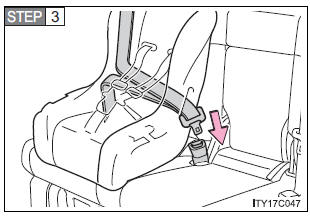
Run the seat belt through the child restraint system and insert the plate into the buckle. Make sure that the belt is not twisted.
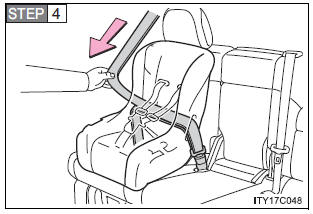
Fully extend the shoulder strap and then allow it to retract slightly into the ALR lock mode.
Lock mode allows the seat belt to retract only.
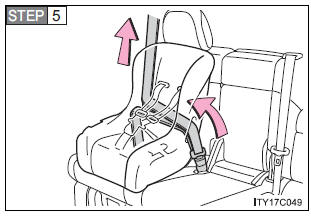
While pushing the child restraint system into the seat, allow the shoulder belt to retract until the child restraint system is securely in place.
After the shoulder belt has retracted to a point where there is no slack in the belt, pull the belt to check that it cannot be extended.
STEP 6
If the child restraint system has a top tether strap, the top tether strap should be latched onto the top tether strap anchor.
- Booster seat
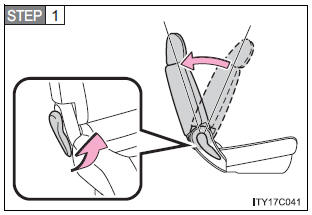
Fold the seatback while pulling the seatback angle lever.
Return the seatback and secure it at the first lock position.
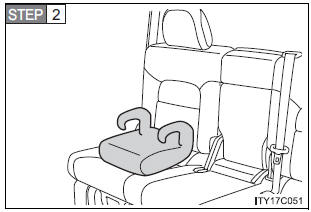
Place the child restraint system on the seat facing the front of the vehicle.
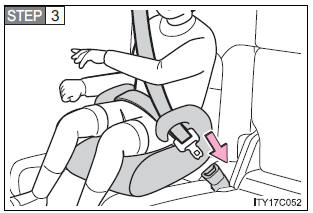
Sit the child in the child restraint system. Fit the seat belt to the child restraint system according to the manufacturer’s instructions and insert the plate into the buckle. Make sure that the belt is not twisted.
Check that the shoulder belt is correctly positioned over the child’s shoulder, and that the lap belt is as low as possible.
Removing a child restraint system installed with a seat belt
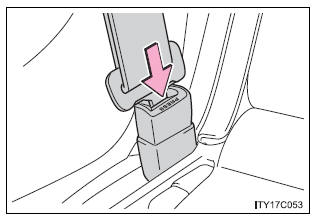
Press the buckle release button and fully retract the seat belt.
Child restraint systems with a top tether strap
STEP 1
Secure the child restraint system using a seat belt or LATCH anchors, and do the following.
- Outside
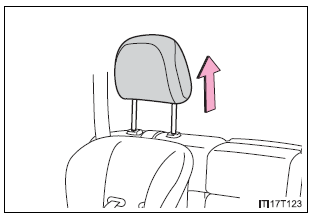
Adjust the head restraint to the upmost position.
- Center
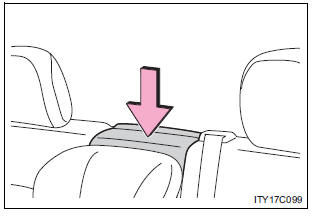
Lower the head restraint to the lowest position.
STEP 2
Open the anchor bracket cover, latch the hook onto the anchor bracket and tighten the top tether strap.
- Outside
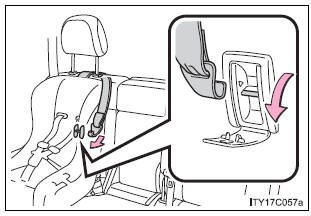
Make sure the top tether strap is securely latched.
- Center
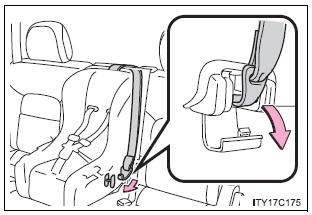
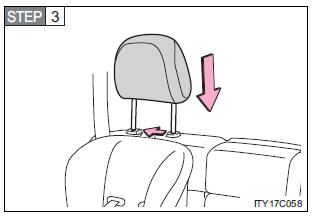
Outside only: Adjust the head restraint to the downmost position.
- Laws and regulations pertaining to anchorages
The LATCH system conforms to FMVSS225.
Child restraint systems conforming to FMVSS213 specifications can be used.
This vehicle is designed to conform to the SAE J1819.
| CAUTION
Do not fully extend the shoulder belt to prevent the belt from going to ALR lock mode: ALR mode causes the belt to tighten only which could cause injury or discomfort to the child. |
| CAUTION
Follow the directions given in the child restraint system installation manual and fix the child restraint system securely in place. If the child restraint system is not correctly fixed in place, the child or other passengers may be seriously injured or even killed in the event of sudden braking, sudden swerving or an accident.
|
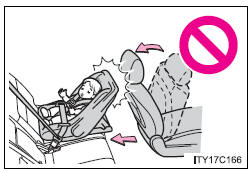
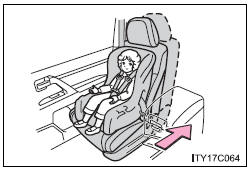
| CAUTION
If a seat belt extender is used when installing a child restraint system, the seat belt will not securely hold the child restraint system, which could cause death or serious injury to the child or other passengers in the event of sudden braking, sudden swerving or an accident.
When using the LATCH anchors, be sure that there are no foreign objects around the anchors and that the seat belt is not caught behind the child restraint system. Make sure the child restraint system is securely attached, or it may cause death or serious injury to the child or other passengers in the event of a sudden stop, sudden swerve or accident. |
Download Manual