Driving procedures
The following procedures should be observed to ensure safe driving.
- Starting the engine
- Driving
STEP 1
With the brake pedal depressed, shift the shift lever to “D”.
STEP 2
Release the parking brake.
STEP 3
Gradually release the brake pedal and gently push the accelerator pedal to accelerate the vehicle.
- Stopping
STEP 1
With the shift lever in “D”, push the brake pedal.
STEP 2
If necessary, set the parking brake.
When the vehicle is stopped for an extended period of time, shift the shift lever to “P” or “N”.
- Parking the vehicle
STEP 1
With the shift lever in “D”, push the brake pedal.
STEP 2
Set the parking brake.
STEP 3
Shift the shift lever to “P”.
When parking on a hill, if necessary, block the wheels.
STEP 4
Press the “ENGINE START STOP” switch to stop the engine.
STEP 5
Lock the door, making sure that you have the key on your person.
Starting on a steep incline
STEP 1
Firmly set the parking brake and shift the shift lever to “D”.
STEP 2
Gently depress the accelerator pedal.
STEP 3
Release the parking brake.
- Driving in the rain
- Drive carefully when it is raining, because visibility will be reduced, the windows may become fogged-up, and the road will be slippery.
- Drive carefully when it starts to rain, because the road surface will be especially slippery.
- Refrain from high speeds when driving on an expressway in the rain, because there may be a layer of water between the tires and the road surface, preventing the steering and brakes from operating properly.
- Engine speed while driving
In the following conditions, the engine speed may become high while driving.
This is due to automatic up-shifting control or down-shifting implementation to meet driving conditions. It does not indicate sudden acceleration.
- The vehicle is judged to be driving uphill or downhill
- When the accelerator pedal is released
- When the brake pedal is depressed while power mode is selected
- Breaking in your new Toyota
To extend the life of the vehicle, the following precautions are recommended to observe:
- For the first 200 miles (300 km): Avoid sudden stops.
- For the first 500 miles (800 km): Do not tow a trailer.
- For the first 1000 miles (1600 km):
- Do not drive at extremely high speeds.
- Avoid sudden acceleration.
- Do not drive continuously in the low gears.
- Do not drive at a constant speed for extended periods.
- Drum-in-disc type parking brake system
Your vehicle has a drum-in-disc type parking brake system. This type of brake system needs bedding-down of the brake shoes periodically or whenever the parking brake shoes and/or drums are replaced. Have your Toyota dealer perform the bedding down operation.
- Operating your vehicle in a foreign country
Comply with the relevant vehicle registration laws and confirm the availability of the correct fuel.
- Eco Driving Indicato
r
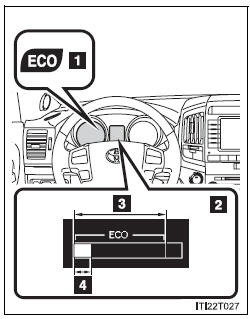
- Eco Driving Indicator Light During Eco-friendly acceleration (Eco driving), Eco Driving Indicator Light will turn on.
- Eco Driving Indicator Zone Display Suggests Zone of Eco driving with current Eco driving ratio based on acceleration.
- Zone of Eco driving
- Eco driving ratio based on acceleration If the vehicle exceeds Zone of Eco driving, the right side of Eco Driving Indicator Zone Display will blink and Eco Driving Indicator Light will turn off.
Eco Driving Indicator Light will not operate in the following conditions:
- The shift lever is in anything other than “D”.
- The vehicle is set to second start mode or power mode.
- The vehicle speed is approximately 81 mph (130 km/h) or higher.
- The Crawl Control is operating.
- When turning off the engine
Emission system operating sounds may continue for a short time after the engine is turned off. This is not a malfunction, and helps to ensure optimal performance of the emission system.
| CAUTION
Always keep your foot on the brake pedal while stopped with the engine running. This prevents the vehicle from creeping.
|
| CAUTION
|
| CAUTION
Be careful not to shift the shift lever with the accelerator pedal depressed. This may lead to unexpected rapid acceleration of the vehicle that may cause an accident and result in death or serious injury.
Have your Toyota dealer check and replace the brake pads as soon as possible. Rotor damage may result if the pads are not replaced when needed. It is dangerous to drive the vehicle when the wear limits of the brake pads and/or those of the rotors are exceeded. |
| CAUTION
|
| CAUTION
Failure to do so may result in the following:
|
| CAUTION
Exhaust gases include harmful carbon monoxide (CO) that is colorless and odorless. Inhaling exhaust gases may lead to death or a serious health hazard.
Always turn the engine off. Otherwise, you may accidentally move the shift lever or depress the accelerator pedal, which could cause an accident or fire due to engine overheating. Additionally, if the vehicle is parked in a poorly ventilated area, exhaust gases may collect and enter the vehicle, leading to death or a serious health hazard. |
| CAUTION
|
| NOTICE
Always put the shift lever in “P”. Failure to do so may cause the vehicle to move or the vehicle may accelerate suddenly if the accelerator pedal is accidentally depressed.
|
| NOTICE
A flat or damaged tire may cause the following situations. Hold the steering wheel firmly and gradually press the brake pedal to slow down the vehicle.
Replace a flat tire with a new one.
Do not drive on a road that has flooded after heavy rain etc. Doing so may cause the following serious damage to the vehicle.
In the event that you drive on a flooded road and the vehicle is flooded, be sure to have your Toyota dealer check the following.
|
Engine (ignition) switch
Performing the following operations when carrying the electronic key on your person starts the engine or changes “ENGINE START STOP” switch modes.
- Starting the engine
STEP 1
Check that the parking brake is set.
STEP 2
Check that the shift lever is set in “P”.
STEP 3
Sit in the driver’s seat and firmly depress the brake pedal.
The “ENGINE START STOP” switch indicator turns green.
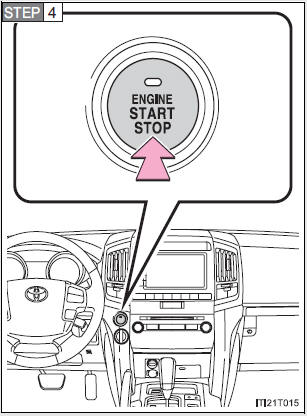
Press the “ENGINE START STOP” switch.
The engine can be started from any “ENGINE START STOP” switch mode.
Continue depressing the brake pedal until the engine is completely started. The engine will crank until it starts or for up to 30 seconds, whichever is less.
- Changing “ENGINE START STOP” switch mode
Modes can be changed by pressing the “ENGINE START STOP” switch with the brake pedal released. (The mode changes each time the switch is pressed.)
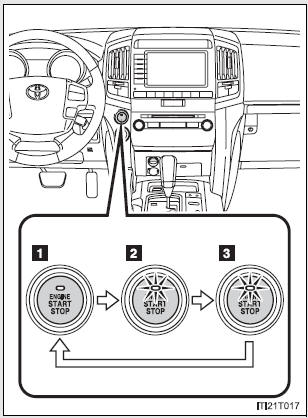
- OFF*
Emergency flashers can be used.
- ACCESSORY mode
Some electrical components such as the audio system can be used.
The “ENGINE START STOP” switch indicator turns amber.
- IGNITION ON mode
All electrical components can be used.
The “ENGINE START STOP” switch indicator turns amber.
*:If the shift lever is in a position other than “P” when turning off the engine, the “ENGINE START STOP” switch will be turned to ACCESSORY mode, not to OFF.
- Operation of the “ENGINE START STOP” switch
When operating the “ENGINE START STOP” switch, one short, firm press is enough. If the switch is pressed improperly, the engine may not start or the “ENGINE START STOP” switch mode may not change. It is not necessary to press and hold the switch.
- When the steering lock cannot be released
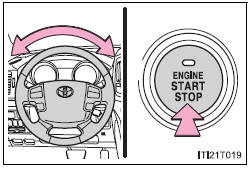
The green indicator light on the “ENGINE START STOP” switch will flash and a message will be shown on the multi-information display. Press the “ENGINE START STOP” switch again while turning the steering wheel left and right.
- If the engine does not start
The engine immobilizer system may not have been deactivated. Contact your Toyota dealer.
- When the “ENGINE START STOP” switch indicator flashes in amb
er
The system may be malfunctioning. Have the vehicle inspected by your Toyota dealer immediately.
- Auto power off function
If the vehicle is left in ACCESSORY mode for more than 20 minutes with the shift lever in P, the “ENGINE START STOP” switch will automatically turn off.
However, this function cannot entirely prevent battery discharge. Do not leave the vehicle with the “ENGINE START STOP” switch in ACCESSORY mode for long periods of time when the engine is not running.
- Electronic key battery depletion
- When the electronic key battery is discharged
- Conditions affecting operation
- Note for the smart key system
| CAUTION
Always start the engine while sitting in the driver’s seat. Do not depress the accelerator pedal while starting the engine under any circumstances. Doing so may cause an accident resulting in death or serious injury.
If you want to stop the engine in an emergency while driving the vehicle, press and hold the “ENGINE START STOP” switch for more than 2 seconds, or press it briefly 3 times or more in succession. However, do not touch the “ENGINE START STOP” switch while driving except in an emergency. Turning the engine off while driving will not cause loss of steering or braking control, but the power assist to these systems will be lost. This will make it more difficult to steer and brake, so you should pull over and stop the vehicle as soon as it is safe to do so. |
| NOTICE
Do not leave the “ENGINE START STOP” switch in ACCESSORY or IGNITION ON mode for long periods without the engine running.
If the “ENGINE START STOP” seems to be operating somewhat differently than usual, such as the switch sticking slightly, there may be a malfunction. Contact your Toyota dealer immediately. |
Automatic transmission
Select a shift position appropriate for the driving conditions.
- Shifting the shift lever
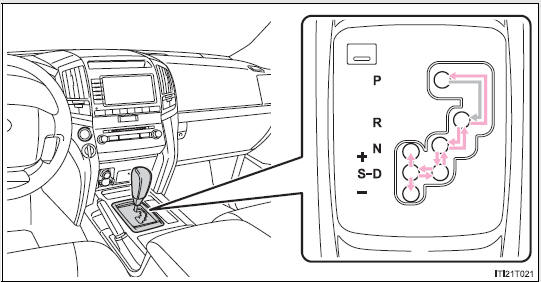
 While the “ENGINE START STOP” switch is in IGNITION ON mode, depress the brake pedal and move the shift lever.
- Shift position uses
| Shift position
|
Function
|
| P | Parking the vehicle or starting the engine |
| R | Reversing |
| N | Condition in which the power is not transmitted |
| D | Normal driving*1 |
| S | “S” mode driving*2 |
*1: Shifting to the “D” position allows the system to select a gear suitable for the driving conditions. Setting the shift lever to the “D” position is recommended for normal driving.
*2: Selecting shift ranges using “S” mode restricts the upper limit of the possible gear ranges, controls engine braking forces, and prevents unnecessary upshifting.
- Selecting a driving mode
The following patterns can be selected to suit current driving and operating conditions.
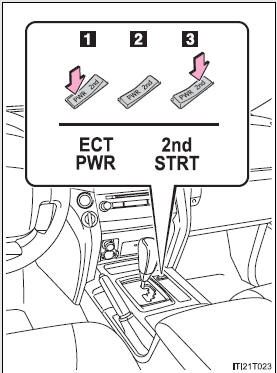
- Power mode
For powerful acceleration and driving in mountainous regions.
- Normal mode
For normal driving.
- Second start mode
For starting on slippery road surfaces, such as on snow.
Press “2nd” to return to normal mode.
Changing shift ranges in “S” mode
Shift the shift lever to the “S” position and operate the shift lever.
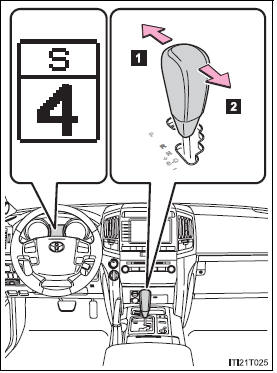
The initial shift range in “S” mode is automatically set to “5” or “4” according to the vehicle’s speed. However, the initial shift range may be set to “3” or “2” if the AI-SHIFT has operated while the shift lever was in the “D” position.
- Shift ranges and their functions
- Automatically selecting gears between 1 and 6 according to vehicle speed and driving conditions. But, the gear is limited according to selected shift range.
- You can choose from 6 levels of engine braking force.
- A lower shift range will provide greater engine braking force than a higher shift range, and the engine revolutions will also increase.
- “S” mode
- When the shift range is “5” or lower, holding the shift lever toward “+” sets the shift range to “6”.
- To prevent excessive engine speed, a function was adopted that automatically selects a higher shift range before the engine speed becomes too high.
- To protect the automatic transmission, a function is adopted that automatically selects a higher shift range when the fluid temperature is high.
- Downshifting restrictions warning buzzer (in the “S” mode)
To help ensure safety and driving performance, downshifting operation may sometimes be restricted. In some circumstances, downshifting may not be possible even when the shift lever is operated. (The warning buzzer will sound twice.)
- When driving with the cruise control or radar cruise control activated
Even when performing the following actions with the intent of enabling engine braking, engine braking will not activate because cruise control or radar cruise control will not be canceled.
- While driving in “S” mode, downshifting to “5” or “4”. (, 214)
- When switching the driving mode to power mode while driving in “D” position.
- Second start mode automatic deactivation
Second start mode is automatically deactivated if the engine is turned off after driving in second start mode.
- If the shift lever cannot be shifted from “P”
- If the “S” indicator does not come on even after shifting the shift lever to “S
”
This may indicate a malfunction in the automatic transmission system. Have the vehicle inspected by your Toyota dealer immediately.
(In this situation, the vehicle will operate as if the shift lever is in “D”.)
- AI-SHIFT
The AI-SHIFT automatically shifts the gear to the suitable position according to the driver performance and driving conditions.
The AI-SHIFT automatically operates when the shift lever is in the “D” position.
(Shifting the shift lever to the “S” position cancels the function.)
Turn signal lever
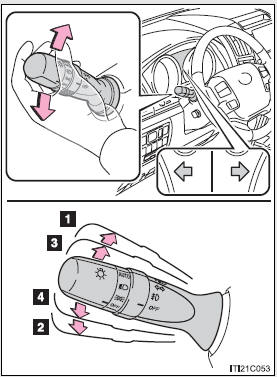
- Right turn
- Left turn
- Move and hold the lever partway to signal a lane change
The right hand signal will flash until you release the lever.
- Move and hold the lever partway to signal a lane change
The left hand signal will flash until you release the lever.
- Turn signals can be operated when
The “ENGINE START STOP” switch is in IGNITION ON mode.
- If the indicators flash faster than usual
Check that a light bulb in the front or rear turn signal lights has not burned out.
Parking brake
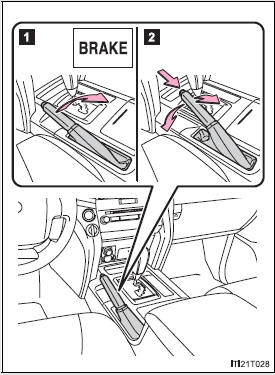
- Sets the parking brake
Fully set the parking brake while depressing the brake pedal.
- Releases the parking brake
Slightly raise the lever and lower it completely while pressing the button.
- Usage in winter time
| NOTICE
Fully release the parking brake. Driving the vehicle with the parking brake set will lead to brake components overheating, which may affect braking performance and increase brake wear. |
Horn
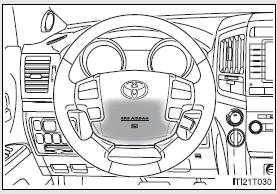
To sound the horn, press on or close to the  mark.
mark.
Download Manual