Towing your vehicle
When towing your vehicle, all State (Provincial in Canada) and local regulations for towing must be followed. Incorrect towing equipment could damage your vehicle. Towing instructions are available from a NISSAN dealer. Local service operators are generally familiar with the applicable laws and procedures for towing. To assure proper towing and to prevent accidental damage to your vehicle, NISSAN recommends having a service operator tow your vehicle. It is advisable to have the service operator carefully read the following precautions:
WARNING
|
CAUTION
- When towing, make sure that the transmission, axles, steering system and powertrain are in working condition. If any of these conditions apply, dollies or a flatbed tow truck must be used.
- Always attach safety chains before towing.
For information about towing your vehicle behind a recreational vehicle (RV), refer to “Flat towing” in the “Starting and Driving” section of this manual.
Towing recommended by NISSAN
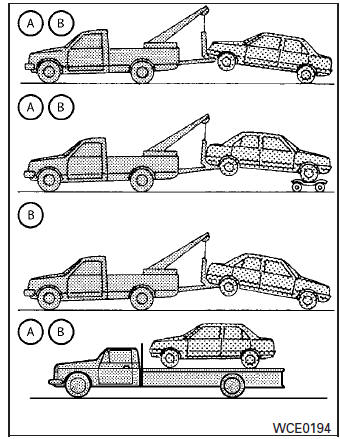
- (CVT) Continuously Variable Transmission
- (M/T) Manual transmission
NISSAN recommends that your vehicle be towed with the driving (front) wheels off the ground or place the vehicle on a flat bed truck as illustrated.
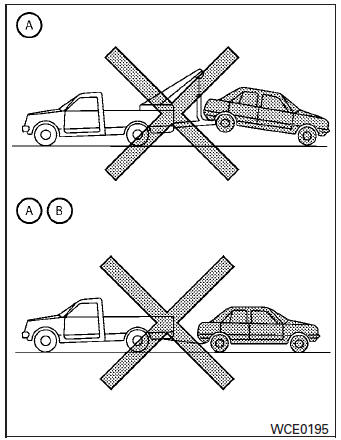
- (CVT) Continuously Variable Transmission
- (M/T) Manual transmiss
CAUTION
- Never tow Continuously Variable Transmission (CVT) models with the front wheels on the ground or four wheels on the ground (forward or backward), as this may cause serious and expensive damage to the transmission. If it is necessary to tow the vehicle with the rear wheels raised always use towing dollies under the front wheels.
- When towing Continuously Variable Transmission (CVT) models with the front wheels on towing dollies, or when towing manual transmission (M/T) models with the front wheels on the ground:
- Place the ignition switch to the OFF position, and secure the steering wheel in a straight-ahead position with a rope or similar device. Never secure the steering wheel by placing the ignition switch in the LOCK position.
This may damage the steering lock mechanism (for models with steering lock mechanism).
- Move the shift lever to the N (Neutral) position.
- When towing Continuously Variable Transmission (CVT) or manual transmission models (M/T) with the rear wheels on the ground (if you do not use towing dollies): Always release the parking brake.
- Observe the following restricted towing speeds and distances for manual transmissions (M/T) only:
- Speed: Below 80 km/h (50 MPH)
- Distance: Less than 80 km (50 miles)
Vehicle recovery (freeing a stuck vehicle)
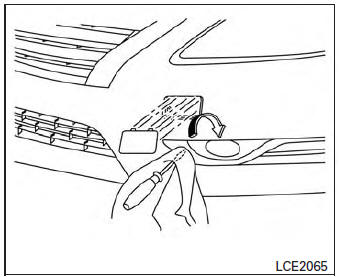
Front (if so equipped)
Do not use the hook to tow the vehicle.
- Remove the cover bumper bracket using a flat screwdriver or any flat tool.
- To protect the bumper body, place a piece of cloth between the tool and the vehicle.
- The tool used should be inserted by the lower portion of the cover.
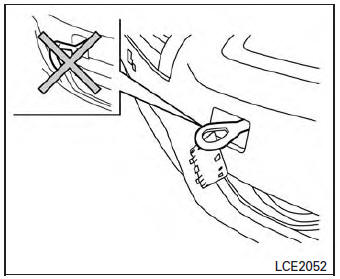
Front (if so equipped)
- To remove the cover it is necessary to rotate the flat tool, as shown in the image, in order to avoid any damage to the body.
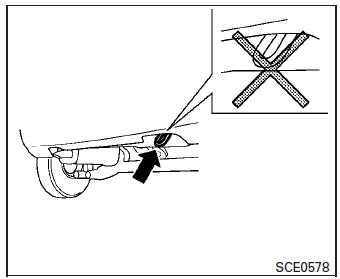
Rear (if so equipped)
Do not use the hook to tow the vehicle.
Pulling a stuck vehicle
| WARNING
To avoid vehicle damage, serious personal injury or death when recovering a stuck vehicle:
|
If your vehicle is stuck in sand, snow, mud, etc., use a tow strap or other device designed specifically for vehicle recovery. Always follow the manufacturer’s instructions for the recovery device.
Do not use the tie-down hooks for towing or vehicle recovery.
Rocking a stuck vehicle
WARNING
|
If your vehicle is stuck in sand, snow, mud, etc., use the following procedure:
- Turn off the Vehicle Dynamic Control System.
- Make sure the area in front and behind the vehicle is clear of obstructions.
- Turn the steering wheel right and left to clear an area around the front tires.
- Slowly rock the vehicle forward and backward.
- Shift back and forth between R (Reverse) and D (Drive) (CVT models) or 1st (Low) and R (Reverse) (M/T models).
- Apply the accelerator as little as possible to maintain the rocking motion.
- Release the accelerator pedal before shifting between R (Reverse) and D (Drive) (CVT models) or 1st (Low) and R (Reverse) (M/T models).
- Do not spin the tires above 35 MPH (55 km/h).
- If the vehicle cannot be freed after a few tries, contact a professional towing service to remove the vehicle.
Download Manual