Cruise control (if so equipped)
Precautions on cruise control
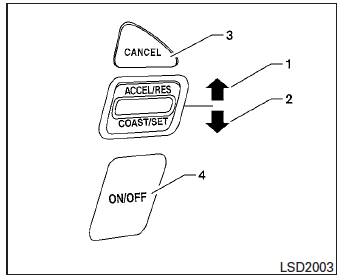
- ACCEL/RES switch
- COAST/SET switch
- CANCEL switch
- ON·OFF switch
- If the cruise control system malfunctions, it cancels automatically. The CRUISE indicator light in the instrument panel then blinks to warn the driver, see “Warnings/Indicator Lights and Audible Reminders” in the “Instruments and controls” section.
- If the CRUISE indicator light blinks, push the cruise control ON·OFF switch off and have the system checked by a NISSAN dealer.
- The CRUISE indicator light may blink when the cruise control ON·OFF switch is pushed ON while pushing the ACCEL/RES, COAST/SET, or CANCEL switch. To properly set the cruise control system, use the following procedures.
| WARNING
Do not use the cruise control when driving under the following conditions:
Doing so could cause a loss of vehicle control and result in an accident. |
Cruise control operations
The cruise control allows driving at a speed between 25 - 89 MPH (40 - 144 km/h) without keeping your foot on the accelerator pedal.
To turn on the cruise control, push the ON·OFF switch. The CRUISE indicator light in the instrument panel comes on.
To set cruising speed, accelerate the vehicle to the desired speed, push the COAST/SET switch and release it. Take your foot off the accelerator pedal. Your vehicle maintains the set speed.
- To pass another vehicle, depress the accelerator pedal. When you release the pedal, the vehicle returns to the previously set speed.
- The vehicle may not maintain the set speed when going up or down steep hills. If this happens, drive without the cruise control.
To cancel the preset speed, use one of the following three methods.
- Push the CANCEL button, or
- Tap the brake pedal, or
- Push the ON·OFF switch off. The CRUISE indicator light in the instrument panel go out.
The cruise control is automatically canceled if:
- you depress the brake or clutch pedal while pushing the ACCEL/RES or SET/COAST switch. The preset speed is deleted from memory.
- the vehicle slows down more than 8 MPH (13 km/h) below the set speed.
- you depress the clutch pedal (manual transmission), or move the shift lever to N (Neutral) (CVT).
To reset at a faster cruising speed, use one of the following three methods.
- Depress the accelerator pedal. When the vehicle attains the desired speed, push and release the COAST/SET switch.
- Push and hold the ACCEL/RES switch.
When the vehicle attains the speed you desire, release the switch.
- Push and release the ACCEL/RES switch.
Each time you do this, the set speed increases by about 1 MPH (1.6 km/h).
To reset at a slower cruising speed, use one of the following three methods.
- Lightly tap the brake pedal. When the vehicle attains the desired speed, push the COAST/SET switch and release it.
- Push and hold the COAST/SET switch. Release the switch when the vehicle slows to the desired speed.
- Push and release the COAST/SET switch.
Each time you do this, the set speed decreases by about 1 MPH (1.6 km/h).
To resume the preset speed, push and release the ACCEL/RES switch. The vehicle returns to the last set cruising speed when the vehicle speed is over 25 MPH (40 km/h).
Break-in schedule
CAUTION
During the first 1,200 miles (2,000 km), follow these recommendations to obtain maximum engine performance and ensure the future reliability and economy of your new vehicle. Failure to follow these recommendations may result in shortened engine life and reduced engine performance.
Avoid driving for long periods at constant speed, either fast or slow, and do not run the engine over 4,000 RPM.
- Do not accelerate at full throttle in any gear.
- Avoid quick starts.
- Avoid hard braking as much as possible.
- Do not tow a trailer for the first 500 mi (800 km). Your engine, axle or other parts could be damaged.
Download Manual