Steps to take in an emergency
505
|
While towing
When towing using cables or chains, avoid sudden starts, etc. which place excessive stress on the towing eyelets, cables or chains. The towing eyelets, cables or chains may become damaged, broken debris may hit people, and cause serious dam- age.
Do not turn the engine switch off.
There is a possibility that the steering wheel is locked and cannot be operated. Installing towing eyelets to the vehicle
Make sure that towing eyelets are installed securely. If not securely installed, towing eyelets may come loose during towing. |

8
506 8-2. Steps to take in an emergency
From the front
|
|
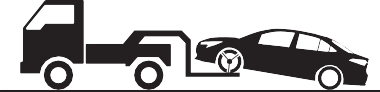
Release the parking brake.
Vehicles with electric parking brake: Turn automatic mode off. (P.182)
From the rear
The following may indicate a problem with your transmission. Contact your Toyota dealer or commercial towing service before towing.
Use a towing dolly under the front wheels.
8-2. Steps to take in an emergency
507
For vehicles with a continuously variable transmission, only the front towing eyelets may be used.
When using a flat-bed truck to transport the vehicle, use tire strapping belts. Refer to the owner's manual of the flat-bed truck for the tire strapping method.
In order to suppress vehicle movement during transporta- tion, set the parking brake and turn the engine switch off.
If a tow truck is not available in an emergency, your vehicle may be temporarily towed using cables or chains secured to the emergency towing eyelets. This should only be attempted on hard surfaced roads for at most 50 miles (80 km) at under 18
mph (30 km/h).
A driver must be in the vehicle to steer and operate the brakes.
The vehicle’s wheels, drive train,
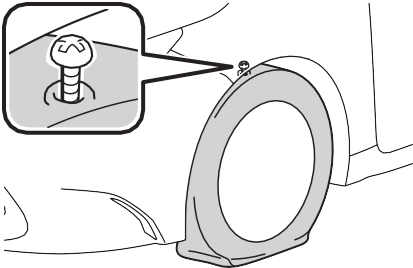
To have your vehicle towed by another vehicle, the towing eye- let must be installed to your vehicle. Install the towing eyelet using the following procedure.
To protect the bodywork, place a rag between the screwdriver and the vehicle body as shown in the illustration.
2.0 L 4-cylinder (M20A-FKS) engine
Take care not to damage the vehi- cle body.
If the engine does not start, turn the engine switch to ON.
Continuously variable trans- mission: When the shift lever cannot be shifted: P.171
If the engine is not running, the power assist for the brakes and steering will not function, making steering and braking more difficult.
Vehicle without wheel nut wrench: Wheel nut wrench can be pur- chased at your Toyota dealer.
Vehicle with wheel nut wrench: Wheel nut wrench is installed in trunk. (P.535)
side when braking
509
cornering
Follow the procedure below to restart the engine after the sys- tem is activated.
|
|
|
Before starting the engine
Inspect the ground under the vehicle. If you find that fuel has leaked onto the ground, the fuel system has been damaged and is in need of repair. Do not restart the engine. |
 NOTICE
8-2. Steps to take in an emergency
511
|
Warning light |
Details/Actions |
|
(U.S.A.) or |
Indicates that: The brake fluid level is low; or
The brake system is malfunctioning
|
|
(Red) (Canada) |
Immediately stop the vehicle in a safe place and con- tact your Toyota dealer. Continuing to drive the vehi- cle may be dangerous. |
8
|
Warning light |
Details/Actions |
|
Indicates that the engine coolant temperature is exces- sively high Immediately stop the vehicle in a safe place. Handling method (P.550) |
*: This light illuminates on the multi-information display.
|
Warning light |
Details/Actions |
|
Indicates a malfunction in the vehicle’s charging system Immediately stop the vehicle in a safe place and con- tact your Toyota dealer. |
|
Warning light |
Details/Actions |
|
Indicates that the engine oil pressure is excessively low Immediately stop the vehicle in a safe place and con- tact your Toyota dealer. |
*: This light illuminates on the multi-information display.
|
Warning light |
Details/Actions |
|
(U.S.A.) or (Canada) |
Indicates a malfunction in: The electronic engine control system;
The electronic throttle control system; or
The electronic continuously variable transmission control system (if equipped)
Immediately stop the vehicle in a safe place and con- tact your Toyota dealer. |
|
Warning light |
Details/Actions |
|
Indicates a malfunction in: The SRS airbag system;
The front passenger occupant classification system; or
The seat belt pretensioner system
Have the vehicle inspected by your Toyota dealer immediately. |
|
Warning light |
Details/Actions |
|
(U.S.A.) or (Canada) |
Indicates a malfunction in: The ABS; or
The brake assist system
Have the vehicle inspected by your Toyota dealer immediately. |
|
Warning light |
Details/Actions |
|
When a buzzer sounds: Indicates a malfunction in: The Brake Override System; or
The Drive-Start Control (if equipped)
Have the vehicle inspected by your Toyota dealer immediately. Indicates that the shift position was changed and Drive-Start Control (if equipped) was operated while depressing the accelerator pedal. Momentarily release the accelerator pedal. When a buzzer does not sound: Indicates that the accelerator and brake pedals are being depressed simultaneously, and the Brake Override System is operating. Release the accelerator pedal and depress the brake pedal. |
*: This light illuminates on the multi-information display.
|
Warning light |
Details/Actions |
|
(Red) or (Yellow) |
Indicates a malfunction in the EPS (Electric Power Steer- ing) system Have the vehicle inspected by your Toyota dealer immediately. |
|
Warning light |
Details/Actions |
|
Indicates that remaining fuel is approximately 2 gal. (7.5 L, 1.6 Imp. gal.) or less Refuel the vehicle. |
|
Warning light |
Details/Actions |
|
Warns the driver and/or front passenger to fasten their seat belts Fasten the seat belt. If the front passenger’s seat is occupied, the front passenger’s seat belt also needs to be fastened to make the warning light (warning buzzer) turn off. |
*: Driver’s seat belt warning buzzer:
The driver’s seat belt warning buzzer sounds to alert the driver that his or her seat belt is not fastened. Once the engine switch is turned to ON, the buzzer sounds. If the seat belt is still unfastened, the buzzer sounds inter- mittently for a certain period of time after the vehicle reaches a certain speed.
Front passenger’s seat belt warning buzzer:
The front passenger’s seat belt warning buzzer sounds to alert the front passenger that his or her seat belt is not fastened. If the seat belt is unfas- tened, the buzzer sounds intermittently for a certain period of time after the vehicle reaches a certain speed.
|
Warning light |
Details/Actions |
|
|
Warns the rear passengers to fasten their seat belts Fasten the seat belt. |

|
Warning light |
Details/Actions |
|
(if equipped) |
When the light comes on after blinking for approximately 1 minute: Malfunction in the tire pressure warning system Have the system checked by your Toyota dealer. When the light comes on: Low tire inflation pressure such as Natural causes
Flat tire
Immediately stop the vehicle in a safe place. Handling method (P.518) |
|
Warning light |
Details/Actions |
|
(Orange) |
Indicates a malfunction in the LTA (Lane Tracing Assist) or LDA (Lane Departure Alert with steering control) Follow the instructions displayed on the multi-infor- mation display. (P.220, 228) |
|
Warning light |
Details/Actions |
|
(Flashes) (if equipped) |
Indicates a malfunction in the RCTA (Rear Cross Traffic Alert) function Have the vehicle inspected by your Toyota dealer immediately. Indicates that the rear bumper around the radar sensor is covered with dirt, etc. (P.255) Follow the instructions displayed on the multi-infor- mation display. (P.259) |
|
Warning light |
Details/Actions |
|
(Flashes or illu- minates) |
When a buzzer sounds simultaneously: Indicates a malfunction has occurred in the PCS (Pre-Colli- sion System). Have the vehicle inspected by your Toyota dealer immediately. If a buzzer does not sound: The PCS (Pre-Collision System) has become temporarily unavailable, corrective action may be necessary. Follow the instructions displayed on the multi-infor- mation display. (P.201) If the PCS (Pre-Collision System) or VSC (Vehicle Stability Control) system is disabled, the PCS warning light will illu- minate. P.210 |
|
Warning light |
Details/Actions |
|
Indicates a malfunction in: The VSC system;
The TRAC system; or
The hill-start assist control system
Have the vehicle inspected by your Toyota dealer immediately. |
|
Warning light |
Details/Actions |
|
(Flashes) (U.S.A.) or (Flashes) (Canada) |
It is possible that the parking brake is not fully engaged or released Operate the parking brake once again. This light comes on when the parking brake is not released. If the light turns off after the parking brake is fully released, the system is operating normally. |
|
Warning light |
Details/Actions |
|
(Flashes) (if equipped) |
Indicates a malfunction in the brake hold system Have the vehicle inspected by your Toyota dealer immediately. |
|
Warning light |
Details/Actions |
|
(Orange) (if equipped) |
Indicates a malfunction in the iMT Have the vehicle inspected by your Toyota dealer immediately. |
In some cases, the buzzer may not be heard due to being in a noisy location or audio sound.
senger, and the warning light may not operate properly.
is closed.
This warning light system monitors the airbag sensor assembly, front impact sensors, side impact sensors (front door), side impact sensors (front), side impact sensors (rear), driver’s seat position sensor, driver’s seat belt buckle switch, front passenger occupant classification system (ECU and sensors), “AIR BAG ON” indicator light, “AIR BAG OFF” indicator light, seat belt pre- tensioners, airbags, interconnecting wiring and power sources. (P.32)
When the battery charge becomes insufficient or the voltage temporar- ily drops, the electric power steering system warning light may come on and the warning buzzer may sound.
Inspect the tires to check if a tire is punctured.
If a tire is punctured: P.523, 534
If none of the tires are punctured: Turn the engine switch off then turn it to ON. Check if the tire pressure warning light comes on or blinks.
If the tire pressure warning light blinks for approximately 1 minute then stays on
There may be a malfunction in the tire pressure warning system. Have the vehicle inspected by your Toyota dealer immediately.
If the tire pressure warning light comes on
inflation pressure of each tire is at the specified level and perform initialization. (P.481)
The tire pressure warning light may come on due to natural causes such as natural air leaks and tire inflation pressure changes caused by tem- perature. In this case, adjusting the tire inflation pressure will turn off the warning light (after a few minutes).
Vehicles with a compact spare tire: The compact spare tire is not equipped with a tire pressure warn- ing valve and transmitter. If a tire goes flat, the tire pressure warning light will not turn off even though the flat tire has been replaced with the spare tire. Replace the spare tire with the repaired tire and adjust the tire inflation pressure. The tire pres- sure warning light will go off after a few minutes.
P.478
|
|
|
If both the ABS and the brake system warning lights remain on
Stop your vehicle in a safe place immediately and contact your Toy- ota dealer. The vehicle will become extremely unstable during brak- ing, and the ABS system may fail, which could cause an accident resulting in death or serious injury. |
 WARNING
8-2. Steps to take in an emergency
521
If a warning message is dis- played again after the appropriate actions have been performed, contact your Toyota dealer.
Additionally, if a warning light comes on or flashes at the same time that a warn- ing message is displayed, take the appropriate correc- tive action for the warning light. (P.511)
The warning messages explained below may differ from the actual messages according to operation conditions and vehicle specifica- tions.
A buzzer may sound when a mes- sage is displayed.
The buzzer may not be audible if the vehicle is in a noisy location or if the audio system volume is high.
The engine oil level is low. Check
the level of the engine oil, and add if necessary.
This message may appear if the vehicle is stopped on a slope. Move the vehicle to a level surface and check to see if the message disap- pears.
This message is displayed if the engine is stopped while driving.
When steering wheel operations are heavier than usual, grip the steering wheel firmly and operate it using more force than usual.
Power was cut off due to the auto- matic power off function. Next time when starting the engine, increase the engine speed slightly and main- tain that level for approximately 5 minutes to recharge the battery.
The following systems may be mal- functioning. Have the vehicle inspected by your Toyota dealer immediately.
tem) (if equipped) 8
The following systems may be sus- pended until the problem shown in the message is resolved. (P.201, 511)
steering control) (if equipped)
The dynamic radar cruise control with full-speed range system or dynamic radar cruise control system is suspended temporarily or until the problem shown in the message is resolved. (causes and coping meth- ods: P.201)
The dynamic radar cruise control with full-speed range system or dynamic radar cruise control system cannot be used temporarily. Use the system when it becomes available again.
Indicates that all maintenance according to the driven distance on the maintenance schedule* should be performed soon.
Comes on approximately 4500 miles (7200 km) after the message has been reset. If necessary, per- form maintenance. Please reset the message after the maintenance is performed. (P.458)
*: Refer to the separate “Scheduled Maintenance” or “Owner’s Man- ual Supplement” for the mainte- nance interval applicable to your vehicle.
Indicates that all maintenance is required to correspond to the driven
distance on the maintenance sched- ule*.
Comes on approximately 5000 miles (8000 km) after the message has been reset. (The indicator will not work properly unless the mes- sage has been reset.) Perform the necessary maintenance. Please reset the message after the mainte- nance is performed. (P.458)
*: Refer to the separate “Scheduled Maintenance” or “Owner’s Man- ual Supplement” for the mainte- nance interval applicable to your vehicle.
The system or part shown on the multi-information display is malfunc- tioning. Have the vehicle inspected by your Toyota dealer immediately.
|
|
|
If “High Power Consumption Partial Limit on AC/Heater Operation” is displayed fre- quently
There is a possible malfunction relating to the charging system or the battery may be deteriorating. Have the vehicle inspected by your Toyota dealer. |
 NOTICE
523
8
524 8-2. Steps to take in an emergency
tinuously variable transmis- sion) or N (manual transmission).
A tire should only be repaired with the emergency tire punc- ture repair kit if the damage is caused by a nail or screw pass- ing through the tire tread.
|
|
In the following cases, the tire can- not be repaired with the emergency tire puncture repair kit. Contact your Toyota dealer.
|
|
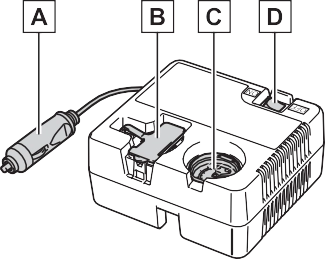
Hose
Air release cap Sticker
Power plug Rubber stopper
Air pressure gauge Compressor switch
Check the sealant expiry date occa- sionally.
The expiry date is shown on the bot- tle. Do not use sealant whose expiry date has already passed. Other-
wise, repairs conducted using the emergency tire puncture repair kit may not be performed properly.
it is not cleaned at once. Immedi- ately wipe away the sealant with a wet cloth.
1 Take out the repair kit from the plastic bag.
527
Attach the sticker enclosed with the bottle on the specified locations. (See step 10.)
You will use the air release cap again. Therefore keep it in a safe place.
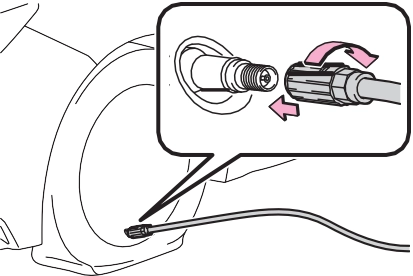
Screw the end of the hose clock-
wise as far as possible.
|
|
|
|
|
|
As shown in the illustration, insert the bottle securely into the com- pressor until the upper side of the mark on the bottle is aligned with
the upper end of the notch.
U.S.A.
Canada
11Check the specified tire infla- tion pressure.
Tire inflation pressure is specified on the label on the driver’s side pil-
529
lar as shown. (P.564)
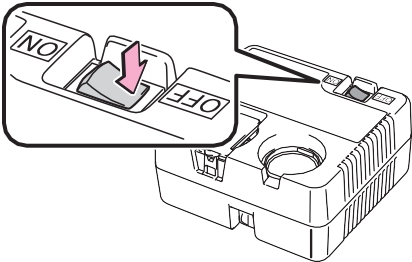
13To inject the sealant and inflate the tire, turn the com- pressor switch on.
14Inflate the tire until the speci- fied air pressure is reached.
|
|
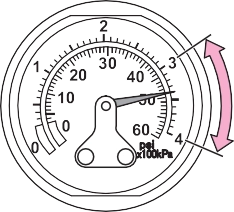
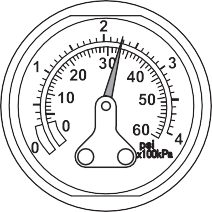
The sealant will be injected and the pressure will spike to between 44 psi (300 kPa, 3.0 kgf/cm2 or bar) and 58 psi (400 kPa, 4.0 kgf/cm2 or bar), then gradually decrease.
The air pressure gauge will display the actual tire inflation pressure about 1 to 5 min- utes after the switch is turned on.
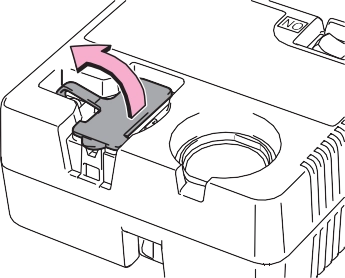
Turn the compressor switch off and then check the tire inflation pres- sure. Being careful not to over inflate, check and repeat the infla- tion procedure until the specified tire inflation pressure is reached.
The tire can be inflated for about 5 to 20 minutes (depending on the outside temperature). If the tire inflation pressure is still lower than the specified point after inflation for 25 minutes, the tire is too damaged
to be repaired. Turn the compres- sor switch off and contact your Toy- ota dealer.
If the tire inflation pressure exceeds the specified air pressure, let out some air to adjust the tire inflation pressure. (P.531, 564)
Some sealant may leak when the hose is removed.
17Attach the air release cap to the end of the hose.
If the air release cap is not attached, the sealant may leak and the vehicle may get dirty.
19To spread the liquid sealant evenly within the tire, imme- diately drive safely for about 3 miles (5 km) below 50 mph
(80 km/h).
20After driving, stop your vehi- cle in a safe place on a hard,
flat surface and reconnect the repair kit.
Remove the air release cap from the hose before reconnecting the hose.
|
|
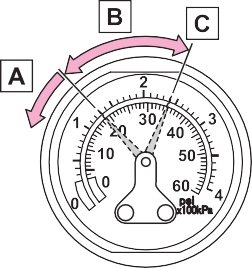
If the tire inflation pressure is under 19 psi (130 kPa, 1.3 kgf/cm2 or bar): The puncture cannot be repaired. Contact your Toyota dealer.
If the tire inflation pressure is 19 psi (130 kPa, 1.3 kgf/cm2or bar) or higher, but less than the specified air pressure: Proceed to step
22.
If the tire inflation pressure is the specified air pressure
(P.564): Proceed to step
531
22Turn the compressor switch on to inflate the tire until the specified air pressure is reached. Drive for about 3 miles (5 km) and then per- form step 20.
23Attach the air release cap to the end of the hose.
If the air release cap is not attached, the sealant may leak and the vehicle may get dirty.
25Taking precautions to avoid sudden braking, sudden acceleration and sharp turns, drive carefully at under 50 mph (80 km/h) to the nearest Toyota dealer that is less than 62 miles (100 km) away for tire repair or replacement.
When having the tire repaired or replaced, make sure to tell the Toy- ota dealer that the sealant is injected.
If the air pressure is under the des- ignated pressure, turn the compres- sor switch on again and repeat the inflation procedure until the speci- fied air pressure is reached.
After a tire is repaired with the emer- gency tire puncture repair kit, the valve should be replaced.
The tire pressure warning valve and transmitter should be replaced.
Even if the tire inflation pressure is at the recommended level, the tire pressure warning light may come
on/flash.
|
|
|
Do not drive the vehicle with a flat tire
Do not continue driving with a flat tire. Driving even a short distance with a flat tire can damage the tire and the wheel beyond repair. Driving with a flat tire may cause a circumferential groove on the side wall. In such a case, the tire may explode when using a repair kit. When fixing the flat tire
Stop your vehicle in a safe and flat area.
Do not touch the wheels or the area around the brakes immedi- ately after the vehicle has been driven.
After the vehicle has been driven, the wheels and the area around the brakes may be extremely hot. Touching these areas with hands, feet or other body parts may result in burns. Connect the valve and hose securely with the tire installed on the vehicle. If the hose is not properly connected to the valve, air leakage may occur as seal- ant may be sprayed out.
If the hose comes off the valve while inflating the tire, there is a risk that the hose will move abruptly due to air pressure.
After inflation of the tire has completed, the sealant may splatter when the hose is dis- connected or some air is let out of the tire.
Follow the operation procedure to repair the tire. If the proce- dures not followed, the sealant may spray out.
|
 WARNING

|
|
|
If you have a flat tire
Do not continue driving with a flat tire. Driving even a short distance with a flat tire can damage the tire and the wheel beyond repair, which could result in an accident. |
 WARNING
2 Take out the jack.
For tightening For loosening
3 Loosen the center fastener that secures the spare tire.
|
|
|
When storing the spare tire
Be careful not to catch fingers or other body parts between the spare tire and the body of the vehicle. |
 WARNING
Insert the wrench into the notch on the wheel cap.
To protect the wheel ornament,
Type A
Type B
When resting the tire on the ground, place the tire so that the wheel design faces up to avoid
scratching the wheel surface.
|
|
|
Replacing a flat tire
Do not touch the disc wheels or the area around the brakes immediately after the vehicle has been driven. After the vehi- cle has been driven the disc wheels and the area around the brakes will be extremely hot. Touching these areas with hands, feet or other body parts while changing a tire, etc. may result in burns.
Failure to follow these precau- tions could cause the wheel nuts to loosen and the tire to fall off, resulting in death or serious injury.
Have the wheel nuts tightened with a torque wrench to 76 ft•lbf (103 N•m, 10.5 kgf•m) as soon as possible after changing wheels.
Do not attach a heavily dam- aged wheel ornament, as it may fly off the wheel while the vehi- cle is moving.
When installing a tire, only use wheel nuts that have been spe- cifically designed for that wheel.
|
 WARNING
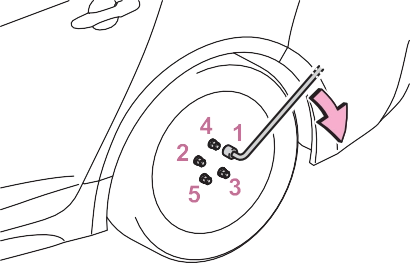
wheel seat .
539
|
|
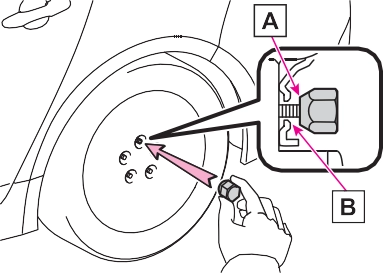
If foreign matter is on the wheel contact surface, the wheel nuts may loosen while the vehicle is in motion, causing the tire to come off.
When replacing a steel wheel with a steel wheel (including a compact spare tire), tighten the wheel nuts
until the tapered portion  comes into loose contact with the disc
When replacing an aluminum wheel with a steel wheel (including a com- pact spare tire), tighten the wheel
nuts until the tapered portion comes into loose contact with the disc wheel seat .
|
|
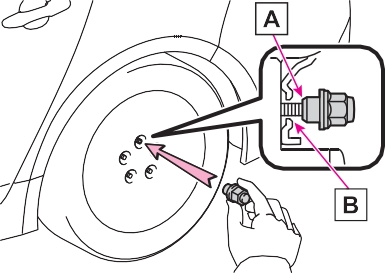
|
|
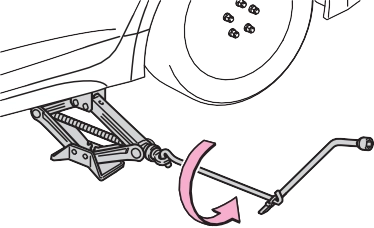
Tightening torque:
76 ft•lbf (103 N•m, 10.5 kgf•m)
|
|
The vehicle becomes lower when driving with the compact spare tire compared to when driving with stan- dard tires.
The tire pressure warning system must be reset. (P.481)
As the compact spare tire is not equipped with a tire pressure warn- ing valve and transmitter, low infla- tion pressure of the spare tire will not be indicated by the tire pressure warning system. Also, if you replace the compact spare tire after the tire pressure warning light comes on, the light remains on.
Install the compact spare tire on one of the rear wheels of the vehicle.
Perform the following steps and fit tire chains to the front tires:
Align the cutout of the wheel orna- ment with the valve stem as shown in the illustration.
|
|
|
When using the compact spare tire
Remember that the compact spare tire provided is specifi- cally designed for use with your vehicle. Do not use your com- pact spare tire on another vehi- cle.
Do not use more than one com- pact spare tires simultaneously.
Replace the compact spare tire with a standard tire as soon as possible.
Avoid sudden acceleration, abrupt steering, sudden brak- ing and shifting operations that cause sudden engine braking.
|
 WARNING

|
|
|
To avoid damage to the tire pressure warning valves and transmitters (vehicles with a tire pressure warning system)
When a tire is repaired with liquid sealants, the tire pressure warn- ing valve and transmitter may not operate properly. If a liquid seal- ant is used, contact your Toyota dealer or other qualified service shop as soon as possible. Make sure to replace the tire pressure warning valve and transmitter when replacing the tire. |
 NOTICE
One of the following may be the cause of the problem:
One of the following may be the cause of the problem:
8-2. Steps to take in an emergency
543
One of the following may be the cause of the problem:
Contact your Toyota dealer if the problem cannot be repaired, or if repair procedures are unknown.
Do not use this starting proce- dure except in case of emer- gency.
1 Set the parking brake. (P.180, 181)
2 Check that the shift lever is in P (continuously variable transmission) or N (manual transmission).
3 Turn the engine switch to ACC.
4 Press and hold the engine switch for about 15 seconds while depressing the brake pedal (continuously variable transmission) or clutch pedal (manual transmission) firmly.
Even if the engine can be started using the above steps, the system may be malfunctioning. Have the vehicle inspected by your Toyota dealer.
If you lose your keys
When the electronic key does not work properly
|
|
|
In case of a smart key system malfunction or other
key-related problems Take your vehicle with all the elec- tronic keys provided with your vehicle to your Toyota dealer. |
 NOTICE
following operations:
545
|
|
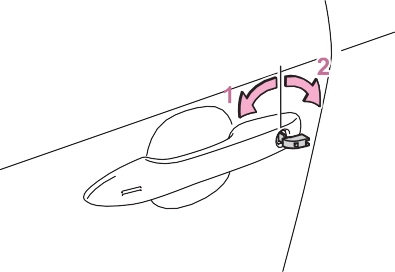
Turning the key unlocks the driver’s door. Turning the key again unlocks the other doors.
*1: If equipped
*2:This setting must be customized at your Toyota dealer.
Vehicles with a manual trans- mission: Shift the shift lever to N and depress the clutch pedal.
When the electronic key is detected, a buzzer sounds and the engine switch will turn to ON.
When the smart key system is deactivated in customization set- ting, the engine switch will turn to
ACC.
check that  is shown on the multi-information display.
In the event that the engine still cannot be started, contact your Toyota dealer.
Shift the shift lever to P (continu- ously variable transmission) or N (manual transmission) and press the engine switch as you normally do when stopping the engine.
As the above procedure is a tempo- rary measure, it is recommended that the electronic key battery be replaced immediately when the bat- tery is depleted. (P.489)
Release the brake pedal (continu- ously variable transmission) or clutch pedal (manual transmission) and press the engine switch in step 3 above.
The engine does not start and
modes will be changed each time the switch is pressed. (P.167)
547
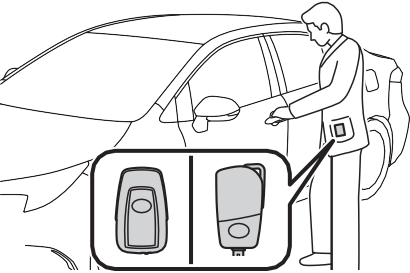
1 Vehicles with an alarm (P.82): Confirm that the electronic key (vehicles with a smart key system) or key (vehicles without a smart key system) is being carried.
When connecting the jumper (or booster) cables, depending on the situation, the alarm may activate and doors locked. (P.83)
|
|
3 Connect a positive jumper cable clamp to
on your vehicle and
connect the clamp on the other end of the positive cable to on the second vehicle. Then, connect a negative cable clamp to
on the second vehicle and connect the clamp at the other end of
the negative cable to .
1.8 L 4-cylinder (2ZR-FAE) engine
Positive (+) battery terminal (your vehicle) Positive (+) battery terminal (second vehicle) Negative (-) battery terminal (second vehicle)
Solid, stationary, unpainted metallic point away from the battery and any moving parts as shown in the illustration
2.0 L 4-cylinder (M20A-FKS) engine
Positive (+) battery terminal (your vehicle) Positive (+) battery terminal (second vehicle) Negative (-) battery terminal (second vehicle)
Solid, stationary, unpainted metallic point away from the battery and any moving parts as shown in the illustration
reverse order from which they were connected.
Once the engine starts, have the vehicle inspected at your Toyota dealer as soon as possible.
The engine cannot be started by push-starting.
549
cleared. When the battery is depleted, have the vehicle inspected at your Toyota dealer.
When the battery terminals are removed, the information stored in the ECU is cleared. Before remov- ing the battery terminals, contact your Toyota dealer.
The electricity stored in the battery will discharge gradually even when the vehicle is not in use, due to nat- ural discharge and the draining effects of certain electrical appli- ances. If the vehicle is left for a long time, the battery may discharge, and the engine may be unable to start. (The battery recharges auto- matically during driving.)
|
|
|
When removing the battery terminals
Always remove the negative (-) terminal first. If the positive (+) ter- minal contacts any metal in the surrounding area when the posi- tive (+) terminal is removed, a spark may occur, leading to a fire in addition to electrical shocks and death or serious injury. Avoiding battery fires or explosions
Observe the following precautions to prevent accidentally igniting the flammable gas that may be emit- ted from the battery: Make sure each jumper cable is connected to the correct termi- nal and that it is not unintention- ally in contact with any other than the intended terminal.
Do not allow the other end of the jumper cable connected to the “+” terminal to come into contact with any other parts or metal surfaces in the area, such as brackets or unpainted metal.
|
 WARNING
If you do not see steam:  Carefully lift the hood.
|
|
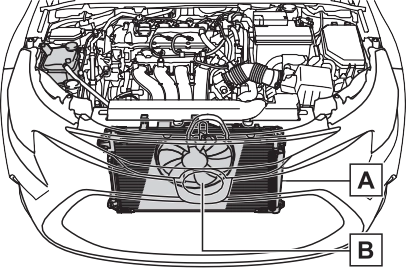
Reservoir cap “FULL” line “LOW” line
6 Start the engine and turn the air conditioning system on to
 552 8-2. Steps to take in an emergency
check that the radiator cool- ing fan operates and to check for coolant leaks from the radiator or hoses.
The fan operates when the air con- ditioning system is turned on imme- diately after a cold start. Confirm that the fan is operating by check- ing the fan sound and air flow. If it is difficult to check these, turn the air conditioning system on and off repeatedly. (The fan may not oper- ate in freezing temperatures.)
If the fan is operating: Have the vehicle inspected at the nearest Toyota dealer.
|
|
|
When inspecting under the hood of your vehicle
Observe the following precau- tions. Failure to do so may result in serious injury such as burns. If steam is seen coming from under the hood, do not open the hood until the steam has sub- sided. The engine compart- ment may be very hot.
Keep hands and clothing (espe- cially a tie, a scarf or a muffler) away from the fan and belts. Failure to do so may cause the hands or clothing to be caught, resulting in serious injury.
Do not loosen the coolant reser- voir cap while the engine and radiator are hot.
High temperature steam or coolant could spray out. |
 WARNING
553


mission) or 1 or R (manual 8
transmission) and release the parking brake. Then, while exercising caution, depress the accelerator pedal.
Press the switch to turn off TRAC.
555
Vehicle specifications 9
9-2. Customization
Customizable features
.................................. 580
9-3. Initialization
Items to initialize 588
9
Download Manual