For safe use
Before driving
Use only floor mats designed specifically for vehicles of the same model and model year as your vehicle. Fix them securely in place onto the carpet.
|
|
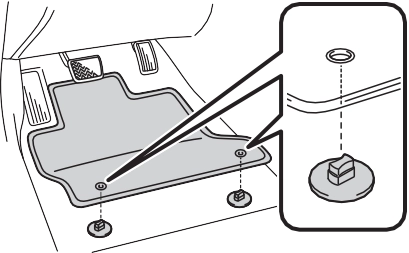
The shape of the retaining hooks (clips) may differ from that shown in the illustration.
|
|
|
Observe the following precau- tions. Failure to do so may cause the driver’s floor mat to slip, possibly interfering with the pedals while driving. An unexpectedly high speed may result or it may become difficult to stop the vehi- cle. This could lead to an acci- dent, resulting in death or serious injury. When installing the driver’s floor mat
Do not use floor mats designed for other models or different model year vehicles, even if they are Toyota Genuine floor mats.
Only use floor mats designed for the driver’s seat.
Always install the floor mat securely using the retaining hooks (clips) provided.
Do not use two or more floor mats on top of each other.
Do not place the floor mat bot- tom-side up or upside-down.
|
 WARNING
|
|
Always align the  marks .
For safe driving
|
|
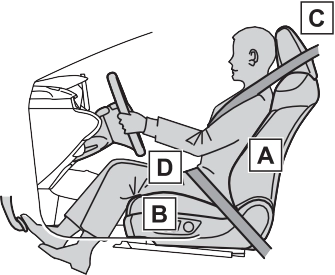
Adjust the angle of the seat- back so that you are sitting straight up and so that you do not have to lean forward to steer. (P.133)
Adjust the seat so that you can depress the pedals fully and so that your arms bend slightly at the elbow when gripping the steering wheel. (P.133)
Lock the head restraint in place with the center of the head restraint closest to the top of your ears. (P.136)
Wear the seat belt correctly. (P.27)
26 1-1. For safe use
Make sure that all occupants are wearing their seat belts before driving the vehicle. (P.27) Use a child restraint system appropriate for the child until the child becomes large enough to properly wear the vehicle’s seat belt. (P.48)
Make sure that you can see backward clearly by adjusting the inside and outside rear view mirrors properly. (P.139, 140)

The seat belts of your vehicle were principally designed for persons of adult size.
If your seat belts cannot be fastened securely because they are not long enough, a personalized seat belt extender is available from your Toy- ota dealer free of charge.

The retractor will lock the belt during a sudden stop or on impact. It may also lock if you lean forward too quickly. A slow, easy motion will allow the belt to extend so that you can move around fully.
When a passenger’s shoulder belt is completely extended and then retracted even slightly, the belt is locked in that position and cannot be extended. This feature is used to hold the child restraint system (CRS) firmly. To free the belt again, fully retract the belt and then pull the belt out once more. (P.48)
Use the seat belt after passing it through the guide if the seat belt comes free from the guide.
anchor down while pressing the release button .
2 Push the seat belt shoulder
anchor up while pressing the release button .
Move the height adjuster up and down as needed until you hear a click.

The pretensioners do not activate
in the event of a minor frontal impact, a minor side impact or a rear impact.
If the vehicle is involved in multiple collisions, the pretensioner will acti- vate for the first collision, but will not activate for the second or subse- quent collisions.
|
|
|
Seat belt pretensioners
Do not place anything, such as a cushion, on the front passen- ger’s seat. Doing so will disperse the passenger’s weight, which prevents the sen- sor from detecting the passen- ger’s weight properly. As a result, the seat belt pretensioner for the front passenger’s seat may not activate in the event of a collision.
If the pretensioner has acti- vated, the SRS warning light will come on. In that case, the seat belt cannot be used again and must be replaced at your Toyota dealer.
|
 WARNING
SRS driver airbag/front passenger airbag
Can help protect the head and chest of the driver and front passenger from impact with interior components
Can help provide driver protection
Can help restrain the front passenger
SRS front side airbags
Can help protect the torso of the front seat occupants
SRS rear side airbags
Can help protect the torso of occupants in the rear outer seats
Front passenger occupant classification system (ECU and sen- sors)
“AIR BAG ON” and “AIR BAG OFF” indicator lights Front passenger airbag
Curtain shield airbags
Side impact sensors (front doors) Front side airbags
Seat belt pretensioners and force limiters Rear side airbags
Side impact sensors (rear) Side impact sensors (front) Driver airbag
Driver’s seat belt buckle switch Driver’s seat position sensor Driver’s knee airbag
SRS warning light Front impact sensors
Airbag sensor assembly
Your vehicle is equipped with ADVANCED AIRBAGS designed based on the US motor vehicle safety standards (FMVSS208). The
airbag sensor assembly (ECU) controls airbag deployment based on 1
information obtained from the sensors etc. shown in the system
components diagram above. This information includes crash sever- ity and occupant information. As the airbags deploy, a chemical reaction in the inflators quickly fills the airbags with non-toxic gas to help restrain the motion of the occupants.
with the occupants to ascertain
the level of emergency and assis- tance required. If the occupants are unable to communicate, the agent automatically treats the call as an emergency and helps to dis- patch the necessary emergency services. (P.73)
However, this threshold velocity will be considerably higher in the follow- ing situations:
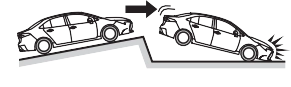
The SRS front airbags and SRS side and curtain shield airbags may also deploy if a serious impact occurs to the underside of your vehi- cle. Some examples are shown in the illustration.
 Landing hard or falling
 The SRS curtain shield airbags may also deploy under the situations shown in the illustration.
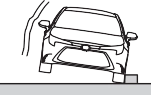
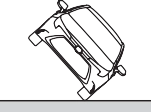 The vehicle skids and hits a curb stone.
The SRS front airbags do not gener- ally inflate if the vehicle is involved in a side or rear collision, if it rolls over, or if it is involved in a
low-speed frontal collision. But, whenever a collision of any type causes sufficient forward decelera- tion of the vehicle, deployment of the SRS front airbags may occur.
involved in a rear collision, if it pitches end over end, or if it is involved in a low-speed side or low-speed frontal collision.
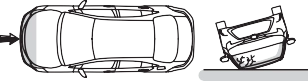
The SRS side and curtain shield air- bags may not activate if the vehicle is subjected to a collision from the side at certain angles, or a collision to the side of the vehicle body other than the passenger compartment.
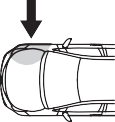
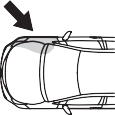 Collision from the side at an angle
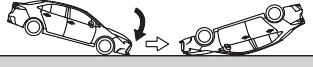
The SRS side airbags do not gener- ally inflate if the vehicle is involved in a frontal or rear collision, if it rolls over, or if it is involved in a
low-speed side collision.
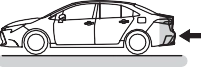 Vehicle rollover
 The SRS curtain shield airbags do not generally inflate if the vehicle is
In the following cases, the vehicle will require inspection and/or repair. Contact your Toyota dealer as soon as possible.
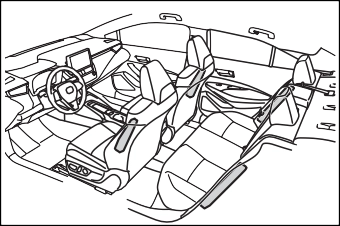
scratched, cracked, or otherwise damaged.
|
|
|
SRS airbag precautions
Observe the following precautions regarding the SRS airbags. Failure to do so may cause death or serious injury. The driver and all passengers in the vehicle must wear their seat belts properly.
The SRS airbags are supple- mental devices to be used with the seat belts. The SRS driver airbag deploys with considerable force, and can cause death or serious injury especially if the driver is very close to the airbag. The National Highway Traffic Safety Administration (NHTSA) advises:
Since the risk zone for the driver’s airbag is the first 2 - 3 in. (50 - 75 mm) of inflation, placing yourself 10 in. (250 mm) from your driver airbag provides you with a margin of safety. This distance is mea- sured from the center of the steer- ing wheel to your breastbone. If you sit less than 10 in. (250 mm) away now, you can change your driving position in several ways: Move your seat to the rear as far as you can while still reach- ing the pedals comfortably.
|
 WARNING
|
|
|
Modification and disposal of SRS airbag system compo- nents
Do not dispose of your vehicle or perform any of the following modi- fications without consulting your Toyota dealer. The SRS airbags may malfunction or deploy (inflate) accidentally, causing death or serious injury. Installation, removal, disassem- bly and repair of the SRS air- bags
Repairs, modifications, removal or replacement of the steering wheel, instrument panel, dash- board, seats or seat upholstery, front, side and rear pillars, roof side rails, front door panels, front door trims or front door speakers
Modifications to the front door panel (such as making a hole in it)
Repairs or modifications of the front fender, front bumper, or side of the occupant compart- ment
Installation of a grille guard (bull bars, kangaroo bar, etc.), snow plows, winches or roof luggage carrier
Modifications to the vehicle’s suspension system
Installation of electronic devices such as mobile two-way radios and CD players
Modifications to your vehicle for a person with a physical disabil- ity
|
 WARNING
SRS warning light
Front passenger seat belt reminder light “AIR BAG OFF” indicator light
“AIR BAG ON” indicator light
42 1-1. For safe use
|
|
|
Child restraint systems installed on the rear seat should not con- tact the front seatbacks.
Do not use a seat accessory, such as a cushion and seat cover, that covers the seat cushion surface.
Do not modify or replace the upholstery of the front seat.
|
 WARNING
|
Indicator/warning light |
“AIR BAG ON” and “AIR BAG OFF” indicator lights |
“AIR BAG ON” |
|
SRS warning light |
Off |
|
|
Front passenger’s seat belt reminder light |
Off*2 or flashing*3 |
|
|
Devices |
Front passenger airbag |
Activated |
|
Seat cushion airbag in the front passenger side |
Activated*2 or deactivated*3 |
|
Indicator/warning light |
“AIR BAG ON” and “AIR BAG OFF” indicator lights |
“AIR BAG OFF” or “AIR BAG ON”*4 |
|
SRS warning light |
Off |
|
|
Front passenger’s seat belt reminder light |
Off*2 or flashing*3 |
|
|
Devices |
Front passenger airbag |
Deactivated or activated*4 |
|
Seat cushion airbag in the front passenger side |
Deactivated or activated*4, 2 |
|
Indicator/warning light |
“AIR BAG ON” and “AIR BAG OFF” indicator lights |
“AIR BAG OFF”*6 |
|
SRS warning light |
Off |
|
|
Front passenger’s seat belt reminder light |
Off*2 or flashing*3 |
|
|
Devices |
Front passenger airbag |
Deactivated |
|
Seat cushion airbag in the front passenger side |
|
Indicator/warning light |
“AIR BAG ON” and “AIR BAG OFF” indicator lights |
“AIR BAG OFF” |
|
SRS warning light |
Off |
|
|
Front passenger’s seat belt reminder light |
||
|
Devices |
Front passenger airbag |
Deactivated |
|
Seat cushion airbag in the front passenger side |
|
Indicator/warning light |
“AIR BAG ON” and “AIR BAG OFF” indicator lights |
“AIR BAG OFF” |
|
SRS warning light |
On |
|
|
Front passenger’s seat belt reminder light |
||
|
Devices |
Front passenger airbag |
Deactivated |
|
Seat cushion airbag in the front passenger side |
*1: The system judges a person of adult size as an adult. When a smaller adult sits in the front passenger seat, the system may not recognize him/her as an adult depending on his/her physique and posture.
*2: In the event the front passenger is wearing a seat belt.
*3: In the event the front passenger does not wear a seat belt.
*4: For some children, child in seat, child in booster seat or child in convert-
ible seat, the system may not recognize him/her as a child. Factors which may affect this can be the physique or posture.
*5: Never install a rear-facing child restraint system on the front passenger seat. A forward-facing child restraint system should only be installed on the front passenger seat when it is unavoidable. (P.48)
*6: In case the indicator light is not illuminated, consult this manual on how
to install the child restraint system properly. (P.48) 1
|
Exhaust pipe
The exhaust system needs to be checked periodically. If there is a hole or crack caused by corro- sion, damage to a joint or abnor- mal exhaust noise, be sure to have the vehicle inspected and repaired by your Toyota dealer. |
|
|
|
Exhaust gases include harmful carbon monoxide (CO), which is colorless and odorless. Observe the following precautions. Failure to do so may cause exhaust gases enter the vehicle and may lead to an accident caused by light-headedness, or may lead to death or a serious health hazard. Important points while driving
Keep the trunk lid closed.
If you smell exhaust gases in the vehicle even when the trunk lid is closed, open the windows and have the vehicle inspected at your Toyota dealer as soon as possible.
When parking
If the vehicle is in a poorly venti- lated area or a closed area, such as a garage, stop the engine.
Do not leave the vehicle with the engine on for a long time. If such a situation cannot be avoided, park the vehicle in an open space and ensure that
exhaust fumes do not enter the vehicle interior. Do not leave the engine running in an area with snow build-up, or where it is snowing. If snow- banks build up around the vehi- cle while the engine is running, exhaust gases may collect and enter the vehicle.
|
 WARNING
Download Manual