Parksense Front/Rear Park Assist System — If Equipped
The ParkSense Park Assist system provides visual and audible indications of the distance between the rear, and if equipped, the front fascia/bumper and a detected obstacle when backing up or moving forward (e.g. during a parking maneuver).
Note:
-
The system is provided to assist the driver and not to substitute the driver.
-
The driver must stay in full control of the vehicle's acceleration and braking and is responsible for controlling the vehicle's movements "⇨ParkSense System Usage Precautions".
ParkSense will retain the last system state (enabled or disabled) from the last ignition cycle when the ignition is changed to the ON/RUN position.
ParkSense is active in DRIVE or REVERSE, as long as the system is on. The system will remain active until the vehicle speed is increased to approximately 7 mph (11 km/h) or above. While in REVERSE and above the system's operating speed, a warning will appear in the instrument cluster display indicating the vehicle speed is too fast. The system will become active again if the vehicle speed is decreased to speeds less than approximately 6 mph (9 km/h).
PARKSENSE SENSORS
The six ParkSense sensors (four when vehicle is not equipped with front sensors), located in the rear fascia/bumper, and the six ParkSense sensors located in the front fascia/bumper, monitor the area in front and behind the vehicle that is within the sensors’ field of view. The front sensors detect obstacles from approximately 12 inches (30 cm) up to 47 inches (120 cm) from the front fascia/bumper. The rear sensors can detect obstacles from approximately 12 inches (30 cm) up to 79 inches (200 cm) from the rear fascia/bumper. These distances depend on the location, type and orientation of the obstacle in the horizontal direction.
PARKSENSE WARNING DISPLAY
The ParkSense Warning screen will only be displayed if “Sound and Display” is selected from the Customer - Programmable Features section of the Uconnect system "⇨UCONNECT SETTINGS".
The ParkSense Warning screen is located within the instrument cluster display "⇨INSTRUMENT CLUSTER DISPLAY". It provides visual warnings to indicate the distance between the rear fascia/bumper and/or front fascia/bumper and the detected obstacle.
PARKSENSE DISPLAY
The warning display will turn on indicating the system status when the vehicle is in REVERSE or when the vehicle is in DRIVE and an obstacle has been detected.
The system will indicate a detected obstacle by showing a single arc in the left and/or right front or rear regions based on the object’s distance and location relative to the vehicle.
If an object is detected in the left and/or right rear region, the display will show a single arc in the left and/or right rear region and the system will produce a tone. As the vehicle moves closer to the object, the display will show the single arc moving closer to the vehicle and the tone will change from a single 1/2 second tone to slow, to fast, to continuous.
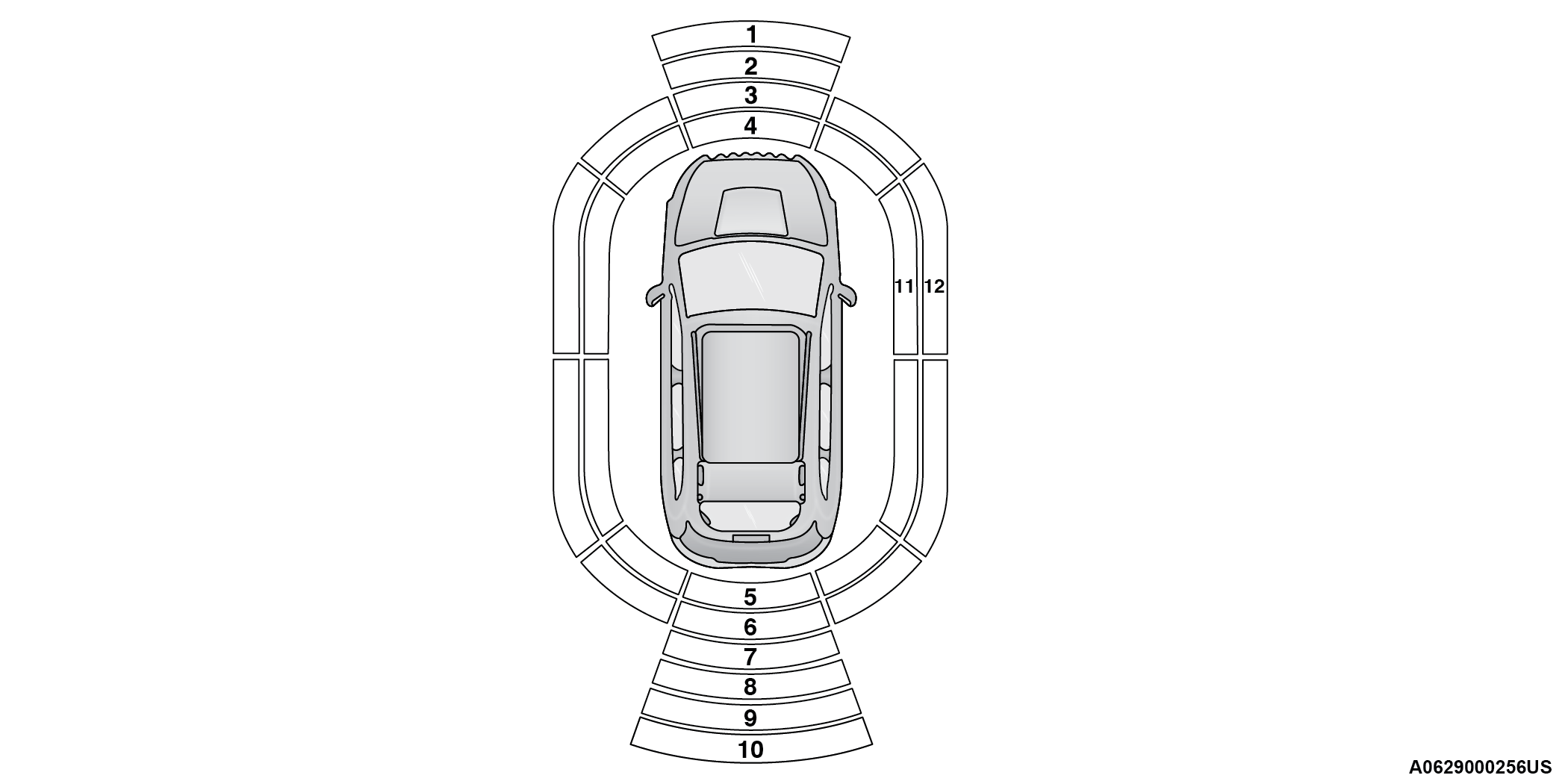
Front/Rear/Side ParkSense Arcs
|
1 — No Tone/Solid Arc |
7 — Fast Tone/Flashing Arc |
|
2 — No Tone/Flashing Arc |
8 — Slow Tone/Solid Arc |
|
3 — Fast Tone/Flashing Arc |
9 — Slow Tone/Solid Arc |
|
4 — Continuous Tone/Flashing Arc |
10 — Single 1/2 Second Tone/Solid Arc |
|
5 — Continuous Tone/Flashing Arc |
11 — Continuous Tone/Flashing Arcs |
|
6 — Fast Tone/Flashing Arc |
12 — Fast Tone/Flashing Arcs |
The vehicle is close to the obstacle when the instrument cluster display shows one flashing arc and sounds a continuous tone. The following chart shows the warning alert operation when the system is detecting an obstacle:
|
WARNING ALERTS FOR REAR |
|||||||
|
Rear Distance (inches/cm) |
Greater than 79 inches (200 cm) |
79-59 inches (200-150 cm) |
59-47 inches (150-120 cm) |
47-39 inches (120-100 cm) |
39-25 inches (100-65 cm) |
25-12 inches (65-30 cm) |
Less than 12 inches (30 cm) |
|
Arcs — Left |
None |
None |
None |
None |
None |
6th Flashing |
5th Flashing |
|
Arcs — Center |
None |
10th Solid |
9th Solid |
8th Solid |
7th Flashing |
6th Flashing |
5th Flashing |
|
Arcs — Right |
None |
None |
None |
None |
None |
6th Flashing |
5th Flashing |
|
Audible Alert Chime |
None |
Single, 1/2 second, audible chime is heard |
Audible chime increases as the objects get closer to the vehicle |
Continuous |
|||
|
Radio Volume Reduced |
No |
Yes |
|
WARNING ALERTS FOR FRONT |
|||||
|
Front Distance (inches/cm) |
Greater than 47 inches (120 cm) |
47-39 inches (120-100 cm) |
39-25 inches (100-65 cm) |
25-12 inches (65-30 cm) |
Less than 12 inches (30 cm) |
|
Arcs — Left |
None |
None |
None |
3rd Flashing |
4th Flashing |
|
Arcs — Center |
None |
1st Solid |
2nd Flashing |
3rd Flashing |
4th Flashing |
|
Arcs — Right |
None |
None |
None |
3rd Flashing |
4th Flashing |
|
Audible Alert Chime |
None |
None |
None |
Audible chime increases as the objects get close to the vehicle |
Continuous |
|
Radio Volume Reduced |
No |
Yes |
Note:
ParkSense will reduce the volume of the radio, if on, when the system is sounding an audible tone.
Front Park Assist Audible Alerts
ParkSense will turn off the Front Park Assist audible alert (chime) after approximately three seconds when an obstacle has been detected, the vehicle is stationary, and brake pedal is applied.
Adjustable Chime Volume Settings
Front and Rear chime volume settings can be selected from the Uconnect system "⇨UCONNECT SETTINGS".
The chime volume settings include low, medium, and high.
ParkSense will retain its last known configuration state through ignition cycles.
ENABLING AND DISABLING PARKSENSE
 ParkSense can be enabled and disabled with the ParkSense switch, located on the switch panel below the Uconnect display.
When the ParkSense switch is pushed to disable the system, the instrument cluster display "⇨INSTRUMENT CLUSTER DISPLAY" will show the “PARKSENSE OFF” message for approximately five seconds.
The ParkSense switch LED will be on when ParkSense is disabled or requires service. The ParkSense switch LED will be off when the system is enabled. If the ParkSense switch is pushed, and requires service, the ParkSense switch LED will blink momentarily, and then the LED will be on.
SERVICE THE PARKSENSE PARK ASSIST SYSTEM
During vehicle start up, when the ParkSense System has detected a faulted condition, the instrument cluster will actuate a single chime, once per ignition cycle, and it will display the "PARKSENSE UNAVAILABLE SERVICE REQUIRED" message for five seconds.
If "PARKSENSE UNAVAILABLE WIPE REAR SENSORS" or "PARKSENSE UNAVAILABLE WIPE FRONT SENSORS" appears in the instrument cluster display make sure the outer surface and the underside of the rear fascia/bumper and/or front fascia/bumper is clean and clear of snow, ice, mud, dirt or other obstruction and then cycle the ignition. If the message continues to appear see an authorized dealer.
If the "PARKSENSE UNAVAILABLE SERVICE REQUIRED" message appears in the instrument cluster display, see an authorized dealer.
CLEANING THE PARKSENSE SYSTEM
Clean the ParkSense sensors with water, car wash soap and a soft cloth. Do not use rough or hard cloths. Do not scratch or poke the sensors. Otherwise, you could damage the sensors.
PARKSENSE SYSTEM USAGE PRECAUTIONS
Note:
-
Ensure that the front and rear fascias/bumpers are free of snow, ice, mud, dirt and debris to keep the ParkSense system operating properly.
-
Jackhammers, large trucks, and other vibrations could affect the performance of ParkSense.
-
When you turn ParkSense off, the instrument cluster display will read “PARKSENSE OFF.” Furthermore, once you turn ParkSense off, it remains off until you turn it on again, even if you cycle the ignition.
-
ParkSense, when on, will reduce the volume of the radio when it is sounding a tone.
-
Clean the ParkSense sensors regularly, taking care not to scratch or damage them. The sensors must not be covered with ice, snow, slush, mud, dirt or debris. Failure to do so can result in the system not working properly. The ParkSense system might not detect an obstacle behind or in front of the fascia/bumper, or it could provide a false indication that an obstacle is behind or in front of the fascia/bumper.
-
Use the ParkSense switch to turn the ParkSense system off if objects such as bicycle carriers, etc. are attached to the rear fascia/bumper. Failure to do so can result in the system misinterpreting a close object as a sensor problem, causing the “ParkSense Unavailable Service Required” message to be displayed in the instrument cluster display.
Note:
If any objects are attached to the bumper within a 6.5 ft (2 m) field of view, they will interfere and cause false alerts and possibly blockage.
-
There may be a delay in the object detection rate if the object is moving.
-
The rear sensors are automatically deactivated when the trailer’s electric plug is inserted in the vehicle’s tow socket. The front sensors stay active and can provide acoustic and visual warnings. The rear sensors are automatically reactivated when the trailer's cable plug is removed.
WARNING:
-
Drivers must be careful when backing up even when using ParkSense. Always check carefully behind your vehicle, look behind you, and be sure to check for pedestrians, animals, other vehicles, obstructions, and blind spots before backing up. You are responsible for safety and must continue to pay attention to your surroundings. Failure to do so can result in serious injury or death.
-
Before using ParkSense, it is strongly recommended that the ball mount and hitch ball assembly be disconnected from the vehicle when the vehicle is not used for towing. Failure to do so can result in injury or damage to vehicles or obstacles because the hitch ball will be much closer to the obstacle than the rear fascia when the vehicle sounds the continuous tone. Also, the sensors could detect the ball mount and hitch ball assembly, depending on its size and shape, giving a false indication that an obstacle is behind the vehicle.
CAUTION:
-
ParkSense is only a parking aid and it is unable to recognize every obstacle, including small obstacles. Parking curbs might be temporarily detected or not detected at all. Obstacles located above or below the sensors will not be detected when they are in close proximity.
-
The vehicle must be driven slowly when using ParkSense in order to be able to stop in time when an obstacle is detected. It is recommended that the driver looks over his/her shoulder when using ParkSense.
SIDE DISTANCE WARNING (SDW) SYSTEM
The Side Distance Warning system has the function of detecting the presence of side obstacles near the vehicle using the parking sensors located in the front and rear bumpers.
SIDE DISTANCE WARNING DISPLAY
The Side Distance Warning screen will only be displayed if this feature is enabled within Uconnect Settings "⇨UCONNECT SETTINGS".
The system warns the driver with an acoustic signal and when selected, with visual indications on the instrument panel display "⇨INSTRUMENT CLUSTER DISPLAY".
|
WARNING ALERTS |
||
|
Distance (in/cm) |
Less than 30 inches (76 cm) |
30 – 65 inches (76–165 cm) |
|
Arcs-Left |
11th Flashing |
12th Flashing |
|
Arcs-Right |
11th Flashing |
12th Flashing |
|
Audible Alert Chime |
Audible alert only when the vehicle is on course for a collision |
|
|
Radio Volume Reduced |
Yes |
Yes |
Note:
ParkSense will reduce the volume of the radio if on when the system is sounding an audible tone.
ACTIVATION/DEACTIVATION
The system can operate only after driving a short distance and if the vehicle speed is between 0 and 7 mph (0 and 11 km/h). The system can be activated/deactivated via the "Settings" menu of the Uconnect system. If the ParkSense System is deactivated via the ParkSense switch, then the side distance warning system will automatically be deactivated.
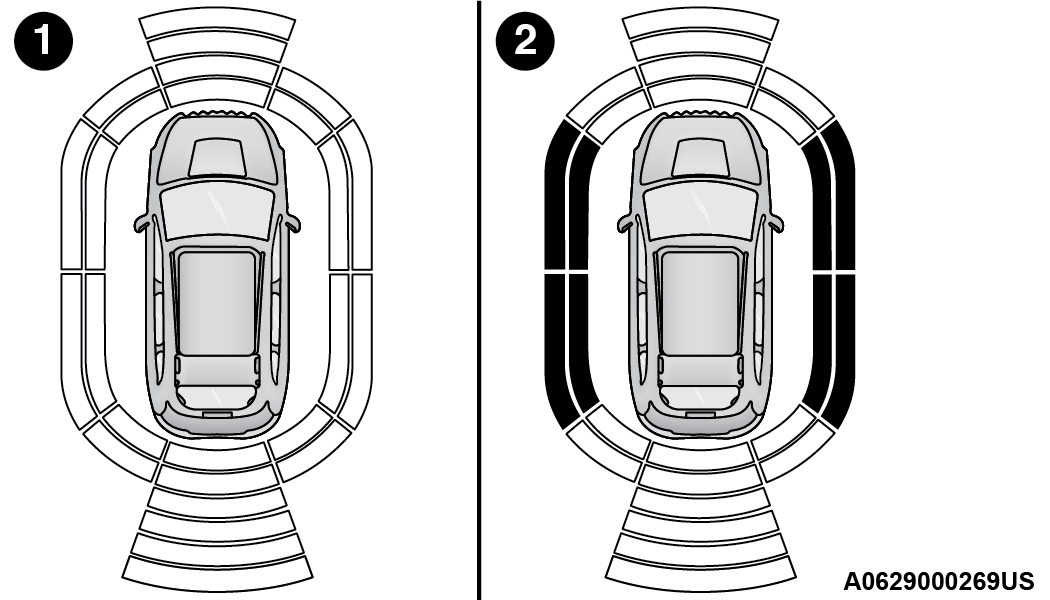
Side Distance Warning System Status
|
1 — System Not Active |
|
2 — System Active |
Note:
The vehicle needs to be driven approximately one car length in order for the Side Distance Warning system to activate.
OPERATION WITH A TRAILER
The system is automatically deactivated when the trailer's electric plug is inserted in the vehicle's tow hook socket. The rear sensors are automatically reactivated when the trailer's cable plug is removed.
PARKSENSE USAGE PRECAUTIONS
Some conditions may influence the performance of the Side Distance Warning system:
Note:
-
Ensure that the front and rear bumper are free of snow, ice, mud, dirt and debris to keep the ParkSense system operating properly.
-
Construction equipment, large trucks, and other vibrations could affect the performance of ParkSense.
-
When you turn ParkSense off, the message in the instrument cluster display will read “PARKSENSE OFF.” Furthermore, once you turn ParkSense off, it remains off until you turn it on again, even if you cycle the ignition key.
-
ParkSense, when on, will reduce the volume of the radio when it is sounding a tone.
-
Clean the ParkSense sensors regularly, taking care not to scratch or damage them. The sensors must not be covered with ice, snow, slush, mud, dirt or debris. Failure to do so can result in the system not working properly. The ParkSense system might not detect an obstacle behind or in front of the fascia/bumper, or it could provide a false indication that an obstacle is behind or in front of the fascia/bumper.
-
The presence of a tow hook without a trailer may interfere with the correct operation of the parking sensors. Before using the ParkSense system, it is recommended to remove the removable tow hook ball assembly and any attachments from the vehicle when it is not used for towing operations. If you leave the tow hook fitted when not towing a trailer, the tow hook could be detected as an obstacle by the sensors. Contact your authorized dealer to update the ParkSense system operations.
WARNING:
-
Drivers must be careful when backing up even when using ParkSense. Always check carefully behind your vehicle, look behind you, and be sure to check for pedestrians, animals, other vehicles, obstructions, and blind spots before backing up. You are responsible for safety and must continue to pay attention to your surroundings. Failure to do so can result in serious injury or death.
-
Before using ParkSense, it is strongly recommended that the ball mount and hitch ball assembly be disconnected from the vehicle when the vehicle is not used for towing. Failure to do so can result in injury or damage to vehicles or obstacles because the hitch ball will be much closer to the obstacle than the rear fascia when the vehicle sounds the continuous tone. Also, the sensors could detect the ball mount and hitch ball assembly, depending on its size and shape, giving a false indication that an obstacle is behind the vehicle.
CAUTION:
-
ParkSense is only a parking aid and it is unable to recognize every obstacle, including small obstacles. Parking curbs might be temporarily detected or not detected at all. Obstacles located above or below the sensors will not be detected when they are in close proximity.
-
The vehicle must be driven slowly when using ParkSense in order to be able to stop in time when an obstacle is detected. It is recommended that the driver looks over his/her shoulder when using ParkSense.
Download Manual