Highway Assist System — If Equipped
The Highway Assist system (HAS) is combined with the Adaptive Cruise Control (ACC) system, and centers the vehicle in the driving lane while traveling at speeds up to 90 mph (145 km/h).
For ACC system operating instructions and system limitations, see "⇨Adaptive Cruise Control (ACC)".
Note:
-
The driver should always obey traffic laws and speed limits. Never drive above applicable speed limit restrictions.
-
The driver can override HAS at any time by braking, accelerating, or steering the vehicle.
Just like ACC, HAS will maintain a set speed as long as the set distance between your vehicle and the vehicle in front is maintained. HAS will also keep your vehicle centered between the lane lines, and monitor for other vehicles in adjacent lanes by utilizing the Blind Spot Monitoring sensors.
HAS uses sensors within the steering wheel to measure driver attentiveness. HAS requires the driver’s hands on the steering wheel at all times. The system will generally aim to keep the vehicle centered in the lane, but when the driver turns the steering wheel (e.g. to move farther away from a large vehicle in an adjacent lane) the system will reduce its control and enter "co-steering" mode. While in co-steering mode, the system will provide reduced assistance and allow the driver to control the path of the vehicle. Once the driver stops providing input to the steering wheel, the system will require a few seconds to fully resume lane centering assistance, especially during curves.
WARNING:
The Highway Assist system is a convenience system. It is not a substitute for active driver involvement. It is always the driver’s responsibility to be attentive of road traffic, weather conditions, vehicle speed, distance to the vehicle ahead, position in the lane compared to other vehicles, and brake operation to ensure safe operation of the vehicle under all road conditions. Your complete attention is always required while driving to maintain safe control of your vehicle. Failure to follow these warnings can result in a collision and death or serious personal injury.
You should turn off the Highway Assist system:
-
When driving in complex driving situations (e.g. urban environments, construction zones, etc.), adverse weather or low visibility conditions (e.g. rain, snow, fog, sleet, dust), or adverse road conditions (e.g. heavy traffic, worn or missing lane markings, etc.).
-
When entering a highway off-ramp, when driving on roads that are icy, snow covered, or slippery.
-
When driving during difficult or uncertain conditions.
TURNING HIGHWAY ASSIST ON OR OFF
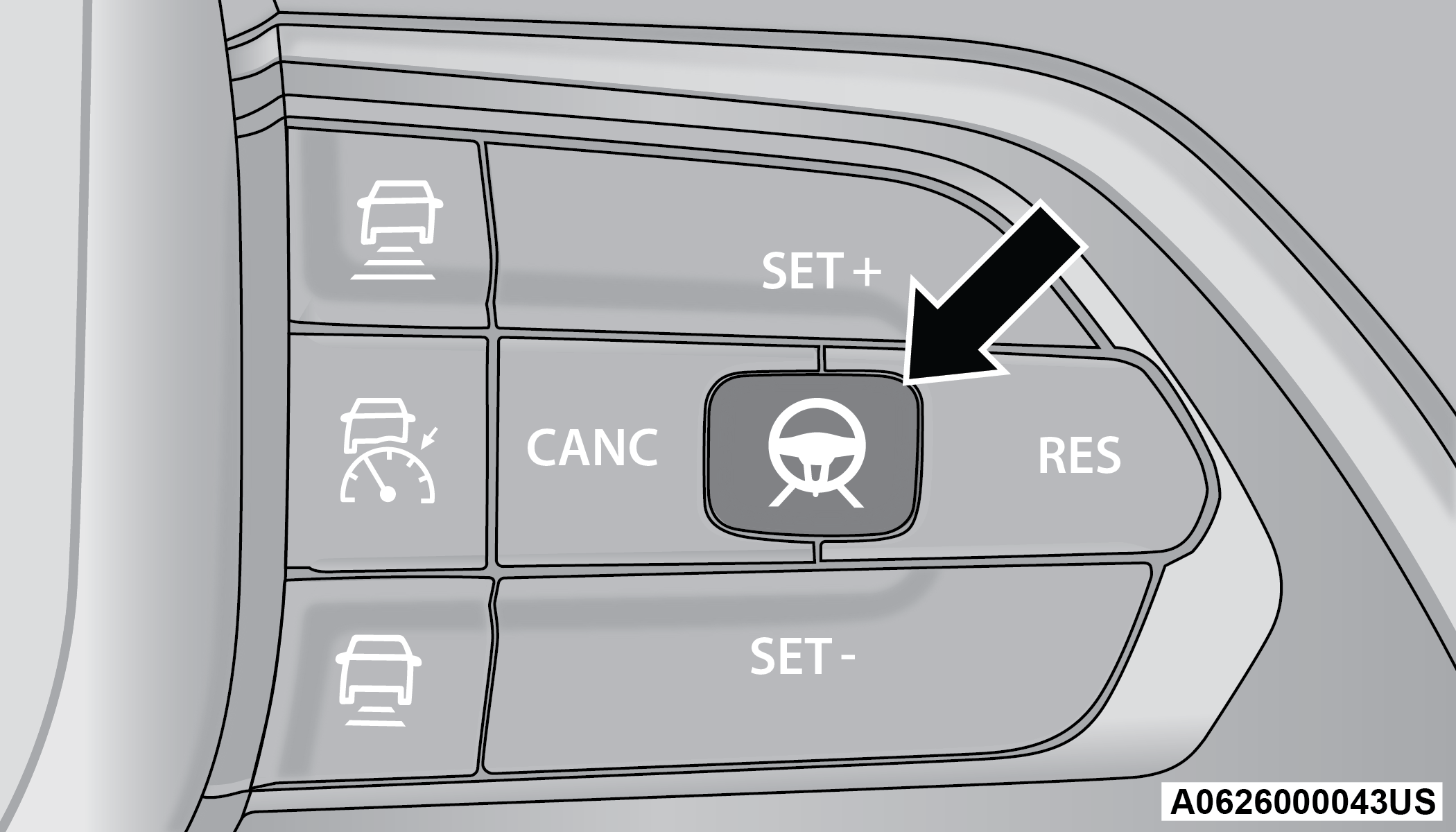
Highway Assist On/Off Button
To enable the Highway Assist system, proceed as follows:
-
Push the Highway Assist on/off button located on the right side of the steering wheel. The steering wheel image will display white in the instrument cluster display until the system is engaged. If ACC was previously disabled, pushing this button will activate BOTH ACC and Highway Assist systems.
-
If ACC was engaged before pushing the HAS on/off button, ACC will remain active and HAS will also become engaged (once all other conditions are met).
-
If ACC was not active before pushing the HAS on/off button, push the SET (+) button or the SET (-) button and release when the desired driving speed is shown in the instrument cluster display.
-
If desired, adjust the ACC distance setting by pushing the Distance Increase or Distance Decrease buttons.
When all system conditions are met as described in “System Engagement Conditions” in the next section, the system will engage and the steering wheel image in the display will change to green.
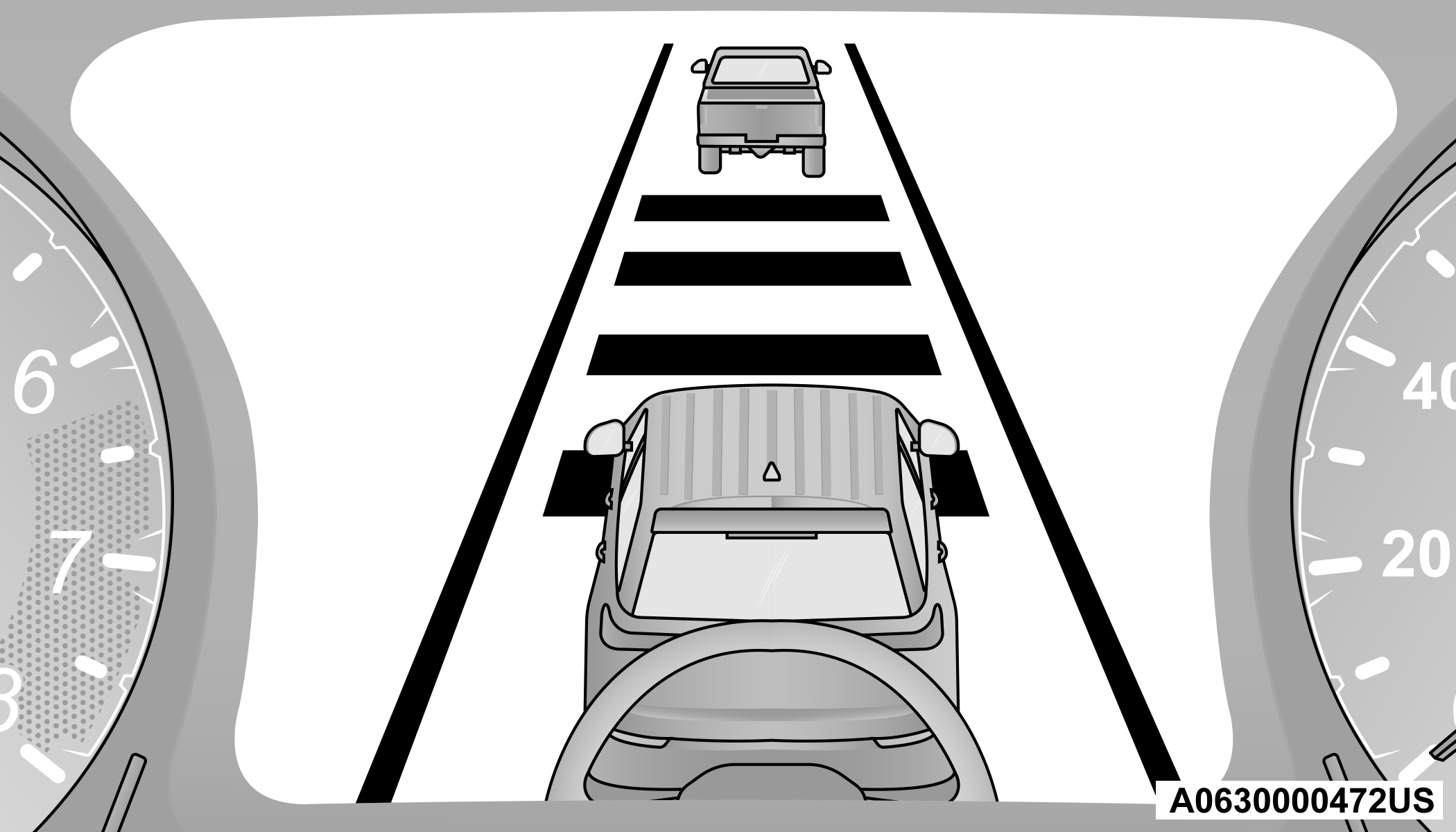
Highway Assist Engaged (Steering Wheel Green)
Note:
Along with the color change of the steering wheel image, the “glow” effect of the instrument cluster display will also change to green when HAS is engaged.
System Engagement Conditions
The following conditions must be met after enabling the Highway Assist system before the system will engage:
-
Highway Assist system is enabled
-
Driver seat belt is buckled
-
System detects visible lane markings
-
Vehicle is traveling below 90 mph (145 km/h)
-
Vehicle is centered in lane
-
Turn signal is not activated
-
Vehicle is not in a tight curve
-
Trailer is not connected
-
Driver has hands on steering wheel
Note:
For the system to detect the driver’s hands on the steering wheel, the wheel must be gripped on the outside. Gripping the inside areas of the steering wheel will not satisfy the hands-on condition to engage the system.
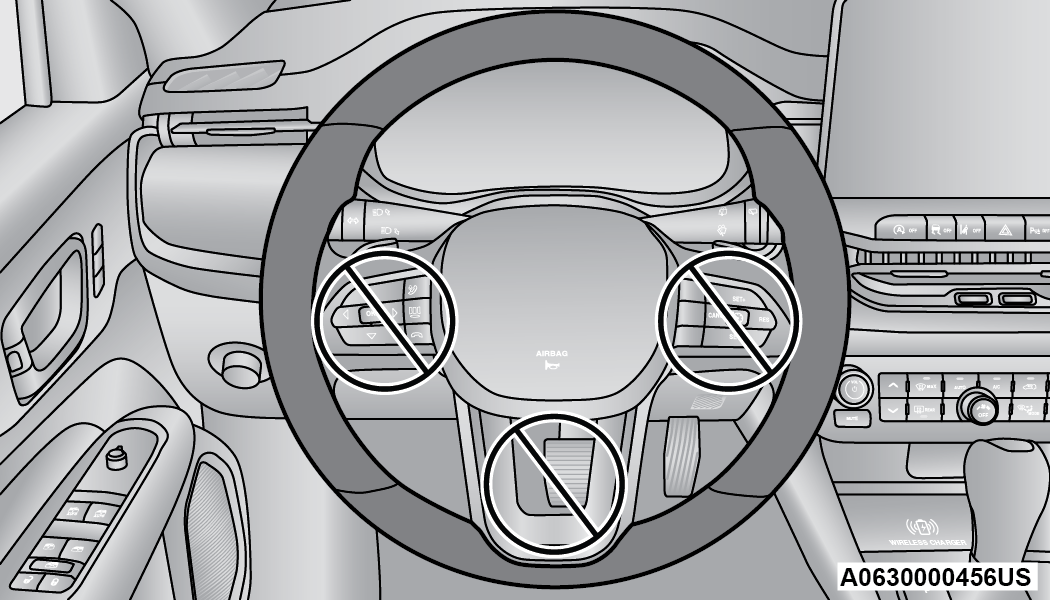
Do Not Grip Inside Of Steering Wheel
System Deactivation
The system will be deactivated in any of the following situations:
-
If the system has detected driver inattentiveness, and has gone through all escalation warnings
-
If lane markings are no longer detected
-
If the brake pedal is pressed or ACC system is deactivated
-
If a turn signal is used (unless a target is in the blind spot zone on the same side the turn signal is being applied)
-
If the driver applies enough input to the steering wheel
-
If the driver’s seat belt is released
-
If the vehicle speed exceeds 90 mph (145 km/h)
-
If the Highway Assist system on/off button is pushed again (HAS will turn off)
-
If the Forward Collision Warning (FCW) system becomes active and is providing warnings/braking
Note:
-
HAS will not enable if the system detects a trailer is connected to the vehicle.
-
Pushing the Highway Assist on/off button will turn the system off. All other deactivation conditions will place the system back into the “enabled” state with the steering wheel indicator displayed in white until all engagement conditions are met again.
-
When the system is deactivated, the system status indicator lights will turn off, Active Lane Management will return to its previous state, and ACC will disable.
INDICATIONS ON THE DISPLAY
The Highway Assist system status can always be viewed in the instrument cluster display, and status changes are shown by changes in color of the system’s indicator lights.
As the system detects driver inattentiveness as previously described "⇨Operation", the system status indicator lights will change from green, to yellow, to red, while the steering wheel icon on the display moves up the screen to the center. The following indicators will change in color as warnings to the driver escalate:
-
Highway Assist Indicator (steering wheel icon in the instrument cluster display)
-
Glow effect of the instrument cluster display
If driver attention is not returned, the system will deactivate.
Highway Assist Indicators Are Off
-
HAS is not turned on/enabled by the driver.
Highway Assist Indicators Are White
-
HAS is turned on/enabled by the driver, but the system is not actively steering and providing speed control for to the vehicle.
Highway Assist Indicators Are Green
-
The system detects driver is attentive and is actively steering and providing speed control for the vehicle.
Highway Assist Indicators Are Yellow
-
Driver inattentiveness has been detected, warning the driver to place hands on the steering wheel.
Highway Assist Indicators Are Red
-
Driver inattentiveness is still being detected, or driver take-over is being requested, warning the driver to place hands on the steering wheel. This warning is also issued when the system has detected a tight curve and is warning the driver to take control.
Note:
The driver MUST replace hands on the steering wheel and take control of the vehicle when the system is deactivated.
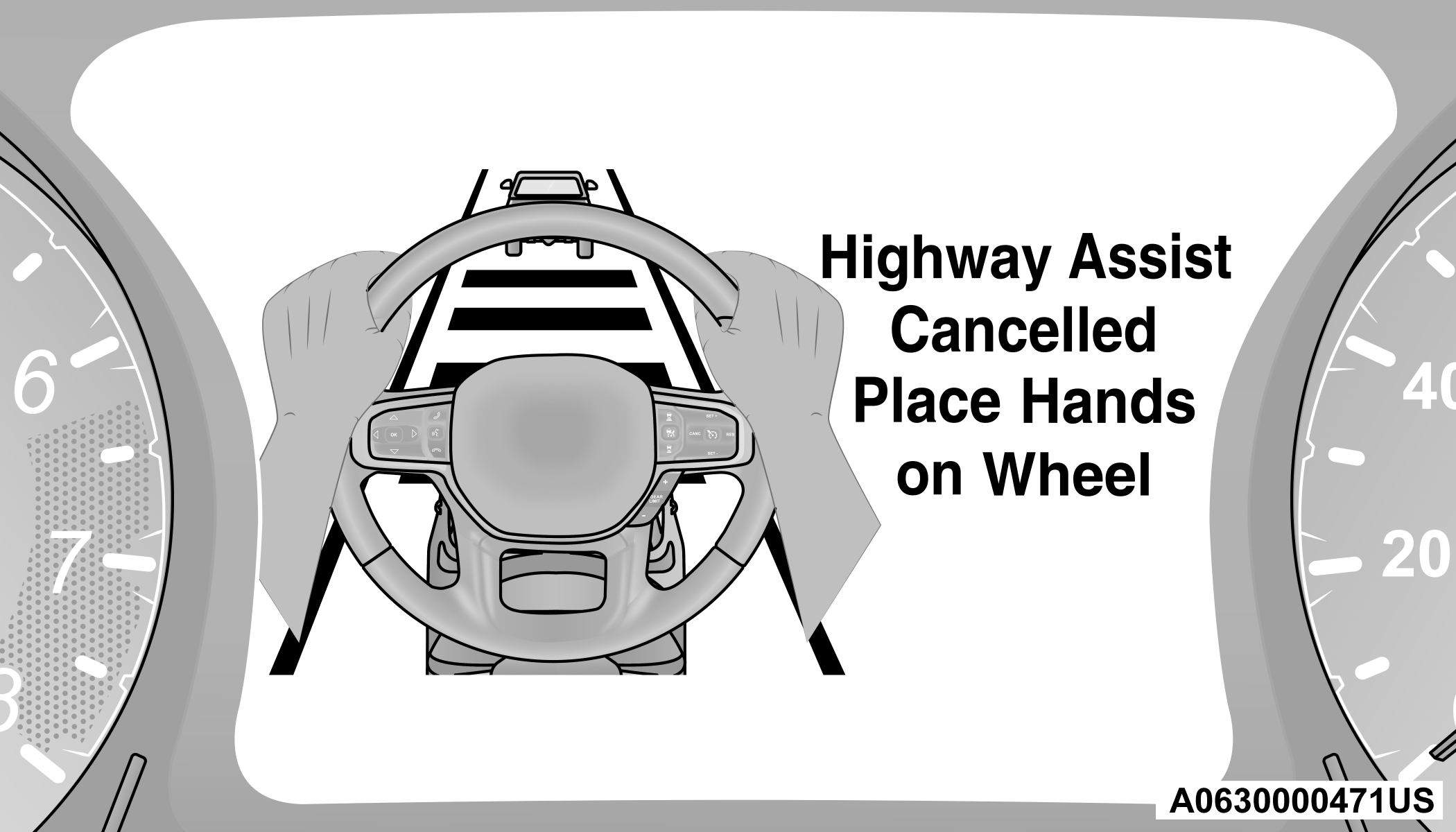
>Highway Assist Cancelled Message
SYSTEM STATUS
Along with changes in the system’s indicator lights (green, yellow, and red), the system can also issue a steering wheel vibration to accompany these warnings. The vibration warning (if enabled) will occur if the vehicle crosses a lane marker, for example, when driving on a tight curve. This feature can be turned on or off within the Uconnect system "⇨UCONNECT SETTINGS".
SYSTEM OPERATION/LIMITATIONS
WARNING:
Highway Assist is an SAE Level 2 Driver Assist feature, requiring driver attention at all times. To prevent serious injury or death:
-
Always remember that the Highways Assist system is a convenience system that cannot accurately detect all situations. Complete attention is always required while driving, even when using the Highway Assist system.
-
Always remain alert and be ready to take control of the vehicle in the event that the Highway Assist system deactivates, or otherwise lacks full functionality as described further before and after this statement.
-
Always keep your hands on the steering wheel when the Highway Assist system is activated.
-
Do not use a hand-held device when the Highway Assist system is engaged.
-
Maintain a safe distance from other vehicles and pay attention to traffic conditions. The Highway Assist system will not steer to avoid safety hazards, constructions zones, objects, or road impediments. You need to take control to steer and brake the vehicle in such situations, and when merging into traffic, exiting the highway, making a turn for crossing traffic, or stopping for traffic control devices.
-
Do not place any objects on the steering wheel (e.g. steering wheel covers) which could interfere with the hand detection sensors.
The Highway Assist system DOES NOT:
-
Warn or prevent collisions with other vehicles
-
Steer your vehicle around stopped vehicles, slower vehicles, construction zones or equipment, pedestrians, or animals
-
Respond to traffic lights or stop signs
-
Merge onto highways or exit off ramps
-
Change lanes or turn
-
React to cross traffic
Note:
Adaptive Cruise Control (ACC) is a core component of the Highway Assist system. For ACC system limitations "⇨Adaptive Cruise Control (ACC)".
The Highway Assist system may have limited or reduced functionality when one of the following conditions occur:
-
The vehicle’s radar sensors and/or forward facing camera is damaged, covered, misaligned, or obstructed (e.g. by mud, ice, snow, etc.)
-
If the suspension alignment is not correct, if the vehicle is modified (e.g. lifting or lowering the suspension, installing different sized wheels or tires)
-
Driving near highway toll booths
Note:
If damage to the windshield occurs, have the windshield replaced by an authorized dealer as soon as possible.
Download Manual