Parksense Active Park Assist System — If Equipped
The ParkSense Active Park Assist system is intended to assist the driver during parallel, perpendicular, and parallel park exit maneuvers by identifying a proper parking space, providing audible/visual instructions, and controlling the steering wheel. The ParkSense Active Park Assist system is defined as “semi-automatic” since the driver maintains control of the accelerator, gear selector and brakes. Depending on the driver's parking maneuver selection, the ParkSense Active Park Assist system is capable of maneuvering a vehicle into a parallel or a perpendicular parking space on either side (i.e., driver side or passenger side), as well as exiting a parallel parking space.
Note:
-
The driver is always responsible for controlling the vehicle, responsible for any surrounding objects, and must intervene as required.
-
The system is designed to assist the driver and not to substitute the driver.
-
During a semi-automatic maneuver, if the driver touches the steering wheel after being instructed to remove their hands from the steering wheel, the system will cancel, and the driver will be required to manually complete the parking maneuver.
-
The system may not work in all conditions (e.g. environmental conditions such as heavy rain, snow, etc., or if searching for a parking space that has surfaces that will absorb the ultrasonic sensor waves).
-
New vehicles from the dealer must have at least 30 miles (48 km) accumulated before the ParkSense Active Park Assist system is fully calibrated and performs accurately. This is due to the system’s dynamic vehicle calibration to improve the performance of the feature.
ENABLING AND DISABLING THE PARKSENSE ACTIVE PARK ASSIST SYSTEM
 The ParkSense Active Park Assist system can be enabled and disabled with the ParkSense Active Park Assist switch, located on the switch panel below the Uconnect display.
To enable or disable the ParkSense Active Park Assist system, push the ParkSense Active Park Assist switch once (LED turns on). Pushing the switch a second time will disable the system (LED turns off).
The ParkSense Active Park Assist system will turn off automatically for any of the following conditions:
-
Parking maneuver is complete.
-
Vehicle speed is greater than 18 mph (30 km/h) when searching for a parking space.
-
Vehicle speed is greater than 5 mph (7 km/h) during active steering guidance into the parking space.
-
Steering Wheel is touched during active steering guidance into the parking space.
-
ParkSense Park Assist switch is pushed.
-
Driver's door is opened.
-
Rear liftgate is opened.
-
Electronic Stability Control/Anti-lock Braking System intervention.
The ParkSense Active Park Assist system will allow a maximum number of shifts between DRIVE and REVERSE. If the maneuver cannot be completed within the maximum amount of shifts, the system will cancel and the instrument cluster display will instruct the driver to complete the maneuver manually.
The ParkSense Active Park Assist system will only operate and search for a parking space when the following conditions are present:
-
Gear selector is in DRIVE.
-
Ignition is in the RUN position.
-
ParkSense Active Park Assist switch is activated.
-
Driver's door is closed.
-
Rear liftgate is closed.
-
The outer surface and the underside of the front and rear fascias/bumpers are clean and clear of snow, ice, mud, dirt or other obstruction.
-
Vehicle speed is less than 15 mph (25 km/h).
Note:
If the vehicle is driven above approximately 15 mph (25 km/h), the instrument cluster display will instruct the driver to slow down. If the vehicle is driven above approximately 18 mph (30 km/h), the system will cancel. The driver must then reactivate the system by pushing the ParkSense Active Park Assist switch.
When pushed, the LED on the ParkSense Active Park Assist switch will blink momentarily, and then the LED will turn off if any of the above conditions are not present.
PARALLEL/PERPENDICULAR PARKING SPACE ASSISTANCE OPERATION
When the ParkSense Active Park Assist system is enabled, the “Active ParkSense Searching - Press  or
or  to Switch Maneuver” message will appear in the instrument cluster display. You may select perpendicular, parallel, or parallel park exit. The arrow buttons on the left side of the steering wheel can be used to switch parking maneuvers.
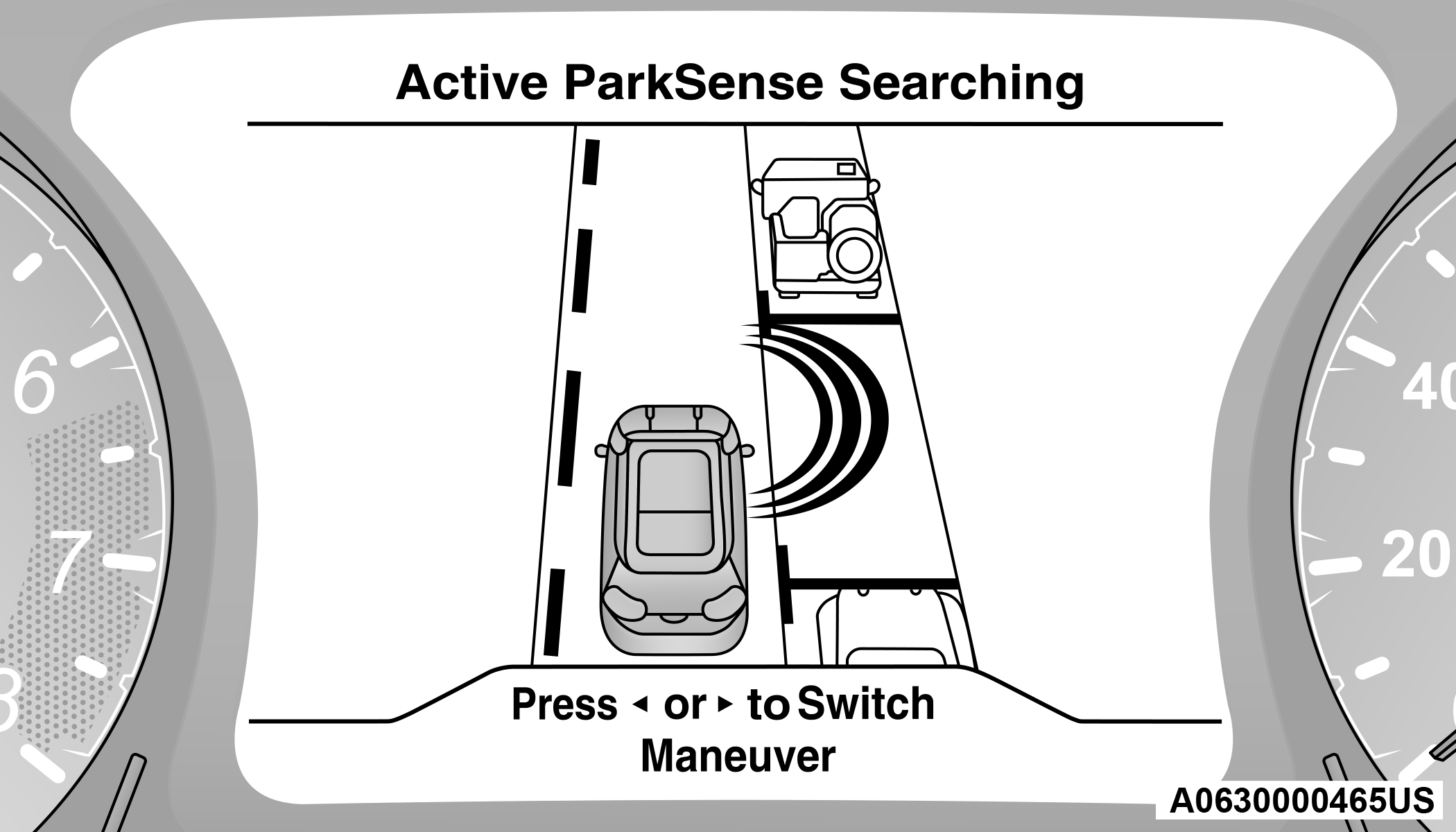
Active ParkSense Searching
Note:
-
When searching for a parking space, use the turn signal indicator to select which side of the vehicle you want to perform the parking maneuver. The ParkSense Active Park Assist system will automatically search for a parking space on the passenger's side of the vehicle if the turn signal is not activated.
-
The driver needs to make sure that the selected parking space for the maneuver remains free and clear of any obstructions (e.g. pedestrians, bicycles, etc.).
-
The driver is responsible to ensure that the selected parking space is suitable for the maneuver and free/clear of anything that may be overhanging or protruding into the parking space (e.g., ladders, tailgates, etc. from surrounding objects/vehicles).
-
When searching for a parking space, the driver should drive as parallel or perpendicular (depending on the type of maneuver) to other vehicles as possible.
-
The feature will only indicate the last detected parking space (example: if passing multiple available parking spaces, the system will only indicate the last detected parking space for the maneuver).
When an available parking space has been found, and the vehicle is not in position, you will be instructed to move forward to position the vehicle for a perpendicular or parallel parking sequence (depending on the type of maneuver being performed).
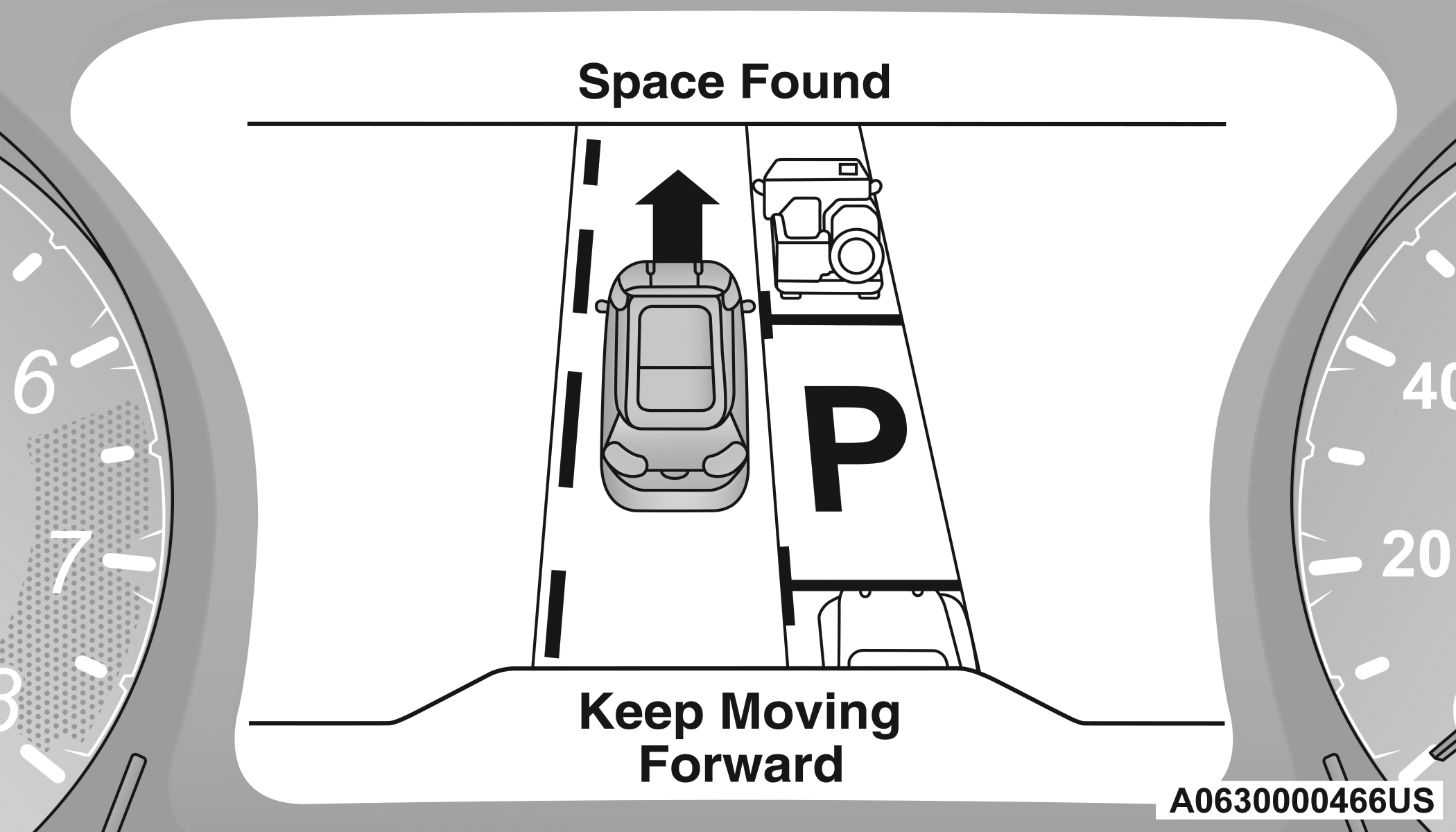
Space Found — Keep Moving Forward
Once the vehicle is in position, you will be instructed to stop the vehicle’s movement and remove your hands from the steering wheel. When the vehicle comes to a standstill (your hands still removed from the steering wheel), you will be instructed to place the gear selector into the REVERSE position.
The system may then instruct the driver to wait for steering to complete before then instructing to check surroundings and move backward.
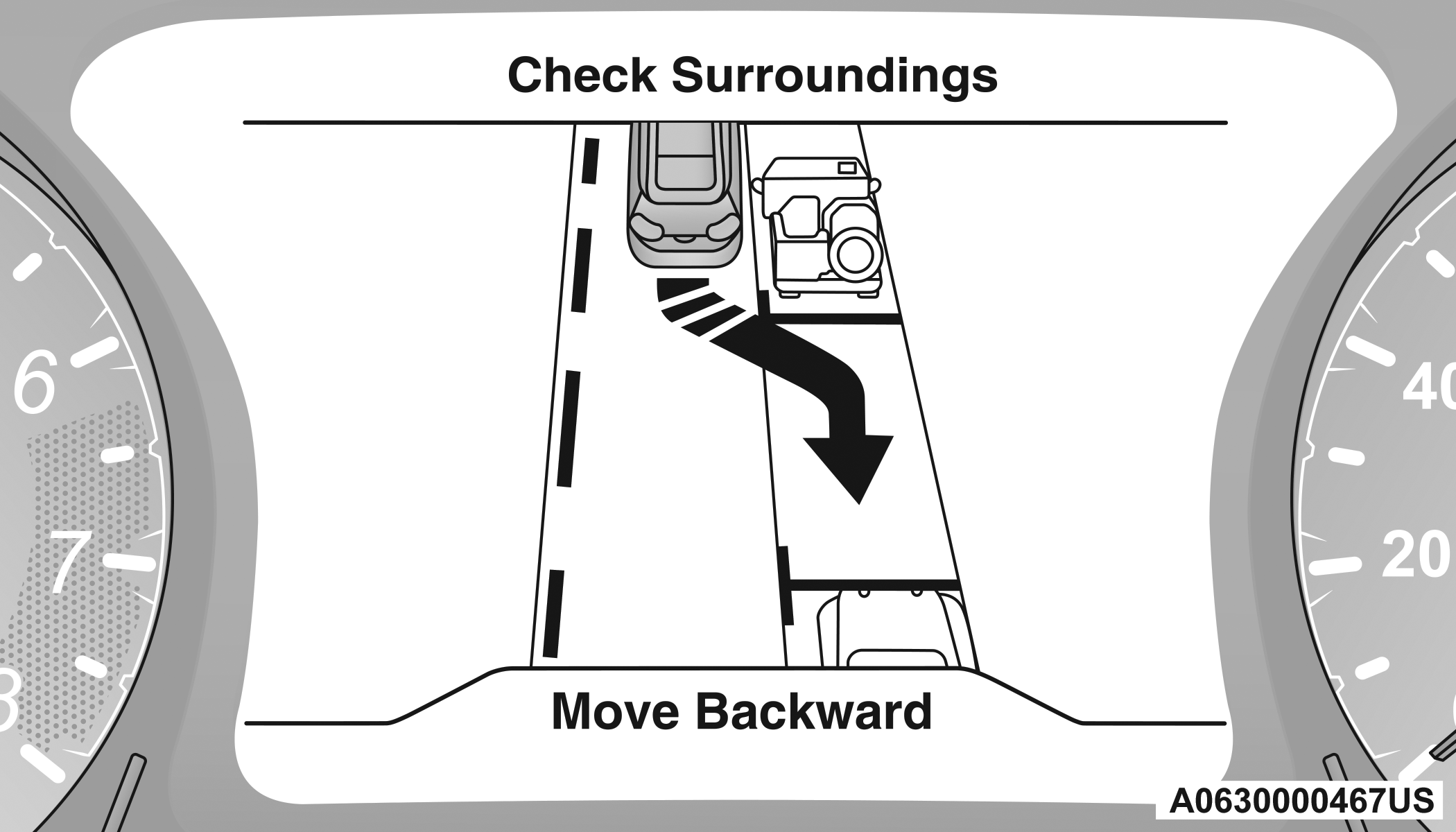
Move Backward Into Parallel Parking Space
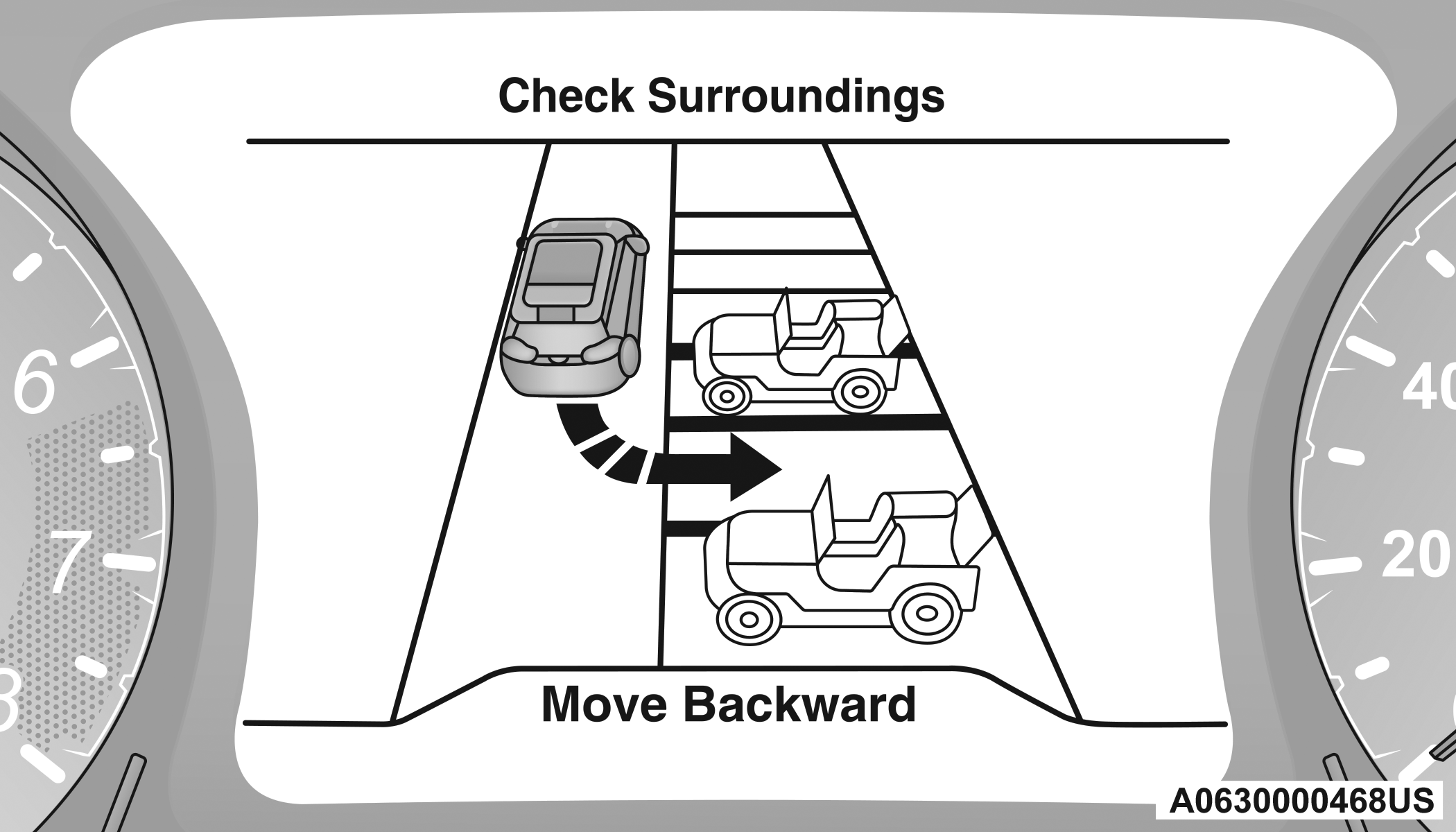
Move Backward Into Perpendicular Parking Space
The system may instruct several more gear shifts (DRIVE and REVERSE), with hands off of the steering wheel, before instructing the driver to check surroundings and complete the parking maneuver.
When the vehicle is in the parking position, the maneuver is complete and the driver will be instructed to check the vehicle's parking position, then shift the vehicle into PARK. The message "Active ParkSense Complete - Check Parking Position" will be displayed momentarily.
Note:
-
It is the driver's responsibility to use the brake and accelerator during the semi-automatic parking maneuver.
-
It is the driver's responsibility to use the brake and stop the vehicle. The driver should check their surroundings and be prepared to stop the vehicle either when instructed to, or when driver intervention is required.
-
When the system instructs the driver to remove their hands from the steering wheel, the driver should check their surroundings and begin to back up slowly.
-
The ParkSense Active Park Assist system will allow a maximum of six shifts between DRIVE and REVERSE. If the maneuver cannot be completed within six shifts, the system will cancel and the instrument cluster display will instruct the driver to complete the maneuver manually.
-
The system will cancel the maneuver if the vehicle speed exceeds 5 mph (7 km/h) during active steering guidance into the parking space. The system will provide a warning to the driver at 3 mph (5 km/h) that tells them to slow down. The driver is then responsible for completing the maneuver if the system is canceled.
-
If the system is canceled during the maneuver for any reason, the driver must take control of the vehicle.
WARNING:
-
Drivers must be careful when performing parallel or perpendicular parking maneuvers even when using the ParkSense Active Park Assist system. Always check carefully behind and in front of your vehicle, look behind and in front of you, and be sure to check for pedestrians, animals, other vehicles, obstructions, and blind spots before backing up and moving forward. You are responsible for safety and must continue to pay attention to your surroundings. Failure to do so can result in serious injury or death.
-
Before using the ParkSense Active Park Assist system, it is strongly recommended that the ball mount and hitch ball assembly be disconnected from the vehicle when the vehicle is not used for towing. Failure to do so can result in injury or damage to vehicles or obstacles because the hitch ball will be much closer to the obstacle than the rear fascia when the vehicle sounds the continuous tone. Also, the sensors could detect the ball mount and hitch ball assembly, depending on its size and shape, giving a false indication that an obstacle is behind the vehicle.
CAUTION:
-
The ParkSense Active Park Assist system is only a parking aid and it is unable to recognize every obstacle, including small obstacles. Parking curbs might be temporarily detected or not detected at all. Obstacles located above or below the sensors will not be detected when they are in close proximity.
-
The vehicle must be driven slowly when using the ParkSense Active Park Assist system in order to be able to stop in time when an obstacle is detected. It is recommended that the driver looks over his/her shoulder when using the ParkSense Active Park Assist system.
EXITING THE PARKING SPACE
Note:
The function does not work for exiting a perpendicular parking space, but only exiting parallel parking spaces.
Activation
To activate this function, shift to DRIVE, push the ParkSense Active Park Assist switch, and then use the steering wheel arrow buttons to select the Parallel Park Exit feature. After the selection, the system activates and instructs the driver through the instrument cluster display about the operations that have to be carried out to perform the maneuver correctly.
Start Of Maneuver
During the maneuver, the system asks the driver to shift to REVERSE, and operate the turn signal in the direction you want to exit. Let go of the steering wheel and use the brake or accelerator pedals while the system handles the steering automatically for exiting the parking space. If the driver continues to carry out a voluntary or involuntary action on the steering wheel during the exit maneuver (touching or holding the steering wheel to prevent its movement), the maneuver will be interrupted.
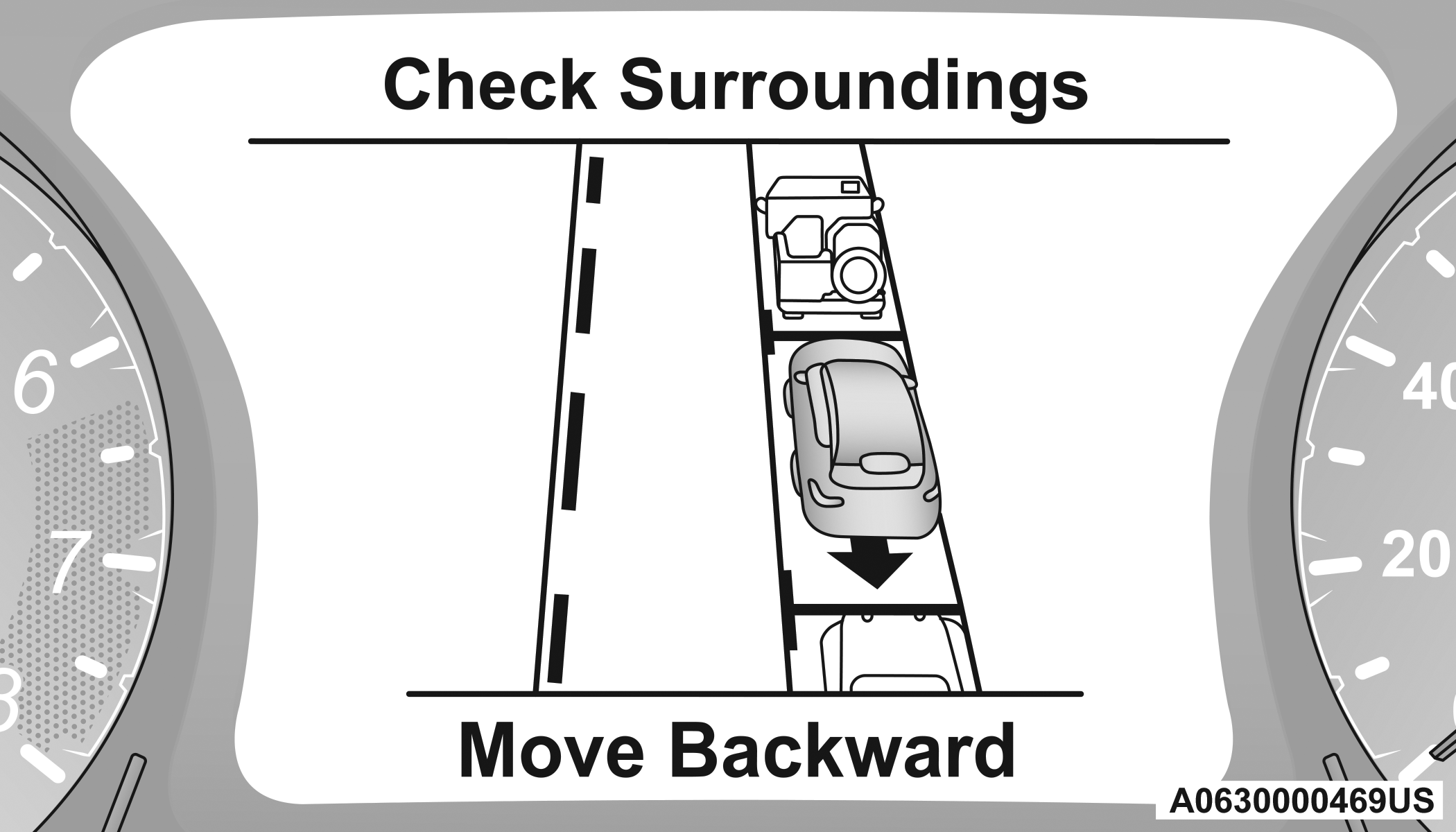
Shift To Reverse Then Move Backward
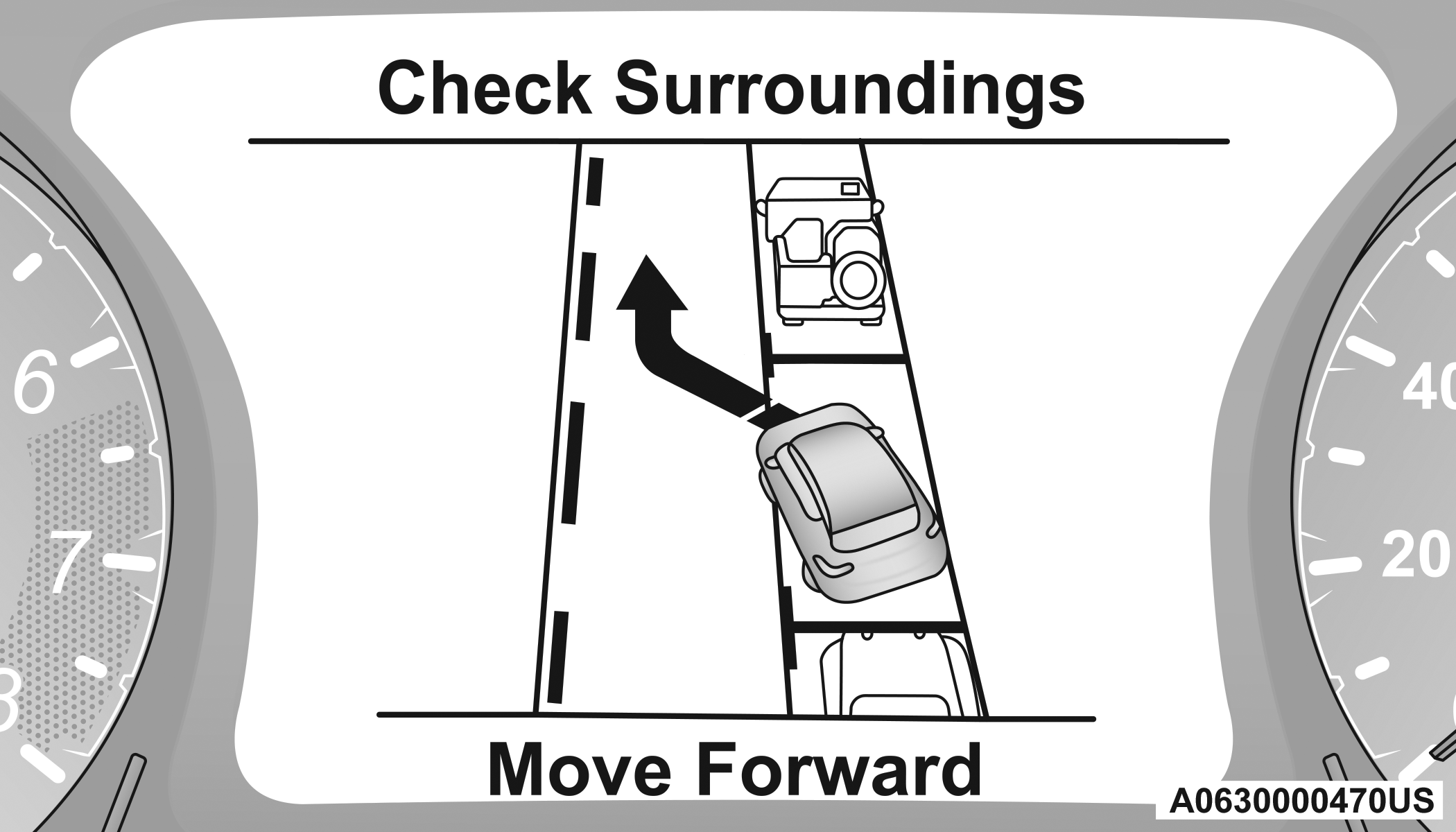
Shift To Drive Then Move Forward
End Of Maneuver
The semi-automatic maneuver ends when the display shows the message of a completed maneuver. At the end of the maneuver, the system gives back the vehicle control to the driver.
IMPORTANT INFORMATION
-
If the sensors undergo impact which alters their position, the system operation could be greatly affected.
-
The sensors reach top performance after the vehicle has gone about 30 miles (50 km) due to the dynamic tire circumference calculations used for parking.
-
Clean the ParkSense sensors regularly, taking care not to scratch or damage them. The sensors must not be covered with ice, snow, slush, mud, dirt or debris. Failure to do so can result in the system not working properly. The ParkSense system might not detect an obstacle behind or in front of the fascia/bumper, or it could provide a false indication that an obstacle is behind or in front of the fascia/bumper.
-
Construction equipment, large trucks, and other vibrations could affect the performance of ParkSense.
-
Sensors may detect a nonexistent obstacle (echo noise) due to mechanical noises, for example while washing the vehicle or in the case of rain, strong wind, and hail.
-
The sensors may not detect objects of a particular shape or made from particular materials (very thin poles, trailer beams, panels, nets, bushes, anti-parking posts, pavements, rubbish bins, motor vehicles, etc.). Always take great care to check that the vehicle and its path are actually compatible with the parking place identified by the system.
-
The use of wheels and tires that are different size to the original equipment could affect the operation of the system.
-
The operation of the rear sensors is automatically deactivated when the trailer's electric plug is inserted in the vehicle's tow hook socket, while the front sensors stay active and can provide acoustic and visual warnings. If this situation occurs, Active Park Assist will not work. The rear sensors are automatically reactivated when the trailer's cable plug is removed.
-
In "Search in Progress" mode, the system could incorrectly identify a parking place to carry out the maneuver (e.g. by a junction, driveways, roads crossing the direction of travel, etc.).
-
In the case of parking maneuvers on roads with inclines, the performance of the system could be inferior and it may deactivate.
-
If a parking maneuver is being carried out between two parked vehicles alongside a curb, the system may cause the vehicle to drive up onto the curb.
-
Some maneuvers at very tight bends might be impossible to be carried out.
-
Take great care to ensure that conditions do not change during the parking maneuver (e.g. if there are persons and/or animals in the parking place, moving vehicles, etc.) and intervene immediately if necessary.
-
During parking maneuvers, pay attention to vehicles approaching from the opposite direction. Always abide by the law and road regulations.
Note:
-
Correct system operation is not guaranteed if snow chains or the compact spare tire are fitted.
-
The function only informs the driver about the last appropriate parking place (parallel or perpendicular) detected by the parking sensors.
-
Some messages displayed are accompanied by acoustic warnings.
Download Manual