Park Brake
Your vehicle is equipped with an EPB system that offers simple operation, and some additional features that make the parking brake more convenient and useful.
The parking brake is primarily intended to prevent the vehicle from rolling while parked. Before leaving the vehicle, make sure that the parking brake is applied. Also, be certain to leave the transmission in PARK.
You can engage the parking brake in two ways:
-
Manually, by applying the EPB switch.
-
Automatically, by enabling the Auto Park Brake feature in the Customer Programmable Features section of the Uconnect settings "⇨UCONNECT SETTINGS".
The EPB switch is located in the center console.
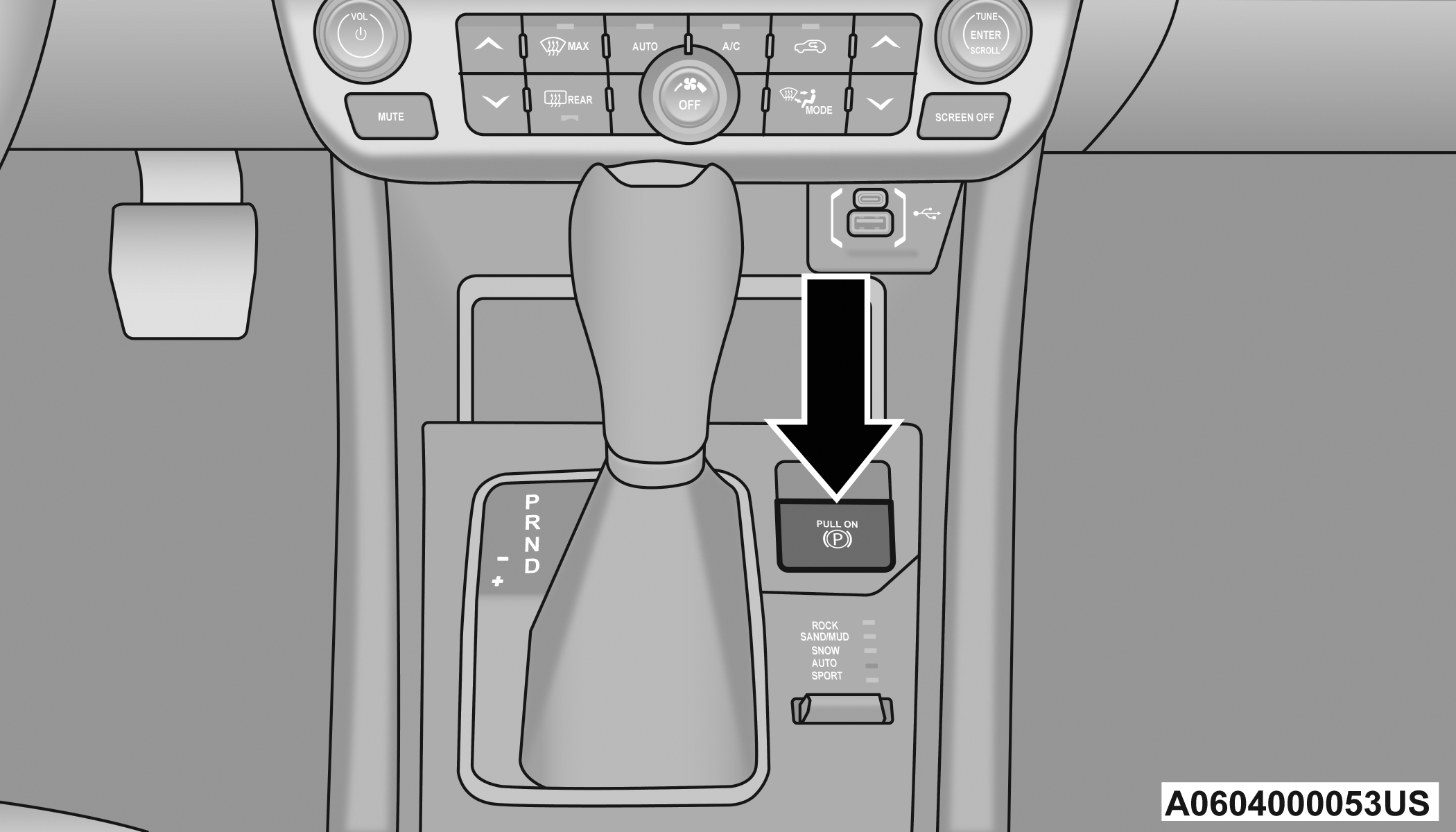
>Electric Park Brake Switch
To apply the parking brake manually, pull up on the switch momentarily. You may hear a sound from the back of the vehicle while the parking brake engages. Once the parking brake is fully engaged, the BRAKE warning lamp in the instrument cluster and an indicator on the switch will illuminate. If your foot is on the brake pedal while you apply the parking brake, you may notice a small amount of brake pedal movement. The parking brake can be applied even when the ignition switch is OFF. The Brake Warning Light will not illuminate and can only be released when the ignition switch is in the ON/RUN position.
Note:
The EPB fault lamp will illuminate if the EPB switch is held for longer than 60 seconds in either the released or applied position. The light will extinguish upon releasing the switch.
If the Auto Park Brake feature is enabled, the parking brake will automatically engage whenever the transmission is placed into PARK. If your foot is on the brake pedal, you may notice a small amount of brake pedal movement while the parking brake is engaging.
The parking brake will release automatically when the ignition switch is ON/RUN, the transmission is in DRIVE or REVERSE, the driver’s seat belt is buckled, and an attempt is made to drive away.
To release the parking brake manually, the ignition switch must be in the ON/RUN position. Put your foot on the brake pedal, then push the EPB switch down momentarily. You may hear a sound from the back of the car while the parking brake disengages. You may also notice a small amount of movement in the brake pedal. Once the parking brake is fully disengaged, the Brake Warning Light in the instrument cluster and the LED indicator on the switch will extinguish.
Note:
When parking on a hill, it is important to turn the front wheels toward the curb on a downhill grade and away from the curb on an uphill grade. Apply the parking brake before placing the gear selector in PARK, otherwise the load on the transmission locking mechanism may make it difficult to move the gear selector out of PARK. The parking brake should always be applied whenever the driver is not in the vehicle.
WARNING:
-
Do not rely on the parking brake to operate effectively if the rear brakes have been immersed in water or mud.
-
Never use the PARK position as a substitute for the parking brake. Always apply the parking brake fully when parked to guard against vehicle movement and possible injury or damage.
-
When leaving the vehicle, always remove the key fob from the ignition and lock your vehicle.
-
Never leave children alone in a vehicle, or with access to an unlocked vehicle. Allowing children to be in a vehicle unattended is dangerous for a number of reasons. A child or others could be seriously or fatally injured. Children should be warned not to touch the parking brake, brake pedal or the gear selector.
-
Do not leave the key fob in or near the vehicle, or in a location accessible to children, and do not leave the ignition of a vehicle equipped with Keyless Enter ’n Go™ in the ACC or ON/RUN position. A child could operate power windows, other controls, or move the vehicle.
-
Be sure the parking brake is fully disengaged before driving; failure to do so can lead to brake failure and a collision.
-
Always fully apply the parking brake when leaving your vehicle, or it may roll and cause damage or injury. Also be certain to leave the transmission in PARK. Failure to do so may allow the vehicle to roll and cause damage or injury.
CAUTION:
If the Brake System Warning Light remains on with the parking brake released, a brake system malfunction is indicated. Have the brake system serviced by an authorized dealer immediately.
If exceptional circumstances should make it necessary to engage the parking brake while the vehicle is in motion, maintain upward pressure on the EPB switch for as long as engagement is desired. The BRAKE warning lamp will illuminate, and a continuous chime will sound. The rear stop lamps will also be illuminated automatically while the vehicle remains in motion.
To disengage the parking brake while the vehicle is in motion, release the switch. If the vehicle is brought to a complete stop using the parking brake, when the vehicle reaches approximately 3 mph, (5 km/h) the parking brake will remain engaged.
WARNING:
Driving the vehicle with the parking brake engaged, or repeated use of the parking brake to slow the vehicle, may cause serious damage to the brake system. Be sure the parking brake is fully disengaged before driving; failure to do so can lead to brake failure and a collision.
In the unlikely event of a malfunction of the EPB system, a yellow EPB fault lamp will illuminate. This may be accompanied by the Brake Warning Light flashing. In this event, urgent service of the EPB system is required. Do not rely on the parking brake to hold the vehicle stationary.
AUTO PARK BRAKE
The EPB can be programmed to be applied automatically whenever the vehicle speed is below 1.9 mph (3 km/h) and the transmission is placed in PARK. Auto Park Brake is enabled and disabled by customer selection through the Customer Programmable Features section of the Uconnect Settings "⇨UCONNECT SETTINGS".
Any single Auto Park Brake application can be bypassed by pushing the EPB switch to the release position while the transmission is placed in PARK and the ignition is in the ON/RUN position.
SAFEHOLD
SafeHold is a safety feature of the EPB system that will engage the parking brake automatically if the vehicle is left unsecured while the ignition switch is in ON/RUN.
For automatic transmissions, the EPB will automatically engage if all of the following conditions are met:
-
Vehicle speed is below 1.9 mph (3 km/h).
-
There is no attempt to press the brake pedal and accelerator pedal.
-
The seat belt is unbuckled.
-
The driver’s door is open.
-
The vehicle is not in the PARK position.
SafeHold can be temporarily bypassed by pushing the EPB switch while the driver’s door is open and the brake pedal is pressed. Once manually bypassed, SafeHold will be enabled again once the vehicle reaches 12 mph (20 km/h) or the ignition is turned to the OFF position and back to ON/RUN again.
AUTO HOLD — IF EQUIPPED
Auto Hold is a comfort feature that allows the driver to remove their foot from the brake pedal once the vehicle has come to a stop. The vehicle must be held at a standstill for a predetermined amount of time by hydraulic braking. The EPB will then engage and continue to hold the vehicle at a stop until the driver applies the accelerator pedal. Auto Hold can be activated or deactivated by pushing the HOLD button located on the switch bank.
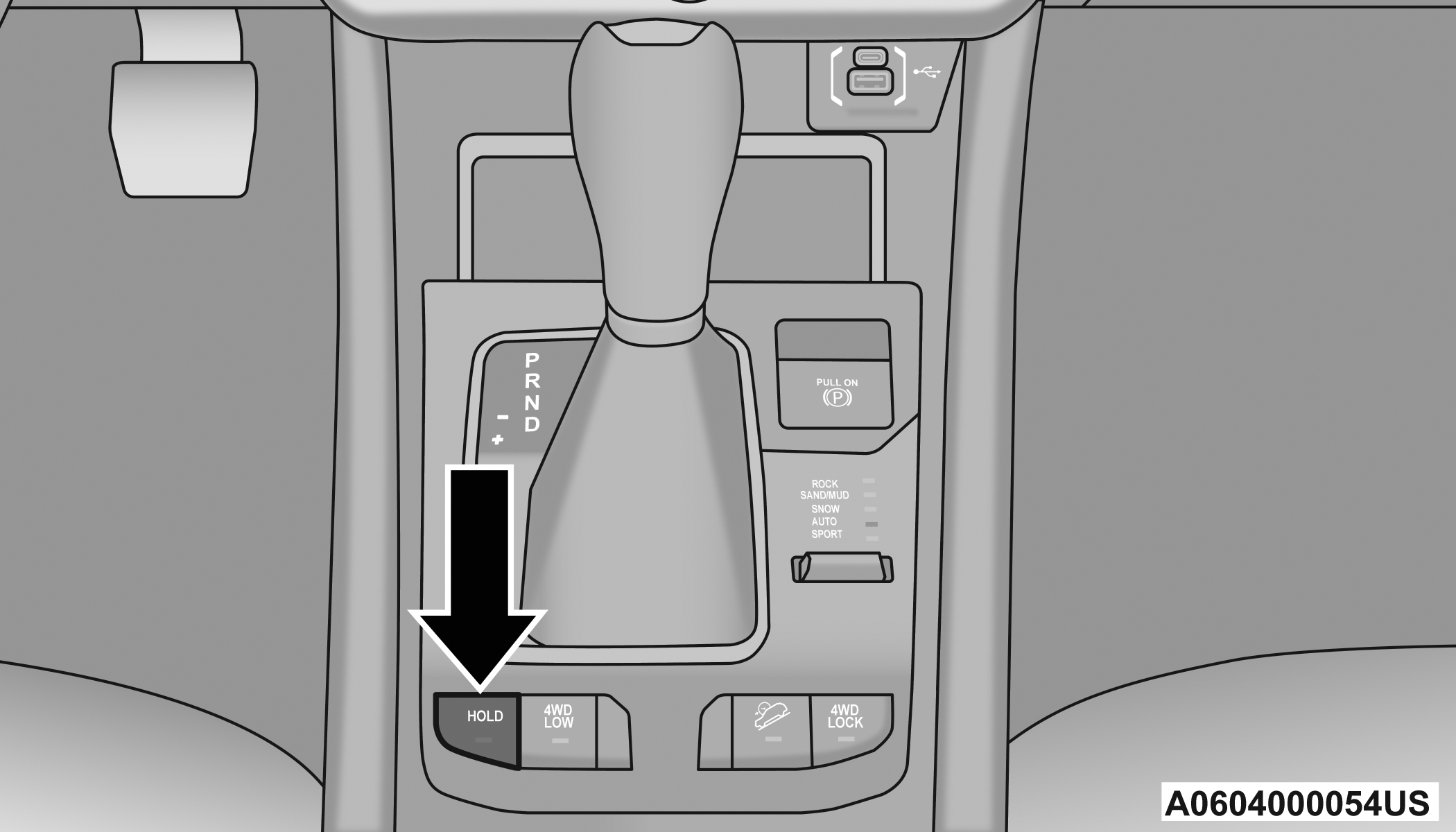
>Auto Hold Switch
The following conditions must be met for Auto Hold to activate:
-
Driver’s door is closed
-
Driver's seat belt is fastened
-
Vehicle is at a standstill
-
Forward gear is selected
-
Adaptive Cruise Control (ACC) is not engaged
-
EPB is not applied
-
ParkSense Active Park Assist System auto parking maneuver is not activated
BRAKE SERVICE MODE
We recommend having your brakes serviced by an authorized dealer.
You should only make repairs for which you have the knowledge and the right equipment. You should only enter Brake Service Mode during brake service.
When servicing your rear brakes, it may be necessary for you or your technician to push the rear piston into the rear caliper bore. With the EPB system, this can only be done after retracting the EPB actuator. The actuator retraction can be done easily by entering the Brake Service Mode through the Uconnect Settings in your vehicle. This menu-based system will guide you through the steps necessary to retract the EPB actuator in order to perform rear brake service.
Service Mode has requirements that must be met in order to be activated:
-
The vehicle must be at a standstill.
-
The parking brake must be disabled.
-
The transmission must be in PARK or NEUTRAL.
-
The EPB switch not activated.
-
The vehicle in ignition ON/RUN position.
-
The brake pedal not pressed.
While in Service Mode, the EPB fault lamp will flash continuously while the ignition switch is ON/RUN.
Note:
A dedicated message will appear in the instrument cluster display if Brake Service Mode cannot be activated.
When brake service work is complete, the following steps must be followed to reset the parking brake system to normal operation:
-
Ensure the vehicle is at a standstill.
-
Press the brake pedal with moderate force.
-
Apply the EPB Switch.
Note:
A dedicated message will appear in the instrument cluster display if Brake Service Mode cannot be deactivated.
WARNING:
You can be badly injured working on or around a motor vehicle. Do only that service work for which you have the knowledge and the right equipment. If you have any doubt about your ability to perform a service job, take your vehicle to a competent mechanic.
Download Manual