Warning Lights, Gauges, and Indicators
Warning lights and gauges can signal that something is wrong before it becomes serious enough to cause an expensive repair or replacement. Paying attention to the warning lights and gauges could prevent injury.
Warning lights come on when there could be a problem with a vehicle function. Some warning lights come on briefly when the engine is started to indicate they are working.
Gauges can indicate when there could be a problem with a vehicle function. Often gauges and warning lights work together to indicate a problem with the vehicle.
When one of the warning lights comes on and stays on while driving, or when one of the gauges shows there may be a problem, check the section that explains what to do. Waiting to do repairs can be costly and even dangerous.
Instrument Cluster
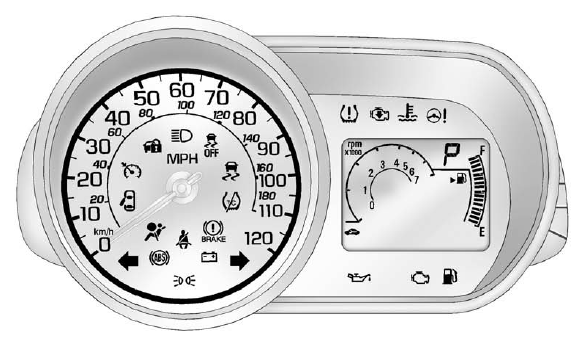
English Automatic Transmission Shown, Metric and Manual Transmission Similar
Speedometer
The speedometer shows the vehicle speed in kilometers per hour (km/h) and miles per hour (mph).
Odometer
 The odometer shows how far the vehicle
has been driven, in either kilometers or miles.
Trip Odometer
The trip odometer shows how far the vehicle has been driven since the trip odometer was last reset.
The trip odometer is accessed and reset through the Driver Information Center (DIC). See Driver Information Center (DIC) on page 5-22.
Tachometer
The tachometer displays the engine speed in revolutions per minute (rpm).
Caution
If the engine is operated with the rpm’s in the warning area at the high end of the tachometer, the vehicle could be damaged, and the damage would not be covered by the vehicle warranty. Do not operate the engine with the rpm’s in the warning area.
Fuel Gauge
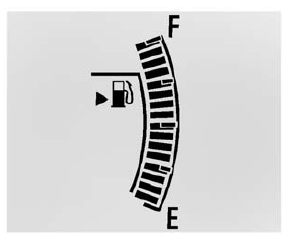
The fuel gauge indicates about how much fuel is left when the ignition is turned to ON/RUN.
When the tank nears empty, the low fuel warning light will come on.
There is still a little fuel left, but the vehicle's fuel tank should be filled soon. See Low Fuel Warning Light on page 5-20 for more information.
An arrow on the fuel gauge indicates on which side of the vehicle the fuel door is located.
Here are four things that some owners ask about. None of these show a problem with the fuel gauge:
- At the service station, the gas pump shuts off before the gauge reads full.
- It takes a little more or less fuel to fill up than the gauge indicated. For example, the gauge may have indicated the tank was half full, but it actually took a little more or less than half the tank's capacity to fill the tank.
- The indicator moves a little when turning a corner or speeding up.
- The gauge goes back to empty when the ignition is turned off.
Safety Belt Reminders
Driver Safety Belt Reminder Light
There is a driver safety belt reminder light on the instrument cluster.
 When the vehicle is started, this
light flashes and a chime may come on to remind the driver to fasten their safety belt. Then the light stays on solid until the belt is buckled.
This cycle may continue several times if the driver remains or becomes unbuckled while the vehicle is moving.
If the driver safety belt is buckled, neither the light nor the chime comes on.
Passenger Safety Belt Reminder Light
There is a passenger safety belt reminder light near the passenger airbag status indicator. See Passenger Sensing System on page 3-25.
 When the vehicle is started, this
light flashes and a chime may come on to remind passengers to fasten their safety belt. Then the light stays on solid until the belt is buckled.
This cycle continues several times if the passenger remains or becomes unbuckled while the vehicle is moving.
If the passenger safety belt is buckled, neither the chime nor the light comes on.
The front passenger safety belt reminder light and chime may turn on if an object is put on the seat such as a briefcase, handbag, grocery bag, laptop, or other electronic device. To turn off the reminder light and/or chime, remove the object from the seat or buckle the safety belt.
Airbag Readiness Light
This light shows if there is an electrical problem with the airbag system. The system check includes the airbag sensor(s), passenger sensing system, the pretensioners (if equipped), the airbag modules, the wiring, and the crash sensing and diagnostic module. For more information on the airbag system, see Airbag System on page 3-19.
 The airbag readiness light comes
on for several seconds when the vehicle is started. If the light does not come on then, have it fixed immediately.
Warning
If the airbag readiness light stays on after the vehicle is started or comes on while driving, it means the airbag system might not be working properly. The airbags in the vehicle might not inflate in a crash, or they could even inflate without a crash. To help avoid injury, have the vehicle serviced right away.
If there is a problem with the airbag system, a Driver Information Center (DIC) message may also come on.
See Vehicle Messages on page 5-26.
Passenger Airbag Status Indicator
The vehicle has a passenger sensing system. See Passenger Sensing System on page 3-25 for important safety information. The center display has a passenger airbag status indicator.
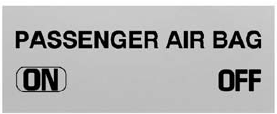
United States
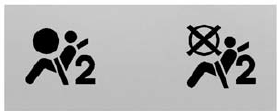
Canada
When the vehicle is started, the passenger airbag status indicator will light ON and OFF, or the symbol for on and off, for several seconds as a system check. Then, after several seconds, the status indicator will light either ON or OFF, or the on or off symbol to let you know the status of the front outboard passenger frontal airbag and knee airbag.
If the word ON or the on symbol is lit on the passenger airbag status indicator, it means that the front outboard passenger frontal airbag and knee airbag are allowed to inflate.
If the word OFF or the off symbol is lit on the passenger airbag status indicator, it means that the passenger sensing system has turned off the front outboard passenger frontal airbag and knee airbag.
If, after several seconds, both status indicator lights remain on, or if there are no lights at all, there may be a problem with the lights or the passenger sensing system. See your dealer for service.
Warning
If the airbag readiness light ever comes on and stays on, it means that something may be wrong with the airbag system. To help avoid injury to yourself or others, have the vehicle serviced right away. See Airbag Readiness Light on page 5-11 for more information, including important safety information.
Charging System Light
 This light will come on briefly
when the ignition is turned on, and the engine is not running, as a check to show it is working.
It should go out when the engine is started. If it stays on, or comes on while driving, there may be a problem with the electrical charging system. Have it checked by your dealer. Driving while this light is on could drain the battery. If a short distance must be driven with the light on, turn off all accessories, such as the radio and air conditioner, to help reduce the drain on the battery.
Malfunction Indicator Lamp
A computer system called OBD II (On-Board Diagnostics-Second Generation) monitors the operation of the vehicle to ensure emissions are at acceptable levels, helping to maintain a clean environment. The malfunction indicator lamp comes on when the vehicle is placed in ON/RUN, as a check to show it is working. If it does not, have the vehicle serviced by your dealer. See Ignition Positions on page 9-13 for more information.
 If the malfunction indicator lamp
comes on while the engine is running, this indicates that the OBD II system has detected a problem and diagnosis and service might be required.
Malfunctions often are indicated by the system before any problem is apparent. Being aware of the light can prevent more serious damage to the vehicle. This system also assists the service technician in correctly diagnosing any malfunction.
Caution
If the vehicle is continually driven with this light on, the emission controls might not work as well,the vehicle fuel economy might not be as good, and the engine might not run as smoothly. This could lead to costly repairs that might not be covered by the vehicle warranty.
Caution
Modifications made to the engine, transmission, exhaust, intake, or fuel system of the vehicle or the replacement of the original tires with other than those of the same Tire Performance Criteria (TPC) can affect the vehicle's emission controls and can cause this light to come on.
Modifications to these systems could lead to costly repairs not covered by the vehicle warranty.
This could also result in a failure to pass a required Emission Inspection/Maintenance test. See Accessories and Modifications on page 10-3.
This light comes on during a malfunction in one of two ways: Light Flashing: A misfire condition has been detected. A misfire increases vehicle emissions and could damage the emission control system on the vehicle. Diagnosis and service might be required.
To prevent more serious damage to the vehicle:
- Reduce vehicle speed.
- Avoid hard accelerations.
- Avoid steep uphill grades.
If the light continues to flash, find a safe place to stop and park the vehicle. Turn the vehicle off, wait at least 10 seconds, and restart the engine. If the light is still flashing, follow the previous steps and see your dealer for service as soon as possible.
Light On Steady: An emission control system malfunction has been detected on the vehicle.
Diagnosis and service might be required.
The following may correct an emission control system malfunction:
- Check that the fuel cap is fully installed. See Filling the Tank on page 9-36. The diagnostic system can determine if the fuel cap has been left off or improperly installed. A loose or missing fuel cap allows fuel to evaporate into the atmosphere.
A few driving trips with the cap properly installed should turn the light off.
- Check that good quality fuel is used. Poor fuel quality causes the engine not to run as efficiently as designed and may cause stalling after start-up, stalling when the vehicle is changed into gear, misfiring, hesitation on acceleration, or stumbling on acceleration.
These conditions might go away once the engine is warmed up.
If one or more of these conditions occurs, change the fuel brand used.
It may require at least one full tank of the proper fuel to turn the light off.
See Fuel on page 9-35.
If none of the above have made the light turn off, your dealer can check the vehicle. The dealer has the proper test equipment and diagnostic tools to fix any mechanical or electrical problems that might have developed.
Emissions Inspection and Maintenance Programs
Depending on where you live, your vehicle may be required to participate in an emission control system inspection and maintenance program. For the inspection, the emission system test equipment will likely connect to the vehicle's Data Link Connector (DLC).
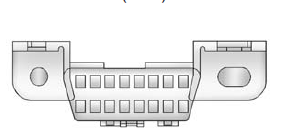
The DLC is under the instrument panel to the left of the steering wheel. See your dealer if assistance is needed.
The vehicle may not pass inspection if:
- The malfunction indicator lamp is on with the engine running, or if the light does not come on when the ignition is turned to ON/RUN while the engine is off. See your dealer for assistance in verifying proper operation of the malfunction indicator lamp.
- The OBD II (On-Board Diagnostics) system determines that critical emission control systems have not been completely diagnosed. The vehicle would be considered not ready for inspection. This can happen if the 12-volt battery has recently been replaced or run down. The diagnostic system is designed to evaluate critical emission control systems during normal driving. This can take several days of routine driving.
If this has been done and the vehicle still does not pass the inspection for lack of OBD II system readiness, your dealer can prepare the vehicle for inspection.
Service Vehicle Soon Light
 For vehicles with this light, it
comes on if a condition exists that may require the vehicle to be taken in for service.
If the light comes on, take the vehicle to your dealer for service as soon as possible.
Owner Manual Indicator
 This symbol is shown when you need
to see the owner manual for additional instructions or information.
Brake System Warning Light
The vehicle brake system consists of two hydraulic circuits. If one circuit is not working, the remaining circuit can still work to stop the vehicle. For normal braking performance, both circuits need to be working If the warning light comes on, there is a brake problem. Have the brake system inspected right away.
Warning
The brake system might not be working properly if the brake system warning light is on.
Driving with the brake system warning light on can lead to a crash. If the light is still on after the vehicle has been pulled off the road and carefully stopped, have the vehicle towed for service.
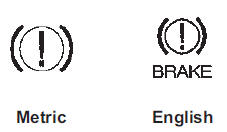 This light should come on briefly
when the ignition is turned to ON.
If it does not come on then, have it fixed so it will be ready to warn if there is a problem.
When the ignition is on, the brake system warning light will also come on when the parking brake is set.
The light will stay on if the parking brake does not fully release. If it stays on after the parking brake is fully released, it means there is a brake problem.
If the light comes on while driving, carefully pull off the road and stop.
The pedal may be harder to push or may go closer to the floor. It may take longer to stop. If the light is still on, have the vehicle towed for service. See Towing the Vehicle on page 10-67.
Antilock Brake System (ABS) Warning Light
 This light comes on briefly when
the engine is started.
If the light stays on, turn the ignition to LOCK/OFF or if the light comes on, stop as soon as possible and turn the ignition off. Then start the engine again to reset the system.
If the light still stays on, or comes on again while driving, the vehicle needs service. See your dealer.
If the regular brake system warning light is not on, the brakes will still work, but the antilock brakes will not work. If the regular brake system warning light is also on, the antilock brakes will not work and there is a problem with the regular brakes.
See Brake System Warning Light on page 5-15.
The ABS warning light will come on briefly when the ignition is turned to ON/RUN. This is normal. If the light does not come on then, have it fixed so it will be ready to warn if there is a problem.
Up-Shift Light
 For manual transmission vehicles,
there is an up-shift light that comes on in the lower DIC area. It shows when to shift to the next higher gear for best fuel economy.
See Manual Transmission on page 9-23.
Power Steering Warning Light
 This light comes on briefly when
the ignition is turned to ON/RUN as a check to show it is working.
If it does not come on have the vehicle serviced by your dealer.
If this light stays on, or comes on while driving, the system may not be working. If this happens, see your dealer for service.
Traction Off Light
 This light comes on briefly while
starting the engine. If it does not, have the vehicle serviced by your dealer. If the system is working normally, the indicator light then turns off.
The traction off light comes on when the Traction Control System (TCS) has been turned off by pressing and releasing the TCS/StabiliTrak button.
This light and the StabiliTrak OFF light come on when StabiliTrak is turned off.
If the TCS is off, wheel spin is not limited. Adjust driving accordingly.
See Traction Control/Electronic Stability Control on page 9-27.
StabiliTrak® OFF Light
 This light comes on briefly while
starting the engine. If it does not, have the vehicle serviced by your dealer.
This light comes on when the StabiliTrak system is turned off.
If StabiliTrak is off, the Traction Control System (TCS) is also off.
If the StabiliTrak and TCS are off, the system does not assist in controlling the vehicle. Turn on the TCS and the StabiliTrak systems and the warning light turns off.
See Traction Control/Electronic Stability Control on page 9-27.
Traction Control System (TCS)/StabiliTrak Light
 The StabiliTrak or Traction Control
System (TCS) indicator/warning light comes on briefly when the engine is started.
If the light does not come on, have the vehicle serviced by your dealer.
If the system is working normally, the indicator light turns off.
If the light is on and not flashing, the TCS, and potentially the StabiliTrak system have been disabled.
If the indicator/warning light is on and flashing, the TCS and/or the StabiliTrak system is actively working.
See Traction Control/Electronic Stability Control on page 9-27.
Engine Coolant Temperature Warning Light
 This light comes on briefly while
starting the vehicle.
If it does not, have the vehicle serviced by your dealer. If the system is working normally the indicator light goes off.
Caution
The engine coolant temperature warning light indicates that the vehicle has overheated. Driving with this light on can damage the engine and it may not be covered by the vehicle warranty. See Engine Overheating on page 10-17.
The engine coolant temperature warning light comes on when the engine has overheated.
If this happens, pull over and turn off the engine as soon as possible.
See Engine Overheating on page 10-17.
Tire Pressure Light
 For vehicles with the Tire Pressure
Monitor System (TPMS), this light comes on briefly when the engine is started. It provides information about tire pressures and the TPMS.
When the Light Is On Steady
This indicates that one or more of the tires are significantly underinflated.
Stop as soon as possible, and inflate the tires to the pressure value shown on the Tire and Loading Information label. See Tire Pressure on page 10-43.
When the Light Flashes First and Then Is On Steady
If the light flashes for about a minute and then stays on, there may be a problem with the TPMS. If the problem is not corrected, the light will come on at every ignition cycle.
See Tire Pressure Monitor Operation on page 10-45.
Engine Oil Pressure Light
Caution
Lack of proper engine oil maintenance can damage the engine. Driving with the engine oil low can also damage the engine. The repairs would not be covered by the vehicle warranty.
Check the oil level as soon as possible. Add oil if required, but if the oil level is within the operating range and the oil pressure is still low, have the vehicle serviced.
Always follow the maintenance schedule for changing engine oil.
 This light should come on briefly
as the engine is started. If it does not come on, have the vehicle serviced by your dealer.
If the light comes on and stays on, it means that oil is not flowing through the engine properly. The vehicle could be low on oil and might have some other system problem. See your dealer.
Low Fuel Warning Light
 The low fuel warning light comes
on briefly when the vehicle is started.
This light also comes on when the fuel level is low. When fuel is added, the light should go off. If it does not, have the vehicle serviced.
Immobilizer Light
 The immobilizer light should come
on briefly as the engine is started.
If it does not come on, have the vehicle serviced by your dealer.
If the system is working normally, the indicator light turns off.
If the light stays on and the engine does not start, there could be a problem with the immobilizer system. See Immobilizer Operation on page 2-11.
Reduced Engine Power Light
 The reduced engine power light should
come on briefly as the engine is started. If it does not come on, have the vehicle serviced by your dealer.
This light, along with the malfunction indicator lamp, displays when a noticeable reduction in the vehicle's performance occurs.
The vehicle can be driven at a reduced speed when the reduced engine power light is on but acceleration and speed might be reduced. If this light stays on, see your dealer as soon as possible for diagnosis and repair.
High-Beam On Light
 This light comes on when the high-beam
headlamps are in use.
See Headlamp High/Low-Beam Changer on page 6-1 for more information.
Daytime Running Lamps (DRL) Indicator Light
 This light, in the display on the
top of the center stack, turns on whenever the Daytime Running Lamps are in use.
See Daytime Running Lamps (DRL) on page 6-2.
Front Fog Lamp Light
 For vehicles with front fog lamps,
this light, in the display on the top of the center stack, comes on when the front fog lamps are in use.
The light goes out when the front fog lamps are turned off. See Fog Lamps on page 6-4.
Lamps On Reminder
 This light comes on when the exterior
lamps are in use. See Exterior Lamp Controls on page 6-1.
Cruise Control Light
 For vehicles with cruise control,
the cruise control light is white when the cruise control is on and ready, and turns green when the cruise control is set and active.
The light turns off when the cruise control is turned off. See Cruise Control on page 9-30.
Door Ajar Light
 This light comes on when a door
is open or not securely latched. Before driving, check that all doors are properly closed.
Download Manual