Jump Starting
For more information about the vehicle battery, see Battery on page 10-22.
If the battery has run down, try to use another vehicle and some jumper cables to start your vehicle.
Be sure to use the following steps to do it safely.
Warning
WARNING: Battery posts, terminals, and related accessories contain lead and lead compounds, chemicals known to the State of California to cause cancer and birth defects or other reproductive harm. Wash hands after handling. See California Proposition 65 Warning on page 10-3.
Warning
Batteries can hurt you. They can be dangerous because:
- They contain acid that can burn you.
- They contain gas that can explode or ignite.
- They contain enough electricity to burn you.
If you do not follow these steps exactly, some or all of these things can hurt you.
Caution
Ignoring these steps could result in costly damage to the vehicle that would not be covered by the vehicle warranty. Trying to start the vehicle by pushing or pulling it will not work, and it could damage the vehicle.
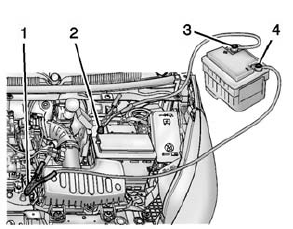
- Discharged Battery Negative Grounding Point
- Discharged Battery Positive Post
- Good Battery Positive Post
- Good Battery Negative Post
The jump start positive post is in the engine compartment on the driver side of the vehicle. See Engine Compartment Overview on page 10-7.
The jump start negative post is the engine block or an engine mounting bolt. Connect to a spot as far away from the discharged battery as possible.
The jump start positive post and negative post are on the battery of the vehicle providing the jump start.
The positive jump start connection for the discharged battery is under a trim cover. Open the cover to expose the post.
These locations are used instead of a direct connection to the battery.
- Check the other vehicle. It must have a 12-volt battery with a negative ground system.
Caution
If the other vehicle does not have a 12-volt system with a negative ground, both vehicles can be damaged. Only use a vehicle that has a 12-volt system with a negative ground for jump starting.
- Position the two vehicles so that they are not touching.
- Set the parking brake firmly and put the shift lever in P (Park) with an automatic transmission, or Neutral with a manual transmission. See Shifting Into Park on page 9-18 with an automatic transmission, or Parking on page 9-20 with a manual transmission.
Caution
If any accessories are left on or plugged in during the jump starting procedure, they could be damaged. The repairs would not be covered by the vehicle warranty. Whenever possible, turn off or unplug all accessories on either vehicle when jump starting.
- Turn the ignition to LOCK/OFF.
Turn off all lights and accessories in both vehicles, except the hazard warning flashers if needed.
Warning
An electric fan can start up even when the engine is not running and can injure you. Keep hands, clothing and tools away from any underhood electric fan.
Warning
Using a match near a battery can cause battery gas to explode.
People have been hurt doing this, and some have been blinded.
Use a flashlight if you need more light.
Battery fluid contains acid that can burn you. Do not get it on you. If you accidentally get it in your eyes or on your skin, flush the place with water and get medical help immediately.
Warning
Fans or other moving engine parts can injure you badly. Keep your hands away from moving parts once the engine is running.
- Connect one end of the red positive (+) cable to the positive (+) post (2) on the discharged battery.
- Connect the other end of the red positive (+) cable to the positive (+) post (3) of the good battery.
- Connect one end of the black negative (–) cable to the negative (–) post (4) of the good battery.
- Connect the other end of the black negative (–) cable to the negative (–) grounding point (1) for the discharged battery.
- Start the engine in the vehicle with the good battery and run the engine at idle speed for at least four minutes.
- Try to start the vehicle that had the dead battery. If it will not start after a few tries, it probably needs service.
Caution
- If the jumper cables are connected or removed in the wrong order, electrical shorting may occur and damage the vehicle. The repairs would not be covered by the vehicle warranty.
- Always connect and remove the jumper cables in the correct order, making sure that the cables do not touch each other or other metal.
Jumper Cable Removal
Reverse the sequence exactly when removing the jumper cables.
Download Manual