Exterior Lighting
Exterior Lamp Controls
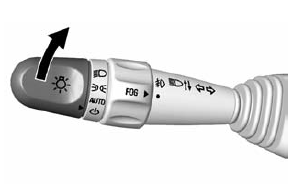
The exterior lamp control is on the turn signal lever on the left side of the steering column.
There are four positions:
 (Headlamps): Turns on the headlamps
together with the parking lamps and instrument panel lights.
 (Parking Lamps): Turns on the parking
lamps including all lamps, except the headlamps.
AUTO (Automatic): Turns the exterior lamps on and off automatically depending on the exterior light.
 (Off): Turns all the lamps off,
except the Daytime Running Lamps (DRL).
The DRL automatically turn off when the vehicle is turned off.
Exterior Lamps Off Reminder
A reminder chime will sound when the headlamps or parking lamps are manually turned on when the ignition is off and a door is open. To disable the chime, turn the light off.
Headlamp High/Low-Beam Changer
The headlamps must be on for this feature to work.
Push the turn signal lever away from you to turn the high beams on.
The  light comes on in the instrument
cluster while the high beams are on and the ignition is turned to ON/RUN.
To return to low beams, push the lever again or pull the lever toward you and release.
Flash-to-Pass
This feature is used to signal to the vehicle ahead that you want to pass.
Pull the turn signal lever toward you until the high-beam headlamps come on, then release the lever to turn them off.
Daytime Running Lamps (DRL)
DRL can make it easier for others to see the front of your vehicle during the day. Fully functional DRL are required on all vehicles first sold in Canada.
The DRL system makes the headlamps come on when the following conditions are met:
- The ignition is on.
- The exterior lamp control is in the off or parking lamp position.
- The parking brake is released.
 This indicator light in the center
stack display comes on when the DRL system is on.
When the DRL system is on, the taillamps, sidemarker lamps, parking lamps, and instrument panel lights do not come on unless the exterior lamp control is turned to the parking lamp or headlamp position.
The DRL system turns off when one of the following conditions is met:
- The ignition is off.
- The parking brake is on.
- The high-beam headlamps are on
- The low-beam headlamps are on.
- The flash-to-pass feature is used.
The regular headlamp system should be used when needed.
Automatic Headlamp System
When it is dark enough outside and the exterior lamp control is in the automatic position, the headlamps come on automatically. See Exterior Lamp Controls on page 6-1.
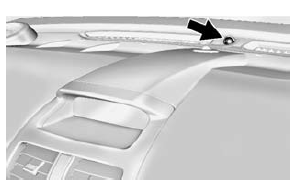
The vehicle has a light sensor on top of the instrument panel. Make sure it is not covered, or the headlamps will be on when they are not needed.
The system may also turn on the headlamps when driving through a parking garage or tunnel.
If the vehicle is started in a dark garage, the automatic headlamp system comes on immediately. If it is light outside when the vehicle leaves the garage, there is a slight delay before the automatic headlamp system changes to the DRL. During that delay, the instrument cluster may not be as bright as usual. Make sure the instrument panel brightness control is in the full bright position. See Instrument Panel Illumination Control on page 6-5.
When it is bright enough outside, the headlamps will turn off or may change to Daytime Running Lamps (DRL).
The automatic headlamp system turns off when the exterior lamp control or the ignition is off.
Lights On with Wipers
If the windshield wipers are activated in daylight with the vehicle on, and the exterior lamp control is in AUTO, the headlamps, parking lamps, and other exterior lamps come on. The transition time for the lamps coming on varies based on wiper speed. When the wipers are not operating, these lamps turn off.
Move the exterior lamp control to  or
or
 to disable this feature.
Hazard Warning Flashers
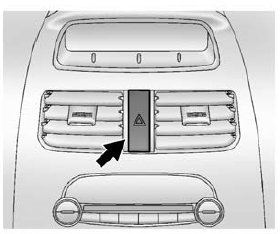
The hazard warning flasher button is on the center stack.
 (Hazard Warning Flasher): Press
to make the front and rear turn signal lamps flash on and off.
This warns others that you are having trouble. Press the button again to turn the flashers off.
When the hazard warning flashers are on, the turn signals will not work.
Turn and Lane-Change Signals
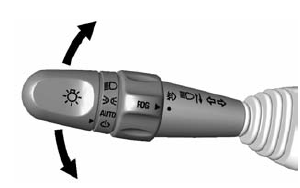
Move the lever all the way up or down to signal a turn.
An arrow on the instrument cluster flashes in the direction of the turn or lane change.
Raise or lower the lever until the arrow starts to flash to signal a lane change. Hold it there until the lane change is completed.
If the lever is moved momentarily to the lane change position, the arrow will flash three times.
The lever returns to its starting position whenever it is released.
If after signaling a turn or a lane change the arrow flashes rapidly or does not come on, a signal bulb may be burned out.
Replace any burned out bulbs. If a bulb is not burned out, check the fuse. See Fuses and Circuit Breakers on page 10-30.
Fog Lamps
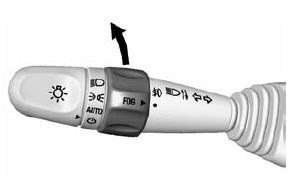
If equipped with fog lamps, they are controlled by the  band on the middle of the turn signal
lever.
To use the fog lamps, the ignition must be turned on and the low-beam headlamps or parking lamps must be on.
Turn the band to  to turn the fog
lamps on. The band automatically returns to its starting position when released. The fog lamp indicator light comes on in the display on top of the center stack. See Front Fog Lamp Light on page 5-21.
To turn the fog lamps off, turn the band to  again. The fog lamp indicator light
will go off.
The fog lamps will also turn off when the high-beam headlamps are turned on. When the high-beam headlamps are turned off, the fog lamps will turn on again.
Some localities have laws that require the headlamps to be on along with the fog lamps.
Download Manual