Fuel
& Fuel requirements
The engine is designed to operate using unleaded gasoline with an octane rating of 87 AKI (90 RON) or higher.
Add a bottle of genuine SUBARU fuel additive to the fuel every 15,000 km (9,000 miles). Refer to an authorized SUBARU dealer for details.
Using a gasoline with a lower octane rating can cause persistent and heavy knocking, which can damage the engine. Do not be
concerned if your vehicle sometimes knocks lightly when you drive up a hill or when you accelerate. Contact your SUBARU dealer if you use a fuel with the specified octane rating and your vehicle knocks heavily or persistently.
! RON
This octane rating is the Research Octane Number.
! AKI
This octane rating is the average of the Research Octane and Motor Octane num- bers and is commonly referred to as the Anti Knock Index (AKI).
The neck of the fuel filler pipe is designed to accept only an unleaded gasoline filler nozzle. Under no circumstances should leaded gasoline be used because it will damage the emission control system and may impair driveability and fuel economy.
SUBARU supports the use of reformulated gasoline when available. Reformulated gasoline has been blended to burn more cleanly and reduce vehicle emissions.
! MMT
Some gasoline contains an octane-enhan- cing additive called MMT (Methylcyclo-
pentadienyl Manganese Tricarbonyl). If you use such fuels, your emission control system performance may deteriorate and the CHECK ENGINE warning light/Mal- function indicator light may turn on. If this happens, return to your authorized SUBARU Dealer for service. If it is determined that the condition is caused by the type of fuel used, repairs may not be covered by your warranty.
Your use of gasoline with detergent ad- ditives will help prevent deposits from forming in your engine and fuel system. This helps keep your engine in tune and your emission control system working properly, and is a way of doing your part for cleaner air. If you continuously use a high quality fuel with the proper detergent and other additives, you should never need to add any fuel system cleaning agents to your fuel tank.
Many gasolines are now blended with materials called oxygenates. Use of these fuels can also help keep the air cleaner. Oxygenated blend fuels, such as ethanol (ethyl or grain alcohol) may be used in your vehicle, but should contain no more than 15% ethanol for the proper operation of your SUBARU.
Do not use any gasoline that contains more than 15% ethanol, including from any pump labeled E30, E50 or E85 (which are only some examples of fuel containing more than 15% ethanol).
In addition, some gasoline suppliers are now producing reformulated gasolines, which are designed to reduce vehicle emissions. SUBARU approves the use of reformulated gasoline.
If you are not sure what the fuel contains, you should ask your service station op- erators if their gasolines contain deter- gents and oxygenates and if they have been reformulated to reduce vehicle emis- sions.
As additional guidance, only use fuels suited for your vehicle as explained in the following description.
under these conditions.
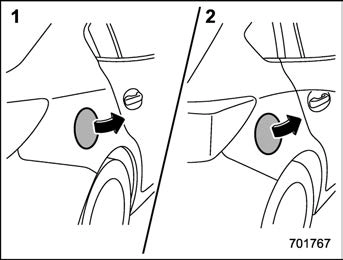
Fuel filler lid
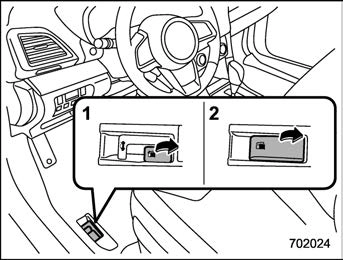
Fuel filler lid release lever
Only one person should be involved in refueling. Do not allow others to approach the area of the vehicle near the fuel filler pipe while refueling is in progress.
Be sure to observe any other precautions that are posted at the service station.
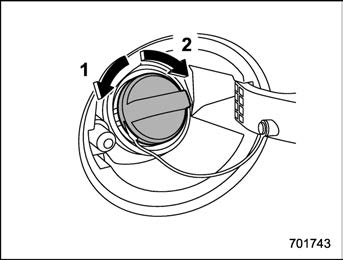
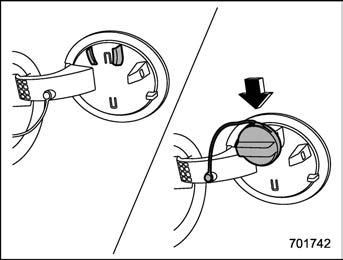
 You will see the “ ” sign in the fuel gauge. This indicates that the fuel filler lid is located on the right side of the vehicle.
Starting and operating/State emission testing (U.S. only) 7-7
Download Manual