Manual transmission
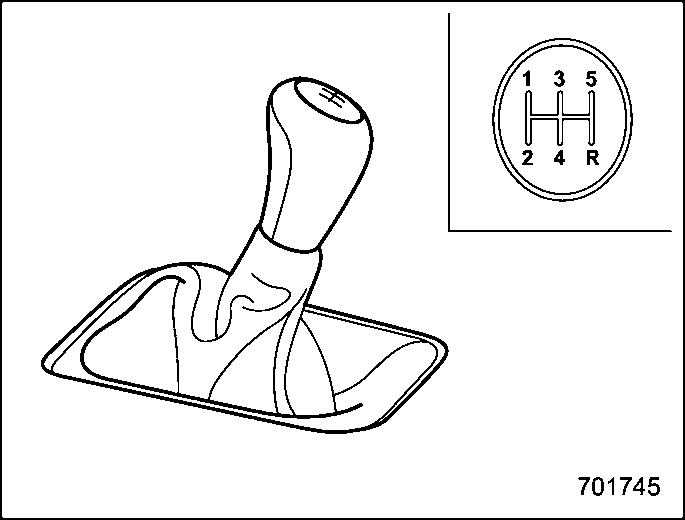
The manual transmission is a fully syn- chromeshed, 5-forward-speed and 1-re- verse-speed transmission.
The shift pattern is shown on the shift lever knob. When shifting from 5th gear to reverse gear, first return the shift lever to the neutral position then shift into reverse gear.
To change gears, fully depress the clutch pedal, move the shift lever, and gradually let up on the clutch pedal.
If it is difficult to shift into gear, put the transmission in neutral, release the clutch pedal momentarily, and then try again.
The best compromise between fuel econ- omy and vehicle performance during normal driving is ensured by shifting up at the speeds listed in the following table.
|
Shift up |
mph (km/h) |
|
1st to 2nd |
15 (24) |
|
2nd to 3rd |
25 (40) |
|
3rd to 4th |
40 (64) |
|
4th to 5th |
45 (72) |
The following table shows the maximum speeds that are possible with each differ- ent gear. The tachometer’s needle will enter the red area if these speeds are exceeded.
With the exception of cases where sudden acceleration is required, the vehicle should not be driven with the tachometer’s needle inside the red area. Failure to observe this precaution can lead to excessive engine wear and poor fuel economy.
7-24
Starting and operating/Manual transmission
depressed at the same time, driving torque may be restrained. This is not a malfunction.
Do not drive with your foot resting on the clutch pedal and do not use the clutch to hold your vehicle at a standstill on an upgrade. Either of those actions may cause clutch damage.
Do not drive with your hand resting on the shift lever. This may cause wear on the transmission components.
When it is necessary to reduce vehicle speed due to slow traffic, turning corners, or driving up steep hills, downshift to a lower gear before the engine starts to labor.
On steep downgrades, downshift the transmission to 4th, 3rd or 2nd gear as necessary; this helps to maintain a safe speed and to extend brake pad life.
In this way, the engine provides a braking effect. Remember, if you “ride” (over use) the brakes while descending a hill, they may overheat and not work properly.
The engine may, on rare occasions, knock when the vehicle rapidly accelerates or rapidly pulls away from a standstill. This phenomenon is not an indication of a problem in your vehicle.
Download Manual