Seats
Front Seats
- Detail
-
Adjust the driver’s seat as far back as possible while allowing you to maintain full control of the vehicle. You should be able to sit upright, well back in the seat and be able to adequately press the pedals without leaning forward, and grip the steering wheel comfortably. The passenger’s seat should be adjusted in a similar manner, so that it is as far back from the front airbag in the dashboard as possible.

- WARNING
Sitting too close to a front airbag can result in serious injury or death if the front airbags inflate.
Always sit as far back from the front airbags as possible while maintaining control of the vehicle.
- Detail
Adjusting the Seat Positions
- Detail
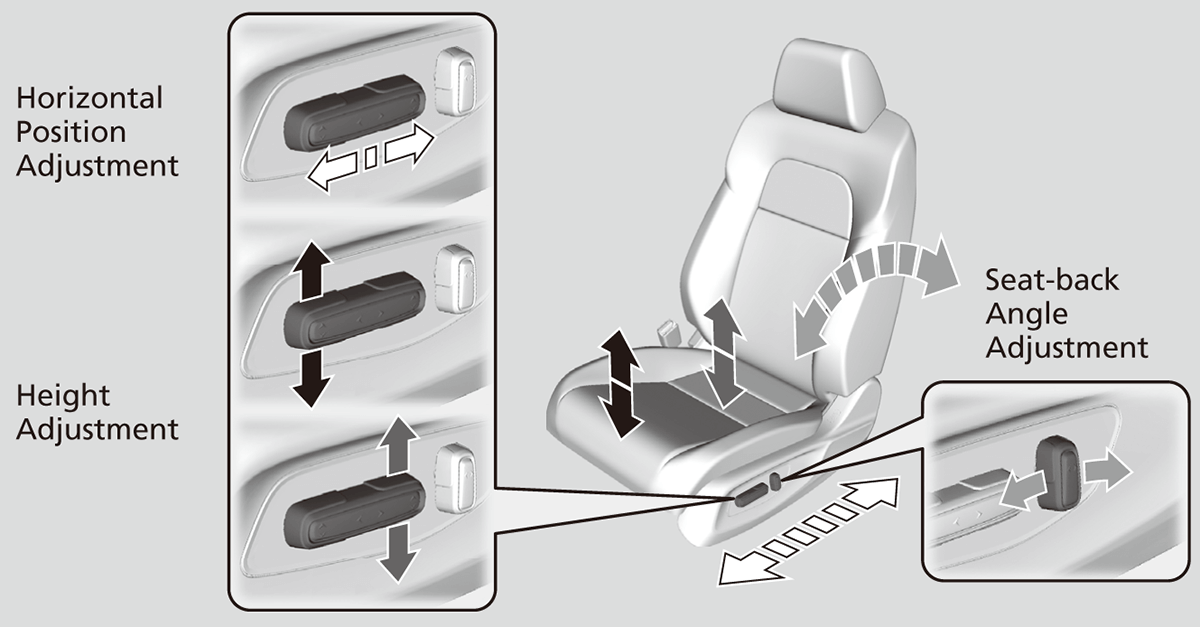
Adjusting the driver’s power seat*
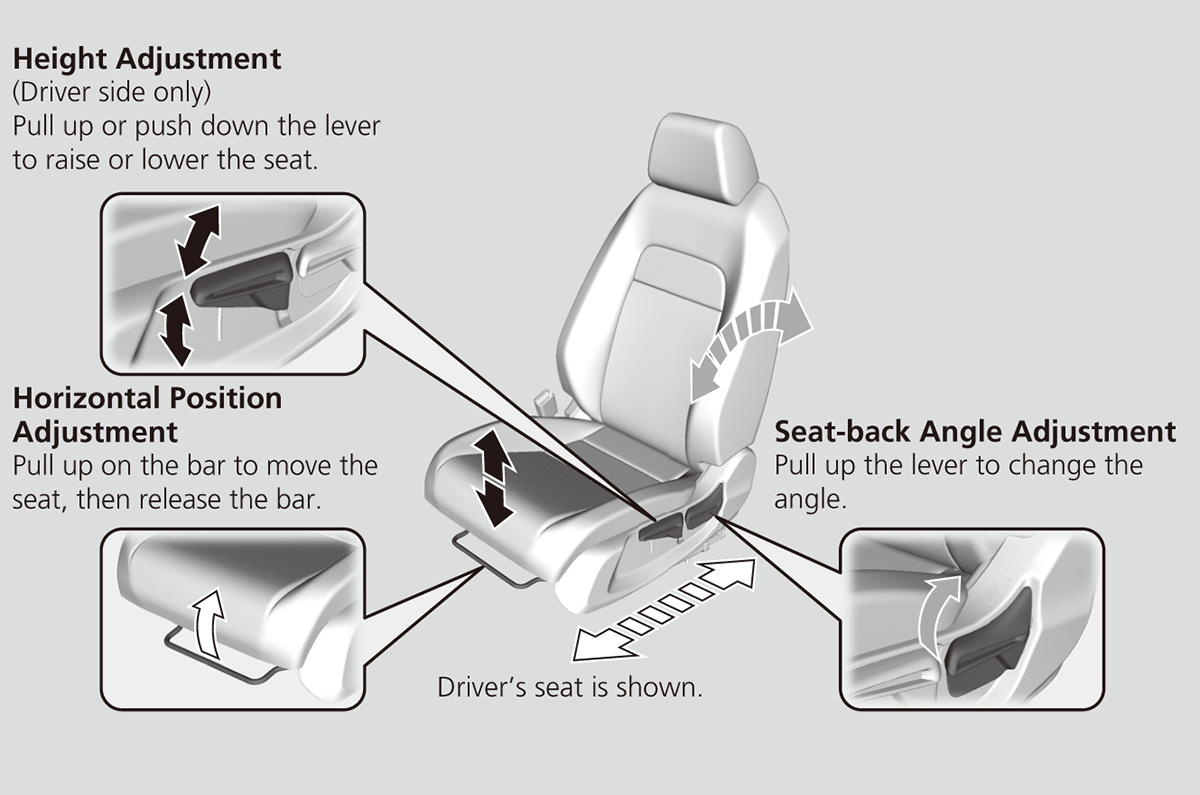
Adjusting the front manual seat(s)*
Adjusting the Seat-Backs
-
Adjust the driver’s seat-back to a comfortable, upright position, leaving ample space between your chest and the airbag cover in the center of the steering wheel.
The front seat passenger should also adjust their seat-back to a comfortable, upright position.
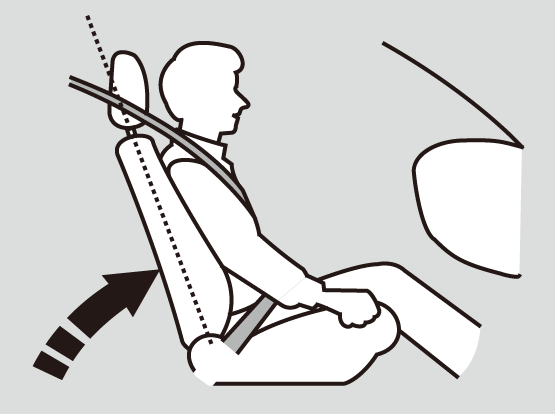
Reclining a seat-back so that the shoulder part of the belt no longer rests against the occupant’s chest reduces the protective capability of the belt. It also increases the chance of sliding under the belt in a crash and being seriously injured. The farther a seat-back is reclined, the greater the risk of injury.
- WARNING
Reclining the seat-back too far can result in serious injury or death in a crash.
Adjust the seat-back to an upright position, and sit well back in the seat.
- Detail
Doing so may interfere with proper seat belt or airbag operation.
* Not available on all models
Rear Seats
Folding Down the Rear Seats
The rear seats can be folded down separately to allow for additional storage space.
-
To fold down the seat
- Store the center seat belt first. Insert the latch plate into the slot on the side of the anchor buckle.
- Retract the seat belt into the holder on the ceiling.
Seat Belt with Detachable Anchor
- Lower the head restraint to its lowest position.

-
- Pull the release lever and fold down the seat-back.
To return the seat to the original position, pull up the seat-back in the upright position.

- Detail
Passenger Airbag Off Indicator
Rear Seat Reminder
This feature alerts you to the possible presence of passengers or items in the rear seats before you exit the vehicle. It activates when the power mode is set to VEHICLE OFF if the rear doors were opened shortly before or after the power mode was set to ON.
-
A reminder appears on the driver information interface and an alert will sound when the power mode is set to VEHICLE OFF.

- Detail
Settings*
How to Customize the Vehicle Settings
* Not available on all models
Maintain a Proper Sitting Position
After all occupants have adjusted their seats and head restraints, and put on their seat belts, it is very important that they continue to sit upright, well back in their seats, with their feet on the floor, until the vehicle is safely parked and the engine is off.
Sitting improperly can increase the chance of injury during a crash. For example, if an occupant slouches, lies down, turns sideways, sits forward, leans forward or sideways, or puts one or both feet up, the chance of injury during a crash is greatly increased.
In addition, an occupant who is out of position in the front seat can be seriously or fatally injured in a crash by striking interior parts of the vehicle or being struck by an inflating front airbag.
- WARNING
Sitting improperly or out of position can result in serious injury or death in a crash.
Always sit upright, well back in the seat, with your feet on the floor.
Head Restraints
Your vehicle is equipped with head restraints in all seating positions.
Adjusting the front head restraint positions
-
Head restraints are most effective for protection against whiplash and other rear-impact crash injuries when the center of the back of the occupant’s head rests against the center of the restraint. The tops of the occupant’s ears should be level with the center height of the restraint.

To raise the head restraint:
Pull it upward.
To lower the head restraint:
Push it down while pressing the release button.

- WARNING
Improperly positioning head restraints reduces their effectiveness and increases the likelihood of serious injury in a crash.
Make sure head restraints are in place and positioned properly before driving.
- Detail
- Do not hang any items on the head restraints, or from the restraint legs.
- Do not place any objects between an occupant and the seat-back.
- Install each restraint in its proper location.
Changing the Rear Seat Head Restraint Positions
-
A passenger sitting in a back seating position should adjust the height of their head restraint to an appropriate position before the vehicle begins moving.
To raise the head restraint:Pull it upward.
To lower the head restraint:Push it down while pressing the release button.

Removing and Reinstalling the Head Restraints
Head restraints can be removed for cleaning or repair.
Pull the restraint up as far as it will go. Then, push the release button and pull the restraint up and out.
Insert the legs back in place, then adjust the head restraint to an appropriate height while pressing the release button. Pull up on the restraint to make sure it is locked in position.
- WARNING
Failure to reinstall, or correctly reinstall, the head restraints can result in severe injury during a crash.
Always replace the head restraints before driving.
- Detail
Armrest
Using the Front Seat Armrest
-
The console compartment can be used as an armrest.

Download Manual