Maintenance Under the Hood
Maintenance Items Under the Hood

Opening the Hood
-
- Park the vehicle on a level surface, and set the parking brake.
- Pull the hood release handle under the driver’s side lower corner of the dashboard.
- The hood will pop up slightly.

-
- Push the hood latch lever (located under the front edge of the hood to the center) to the side and raise the hood. Once you have raised the hood slightly, you can release the lever.

-
- Remove the support rod from the clamp using the grip. Mount the support rod in the hood.
When closing, remove the support rod, and stow it in the clamp, then gently lower the hood. Remove your hand at a height of approximately 12 inches (30 cm) and let the hood close.

- WARNING
The hood support rod can become very hot due to heat from the engine.
To ensure against possible burns, do not handle the metal section of the rod:
Use the foam grip instead.
- Detail
NOTICE
Do not open the hood when the wiper arms are raised.
The hood will strike the wipers, resulting in possible damage to the hood and/or the wipers.
NOTICE
Do not press the engine cover forcibly. This may damage the engine cover and component parts.
Recommended Engine Oil
Use a genuine engine oil or another commercial engine oil of suitable type and viscosity (for the ambient temperature) as shown in the image that follows.
Oil is a major contributor to your engine’s performance and longevity. If you drive the vehicle with insufficient or deteriorated oil, the engine may fail or be damaged.
|
Genuine Engine Oil
|
Commercial Engine Oil
|
|---|---|
|
|
 |
 |
- Formulated to improve fuel economy.
- Detail
Your vehicle does not require oil additives. In fact, they may adversely affect the engine performance and durability.

Synthetic oil
You may also use synthetic motor oil if it is labeled with the API Certification Seal and is the specified viscosity grade.
Oil Check
We recommend that you check the engine oil level every time you refuel.
Park the vehicle on level ground.
Wait approximately three minutes after turning the engine off before you check the oil.
-
- Remove the dipstick (orange).
- Wipe the dipstick with a clean cloth or paper towel.
- Insert the dipstick back all the way into its hole.

-
- Remove the dipstick again, and check the level. It should be between the upper and lower marks. Add oil if necessary.

- Detail
Adding Engine Oil
-
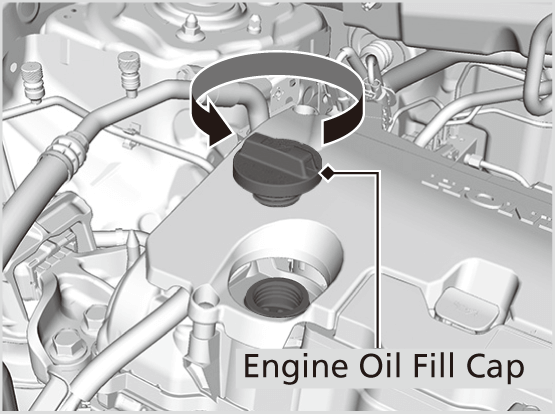
- Unscrew and remove the engine oil fill cap.
- Add oil slowly.
- Reinstall the engine oil fill cap, and tighten it securely.
- Wait for three minutes and recheck the engine oil dipstick.
- Detail
NOTICE
Do not fill the engine oil above the upper mark. Overfilling the engine oil may result in leaks and engine damage.
Changing the Engine Oil and Oil Filter
You must change the engine oil and oil filter regularly in order to maintain the engine’s lubrication. The engine may be damaged if they are not changed regularly.
Change the oil and filter in accordance with the maintenance message on the driver information interface.
-
- Run the engine until it reaches normal operating temperature, and then turn the engine off.
- Open the hood and remove the engine oil fill cap.
- Remove the Phillips-head screws and slotted head screws by turning 90° counter-clockwise on the undercarriage and remove the under cover.

-
- Remove the drain bolt and washer from the bottom of the engine, and drain the oil into a suitable container.

-
- Remove the oil filter and dispose of the remaining oil.
- Check that the filter gasket is not stuck to the engine contact surface.
- If it is stuck, you must detach it.
- Wipe away dirt and dust adhering to the contact surface of the engine block, and install a new oil filter.
- Apply a light coat of new engine oil to the filter gasket.
- Put a new washer on the drain bolt, then reinstall the drain bolt.
- Tightening torque:
30 lbf∙ft (40 N∙m, 4.0 kgf∙m)
- Tightening torque:
- Pour the recommended engine oil into the engine.
- Engine oil change capacity (including filter):
4.4 US qt (4.2 L)
- Engine oil change capacity (including filter):
- Reinstall the engine oil fill cap securely and start the engine.
- Run the engine for a few minutes, and then check that there is no leak from the drain bolt or oil filter.
- Stop the engine, wait for three minutes, and then check the oil level on the dipstick.
- If necessary, add more engine oil.

- Detail
NOTICE
You may damage the environment if you do not dispose of the oil in a suitable way. If you are changing the oil by yourself, appropriately dispose of the used oil. Put the oil in a sealed container and take it to a recycling center. Do not throw the oil away into a garbage can or onto the ground.
Engine Coolant
|
Specified coolant: Honda Long Life Antifreeze/Coolant Type 2
|
This coolant is premixed with 50% antifreeze and 50% water. Do not add any straight antifreeze or water.
We recommend you check the engine coolant level every time you refuel. Check the reserve tank first. If it is completely empty, also check the coolant level in the radiator. Add the engine coolant accordingly.
- WARNING
Removing the radiator cap while the engine is hot can cause the coolant to spray out, seriously scalding you.
Always let the engine and radiator cool down before removing the radiator cap.
- Detail
NOTICE
Genuine Honda engine coolant is a 50/50 mixture of antifreeze and water that can withstand freezing at temperatures as low as about -31°F (-35°C). If your vehicle is consistently subjected to temperatures below this, the concentration of antifreeze in the coolant should be increased. Consult a dealer for details.
Reserve Tank
-
- Make sure the engine and radiator are cool.
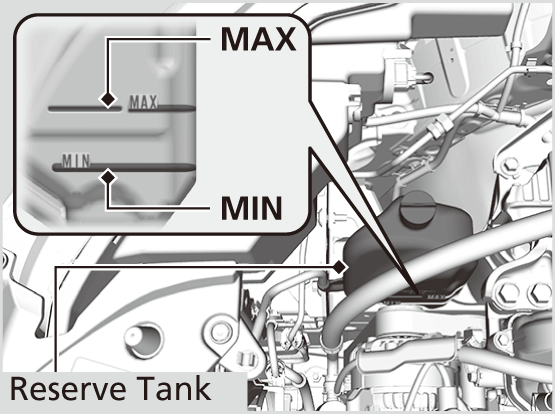
- Check the amount of coolant in the reserve tank.
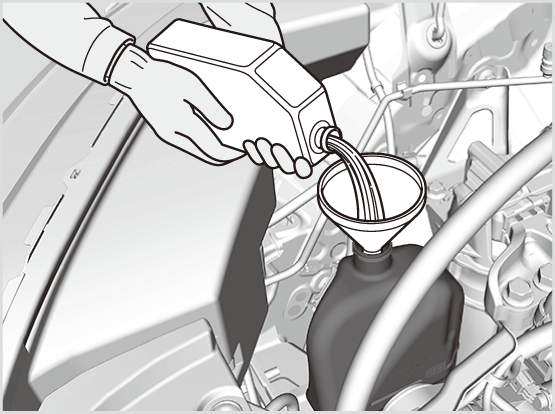
- If the coolant level is below the MIN mark, add the specified coolant until it reaches the MAX mark.
-
- Inspect the cooling system for leaks.
Radiator
-
- Make sure the engine and radiator are cool.
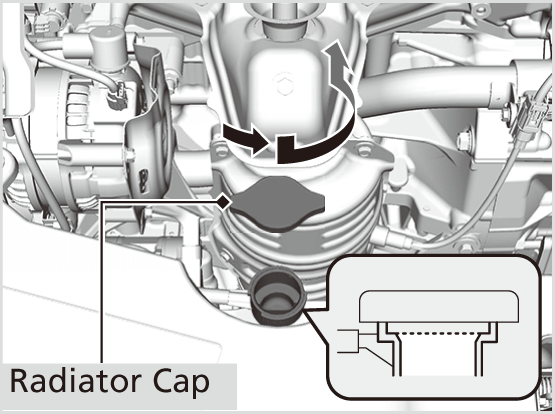
- Turn the radiator cap 1/8 turn counter-clockwise and relieve any pressure in the cooling system. Do not push the cap down when turning.
- Push down and turn the radiator cap counter-clockwise to remove it.
- The coolant level should be up to the base of the filler neck. Add coolant if it is low.
- Put the radiator cap back on, and tighten it fully.
- Detail
NOTICE
Pour the fluid slowly and carefully so you do not spill any. Clean up any spills immediately; they can damage components in the engine compartment.
Transmission Fluid
Continuously Variable Transmission (CVT) Fluid
|
Specified fluid: Honda HCF-2
|
Have a dealer check the fluid level and replace if necessary.
Do not attempt to check or change the continuously variable transmission fluid yourself.
- Detail
NOTICE
Do not mix HCF-2 with other transmission fluids
Using a transmission fluid other than HCF-2 may adversely affect the operation and durability of your vehicle's transmission, and damage the transmission.
Any damage caused by using a transmission fluid that is not equivalent to HCF-2 is not covered by Honda's new vehicle limited warranty.
Brake Fluid
|
Specified fluid: Honda Heavy Duty Brake Fluid DOT 3
|
- Detail
NOTICE
Brake fluid marked DOT 5 is not compatible with your vehicle’s braking system and can cause extensive damage.
Checking the Brake Fluid
-
The fluid level should be between the MIN and MAX marks on the side of the reserve tank.

Refilling Window Washer Fluid
-
U.S. models
Check the amount of window washer fluid by looking at the reservoir.
If the level is low, fill the washer reservoir.
Canadian modelsIf the washer fluid is low, a message appears on the driver information interface.

Pour the washer fluid carefully. Do not overflow the reservoir.
- Detail
NOTICE
Do not use engine antifreeze or a vinegar/water solution in the window washer reservoir.
Antifreeze can damage your vehicle’s paint. A vinegar/water solution can damage the window washer pump.
Use only commercially available windshield washer fluid.
Avoid prolonged use of hard water to prevent lime scale buildup.
Download Manual