Disclaimer: Not affiliated with or endorsed by Chevrolet Motor Company. For informational purposes only. Full Disclaimer

2019 Chevrolet Silverado 2500HD Owners Manual - Towing the Vehicle


Towing the Vehicle

GM recommends a flatbed tow truck to transport a disabled vehicle. Use ramps to help reduce approach angles, if necessary. A towed vehicle should have its drive wheels off the ground. Contact Roadside Assistance or a professional towing service if the disabled vehicle must be towed.

The vehicle is equipped with specific attachment points to be used to pull the vehicle onto a flatbed car carrier from a flat road surface. Do not use these attachment points to pull the vehicle from snow, mud or sand.

Recreational Vehicle Towing

Recreational vehicle towing means towing the vehicle behind another vehicle, such as a motor home. The two most common types of

recreational vehicle towing are dinghy and dolly towing. Dinghy towing is towing the vehicle with all four wheels on the ground. Dolly towing is towing the vehicle with two wheels on the ground and two wheels on a dolly.

    Before towing the vehicle, become familiar with the local laws that apply to recreational vehicle towing. These laws may vary by region.
    What is the towing capacity of the towing vehicle? Be sure to read the tow vehicle manufacturer's recommendations.
    What is the distance that will be traveled? Some vehicles have restrictions on how far and how long they can tow.
    Is the proper towing equipment going to be used? See your dealer or trailering professional for additional advice and equipment recommendations.
    Is the vehicle ready to be towed? Just as preparing the vehicle for a long trip, make sure the vehicle is prepared to be towed.

Follow the tow vehicle manufacturer’s instructions.

Two-Wheel-Drive Vehicles
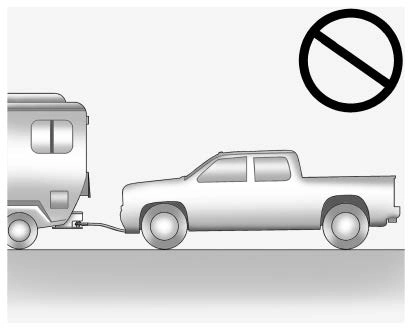
Two-wheel-drive vehicles should not be towed with all four wheels on the ground.

Four-Wheel-Drive Vehicles
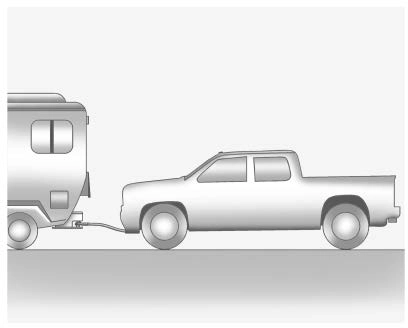
Only dinghy tow four-wheel-drive vehicles with a two-speed transfer case that have an N (Neutral) and a Four-Wheel Drive Low (4 (n) setting.

To dinghy tow:

    Position the vehicle being towed behind the tow vehicle, facing forward and on a level surface.
    Securely attach the vehicle being towed to the tow vehicle.
    Apply the parking brake and start the engine.
    Shift the transfer case to N (Neutral). See “Shifting into N (Neutral)” under Four-Wheel Drive 0 262. Check that the vehicle is in N (Neutral) by shifting the transmission to

R (Reverse) and then to D (Drive). There should be no movement of the vehicle while shifting.

    Turn the engine off.

    Disconnect the negative battery cable at the battery and secure the nut and bolt. Cover the negative battery post with a non-conductive material to prevent any contact with the negative battery terminal.
    Shift the transmission to P (Park).

    Move the steering wheel to make sure the steering column is unlocked.
    With a foot on the brake pedal, release the parking brake. Keep the ignition key in the towed vehicle in ACC/ ACCESSORY to prevent the steering column from locking.

Disconnecting the Towed Vehicle

Before disconnecting the towed vehicle:

    Park on a level surface.
    Set the parking brake, then shift the transmission to

P (Park), and move the ignition key to OFF.

    Connect the battery.
    Apply the brake pedal.
    Turn the ignition on with the engine off. Shift the transfer case out of N (Neutral) to Two-Wheel Drive High. See “Shifting out of N (Neutral)”

under Four-Wheel Drive 0 262. See your dealer if the transfer case cannot be shifted out of N (Neutral).

    Check that the vehicle is in Two-Wheel Drive High by shifting the transmission to R (Reverse) and then to D (Drive). There should be

movement of the vehicle while shifting.

    Shift the transmission to P (Park) and turn off the ignition.
    Disconnect the vehicle from the tow vehicle.
    Release the parking brake.
    Reset any lost presets.

The outside temperature display will default to 0 °C (32 °F) but will reset with normal usage.

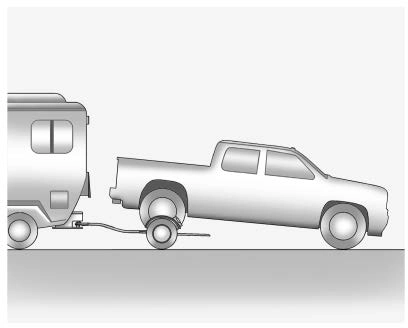
Front Towing (Front Wheels Off the Ground) – Two-Wheel-Drive Vehicles
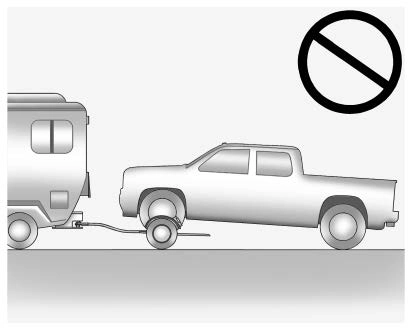
Two-wheel-drive vehicles should not be towed with the rear wheels on the ground. Two-wheel-drive transmissions have no provisions for internal lubrication while being towed.

To dolly tow a two-wheel-drive vehicle, the vehicle must be towed with the rear wheels on the dolly. See “Rear Towing (Rear Wheels Off the Ground)” later in this section.
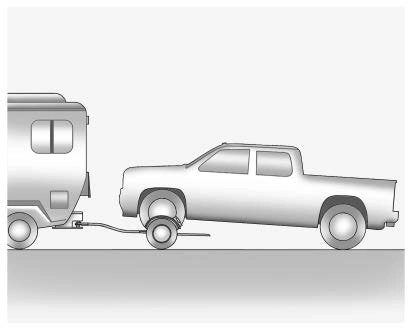
Front Towing (Front Wheels Off the Ground) – Four-Wheel-Drive Vehicles

To dolly tow a four-wheel-drive vehicle from the front:

    Attach the dolly to the tow vehicle following the dolly manufacturer's instructions.
    Drive the front wheels onto the dolly.
    Shift the transmission to P (Park).
    Set the parking brake.
    Use a clamping device designed for towing to ensure that the front wheels are locked into the straight position.
    Secure the vehicle to the dolly following the manufacturer's instructions.
    Shift the transfer case to N (Neutral). See “Shifting into N (Neutral)” under Four-Wheel Drive 0 262 for the proper procedure.
    Release the parking brake only after the vehicle being towed is firmly attached to the tow vehicle.
    Turn the ignition to LOCK/OFF.

Two-Wheel-Drive Vehicles

To dolly tow a two-wheel-drive vehicle from the rear:

    Drive the rear wheels onto the dolly.
    Set the parking brake. See

Parking Brake 0 271.

    Put the transmission in P (Park).
    Secure the vehicle to the dolly following the manufacturer's instructions.
    Use a clamping device designed for towing to ensure that the front wheels are locked into the straight position.
    Turn the ignition to LOCK/OFF.

Four-Wheel-Drive Vehicles

To dolly tow a four-wheel-drive vehicle from the rear:

    Drive the rear wheels onto the dolly.
    Set the parking brake. See

Parking Brake 0 271.

    Put the transmission in P (Park).
    Secure the vehicle to the dolly following the manufacturer's instructions.
    Use a clamping device designed for towing to ensure that the front wheels are locked into the straight position.
    Shift the transfer case to N (Neutral). See “Shifting into N (Neutral)” under Four-Wheel Drive 0 262 for the proper procedure.
    Turn the ignition to LOCK/OFF.

Download Manual