Drive Systems
If equipped, four-wheel drive engages the front axle for extra traction.
Read the appropriate section for transfer case operation before using.
Driving on clean, dry pavement in 4 m or 4 n may:
Engagement noise and bump when shifting between 4 n and 4 m or from N (Neutral), with the engine running, is normal.
Shifting into 4 n will turn Traction Control and StabiliTrak/Electronic Stability Control (ESC) off. See
Traction Control/Electronic Stability Control 0 273.
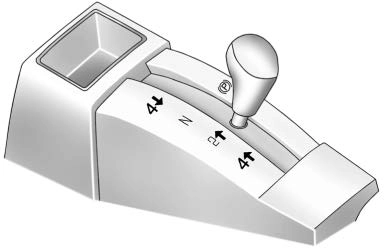
Move the lever to shift into and out of four-wheel drive.

An indicator light comes on when four-wheel drive is engaged. See Four-Wheel-Drive Light 0 150.
N (Neutral) : Use only when the vehicle needs to be towed.
See Recreational Vehicle Towing
0 413 or Towing the Vehicle 0 413.
2 m (Two-Wheel Drive High) : Use this setting for driving on most
streets and highways. The front axle is not engaged. This setting provides the best fuel economy.
4 n (Four-Wheel Drive Low) : This setting also engages the front axle and delivers extra torque. Choose 4 n if driving off-road in deep sand, deep mud, or deep snow, and while climbing or descending steep hills.
When engaged, keep vehicle speed below 72 km/h (45 mph).
4 m (Four-Wheel Drive High) : Use this setting when extra traction is
needed. The front axle engages and helps when driving on snowy or icy roads, when off-roading, or when plowing snow.
The vehicle can be shifted between 2 m and 4 m while the vehicle is moving. In extremely cold weather, it may be necessary to stop or slow the vehicle to shift into 4 m.
Using the Manual Transfer Case
uneven tire wear, low tire pressure, high vehicle loading, or cold temperatures.
Shifting from 2 m to 4 m
weather.
Shifting In or Out of 4 n
Shifting In or Out of N (Neutral)
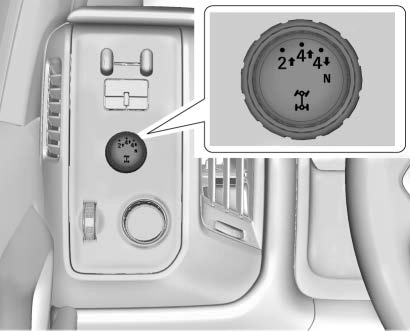
Use the transfer case knob, next to the steering wheel, to shift into and out of four-wheel drive for extra traction.
All of the lights will flash on then off momentarily when the ignition is turned on. The light that remains on will indicate the state of the
transfer case.
If the indicator mark on the knob does not match up with the light then that likely means the knob was moved when the ignition was off.
The indicator mark on the knob must line up with the indicator light before a shift can be commanded. To command a shift rotate the transfer case knob to the new desired position. The light will flash meaning that the shift is in progress. When the shift is completed the new position will be illuminated. If the transfer case cannot complete a shift command, it will go back to its last chosen setting.
In extreme cold weather it may be necessary to slow or stop the vehicle to shift from 2m to 4m.
Delayed shifts from 4 m to 2 m may be experienced due to uneven tire
wear, low tire pressure, high vehicle loading, or cold temperatures.
The settings are:
N (Neutral) : Use only when the vehicle needs to be towed.
See Recreational Vehicle Towing
0 413 or Towing the Vehicle 0 413.
2 m (Two-Wheel Drive High) : Use for driving on most streets and
highways. The front axle is not engaged. This setting provides the best fuel economy.
4 n (Four-Wheel Drive Low) : This setting engages the front axle and delivers extra torque. Choose 4 n if driving off-road in deep sand, deep mud, or deep snow, and while climbing or descending steep hills. When engaged, keep vehicle speed below 72 km/h (45 mph).
Shifting into 4 n will turn Traction Control and StabiliTrak/ESC off.
See Traction Control/Electronic Stability Control 0 273.
4 m (Four-Wheel Drive High) : Use when extra traction is needed. The
front axle engages and helps when driving on snowy or icy roads, when
off-roading, or when plowing snow. The vehicle can be shifted from 2 m to 4 m while the vehicle is moving.
Shifting Into 4 m
Turn the knob to 4 m at any speed up to 121 km/h (75 mph), except from 4 n. The indicator light will flash while shifting and will remain on the selected setting.
Shifting Into 2 m
Turn the knob to 2 m at any speed, except when shifting from 4 n.
Shifting Into 4 n
When 4 n is engaged, vehicle speed should be kept below 72 km/h (45 mph).
1.6 to 3.2 km/h (1 to 2 mph).
If the transmission is in gear and/or moving more than 5 km/h (3 mph), the 4 n indicator light will flash for 30 seconds and not complete the shift. After 30 seconds the transfer case will shift to 4 m. Turn the knob
to 4 m to see the indicator. With the
vehicle moving less than 5 km/h
(3 mph), and the transmission in N (Neutral), attempt the shift again.
Shifting Out of 4 n
less than 5 km/h (3 mph) with the transmission in N (Neutral) and the ignition in on. It is best for the vehicle to be moving
1.6 to 3.2 km/h (1 to 2 mph).
into gear.
If the transmission is in gear and/or moving more than 5 km/h (3 mph), the 4 m or 2 m indicator light will flash for 30 seconds, but will not complete the shift. With the vehicle moving
less than 5 km/h (3 mph), and the transmission in N (Neutral), attempt the shift again.
Shifting Into N (Neutral)
To shift:
position. The N (Neutral) light
will come on when the transfer case shift to N (Neutral) is complete.
Shifting Out of N (Neutral)
To shift:
After the transfer case has shifted out of N (Neutral), the N (Neutral) light will go out.
desired gear.
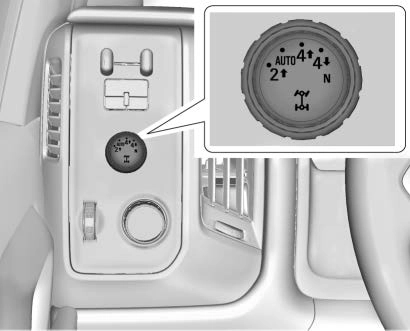
If equipped, use the transfer case knob next to the steering wheel to shift into and out of four-wheel drive.
All of the lights will flash on then off momentarily when the ignition is turned on. The light that remains on will indicate the state of the
transfer case.
If the indicator mark on the knob does not match up with the light then that likely means the knob was moved when the ignition was off.
The indicator mark on the knob must line up with the indicator light before a shift can be commanded. To command a shift rotate the transfer case knob to the new desired position. The light will flash meaning that the shift is in progress. When the shift is completed the new position will be illuminated. If the transfer case cannot complete a shift command, it will go back to its last chosen setting.
The settings are:
N (Neutral) : Use only when the vehicle needs to be towed.
See Recreational Vehicle Towing
0 413 or Towing the Vehicle 0 413.
2 m (Two-Wheel Drive High) : Use for driving on most streets and
highways. The front axle is not engaged. This setting provides the best fuel economy.
AUTO (Automatic Four-Wheel Drive) : Use when road surface traction conditions are variable. When driving in AUTO, the front axle is engaged, and the vehicle's power is sent to the front and rear
wheels automatically based on driving conditions. This setting provides slightly lower fuel economy than 2 m.
Do not use AUTO mode,
if equipped, to park on a steep grade with poor traction such as ice, snow, mud, or gravel. In AUTO mode only the rear wheels will hold the vehicle from sliding when parked. If parking on a steep grade, use 4 m to keep all four wheels
engaged.
needed, such as when driving on snowy or icy roads, when
off-roading, or when plowing snow.
4 n (Four-Wheel Drive Low) : This setting engages the front axle and delivers extra torque. Choose 4 n when driving off-road in deep sand, deep mud, or deep snow, and while climbing or descending steep hills.
Shifting into 4 n will turn Traction Control and StabiliTrak off. See
Traction Control/Electronic Stability Control 0 273.
Shifting Into 4 m or AUTO
Turn the knob to the 4 m or AUTO position at any speed, except from 4 n. The indicator light will flash while shifting and will remain on when the shift is completed.
Shifting Into 2 m
Turn the knob to 2 m at any speed, except when shifting from 4 n. The indicator light will flash while shifting
and will remain on when the shift is completed.
Shifting Into 4 n
When 4 n is engaged, keep vehicle speed below 72 km/h (45 mph).
To shift:
(3 mph) with the transmission in N (Neutral). It is best for the vehicle to be moving
1.6 to 3.2 km/h (1 to 2 mph).
transmission into gear.
If the transmission is in gear and/or moving more than 5 km/h (3 mph), the 4 n indicator light will flash for 30 seconds and not complete the shift. After 30 seconds the transfer case will shift to 4 m. Turn the knob
to 4 m to display the indicator. With
the vehicle moving less than 5 km/h
(3 mph), and the transmission in N (Neutral), attempt the shift again.
Shifting Out of 4 n
To shift:
1.6 to 3.2 km/h (1 to 2 mph).
transmission into gear.
If the transmission is in gear and/or moving more than 5 km/h (3 mph), the 4 m, AUTO, or 2 m indicator light will flash for 30 seconds but will not complete the shift. With the vehicle
moving less than 5 km/h (3 mph), and the transmission in N (Neutral), attempt the shift again.
Shifting Into N (Neutral)
To shift into N (Neutral):
position. The N (Neutral) light
will come on when the transfer case shift to N (Neutral) is complete.
Shifting Out of N (Neutral)
To shift out of N (Neutral):
After the transfer case has shifted out of N (Neutral), the N (Neutral) light will go out.
desired gear.
Download Manual