Jump-starting
 Introduction
For technical reasons the vehicle must not be tow-started ⇒  .
.
If the engine cannot start because the 12-volt vehicle battery has drained, the 12-volt vehicle battery on another vehicle can be used to start your vehicle.
A suitable jumper cable is required for jump-starting.
The wire diameter for the jumper cable.
-
For vehicles with a gasoline engine, at least 25 mm2 (0.038 in2).
For a vehicle with a 12 V vehicle battery in the luggage compartment, the jumper cable may only be connected to the jump-start points in the engine compartment.
 WARNING
Using jumper cables and performing a jump-start incorrectly can cause the 12 V vehicle battery to explode, which can cause serious injuries. To reduce the risk of the 12 V vehicle battery exploding, heed the following:
-
Always read and heed the warnings and safety precautions before working on the 12 V vehicle battery ⇒
Introduction. -
Please note that the vehicle battery supplying the power must have the same voltage (12 V) and approximately the same battery capacity (see the label on the vehicle battery) as the drained 12 V vehicle battery.
-
Never switch the positive battery terminal with the negative terminal or connect the jumper cable incorrectly.
-
Position the jumper cable so that it will never contact rotating components in the engine compartment.
-
Follow the operating instructions provided by the manufacturer of the jumper cable.
-
Follow the operating instructions for the vehicle providing the jump-start.
WARNING
During a jump-start, a highly explosive gas mixture builds up at the 12 V vehicle battery.
-
Always keep fires, sparks, open flames, and lit cigarettes far away from the 12 V vehicle battery.
-
Never use a cell phone while connecting and disconnecting the jumper cable.
 NOTICE
A drained 12 V vehicle battery can freeze at temperatures around 32 °F (0 °C).
-
Never charge a frozen or thawed 12 V vehicle battery.
-
Always replace a frozen or thawed 12 V vehicle battery.
NOTICE
To avoid the risk of considerable damage to the vehicle electrical system, heed the following:
-
Jumper cables that are connected incorrectly can cause a short circuit.
-
There must be no contact between the vehicles. Otherwise, current could already be flowing when the positive battery terminals are connected.
-
Only use a jumper cable with fully insulated terminal clamps.
NOTICE
Tow-starting can cause damages.
Jump-start point (negative battery terminal)

Fig. 189 In the engine compartment: jump-start point (negative terminal).
 The jump-start point (negative terminal) is for connecting the black jumper cable fig. 189.
Only perform jump-starting using this jump-start point (negative terminal).
Jump-start point (positive battery terminal)

Fig. 190 Under a cover in the engine compartment: Jump-start point (positive battery terminal).
 In vehicles with a 12 V vehicle battery in the luggage compartment, the jump-start point (positive battery terminal) for connecting the red jumper cable is located under a cover in the engine compartment.
The vehicle is only able to give and receive a jump-start using this jump-start point (positive battery terminal).
Jump-starting
Please read the introductory information and heed the Warnings and Notice ⇒  andIntroduction.
Preparations
-
The drained 12 V vehicle battery must be connected correctly to the vehicle electrical system.
-
If a 12 V vehicle battery with a viewing window has been installed in the vehicle, check the color of the viewing window ⇒ Checking the 12 V vehicle battery acid level. If the viewing window is light yellow or has no color, do not perform a jump-start and contact an authorized Volkswagen dealer or authorized Volkswagen Service Facility.
-
Make sure that the vehicles do not touch each other. Otherwise, current could begin flowing when the positive battery terminal is connected.
-
Make sure the terminal clamps have sufficient contact with metal.
-
If the engine does not start, stop the starting process after ten seconds, and try again after approximately one minute.
-
If the engine still will not start, contact an authorized Volkswagen dealer or authorized Volkswagen Service Facility.
NOTICE
Take note of the instructions on jump-starting in the other vehicle's Owner's Manual.
Connect the jumper cable (vehicles with 12-volt vehicle battery in the engine compartment)
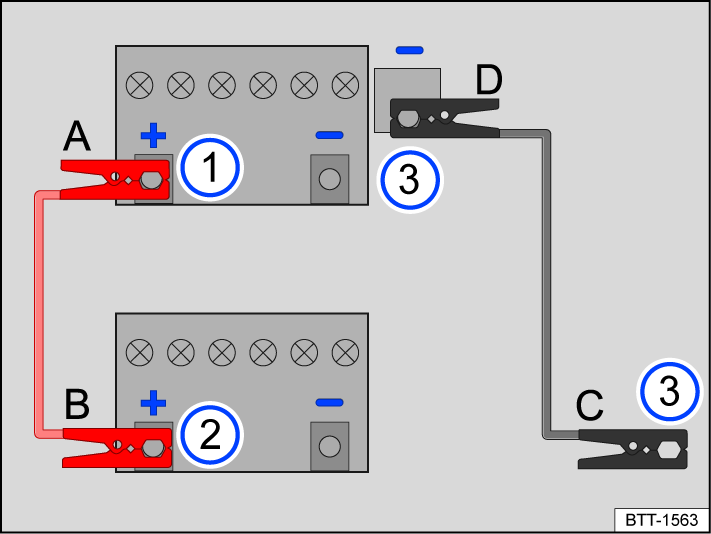
Fig. 191 Diagram for connecting the jumper cable (12-volt vehicle battery in the engine compartment).
 Vehicle with the drained 12 V vehicle battery that is receiving the jump-start.
 Vehicle with the 12 V vehicle battery providing power that is providing the jump-start.
 Suitable negative terminal: Preferably a jump-start point negative terminal (–), a robust metal part that is bolted securely to the engine block, or the engine block itself.
Only connect the jumper cables in the sequence A – B – C – D fig. 191.
Never connect the black jumper cable to the negative terminal ( –) on the 12 V vehicle battery. Connecting to the negative terminal can lead to an incorrect evaluation of the status of the 12 V vehicle battery by the vehicle electronics.
-
Switch the ignition off on both vehicles ⇒ Starting and stopping the engine.
-
If necessary, open the cover on the 12 V vehicle battery in the engine compartment ⇒
Introduction. -
Connect one end of the red jumper cable A to the positive battery terminal ( +) in the vehicle with the discharged 12 V vehicle battery fig. 191
⇒ . -
Connect the other end of the red jumper cable B to the positive battery terminal ( +) of the vehicle supplying the power fig. 191
. -
Connect one end of the black jumper cable C preferably to a jump-start point negative terminal ( –), otherwise to a robust metal part that is bolted securely to the engine block or to the engine block itself of the vehicle supplying the power fig. 191
. -
Connect the other end of the black jumper cable D preferably to the jump-start point ground connection on the vehicle with the discharged 12-volt vehicle battery ( –), otherwise to a large metal part bolted to the engine block or to the engine block itself fig. 191
⇒ . -
Route the jumper cables so that they cannot become caught in moving parts in the engine compartment.
Connect the jumper cable (vehicles with 12-volt vehicle battery in the luggage compartment)
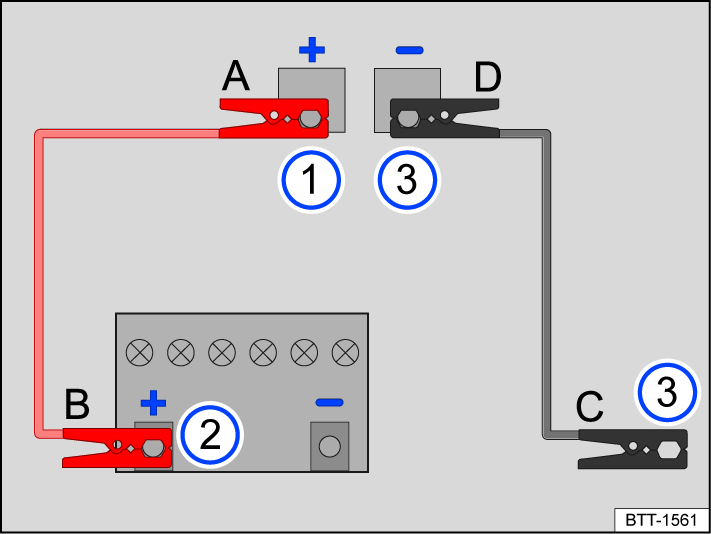
Fig. 192 Diagram for connecting the jumper cable (12 V vehicle battery in the luggage compartment).
- Vehicle with the drained 12 V vehicle battery that is receiving the jump-start.
- Vehicle with the 12 V vehicle battery providing power that is providing the jump-start.
- Suitable negative terminal: Preferably a jump-start point negative terminal (–), a robust metal part that is bolted securely to the engine block, or the engine block itself.
Only connect the jumper cables in the sequence A – B – C – D fig. 192.
-
Switch the ignition off on both vehicles ⇒ Starting and stopping the engine.
-
In the engine compartment, open the cover on the jump-start point ⇒ Jump-start point (positive battery terminal).
-
Connect one end of the red jumper cable A to the jump-start point positive battery terminal ( +) on the vehicle with the discharged 12-volt vehicle battery fig. 192
⇒ . -
Connect the other end of the red jumper cable B to the positive battery terminal ( +) of the vehicle supplying the power fig. 192
. -
Connect one end of the black jumper cable C preferably to a jump-start point negative terminal ( –) on the vehicle providing the power from its 12 V vehicle battery, otherwise to a robust metal part bolted to the engine block or to the engine block itself fig. 192
. -
Connect the other end of the black jumper cable D preferably to the jump-start point ground connection on the vehicle with the discharged 12-volt vehicle battery ( –), otherwise to a large metal part bolted to the engine block or to the engine block itself fig. 192
⇒ . -
Route the jumper cables so that they cannot become caught in moving parts in the engine compartment.
Vehicles with a 12 V vehicle battery in the luggage compartment can jump-start another vehicle via the positive jump-start point (+) and the negative jump-start point (–).
Starting the engine
-
Start the engine in the vehicle that is providing current and allow it to run at idle.
-
Start the engine in the vehicle with the drained 12 V vehicle battery and wait two to three minutes until the engine is running “evenly”.
Removing the jumper cables
-
Before disconnecting the jumper cables, switch off the low beam headlight if necessary.
-
In the vehicle with the drained 12 V vehicle battery, switch on the blower for the air conditioner or the heating and fresh air system and the rear window defroster. This will reduce any voltage surges that may occur when disconnected.
-
With the engines running, always disconnect the jump-start cables in the sequence D – C – B – A fig. 191 or fig. 192.
-
If necessary, close the battery cover or fold back the cover of the jump-start point ⇒ Jump-start point (negative battery terminal).
-
After successful jump-starting, have the 12 V vehicle battery checked by an authorized Volkswagen dealer or authorized Volkswagen Service Facility. Volkswagen recommends contacting an authorized Volkswagen dealer or authorized Volkswagen Service Facility.
WARNING
Performing a jump-start incorrectly can cause the 12 V vehicle battery to explode, which can cause serious injuries. To reduce the risk of the 12 V vehicle battery exploding, note the following:
-
Always wear suitable protective eyewear and protective gloves, and never bend over the 12 V vehicle battery.
-
Connect the cables in the correct sequence – first the positive cable, and then the negative cable.
-
Never connect the negative terminal to parts of the fuel system or to the brake lines.
-
Make sure that the terminal clamps without insulation do not touch each other.
-
Make sure that the cable that is connected to the positive battery terminal on the 12 V vehicle battery does not come into contact with any vehicle components that conduct electricity.
-
Avoid discharging static electricity near the 12 V vehicle battery. Sparks could form and ignite the flammable gas that is released by the 12 V vehicle battery.
-
Never jump-start a vehicle if the 12 V vehicle battery is damaged, frozen or thawed.
NOTICE
After successful jump-starting, have the 12 V vehicle battery checked by an authorized Volkswagen dealer or authorized Volkswagen Service Facility. Volkswagen recommends contacting an authorized Volkswagen dealer or authorized Volkswagen Service Facility.
Download Manual