Instrument cluster
Gauges and meters
Non-Optitron type meters
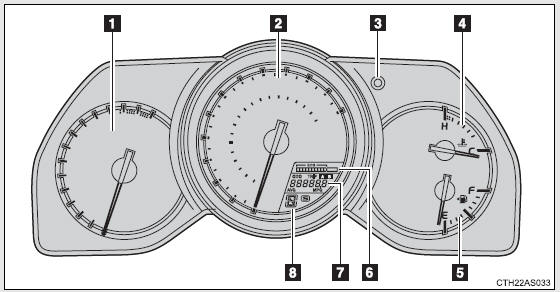
Optitron type meters
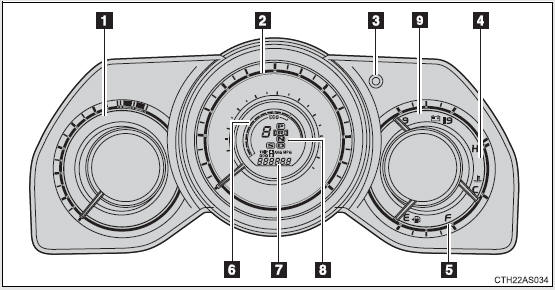
1. Tachometer Displays the engine speed in revolutions per minute 2. Speedometer Displays the vehicle speed 3. Display change button 4. Engine coolant temperature gauge Displays the engine coolant temperature 5. Fuel gauge Displays the quantity of fuel remaining in the tank 6. Eco Driving Indicator Zone Display 7. Odometer, trip meter and average fuel consumption display 8. Shift position and shift range indicators 9. Voltmeter Displays the charge state
Switching the display
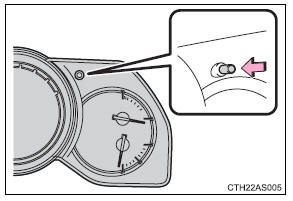
Items displayed can be switched by pressing the display change button.
Odometer
Displays the total distance the vehicle has been driven.
Trip
meter
Displays the distance the vehicle has been driven since the meter was last reset. Trip meters “A” and “B” can be used to record and display different distances independently.
Pressing and holding the display change button will reset the trip meter that is currently displayed.
Eco Driving Indicator and average fuel consumption
Non-Optitron type meter
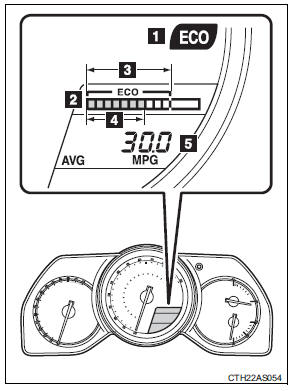
1. Eco Driving Indicator Light During Eco-friendly acceleration (Eco driving), Eco Driving Indicator Light will turn on.
2. Eco Driving Indicator Zone Display Suggests Zone of Eco driving with current Eco driving ratio based on acceleration.
3. Zone of Eco driving 4. Eco driving ratio based on acceleration In case over-use of the accelerator causes the vehicle to exceed Zone of Eco driving, the right of Eco Driving Indicator Zone Display will blink and Eco Driving Indicator Light will turn off.
5. Average fuel consumption Displays the average fuel consumption since the function was reset.
Pressing and holding the display change button will reset the average fuel consumption.
Use the displayed average fuel consumption as a reference.
Optitron type meter
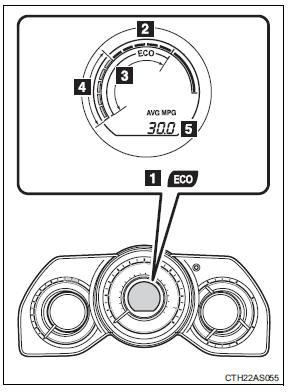
1. Eco Driving Indicator Light
During Eco-friendly acceleration (Eco driving), Eco Driving Indicator Light will turn on.
2. Eco Driving Indicator Zone Display
Suggests Zone of Eco driving with current Eco driving ratio based on acceleration.
3. Zone of Eco driving
4. Eco driving ratio based on
acceleration In case over-use of the accelerator causes the vehicle to exceed Zone of Eco driving, the right of Eco Driving Indicator Zone Display will blink and Eco Driving Indicator Light will turn off.
5. Average fuel consumption
Displays the average fuel consumption since the function was reset.
Pressing and holding the display change button will reset the average fuel consumption.
Use the displayed average fuel consumption as a reference.
Eco Driving Indicator Light customization
Non-Optitron type meter
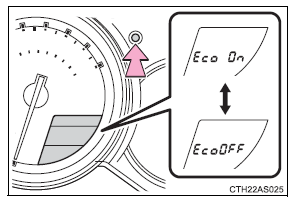
Eco Driving Indicator Light can be activated or deactivated by pressing and holding the display change button.
Optitron type meter
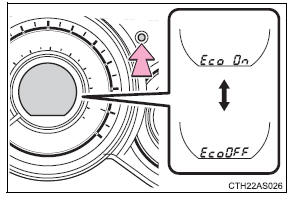
Eco Driving Indicator Light can be activated or deactivated by pressing and holding the display change button.
Instrument panel light control
The brightness of the instrument panel lights can be adjusted.
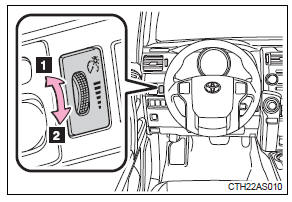
1. Brighter
2. Darker
The meters and display illuminate when (Optitron type meter)
Vehicles without a smart key system:
The engine switch is in the “ON” position.
Vehicles with a smart key system:
The “ENGINE START STOP” switch is in IGNITION ON mode.
Eco Driving Indicator Light will not operate in the following conditions
• The shift lever is in anything other than D.
• The vehicle speed is approximately 80 mph (130 km/h) or higher.
When the average fuel consumption is reset
The average fuel consumption displayed on the accessory meter and “Past Record” screen of the Display Audio system (if equipped) or the navigation system (if equipped) will be reset at the same time.
The brightness of the instrument panel lights (Optitron type meter)
When the headlight switch is turned to on, the brightness will be reduced slightly unless the control dial is turned fully upward.
NOTICE
To prevent damage to the engine and its components
• Do not let the indicator needle of the tachometer enter the red zone, which indicates the maximum engine speed.
• The engine may be overheating if the engine coolant temperature gauge is in the red zone (H). In this case, immediately stop the vehicle in a safe place, and check the engine after it has cooled completely.
While driving (Optitron type meter)
When the voltmeter indicates more than 19 V or less than 9 V, the battery may be malfunctioning. Have your vehicle checked at your Toyota dealer.
Indicators and warning lights
The indicator and warning lights on the instrument cluster and center panel inform the driver of the status of the vehicle’s various systems.
Instrument cluster (non-Optitron type meters)
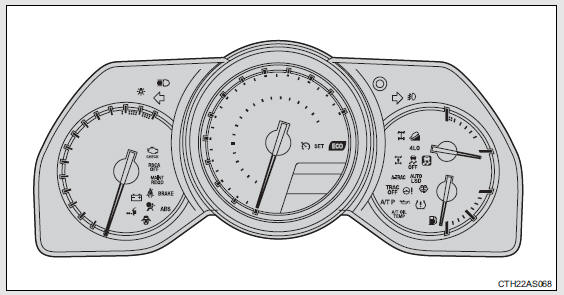
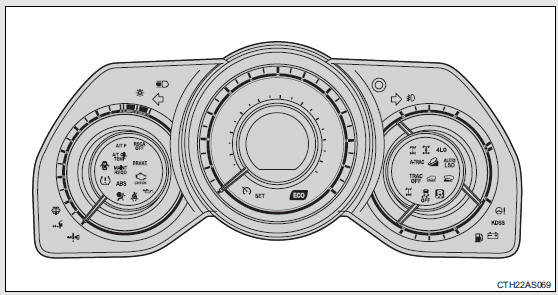
Instrument cluster (Optitron type meters)
Center panel
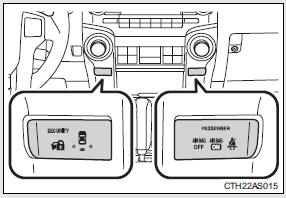
Indicators
The indicators inform the driver of the operating state of the vehicle’s various systems.
 Turn signal indicator
 Headlight high beam indicator
 Headlight indicator
 Tail light indicator
 Front fog light indicator
 Cruise control indicator
 Cruise control set indicator
 Slip indicator
 VSC off indicator
 “TRAC OFF” indicator
 Roll sensing of curtain shield
airbags off indicator
 Four-wheel drive indicator
 Downhill assist control system
indicator
 Low speed four-wheel drive
indicator
 Rear differential lock indicator
 Center differential lock
indicator
 “A-TRAC” indicator
 “AUTO LSD” indicator
 Multi-terrain Select indicator
 Crawl Control indicator
 Eco Driving Indicator Light
 SRS airbag on-off indicator
 Security indicator
 Intuitive parking assist
indicator
 Automatic running boards
indicator
*1: These lights turn on when the “ENGINE START STOP” switch is turned to IGNITION ON mode (vehicles with a smart key system) or the engine switch is turned to the “ON” position (vehicles without a smart key system) to indicate that a system check is being performed.
They will turn off after the engine is started, or after a few seconds. There may be a malfunction in a system if a light does not come on, or if the lights do not turn off. Have the vehicle inspected by your Toyota dealer.
*2: The light flashes to indicate that the system is operating.
Warning lights
Warning lights inform the driver of malfunctions in any of the vehicle’s systems.
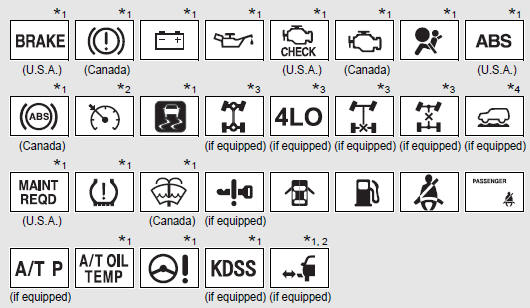
*1: These lights turn on when the “ENGINE START STOP” switch is turned to IGNITION ON mode (vehicles with a smart key system) or the engine switch is turned to the “ON” position (vehicles without a smart key system) to indicate that a system check is being performed.
They will turn off after the engine is started, or after a few seconds. There may be a malfunction in a system if a light does not come on, or if the lights do not turn off. Have the vehicle inspected by your Toyota dealer.
*2: The light flashes to indicate a malfunction.
*3: The light flashes rapidly to indicate a malfunction.
*4: The light flashes continuously to indicate a malfunction.
CAUTION
If a safety system warning light does not come on
Should a safety system light such as the ABS or SRS warning light not come on when you start the engine, this could mean that these systems are not available to help protect you in an accident, which could result in death or serious injury. Have the vehicle inspected by your Toyota dealer immediately if this occurs.
Accessory meter
The accessory meter presents the driver with a variety of drivingrelated data including the current outside air temperature.
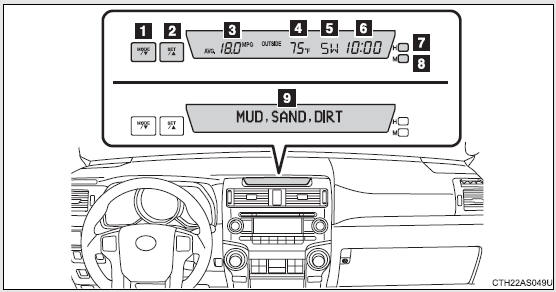
1. “MODE/  ” button
2. “SET/  ” button
3. Trip information Displays driving range and average fuel consumption 4. Outside temperature display 5. Compass
6. Clock
7. H (Hour) button
8. M (Minute) button
9. Multi-terrain Select display Automatically displayed when using Multi-terrain Select
Trip information
Items displayed can be switched by pressing the “MODE/ ” button.
Driving range
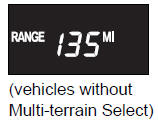
Displays the estimated maximum distance that can be driven with the quantity of fuel remaining
• This distance is computed based on your average fuel consumption. As a result, the actual distance that can be driven may differ from that displayed.
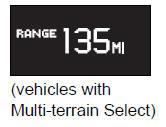
• When only a small amount of fuel is added to the tank, the display may not be updated.
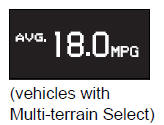
Average fuel consumption
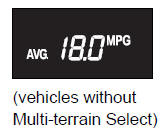
Displays the average fuel consumption since the function was reset
• Pressing and holding the “SET/ ”
button will reset the average fuel consumption.
• Use the displayed average fuel consumption as a reference.
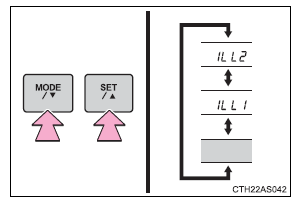
Accessory meter light control
The daytime brightness of the accessory meter can be adjusted.
 Turn the headlight switch off.
 Press and hold the “MODE/
” button.
 Press the “MODE/
” or “SET/
” button.
Vehicles without Multi-terrain Select
Vehicles with Multi-terrain Select
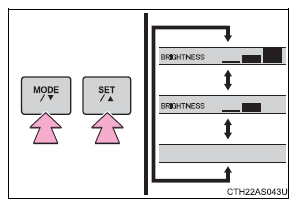
 Press and hold the “SET/
” button.
When the average fuel consumption is reset
The average fuel consumption displayed on the instrument cluster and “Past Record” screen of the Display Audio system (if equipped) or the navigation system (if equipped) will be reset at the same time.
Adjusting the brightness of the accessory meter
• If left idle for approximately 6 seconds or more while adjusting, the display will revert to the trip information display.
• When the parking lights are on, the brightness of the accessory meter can be adjusted only with the instrument panel light control.
• If the “MODE/ ” button is pressed
and held when the accessory meter light control is displayed, the display will switch to compass calibration.
Liquid crystal display
Small spots or light spots may appear on the display. This phenomenon is characteristic of liquid crystal displays, and there is no problem with continuing to use the display.
NOTICE
The accessory meter at low temperatures
Allow the interior of the vehicle to warm up before using the liquid crystal display.
At extremely low temperatures, the display monitor may respond slowly, and display changes may be delayed.
Download Manual