Vehicle Features
See the infotainment manual for information on the radio, audio players, phone, navigation system, and voice or speech recognition.
It also includes information on settings.
The infotainment system can be operated by using the steering wheel controls. See “Steering Wheel Controls” in the infotainment manual.
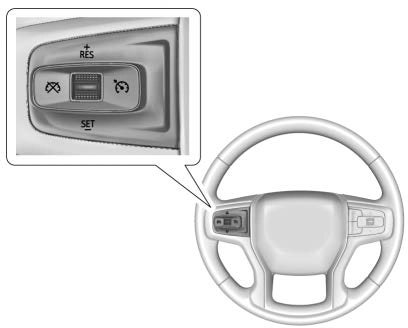
5 : If equipped, press to turn the system on or off. A white indicator comes on in the instrument cluster
when cruise control is on and turns off when cruise control is off.
+ RES : If there is a set speed in memory, press the control up briefly to resume to that speed or press and hold to accelerate. If cruise control is already engaged, use to increase vehicle speed.
SET − : Press the control down briefly to set the speed and activate cruise control. If cruise control is already engaged, use to decrease vehicle speed.
* : Press to disengage cruise control without erasing the set speed from memory.
See Cruise Control 0 254.
The DIC display is in the instrument cluster. It shows the status of many vehicle systems.
If the vehicle has the base level instrument cluster, the trip odometer reset stem is used to operate
the DIC.
If the vehicle has the uplevel instrument cluster, the right steering wheel controls are used to operate the DIC.
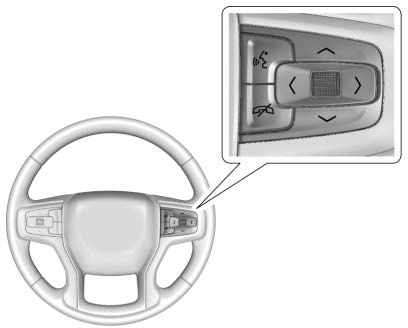
y or z : Use the thumbwheel to scroll up or down in a list. Press the thumbwheel to select.
S or T : Press to move between the interactive display zones in the cluster. Press the thumbwheel to select.
See Driver Information Center (DIC) (Midlevel and Uplevel) 0 162 or Driver Information Center (DIC) (Base Level) 0 161.
If equipped, FCA may help avoid or reduce the harm caused by
front-end crashes. FCA provides a green indicator, V, when a vehicle is detected ahead. This indicator displays amber when following a vehicle much too closely. When approaching a vehicle ahead too quickly, FCA provides a flashing red alert on the windshield and rapidly beeps or pulses the driver seat.
See Forward Collision Alert (FCA) System 0 264.
If the vehicle has Forward Collision Alert (FCA), it also has FAB, which includes Intelligent Brake Assist (IBA). When the system detects a vehicle ahead in your path that is traveling in the same direction that you may be about to crash into, it can provide a boost to braking or automatically brake the
vehicle. This can help avoid or lessen the severity of crashes when driving in a forward gear.
See Forward Automatic Braking (FAB) 0 267.
If equipped, the FPB system may help avoid or reduce the harm caused by front-end crashes with nearby pedestrians when driving in a forward gear. FPB displays an amber indicator, ~, when a nearby pedestrian is detected directly ahead. When approaching a detected pedestrian too quickly, FPB provides a red flashing alert on the windshield and rapidly beeps or pulses the driver seat. FPB can provide a boost to braking or automatically brake the vehicle.
See Front Pedestrian Braking (FPB) System 0 268.
If equipped, LKA may help avoid crashes due to unintentional lane departures. It may assist by gently turning the steering wheel if the vehicle approaches a detected lane marking without using a turn signal in that direction. It may also provide a Lane Departure Warning (LDW) alert as the lane marking is crossed. The system will not assist or alert if it detects that you are actively steering. Override LKA by turning the steering wheel. LKA uses a camera to detect lane markings between 60 km/h (37 mph) and
180 km/h (112 mph).
See Lane Departure Warning (LDW)
0 273 and
Lane Keep Assist (LKA) 0 273.
If equipped, the LCA system is a lane-changing aid that assists drivers with avoiding lane change crashes that occur with moving vehicles in the side blind zone areas or with vehicles rapidly approaching
these areas from behind. The LCA warning display will light up in the corresponding outside mirror and will flash if the turn signal is on. The Side Blind Zone Alert (SBZA) system is included as part of the LCA system.
See Side Blind Zone Alert (SBZA)
0 270 and
Lane Change Alert (LCA) 0 271.
If equipped, views around the vehicle appear in the infotainment display to aid with parking and low-speed maneuvers.
See “Surround Vision” under Assistance Systems for Parking or Backing 0 258.
If equipped, RVC shows a view of the area behind the vehicle on the infotainment display when the vehicle is shifted into R (Reverse) to aid with parking and low-speed backing maneuvers.
See Assistance Systems for Parking or Backing 0 258.
If equipped, the RCTA system shows a triangle with an arrow on the infotainment display to warn of traffic behind your vehicle that may cross your vehicle's path while in R (Reverse). In addition, beeps will sound, or the driver seat will pulse.
See Assistance Systems for Parking or Backing 0 258.
If equipped, Rear Park Assist (RPA) uses sensors on the rear bumper to assist with parking and avoiding objects while in R (Reverse).
It operates at speeds less than 8 km/h (5 mph). RPA may show a warning triangle on the infotainment display and a graphic on the instrument cluster to provide the object distance. In addition, multiple beeps or seat pulses may occur if very close to an object.
The vehicle may also have the Front Park Assist system.
See Assistance Systems for Parking or Backing 0 258.
Accessory power outlets can be used to plug in electrical equipment, such as a cell phone, MP3
player, etc.
The vehicle has one accessory power outlet under the climate control system and one accessory power outlet on the rear of the center console, if equipped, or on the rear of the bench seat,
if equipped.
Lift the cover to access and replace when not in use.
See Power Outlets 0 134.
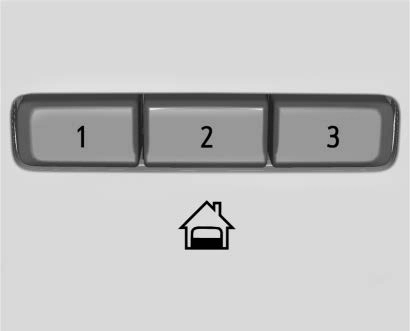
If equipped, the Universal Remote system enables the vehicle to control three different devices, ranging from garage doors and gates to home lighting. These buttons are in the overhead console.
See Universal Remote System
0 174.
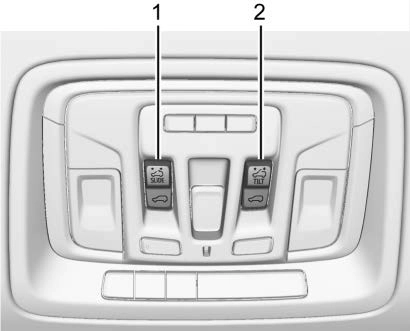
If equipped, the sunroof operates when the ignition is on or in ACC/ ACCESSORY, or when Retained Accessory Power (RAP) is active. See Retained Accessory Power (RAP) 0 227.
Slide Switch
Express-Open/Express-Close : To express-open the sunroof, fully press and release I (1). Press and
release I (1) again to stop the movement. To express-close the sunroof, fully press and release K (1). Press and release K (1) again to stop the movement.
Open/Close (Manual Mode) : To open the sunroof, press and hold I (1). Release I (1) to stop the
movement. Press and hold K (1) to close the sunroof. Release K
(1) to stop the movement.
Tilt Switch
Vent : From the closed position, press J (2) to vent the sunroof. Press K (2) to close the vent.
When the sunroof is opened, an air deflector will automatically raise.
The air deflector will retract when the sunroof is closed.
The sunroof also has a sunshade, which can be pulled forward to block sun rays. The sunshade must be opened and closed manually.
The sunroof has an automatic reversal system that is only active when the sunroof is operated in express-close mode.
If an object is in the path while express-closing, the reversal system will detect an object, stop, and open the sunroof again.
See Sunroof 0 66.
Download Manual