Initial Drive Information
This section provides a brief overview about some of the important features that may or may not be on your specific vehicle.
For more detailed information, refer to each of the features which can be found later in this owner’s manual.
If equipped, the Stop/Start system will shut off the engine to help conserve fuel. It has components designed for the increased number of starts.
When the brakes are applied and the vehicle is at a complete stop, the engine may turn off. When stopped, the tachometer displays AUTO STOP. See Tachometer
0 145. When the brake pedal is released or the accelerator pedal is pressed, the engine will restart. See Stop/Start System 0 224.
The Remote Keyless Entry (RKE) transmitter functions may work from up to 60 m (197 ft) away from the vehicle.
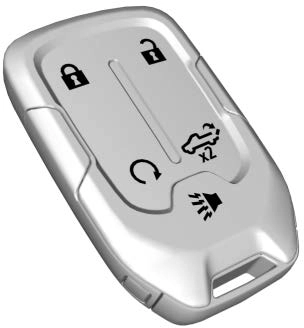
Keyless Access
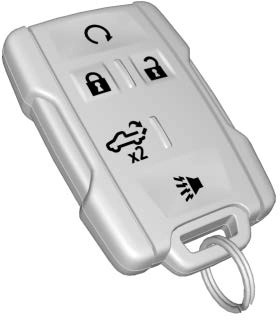
Key Access
K : Press to unlock the driver door. Press K again within three seconds
to unlock all remaining doors and the tailgate, if equipped.
Q : Press to lock all doors and the tailgate, if equipped. Lock and unlock feedback can be
personalized. See Vehicle Personalization 0 170.
7 : Press and release one time to initiate vehicle locator. Press 7 and
hold for more than three seconds to sound the panic alarm. Press 7 again to cancel the panic alarm.
 : Press twice quickly to release the tailgate, if equipped.
See Keys 0 31 and
Remote Keyless Entry (RKE) System Operation (Keyless Access) 0 34 or
Remote Keyless Entry (RKE) System Operation (Key Access) 0 42.
If equipped, the engine can be started from outside of the vehicle.
Start the vehicle normally after entering.
When the vehicle starts, the parking lamps will turn on.
Remote start can be extended.
To cancel a remote start, do one of the following:
There are several ways to lock and unlock the vehicle.
From outside, use one of the following:
From inside:
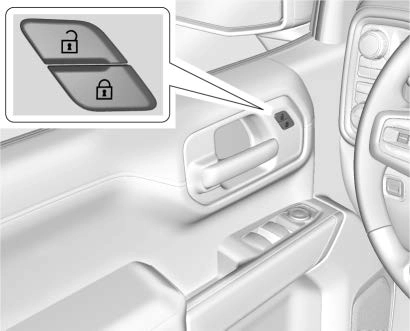
Q : Press to lock the doors.
K : Press to unlock the doors. See Door Locks 0 45 and
Power Door Locks 0 46.
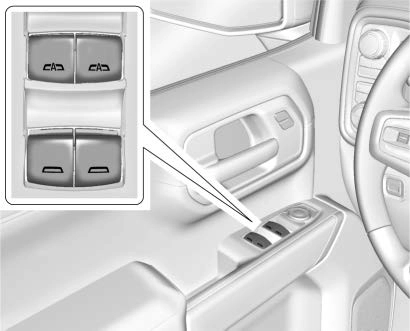
Power windows work when the ignition is on, in ACC/ACCESSORY, or when Retained Accessory Power (RAP) is active. See Retained Accessory Power (RAP) 0 227.
Using the window switch, press to open or pull to close the window.
The windows may be temporarily disabled if they are used repeatedly within a short time.
See Power Windows 0 64.
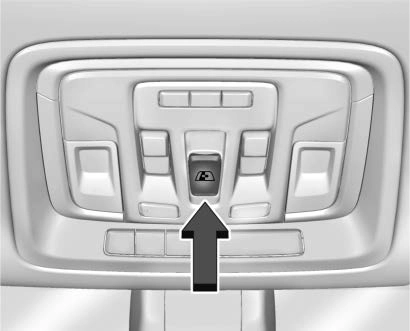
If equipped, the power sliding rear window works when the ignition has been turned on or to ACC/ ACCESSORY, or when Retained Accessory Power (RAP) is active. See Retained Accessory Power (RAP) 0 227.
Using the window switch, press to open or pull to close the window.
The power sliding rear window cannot be operated manually. See “Power Sliding Rear Window” in Rear Windows 0 66.
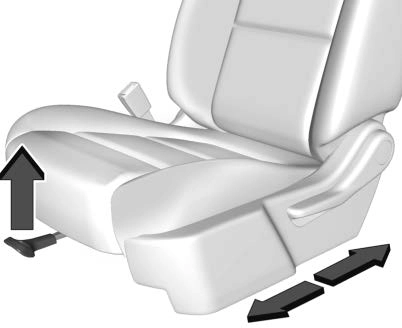
To adjust a manual seat:
See Seat Adjustment 0 70.
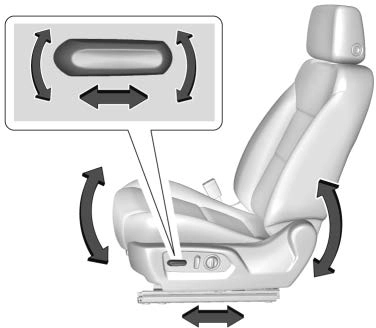
To adjust a power seat, if equipped:
See Power Seat Adjustment 0 71.
Manual Reclining Seatbacks
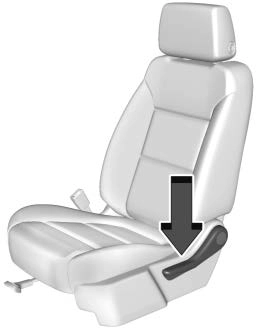
To adjust a manual seatback:
The seatback will automatically fold forward.
To return the seatback to the upright position:
See Reclining Seatbacks 0 72.
Power Reclining Seatbacks
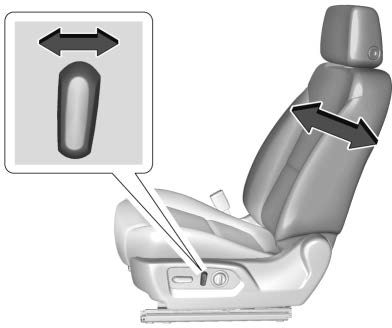
To recline a power seatback, if equipped:
See Reclining Seatbacks 0 72.
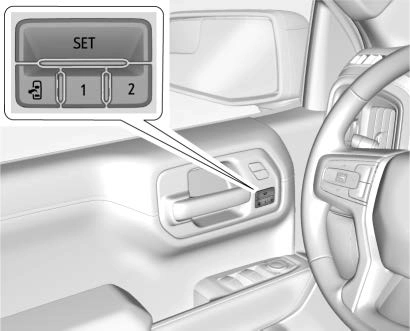
If equipped, memory seats allow two drivers to save and recall their unique seat positions for driving the vehicle, and a shared exit position for getting out of the vehicle. Other feature positions may also be saved, such as power mirrors,
if equipped. Memory positions are linked to RKE transmitter 1 or 2 for automatic memory recalls.
Before saving, adjust all available memory feature positions. Turn the ignition on and then press and release SET; a beep will sound.
Then immediately press and hold 1,
2, or B (Exit) until two beeps sound. To manually recall these positions, press and hold 1, 2, or B until the saved position is reached.
When Seat Entry Memory is enabled in vehicle personalization, positions previously saved to memory buttons 1 and 2 are recalled when the ignition is changed from off to on or ACC/ ACCESSORY.
When Seat Exit Memory is enabled in vehicle personalization, the feature automatically recalls the previously saved exit position when exiting the vehicle.
Memory adjustments may not be available upon delivery or after service until steps in “Saving Memory Positions” section are performed. See Memory Seats 0 74.
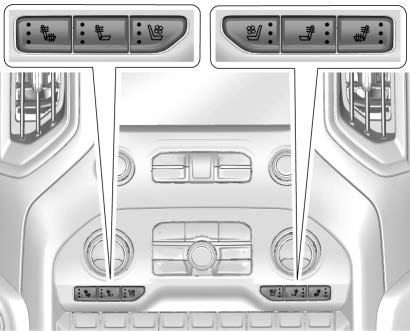
Heated and Ventilated Seat Buttons Shown, Heated Seat Buttons Similar
If equipped, the buttons are on the center stack. To operate, the engine must be running.
Press I or + to heat the driver or passenger seatback only.
Press J or z to heat the driver or passenger seat cushion and seatback.
Press C or { to ventilate the driver or passenger seat.
See Heated and Ventilated Front Seats 0 76.
Do not drive until the head restraints for all occupants are installed and adjusted properly.
To achieve a comfortable seating position, change the seatback recline angle as little as necessary while keeping the seat and the head restraint height in the proper position.
See Head Restraints 0 69 and
Seat Adjustment 0 70.
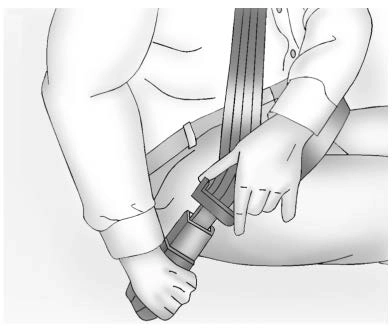
Refer to the following sections for important information on how to use seat belts properly:
0 81
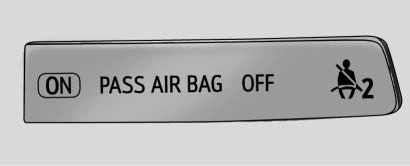
United States
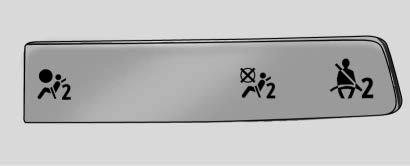
Canada
The passenger sensing system turns off the front outboard passenger frontal airbag under certain conditions. No other airbag is affected by the passenger sensing system. See Passenger Sensing System 0 93.
The passenger airbag status indicator will light on the overhead console when the vehicle is started. See Passenger Airbag Status Indicator 0 150.
Using hood-mounted air deflectors and add-on convex mirror attachments could decrease mirror performance.
Manual Mirrors
If equipped, adjust manual mirrors by moving them up and down or left to right to see a little of the side of the vehicle and to have a clear view behind the vehicle.
See Manual Mirrors 0 57.
Power Mirrors
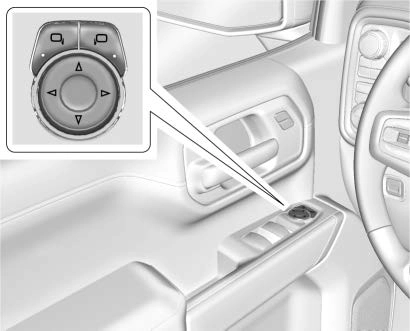
See Power Mirrors 0 58.
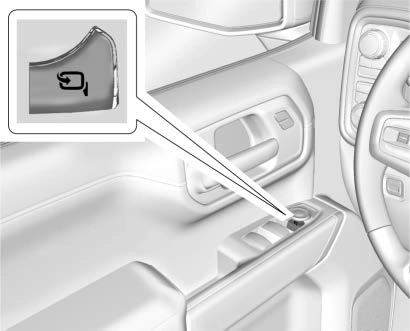
If equipped with power folding mirrors:
For manual, power, and remote folding mirrors, see Folding Mirrors 0 58.
The mirrors may also include a memory function that works with the memory seats. See Memory Seats 0 74.
Adjustment
Adjust the mirror for a clear view of the area behind the vehicle.
Manual Dimming Rearview Mirror
If equipped, push the tab forward for daytime use and pull it for nighttime use to avoid glare from the headlamps from behind. See Manual Rearview Mirror 0 61.
Automatic Dimming Rearview Mirror
If equipped, the mirror will automatically reduce the glare of the headlamps from behind. The dimming feature comes on when the vehicle is started.
See Automatic Dimming Rearview Mirror 0 61.
Rear Camera Mirror
If equipped, this automatic dimming rearview mirror provides a wide angle camera view of the area behind the vehicle. Adjust the mirror
for a clear view of the area behind the vehicle while the display is off. See Rear Camera Mirror 0 61.
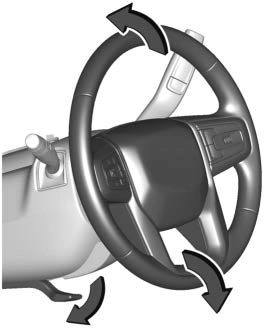
To adjust the steering wheel:
Tilt and Telescoping Wheel
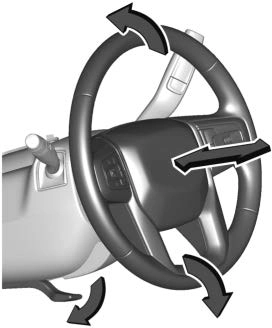
To adjust the tilt and telescoping steering wheel, if equipped:
Do not adjust the steering wheel while driving.
Dome Lamps
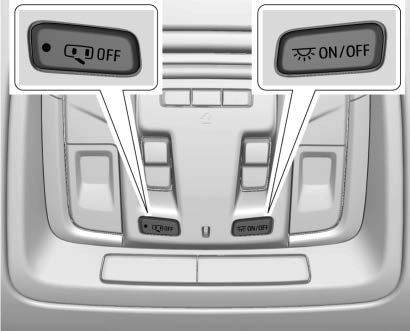
The dome lamp controls are in the overhead console.
To operate, press the following buttons:
j OFF : Press to turn off the dome lamps when a door is open. An indicator light on the button will turn on when the dome lamp override is activated. Press j
OFF again to deactivate this feature
and the indicator light will turn off. The dome lamps will come on when doors are opened.
+ ON/OFF : Press to turn the dome lamps on manually. Press again to turn the dome lamps off.
Reading Lamps
There are reading lamps on the overhead console and over the rear seats. These lamps come on when any door is opened.
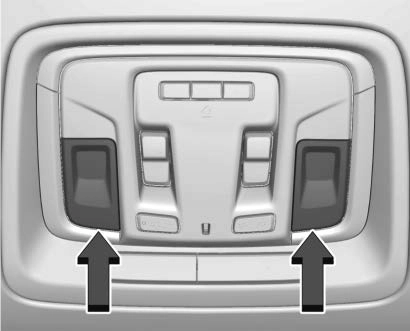
Front Reading Lamps
The front reading lamps are in the overhead console.
Press the lamp lenses to turn the front reading lamps on or off.
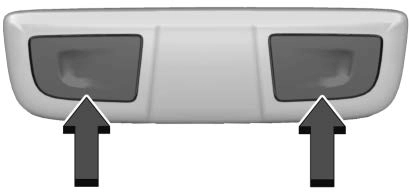
Rear Reading Lamps
The rear reading lamps are over the rear seats.
Press the lamp lens to turn the rear reading lamps on or off.
For more information on interior lighting, see Instrument Panel Illumination Control 0 185.
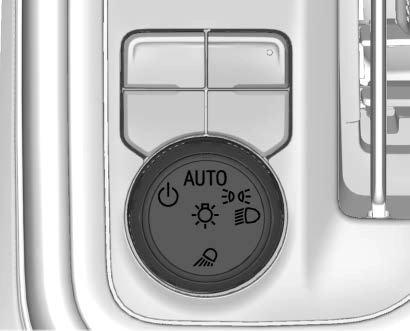
The exterior lamp control is on the instrument panel to the left of the steering wheel.
O : Turns off the automatic headlamps and Daytime Running Lamps (DRL). Turn the headlamp control to O again to turn the
automatic headlamps or DRL back on.
For vehicles first sold in Canada, off will only work when the vehicle is in P (Park).
AUTO : Automatically turns on the headlamps, parking lamps, taillamps, instrument panel lights, roof marker lamps (if equipped), front/rear sidemarker lamps, and license plate lamps.
; : Turns on the parking lamps including all lamps, except the headlamps and fog lamps,
if equipped.
5 : Turns on the headlamps together with the parking lamps, taillamps, instrument panel lights, roof marker lamps (if equipped), front/rear sidemarker lamps, and license plate lamps.
See:
0 181.
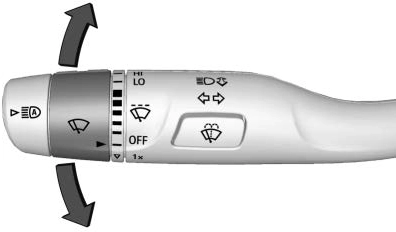
The windshield wiper control is on the turn signal lever.
The windshield wipers are controlled by turning the band with N on it.
HI : Use for fast wipes.
LO : Use for slow wipes.
3 : Turn the band up for more frequent intermittent wipes or down for less frequent intermittent wipes.
OFF : Use to turn the wipers off.
1x : For a single wipe, briefly turn the  band down. For several wipes, hold the band down.
L : Press L on the windshield wiper control to spray windshield washer fluid and activate the wipers.
See Windshield Wiper/Washer
0 133.
The heating, cooling, and ventilation in the vehicle can be controlled with these systems.
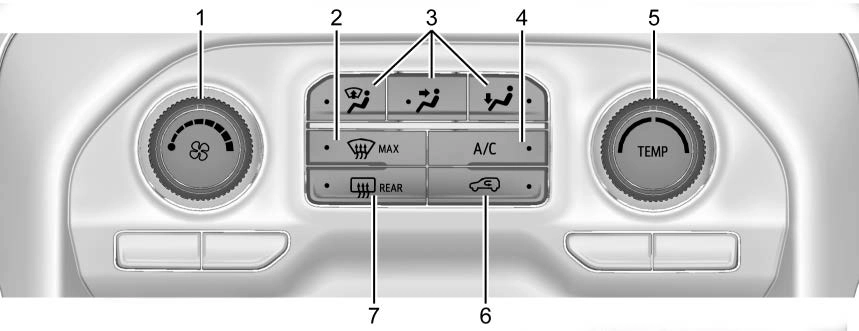
Climate Control System
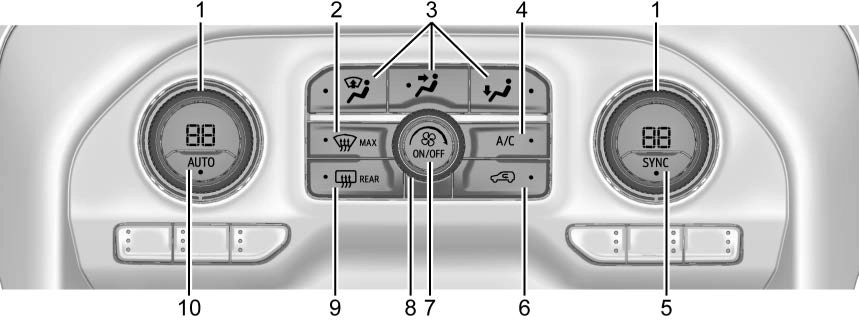
Dual Automatic Climate Control System
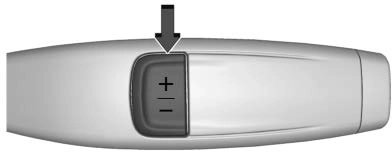
The Range Selection Mode switch is on the shift lever.
or
Dual Automatic Climate Control System 0 192 (If Equipped).
feature, move the shift lever to the L (Manual Mode) position. The current range will appear next to the L. This is the highest attainable range with all lower gears accessible. As an example, when 5 (Fifth) gear is selected, 1 (First) through 5 (Fifth) gears are available.
While using Range Selection Mode, cruise control and the Tow/Haul Mode can be used.
Grade Braking is not available when Range Selection Mode is active.
See Tow/Haul Mode 0 237.
If equipped with four-wheel drive, the engine's driving power can be sent to all four wheels for extra traction.
Use the transfer case controls to shift into and out of the different four-wheel drive modes.
Automatic Transfer Case
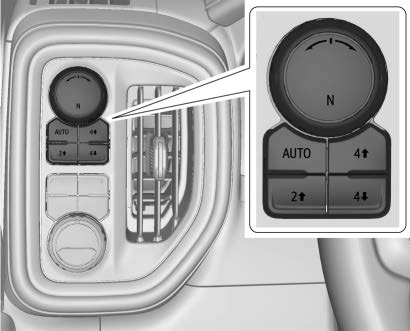
The transfer case controls are to the left of the steering column.
The different drive options that may be available are described as follows.
2 m (Two-Wheel Drive High) : This setting is used for driving in most street and highway situations.
AUTO (Automatic Four-Wheel Drive) : This setting is ideal for use when road surface conditions are variable.
If equipped, use 4 n, AUTO, or 4 m to provide additional traction when
parking on a steep grade with poor traction such as ice, snow, mud,
or gravel.
4 m (Four-Wheel Drive High) : Use this setting when extra traction is
needed for conditions such as rough roads, deep snow or most off road situations.
The following options are only available with a two-speed transfer case:
N (Neutral) : Shift to this setting only when towing the vehicle. See Recreational Vehicle Towing 0 403 or
Towing the Vehicle 0 402.
4 n (Four-Wheel Drive Low) : This setting sends maximum power to all four wheels. Choose 4n when driving in deep sand, mud, or snow,
and while climbing or descending steep hills.
See Four-Wheel Drive 0 238.
Download Manual