Maintenance
MAINTENANCE PRECAUTIONS
Service your vehicle regularly to help maintain its roadworthiness and resale value. There is a large network of authorized dealers that are there to help you with their professional servicing expertise. We believe that their specially trained technicians are best qualified to service your vehicle properly and expertly. They are supported by a wide range of highly specialized tools developed specifically for servicing your vehicle.
If your vehicle requires professional service, an authorized dealer can provide the necessary parts and service. Check your warranty information to find out which parts and services are covered.
Use only recommended fuels, lubricants, fluids and service parts conforming to specifications.
- Do not work on a hot engine.
- Make sure that nothing gets caught in moving parts.
- Do not work on a vehicle with the engine running in an enclosed space, unless you are sure you have enough ventilation.
- Keep all open flames and other burning material, such as cigarettes, away from the battery and all fuel related parts.
- Set the parking brake, shift the transmission to park (P) and block the wheels.
OPENING AND CLOSING THE HOOD
Opening the Hood
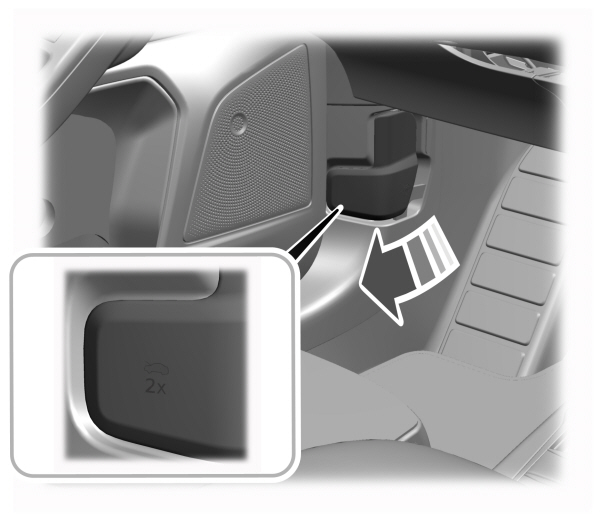
- Open the left-hand front door.
- Fully pull the hood release lever and let it completely retract.
Note: This action releases the hood latch.
- Fully pull the hood release lever for a second time.
Note: This action fully releases the hood.
- Open the hood.
Note: There is no secondary hood release under the hood.
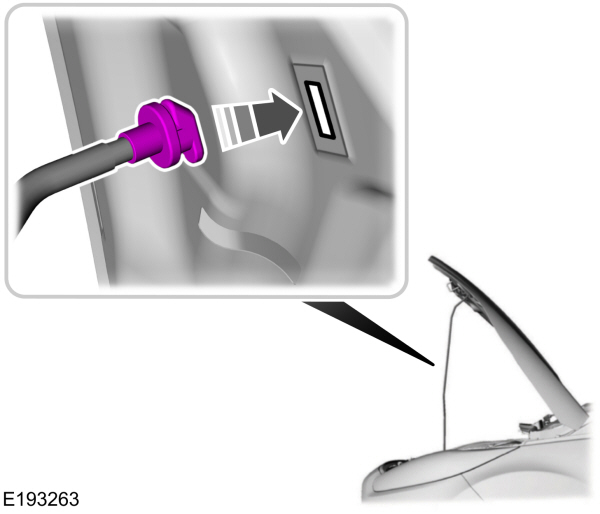
- Support the hood with the strut.
Closing the Hood
 WARNING: Make sure that you fully latch the hood before driving. Failure to follow this instruction could result in personal injury or death. WARNING: Make sure that you fully latch the hood before driving. Failure to follow this instruction could result in personal injury or death. |
- Remove the strut from the catch and secure it correctly in the clip.
- Lower the hood and allow it to drop under its own weight for the last 10–14 in (25–35 cm).
Warning Lamps and Indicators
 This lamp illuminates when the ignition is on and the hood is not completely closed. This lamp illuminates when the ignition is on and the hood is not completely closed. |
Information Messages
| Message | Action |
|---|---|
|
Hood Ajar |
Stop your vehicle as soon as it is safe to do so and close the hood. |
UNDER HOOD OVERVIEW - 1.5L ECOBOOST™
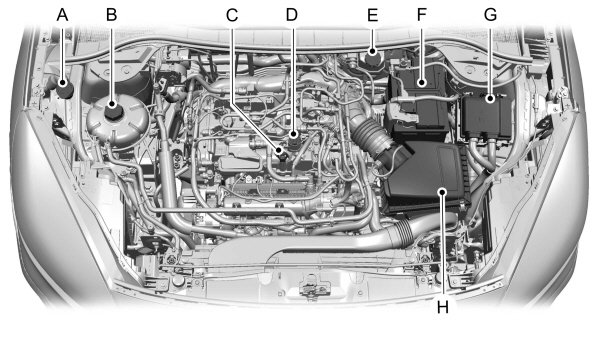
A Windshield washer fluid.See Adding Washer Fluid. Windshield washer fluid.See Adding Washer Fluid. B Engine coolant reservoir.See Checking the Coolant Level . C Engine oil dipstick.See Engine Oil Dipstick Overview - 1.5L EcoBoost (132kW/180PS) – I3 (Y1). D Engine oil filler cap.See Adding Engine Oil. E Brake fluid reservoir.See Locating the Brake Fluid Reservoir. F Battery.See Changing the 12V Battery - 1.5L EcoBlue (88kW/120PS) (ZT)/1.5L EcoBlue (90kW/120PS) (BE)/1.5L EcoBoost (129kW/175PS) (CR)/1.5L EcoBoost (90kW/120PS) - I3 (UN)/1.5L EcoBoost (110kW/150PS) – I3 (YZ)/1.5L EcoBoost (132kW/180PS) – I3 (Y1)/1.5L EcoBoost (134kW/182PS) – I3 (YZ)/1.5L EcoBoost – Hybrid (BR)/2.0L EcoBlue (77kW/105PS) (BJ)/2.0L EcoBlue (110kW/150PS) (BK)/2.0L EcoBlue (110kW/150PS) (YL)/2.0L EcoBlue (110kW/150PS) (YM)/2.0L EcoBlue (140kW/190PS) (YM)/2.0L EcoBoost (177kW/240PS) – MI4/2.0L EcoBoost (184kW/250PS) – MI4, Excluding: Full Hybrid Electric Vehicle (FHEV)/Plug-In Hybrid Electric Vehicle (PHEV) . G Engine compartment fuse box.See Fuses. H Air filter assembly. |
UNDER HOOD OVERVIEW - 2.0L ECOBOOST™
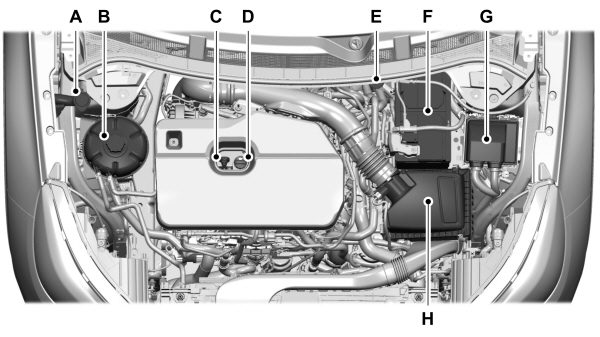
| AWindshield washer fluid reservoir. See Adding Washer Fluid. B Engine coolant reservoir.See Checking the Coolant. C Engine oil dipstick.See Engine Oil Dipstick Overview - 1.5L EcoBoost (132kW/180PS) – I3 (Y1). D Engine oil filler cap.See Adding Engine Oil. E Brake fluid reservoir.See Locating the Brake Fluid Reservoir. F Battery.See Changing the 12V Battery. G Engine compartment fuse box.See Fuses. H Air filter assembly. See Changing the Engine Air Filter - 1.5L EcoBoost™/2.0L EcoBoost™. |
UNDER HOOD OVERVIEW - HYBRID ELECTRIC VEHICLE (HEV)
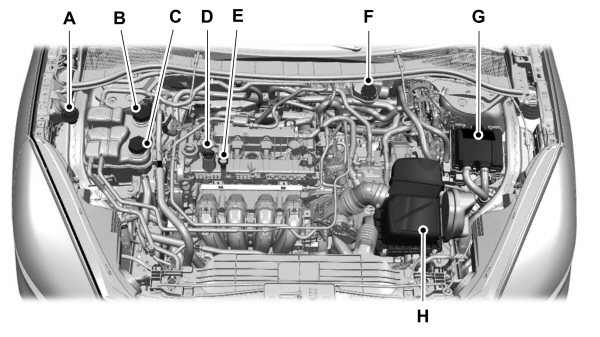
| AWindshield washer fluid reservoir: See Adding Washer Fluid. B Low temperature coolant cap: See Checking the Coolant. C High temperature coolant cap: See Checking the Coolant. D Engine oil filler cap: See Adding Engine Oil. E Engine oil dipstick: See Engine Oil Dipstick Overview - 1.5L EcoBoost (132kW/180PS) – I3 (Y1). F Brake fluid reservoir: See Checking the Brake Fluid. G Power distribution box: See Fuses. H Air filter assembly: See Changing the Engine Air Filter - 2.5L, Hybrid Electric Vehicle (HEV)/Plug-In Hybrid Electric Vehicle (PHEV). |
ENGINE OIL DIPSTICK OVERVIEW - 1.5L ECOBOOST (132KW/180PS) – I3 (Y1)
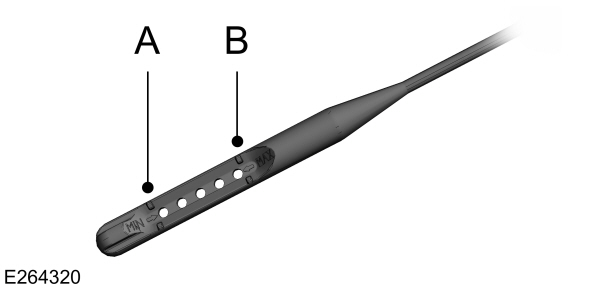
| AMinimum. B Maximum. |
ENGINE OIL DIPSTICK OVERVIEW - 2.0L ECOBOOST (177KW/240PS) – MI4/2.5L DURATEC – HYBRID (121KW/164PS) (BG)
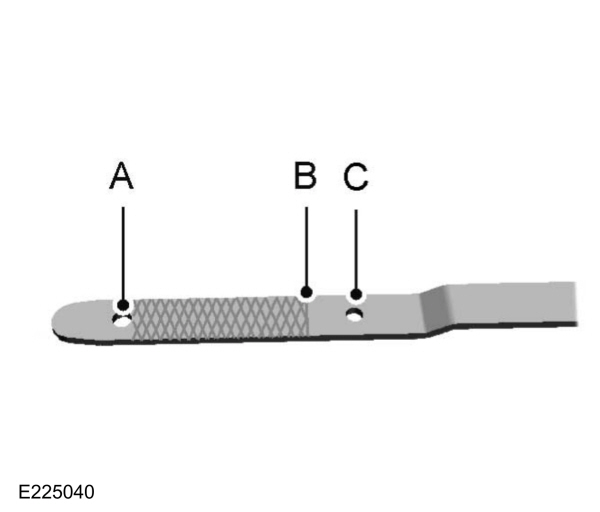
| AMinimum. B Fill Level.C Maximum. |
CHECKING THE ENGINE OIL LEVEL
- Make sure that your vehicle is on level ground.
- Check the oil level before starting the engine, or switch the engine off after warm up and wait 15 minutes for the oil to drain into the oil pan.
Note: Checking the oil level too soon could result in an inaccurate reading.
- Remove the dipstick and wipe it with a clean, lint-free cloth.
- Reinstall the dipstick and make sure it is fully seated.
- Remove the dipstick again to check the oil level.
Note: Read both sides of the dipstick and use the lowest oil level as the correct reading.
Note: If the oil level is between the maximum and minimum marks, the oil level is acceptable.Do not add oil.
- If the oil level is at the minimum mark, immediately add oil.
- Reinstall the dipstick. Make sure it is fully seated.
Note: The oil consumption of new engines reaches its normal level after approximately 3,000 mi (5,000 km).
Note: Increases in oil level can occur from frequent short trips that do not allow the engine to get to operating temperature, as well as frequent idling or low speed driving for long periods of time.
Note: If oil levels are continuously noted above the maximum mark, have your vehicle checked as soon as possible.
ADDING ENGINE OIL
| WARNING: Do not remove the filler cap when the engine is running. WARNING: Do not add engine oil when the engine is hot. Failure to follow this instruction could result in personal injury. |
Do not use supplemental engine oil additives because they are unnecessary and could lead to engine damage that the vehicle warranty may not cover.
- Clean the area surrounding the engine oil filler cap before you remove it.
- Remove the engine oil filler cap.
- Add engine oil that meets our specifications.See Capacities and Specifications.
- Reinstall the engine oil filler cap.Turn it clockwise until you feel a strong resistance.
Note: Do not add oil further than the maximum mark.Oil levels above the maximum mark may cause engine damage.
Note: Immediately soak up any oil spillage with an absorbent cloth.
RESETTING THE ENGINE OIL CHANGE REMINDER
Use the information display controls on the steering wheel to reset the oil change reminder.
From the main menu scroll to:
| Message | Action and description |
|---|---|
|
Settings |
Press the right arrow button, then from this menu scroll to the following message. |
|
Convenience |
Press the right arrow button, then from this menu scroll to the following message. |
|
Oil Life Reset |
Press the right arrow button, then from this menu scroll to the following message. |
|
Hold OK to Reset |
Press and hold the OK button until the instrument cluster displays the following message. |
|
Reset Successful |
|
| When the oil change reminder resets the instrument cluster displays 100%. | |
|
Remaining Life |
|
|
{00}% |
|
| If the instrument cluster displays one of the following messages, repeat the process. | |
|
Not Reset |
|
|
Reset Cancelled |
ENGINE OIL CAPACITY AND SPECIFICATION
For filling information, please refer to the Capacities and Specifications section of your owner's manual.See Capacities and Specifications .
CHECKING THE COOLANT
When the engine is cold, check the concentration and level of the coolant at the intervals listed in the scheduled maintenance information. See Scheduled Maintenance.
Note: Make sure that the coolant level is between the minimum and maximum marks on the coolant reservoir.
Note: Coolant expands when it is hot.The level may extend beyond the MAX mark.
If the coolant level is at or below the minimum mark, add prediluted coolant immediately.
Maintain coolant concentration within 48% to 50%, which equates to a freeze point between -29 °F (-34 °C) and -35 °F (-37 °C). Coolant concentration should be checked using a refractometer. We do not recommend the use of hydrometers or coolant test strips for measuring coolant concentration.
Adding Coolant
| WARNING: Keep your hands and clothing clear of the cooling fan. WARNING: Do not remove the coolant reservoir cap when the engine is on or the cooling system is hot. Wait 10 minutes for the cooling system to cool down. Cover the coolant reservoir cap with a thick cloth to prevent the possibility of scalding and slowly remove the cap. Failure to follow this instruction could result in personal injury. WARNING: Do not add coolant when the vehicle is on or the cooling system is hot. Failure to follow this instruction could result in personal injury. WARNING: Do not add coolant further than the MAX mark. WARNING: Do not put coolant in the windshield washer reservoir. If sprayed on the windshield, coolant could make it difficult to see through the windshield. WARNING: Do not allow the fluid to touch your skin or eyes. If this happens, rinse the affected areas immediately with plenty of water and contact your physician. |
Note: Do not use stop leak pellets, cooling system sealants, or non-specified additives as they can cause damage to the engine cooling or heating systems.Resulting component damage may not be covered by the vehicle Warranty.
Note: Automotive fluids are not interchangeable.
It is very important to use prediluted coolant approved to the correct specification in order to avoid plugging the small passageways in the engine cooling system. Do not mix different colors or types of coolant in your vehicle. Mixing of engine coolants or using an incorrect coolant may harm the engine or cooling system components and could void the vehicle Warranty.
Note: If prediluted coolant is not available, use the approved concentrated coolant diluting it to 50/50 with deionized or distilled water. Using water that has not been deionized may contribute to deposit formation, corrosion and plugging of the small cooling system passageways.
To top up the coolant level do the following:
- Unscrew the cap slowly. Any pressure escapes as you unscrew the cap.
- Add enough prediluted coolant to reach the correct level.
Note: We do not recommend the use of recycled coolant.
- Replace the coolant reservoir cap. Turn the cap clockwise until it contacts the hard stop.
- Check the coolant level in the coolant reservoir the next few times you drive your vehicle. If necessary, repeat step 2.
If you have to add more than 1.1 qt (1 L) of engine coolant per month, have your vehicle checked as soon as possible. Operating an engine with a low level of coolant can result in engine overheating and possible engine damage.
In case of emergency, you can add a large amount of water without engine coolant in order to reach a vehicle service location. Service your vehicle as soon as possible.
Water alone, without engine coolant, can cause engine damage from corrosion, overheating or freezing.
Do not use the following as a coolant substitute, as they can cause engine damage from overheating or freezing:
- Alcohol.
- Methanol.
- Brine.
- Any coolant mixed with alcohol or methanol antifreeze.
Do not add extra inhibitors or additives to the coolant. These can be harmful and compromise the corrosion protection of the coolant.
Severe Climates
If you drive in extremely cold climates, you may need to increase the coolant concentration above 50%.
Note: A coolant concentration of 60% provides improved freeze point protection. Coolant concentrations above 60% decrease the overheat protection characteristics of the coolant and could cause engine damage.
If you drive in extremely hot climates, you may need to decrease the coolant concentration to 40%.
Note: A coolant concentration of 40% provides improved overheat protection. Coolant concentrations below 40% decrease the overheat and corrosion protection characteristics of the coolant and could cause engine damage.
Coolant Change
| WARNING: Do not dispose of coolant in the household refuse or the public sewage system. Use an authorized waste disposal facility. |
Change the coolant at specific mileage intervals. Refer to the scheduled maintenance information. See Normal Scheduled Maintenance.
Note: Dispose of used coolant in the appropriate manner.
Follow your community's regulations and standards for recycling and disposing of automotive fluids.
Fail-Safe Cooling
Fail-safe cooling allows you to temporarily drive your vehicle before any incremental component damage occurs. The fail-safe distance depends on ambient temperature, vehicle load and terrain.
How Fail-Safe Cooling Works
| WARNING: If you continue to drive your vehicle when the engine is overheating, the engine could stop without warning. Failure to follow this instruction could result in the loss of control of your vehicle. |
 If the engine begins to overheat, the coolant temperature gauge moves toward the red zone: If the engine begins to overheat, the coolant temperature gauge moves toward the red zone: |
 A warning lamp illuminates and a message may appear in the information display. A warning lamp illuminates and a message may appear in the information display. |
If the engine reaches a preset over-temperature condition, the engine automatically switches to alternating cylinder operation. Each disabled cylinder acts as an air pump and cools the engine.
When this occurs, your vehicle still operates, however:
- Engine power is limited.
- The air conditioning system turns off.
Continued operation increases the engine temperature, causing the engine to completely shut down. Your steering and braking effort increases in this situation.
When the engine temperature cools, you can re-start the engine. Have your vehicle checked as soon as possible to minimize engine damage.
When Fail-Safe Mode Is Activated
| WARNING: Fail-safe mode is for use during emergencies only. Operate your vehicle in fail-safe mode only as long as necessary to bring your vehicle to rest in a safe location and seek immediate repairs. When in fail-safe mode, your vehicle will have limited power, will not be able to maintain high-speed operation, and may completely shut down without warning, potentially losing engine power, power steering assist, and power brake assist, which may increase the possibility of a crash resulting in serious injury. WARNING: Do not remove the coolant reservoir cap when the engine is on or the cooling system is hot. Wait 10 minutes for the cooling system to cool down. Cover the coolant reservoir cap with a thick cloth to prevent the possibility of scalding and slowly remove the cap. Failure to follow this instruction could result in personal injury. |
Your vehicle has limited engine power when in the fail-safe mode, drive your vehicle with caution. Your vehicle does not maintain high-speed operation and the engine could operate poorly.
Remember that the engine is capable of automatically shutting down to prevent engine damage. In this situation:
- Pull off the road as soon as safely possible and switch the engine off.
- If you are a member of a roadside assistance program, we recommend that you contact your roadside assistance service provider.
- If this is not possible, wait for a short period of time for the engine to cool.
- Check the coolant level. If the coolant level is at or below the minimum mark, add prediluted coolant immediately.
- When the engine temperature cools, you can re-start the engine. Have your vehicle checked as soon as possible to minimize engine damage.
Note: If you continue to drive your vehicle in fail-safe mode without repairing it, you will damage your engine.
Engine Coolant Temperature Management (If Equipped)
| WARNING: To reduce the risk of crash and injury, be prepared that the vehicle speed may reduce and the vehicle may not be able to accelerate with full power until the coolant temperature reduces. |
If you tow a trailer with your vehicle, the engine may temporarily reach a higher temperature during severe operating conditions, for example ascending a long or steep grade in high ambient temperatures.
At this time, you may notice the coolant temperature gauge moves toward the red zone and a message may appear in the information display.
You may notice a reduction in vehicle speed caused by reduced engine power in order to manage the engine coolant temperature.Your vehicle may enter this mode if certain high-temperature and high-load conditions take place.The amount of speed reduction depends on vehicle loading, grade and ambient temperature. If this occurs, there is no need to stop your vehicle.You can continue to drive.
The air conditioning may automatically turn on and off during severe operating conditions to protect the engine from overheating. When the coolant temperature decreases to the normal operating temperature, the air conditioning turns on.
If the coolant temperature gauge moves fully into the red zone, or if the coolant temperature warning or service engine soon messages appear in your information display, do the following:
- Stop your vehicle as soon as it is safe to do so. Fully apply the parking brake, shift into park (P) or neutral (N).
- Leave the engine running until the coolant temperature gauge needle returns to the normal position.If the temperature does not drop after several minutes, follow the remaining steps.
- Switch the engine off and wait for it to cool. Check the coolant level.
- If the coolant level is at or below the minimum mark, add prediluted coolant immediately.
- If the coolant level is normal, restart the engine and continue.
CHANGING THE ENGINE AIR FILTER - 1.5L ECOBOOST™/2.0L ECOBOOST™
| WARNING: To reduce the risk of vehicle damage and personal burn injuries, do not start your engine with the air cleaner removed and do not remove it while the engine is running. |
When changing the air filter element, use only parts that meet or exceed our specifications.
For EcoBoost equipped vehicles: When servicing the air cleaner, it is important that no foreign material enter the air induction system. The engine and turbocharger are susceptible to damage from even small particles.
Change the air filter element at the proper interval. See Scheduled Maintenance.
Note: Failure to use the correct air filter element may result in severe engine damage.The customer warranty may be void for any damage to the engine if the correct air filter element is not used.
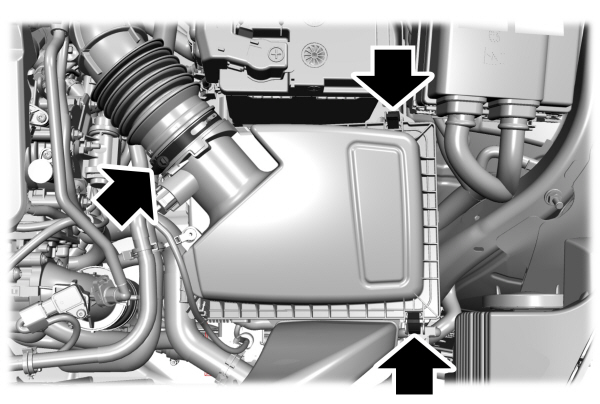
- Using a screwdriver, loosen the clamp on the air filter housing cover.
- Gently pull the boot back away from the air filter housing cover.
- Release the two clips from the air filter housing cover.
- Remove the air filter housing cover.
- Remove the air filter element from the air filter housing.
- Wipe any dirt or debris from the air filter housing assembly to make sure no dirt gets in the engine and to make sure you have a good seal.
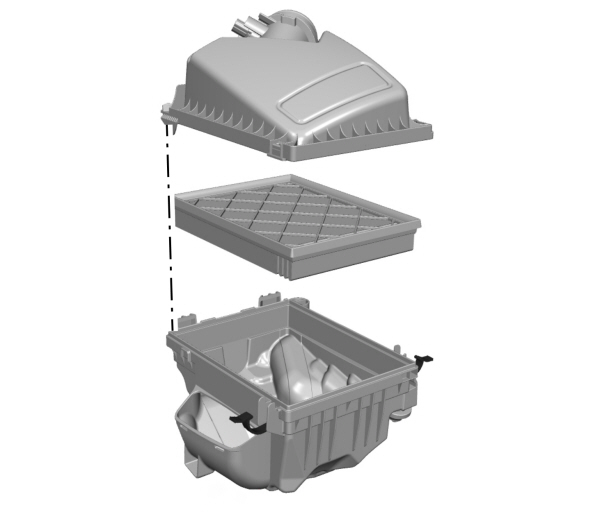
- Install a new air filter element.Be careful not to crimp the filter element edges between the air filter housing and cover.This could cause filter damage and allow unfiltered air to enter the engine if it is not properly seated.
- Install the air filter housing cover.
- Engage the clips to secure the air filter housing cover to the air filter housing.
- Reconnect the boot to the air filter housing cover and tighten securely.
CHANGING THE ENGINE AIR FILTER - 2.5L, HYBRID ELECTRIC VEHICLE (HEV)/PLUG-IN HYBRID ELECTRIC VEHICLE (PHEV)
| WARNING: To reduce the risk of vehicle damage and personal burn injuries, do not start your engine with the air cleaner removed and do not remove it while the engine is running. |
When changing the air filter element, use only parts that meet or exceed our specifications.
Change the air filter element at the proper interval. See Scheduled Maintenance.
Note: If you do not use the correct air filter element, your vehicle warranty could be void.
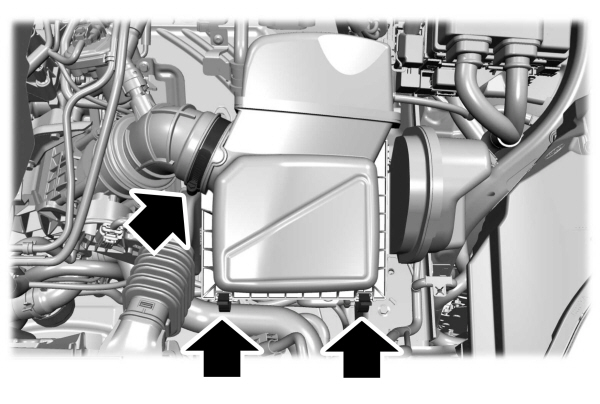
- Using a screwdriver, loosen the clamp on air filter housing cover.
- Gently pull the boot back away from the air filter housing cover.
- Release the two clips from the air filter housing cover.
- Remove air filter housing cover.
- Remove the air filter element from the air filter housing.
- Wipe any dirt or debris from the air filter housing assembly to make sure no dirt gets in the engine and to make sure you have a good seal.
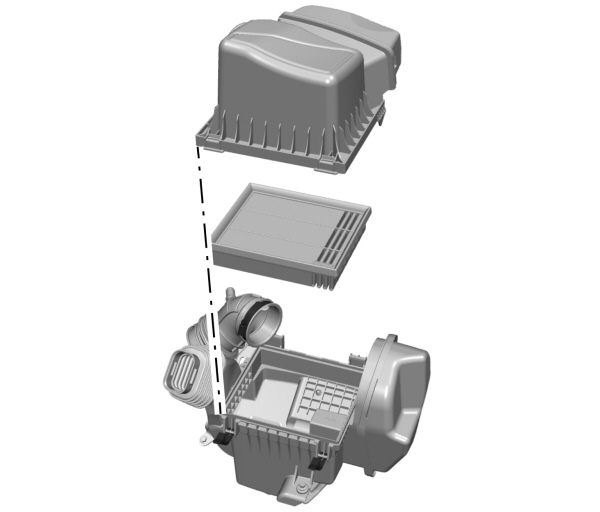
- Install a new air filter element.Be careful not to crimp the filter element edges between the air filter housing and cover.This could cause filter damage and allow unfiltered air to enter the engine if it is not properly seated.
- Install the air filter housing cover.
- Engage the clips to secure the air filter housing cover to the air filter housing.
- Reconnect the boot to the air filter housing cover and tighten securely.
CHANGING THE FUEL FILTER - GASOLINE, HYBRID ELECTRIC VEHICLE (HEV)
Your vehicle has a lifetime fuel filter that integrates with the fuel tank. It does not need regular maintenance or replacement.
DRIVE BELT ROUTING OVERVIEW - 1.5L ECOBOOST™
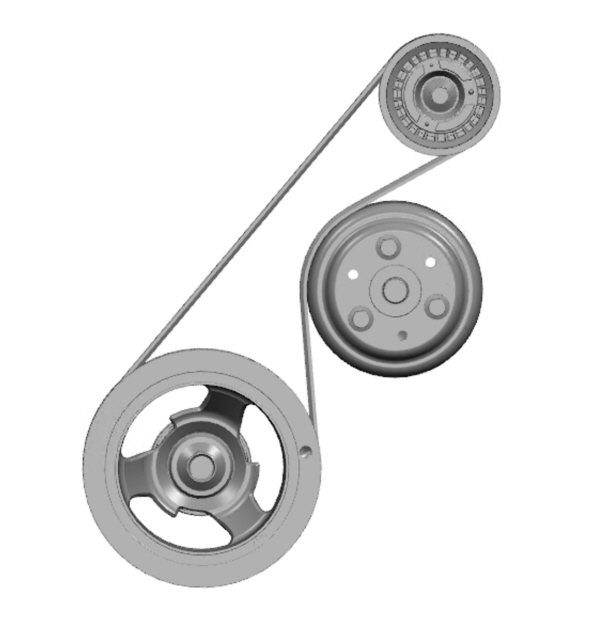
DRIVE BELT ROUTING OVERVIEW - 2.0L ECOBOOST™
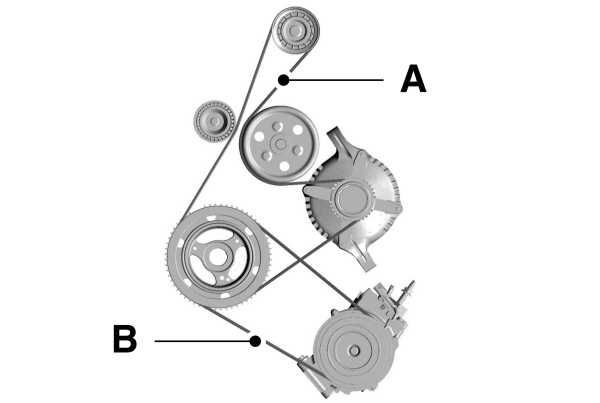
| A.The long drive belt is on the first pulley groove closest to the engine. B. The short drive belt is on the second pulley groove farthest from engine. |
12V BATTERY PRECAUTIONS
| WARNING: Batteries normally produce explosive gases which can cause personal injury. Therefore, do not allow flames, sparks or lighted substances to come near the battery. When working near the battery, always shield your face and protect your eyes. Always provide correct ventilation. WARNING: When lifting a plastic-cased battery, excessive pressure on the end walls could cause acid to flow through the vent caps, resulting in personal injury and damage to the vehicle or battery. Lift the battery with a battery carrier or with your hands on opposite corners. WARNING: Keep batteries out of reach of children. Batteries contain sulfuric acid. Avoid contact with skin, eyes or clothing. Shield your eyes when working near the battery to protect against possible splashing of acid solution. In case of acid contact with skin or eyes, flush immediately with water for a minimum of 15 minutes and get prompt medical attention. If acid is swallowed, call a physician immediately. WARNING: Battery posts, terminals and related accessories contain lead and lead compounds, chemicals known to the State of California to cause cancer and reproductive harm. Wash your hands after handling. WARNING: This vehicle may have more than one battery. Removing the battery cables from only one battery does not disconnect your vehicle electrical system. Make sure you disconnect the battery cables from all batteries when disconnecting power. Failure to do so may cause serious personal injury or property damage. WARNING: For vehicles with Auto-Start-Stop the battery requirement is different. You must replace the battery with one of exactly the same specification. |
WHAT IS THE BATTERY MANAGEMENT SYSTEM
The battery management system monitors battery conditions and takes actions to extend battery life.
HOW DOES THE BATTERY MANAGEMENT SYSTEM WORK
If excessive battery drain is detected, the system temporarily disables some electrical systems to protect the battery.
Systems included are:
- Heated rear window.
- Heated seats.
- Climate control.
- Heated steering wheel.
- Audio unit.
- Navigation system.
A message could appear in the information display to alert you that battery protection actions are active. This message is only for notification that an action is taking place, and not intended to indicate an electrical problem or that the battery requires replacement.
BATTERY MANAGEMENT SYSTEM LIMITATIONS
After battery replacement, or in some cases after charging the battery with an external charger, the battery management system requires eight hours of vehicle sleep time to relearn the battery state of charge. During this time, your vehicle must remain fully locked with the ignition switched off.
Note: Prior to relearning the battery state of charge, the battery management system could temporarily disable some electrical systems.
Electrical Accessory Installation
To make sure the battery management system works correctly, do not connect an electrical device ground connection directly to the battery negative post. This can cause inaccurate measurements of the battery condition and potential incorrect system operation.
Note: If you add electrical accessories or components to the vehicle, it could adversely affect battery performance and durability. This could also affect the performance of other electrical systems in the vehicle.
RESETTING THE BATTERY SENSOR
When you install a new battery, reset the battery sensor by doing the following:
- Switch the ignition on, and leave the engine off.
Note: Complete Steps 2 and 3 within 10 seconds.
- Flash the high beam headlamps five times, ending with the high beams off.
- Press and release the brake pedal three times.
The battery warning lamp flashes three times to confirm that the reset is successful.
RECYCLING AND DISPOSING OF THE 12V BATTERY
 Make sure that you dispose of old batteries in an environmentally friendly way. Seek advice from your local authority about recycling old batteries. Make sure that you dispose of old batteries in an environmentally friendly way. Seek advice from your local authority about recycling old batteries. |
CHANGING THE 12V BATTERY
The battery is in the engine compartment. See Under Hood Overview - 1.5L EcoBoost™.
Your vehicle has a maintenance-free battery. It does not require additional water during service.
For longer, trouble-free operation, keep the top of the battery clean and dry and the battery cables tightly fastened to the battery terminals. If any corrosion is present on the battery or terminals, remove the cables from the terminals and clean with a wire brush. You can neutralize the acid with a solution of baking soda and water.
We recommend that you disconnect the negative battery cable terminal from the battery if you plan to store your vehicle for an extended period.
Note: If you only disconnect the negative battery cable terminal, make sure it is isolated or placed away from the battery terminal to avoid unintended connection or arcing.
To maintain correct operation of the battery management system, if you add any electrical devices to your vehicle, do not connect the ground connection directly to the negative battery terminal. A connection at the negative battery terminal can cause inaccurate measurements of the battery condition and potential incorrect system operation.
Note: If you add electrical accessories or components to your vehicle this may adversely affect battery performance, durability and the performance of other electrical systems on your vehicle.
If you replace the battery make sure it matches the electrical requirements of your vehicle.
If you disconnect or replace the battery and your vehicle has an automatic transmission, it must relearn its adaptive strategy. Because of this, the transmission may shift firmly when first driven. This is normal operation while the transmission fully updates its operation to optimum shift feel.
Remove and Reinstall the Battery
To disconnect or remove the battery, do the following:
- Apply the parking brake and switch the ignition off.
- Switch all electrical equipment off, for example lights and radio.
- Wait a minimum of two minutes before disconnecting the battery.
Note: The engine management system has a power hold function and remains powered for a period of time after you switch the ignition off. This is to allow diagnostic and adaptive tables to be stored. Disconnecting the battery without waiting can cause damage not covered by the vehicle Warranty.
- Disconnect the negative battery cable terminal.
- Disconnect the positive battery cable terminal.
- Remove the battery securing clamp.
- Remove the battery.
- To install, reverse the removal procedure.
Note: Before reconnecting the battery, make sure the ignition remains switched off.
Note: Make sure the battery cable terminals are fully tightened.
Note: After cleaning or replacing the battery, make sure you reinstall the battery cover or shield.
If you disconnect or replace the vehicle battery, you must reset the following features:
- Window bounce-back. See Windows.
- Clock settings.
- Pre-set radio stations.
- Steering angle sensor.
Note: To calibrate the steering angle sensor, drive the vehicle above 30 mph (50 km/h) for a minimum of 1.2 mi (2 km). Make sure to drive straight ahead for a minimum of 30 seconds. Several vehicle functions are disabled and a warning light could appear until the sensor is calibrated.
ADJUSTING THE HEADLAMPS
Vertical Aim Adjustment
The headlamps on your vehicle are properly aimed at the assembly plant. If your vehicle has been in an accident, the alignment of your headlamps should be checked by your authorized dealer.
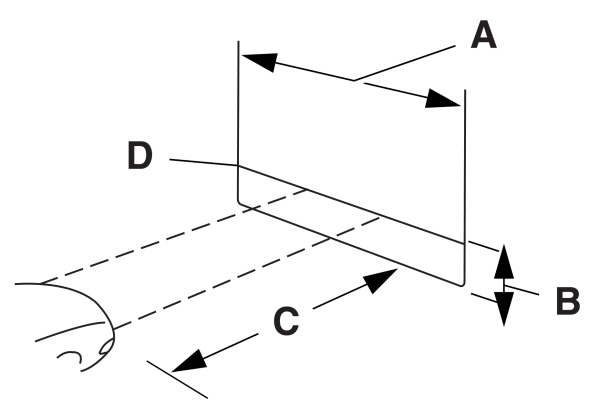
| A8 feet (2.4 meters) B Center height of lamp to groundC 25 feet (7.6 meters)D Horizontal reference line |
- Park the vehicle directly in front of a wall or screen on a level surface, approximately 25 ft (7.6 m) away.
- Measure the height of the headlamp bulb center from the ground and mark an 8 ft (2.4 m) horizontal reference line on the vertical wall or screen at this height.
Note: To see a clearer light pattern for adjusting, you may want to block the light from one headlamp when adjusting the other.
- Switch on the low beam headlamps to illuminate the wall or screen and open the hood.
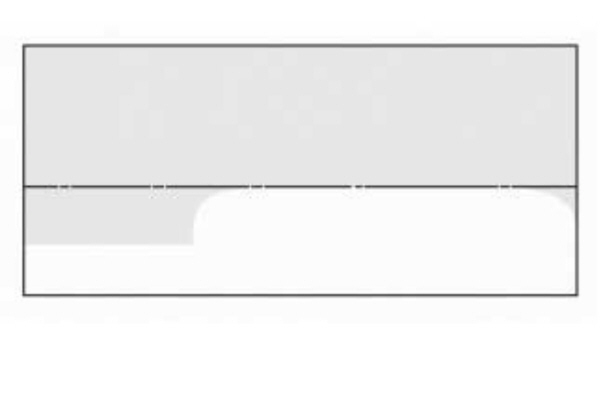
- On the wall or screen you will observe a flat zone of high intensity light located at the top of the right hand portion of the beam pattern. If the top edge of the high intensity light zone is not at the horizontal reference line, the headlamp does need to be adjusted.
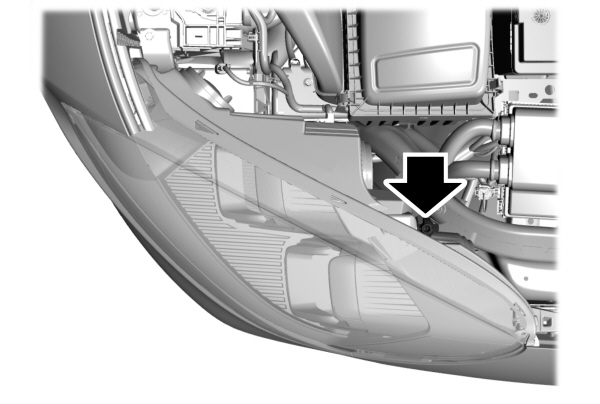
- Locate the vertical adjuster on each headlamp.Using a Phillips #2 screwdriver, turn the adjuster either clockwise or counterclockwise in order to aim the headlamp.The horizontal edge of the brighter light should touch the horizontal reference line.
- Close the hood and switch off the lamps.
Horizontal Aim Adjustment
Horizontal aim is not required for this vehicle and is non-adjustable.
EXTERIOR BULB SPECIFICATION CHART
| Lamp | Specification |
|---|---|
| Base headlamp low beam. | H9 |
| Base headlamp high beam. | HB3 |
| Base headlamp turn. | T20 Amber |
| Base headlamp side marker.1 | LED |
| Optional headlamp.1 | LED |
| Base fog lamp. | H8 |
| Optional fog lamp.1 | LED |
| Tail, brake lamp.1 | LED |
| Rear turn lamp. | T20 Amber |
| Backup, reverse lamp. | T20 |
| Rear side marker. | W5W |
| License plate lamp.1 | LED |
| High-mount brake lamp.1 | LED |
1 To replace these lamps, see your authorized dealer.
CHANGING A HEADLAMP BULB
| WARNING: Make sure the bulbs have cooled down before removing them. Failure to follow this warning could result in serious personal injury. |
Note: Handle a halogen headlamp bulb carefully and keep out of children’s reach. Grasp the bulb by only its plastic base and do not touch the glass. The oil from your hand could cause the bulb to break the next time you operate the headlamps.
Note: If you accidentally touch the bulb, clean it with rubbing alcohol before using it.
Headlamp
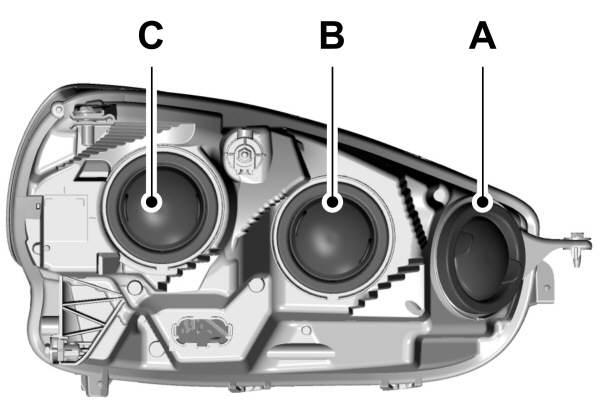
| APark/Turn lamp B High beam headlampC Low beam headlamp |
High beam headlamp
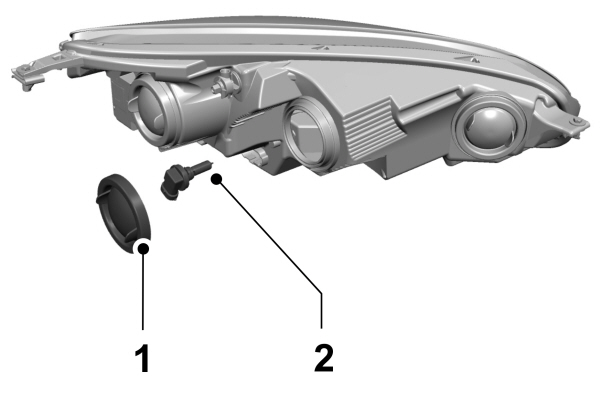
- Remove service cap.
- Remove the bulb from the headlamp assembly by turning it counterclockwise, then pull it straight out.
- Disconnect the electrical connector.
- To install, reverse the removal procedure.
Low beam headlamp
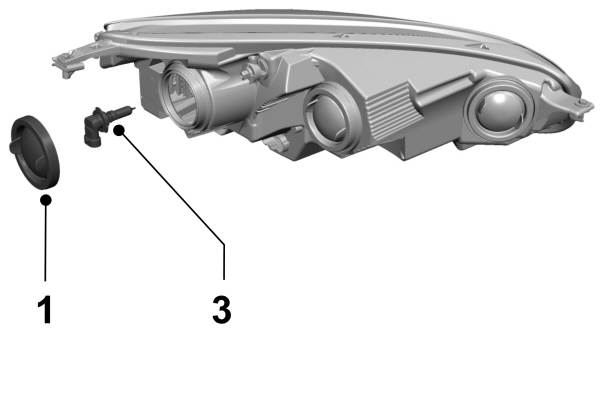
- Remove service cap.
- Disconnect the electrical connector.
- Remove the bulb from the headlamp assembly by turning it counterclockwise, then pull it straight out.
- To install, reverse the removal procedure.
CHANGING A FRONT TURN SIGNAL LAMP BULB
Headlamp
| APark/Turn lamp B High beam headlampC Low beam headlamp |
Park/Turn lamp
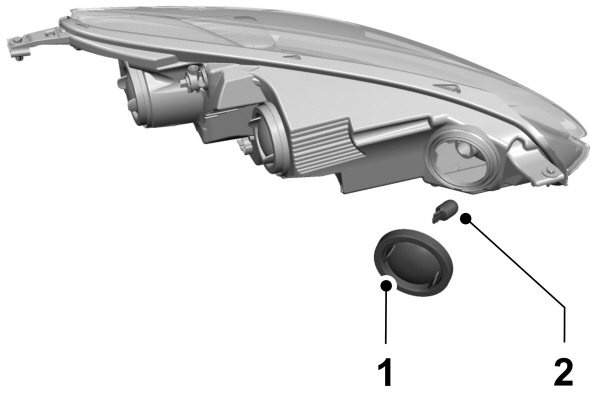
- Remove service cap, if applicable.
- Remove bulb from the headlamp assembly by turning it counterclockwise, then pull it straight out.
- Disconnect the electrical connector.
- To install, reverse the removal procedure.
CHANGING A FRONT FOG LAMP BULB
- If you are replacing the driver side bulb, turn the steering wheel all the way to the right. If you are replacing the passenger side bulb, turn the steering wheel all the way to the left.
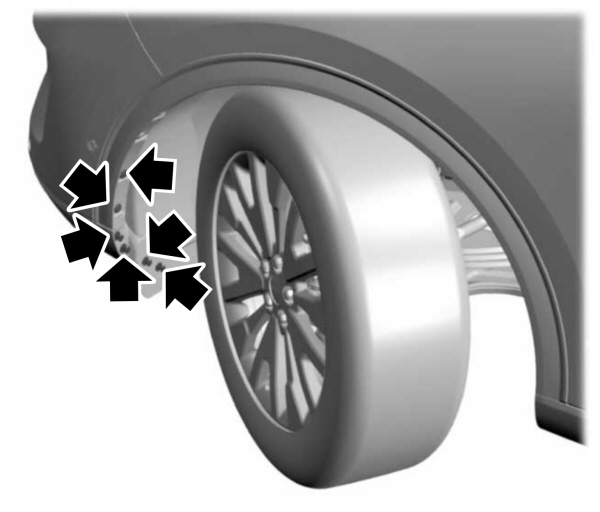
- Remove the six lower splash shield push pins and pull the splash shield back.
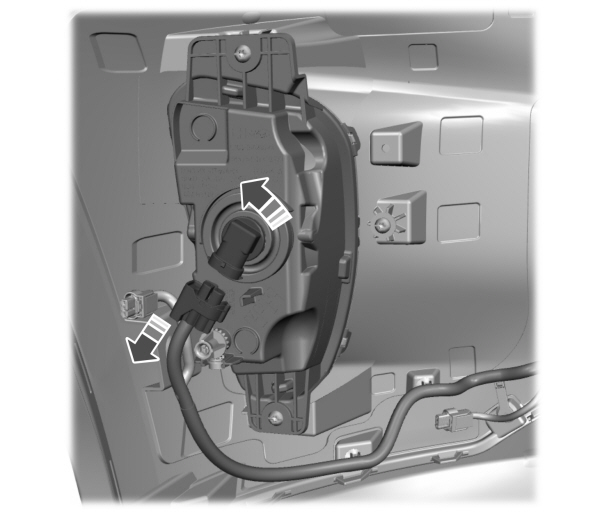
- Disconnect the bulb electrical connector.
- To remove the bulb from the headlamp assembly, turn it counterclockwise, then pull it straight out.
- To install, perform these steps in reverse order.
CHANGING A REVERSING LAMP BULB
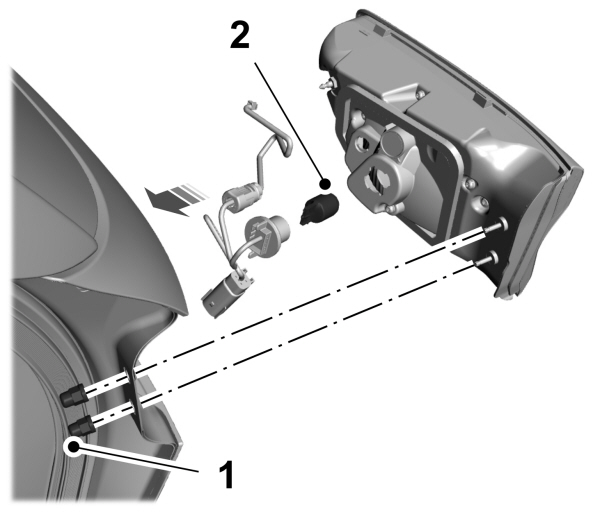
- Remove the screws with a flathead screwdriver and pull the lamp assembly away from the vehicle.
- Remove the bulb by turning the lower bulb socket counterclockwise. Gently pull the bulb straight out of the socket.
- To install, reverse the removal procedure.
INTERIOR BULB SPECIFICATION CHART
Your vehicle has LED lamps. These are not serviceable items. See an authorized dealer if they fail.
Download Manual