Starting and Operating
New Vehicle Break-In
Ignition Positions (Key Access)
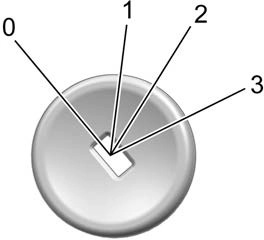
The ignition switch has four positions.
To shift out of P (Park), the ignition must be ON/RUN and the brake pedal must be applied.
0 (Stopping the Engine/LOCK/OFF) : This position turns off the vehicle. It also locks the ignition, the transmission, and the steering column, if equipped with a locking steering column.
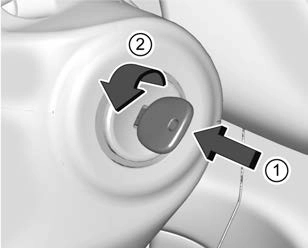
To turn off the vehicle:
See your dealer if the key can be removed in any other position.
Retained Accessory Power (RAP) will remain active. See Retained Accessory Power (RAP) 0 229.
A warning chime will sound when the driver door is opened and the key is in the ignition.
If equipped with a locking steering column, the steering can bind with the front wheels turned off center, which may prevent key rotation out of LOCK/OFF. If this happens, move the steering wheel from right to left while turning the key to ACC/ACCESSORY.
If this does not work, then the vehicle needs service.
In an emergency, if the vehicle cannot be pulled over and must be turned off while driving:
From ON/RUN, push the key all the way in toward the steering column, then turn the key to ACC/ACCESSORY.
If the key is left in ACC/ACCESSORY with the engine off, the battery could drain and the vehicle may not start.
A warning chime will sound when the driver door is opened and the key is in the ignition.
If the key is left in ON/RUN with the engine off, the battery could drain and the vehicle may not start.
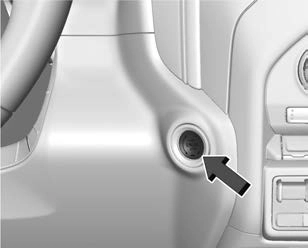
Vehicles equipped with Keyless Access have pushbutton starting.
The Remote Keyless Entry (RKE) transmitter must be in the vehicle for the system to operate. If the pushbutton start is not working, the vehicle may be near a strong radio antenna signal causing interference to
the Keyless Access system. See Remote Keyless Entry (RKE) System Operation (Key Access) 0 10 or
Remote Keyless Entry (RKE) System Operation (Keyless Access) 0 13.
To shift out of P (Park), the ignition must be on or in Service Mode, and the brake pedal must be applied.
Stopping the Engine/LOCK/OFF (No Indicator Lights) : When the vehicle is stopped, press ENGINE START/STOP once to turn the engine off.
If the vehicle is in P (Park), the ignition will turn off, and Retained Accessory Power (RAP) will remain active. See Retained Accessory Power (RAP) 0 229.
If the vehicle is not in P (Park), the ignition will return to ACC/ACCESSORY and display the message SHIFT TO PARK in the Driver
Information Center (DIC). When the vehicle is shifted into P (Park), the ignition system will turn off.
The vehicle may have an electric steering column lock. The lock is activated when the ignition is turned off and driver door is opened. A sound may be heard as the lock actuates or releases. The steering column lock may not release with the wheels turned off center. If this happens, the vehicle may not start. Move the steering wheel from left to right while attempting to start the vehicle. If this does not work, the vehicle needs service.
Unless an emergency exists, do not turn the engine off when the vehicle is moving. This will cause a loss of power assist in the brake and steering systems and disable the airbags.
If the vehicle must be shut off in an emergency:
P (Park), and make sure engine is off. The shift lever must be in P (Park) to turn the ignition off.
ACC/ACCESSORY (Amber Indicator Light) : This mode allows some electrical accessories to be used when the engine is off.
With the ignition off, pressing the ENGINE START/STOP button one time without the brake pedal applied will place the ignition system in ACC/ACCESSORY.
The ignition will switch from ACC/ ACCESSORY to off after five minutes to prevent battery rundown.
ON/RUN/START (Green Indicator Light) : This mode is for driving and starting. With the ignition off, and the brake pedal applied, pressing ENGINE START/STOP button once will turn the ignition on. Once engine cranking begins, release the button. Engine cranking will continue until the engine starts. See Starting the Engine 0 227.
Service Mode
This power mode is available for service and diagnostics, and to verify the proper operation of the malfunction indicator lamp as may be required for emission inspection purposes. With the vehicle off, and the brake pedal not applied, pressing and holding the ENGINE START/STOP button for more than five seconds will place the vehicle in Service Mode. The instruments and audio systems will operate as they do when the ignition is on, but the vehicle will not be
able to be driven. The engine will not start in Service Mode. Press the ENGINE START/ STOP button again to turn the ignition off.
If the vehicle has a diesel engine, see the Duramax diesel supplement.
Move the shift lever to P (Park) or
N (Neutral). To restart the engine when the vehicle is already moving, use
N (Neutral) only.
The driver may observe a minor, and temporary, brake pedal kickback when starting the vehicle. This is normal.
The idle speed will go down as the engine gets warm. Do not race the engine immediately after starting it. Operate the engine and transmission gently to allow the oil to warm up and lubricate all moving parts.
When the low fuel warning light is on and the FUEL LEVEL LOW message is displayed in the Driver Information Center (DIC), hold the ignition switch in the START position to continue engine cranking.
the engine and transmission gently until the oil warms up and lubricates all moving parts.
If equipped, the engine heater can provide easier starting and better fuel economy during engine warm-up in cold weather conditions at or below −18 °C (0 °F). Vehicles with an engine heater should be plugged in at least four hours before starting. An internal thermostat in the plug-end of the cord may exist, which will prevent engine heater operation at temperatures above
−18 °C (0 °F).
The length of time the heater should remain plugged in depends on several factors. Ask a dealer in the area where you will be parking the vehicle for the best advice on this.
When the ignition is turned from on to off, the following features (if equipped) will continue to function for up to 10 minutes, or until the driver door is opened. These features will also work when the ignition is in RUN or ACC/ACCESSORY:
For Keyless Access, take the Remote Keyless Entry (RKE) transmitter with you.
If you have to leave the vehicle with the engine running, be sure the vehicle is in P (Park) and the parking brake is firmly set before you leave it. After moving the shift lever into P (Park), hold the regular brake pedal down. Then, see if you can move the shift lever away from P (Park) without first pulling it toward you. If you can, it means that the shift lever was not fully locked into P (Park).
If you are parking on a hill and you do not shift the transmission into P (Park) properly, the weight of the vehicle may put too much force on the parking pawl in the transmission. You may find it difficult to pull the shift lever out of P (Park). This is called torque lock. To prevent torque lock, set the parking brake and then shift into P (Park) properly before you leave the driver seat.
When you are ready to drive, move the shift lever out of P (Park) before you release the parking brake.
If torque lock does occur, you may need to have another vehicle push yours a little uphill to take some of the pressure from the parking pawl in the transmission. You will then be able to pull the shift lever out of P (Park).
This vehicle is equipped with an electronic shift lock release system. The system is designed to prevent movement of the shift lever out of P (Park), unless the brake pedal is applied and the ignition is on or in Service Mode.
The shift lock release is always functional except in the case of an uncharged or low voltage – less than 9 volt – battery.
If the vehicle has an uncharged or low voltage battery, try charging or jump starting the battery. See Jump Starting - North America 0 367.
To shift out of P (Park):
If the vehicle still cannot be shifted out of P (Park):
If there is still a problem shifting, have the vehicle serviced soon.
Extended Parking
It is best not to park with the vehicle running. If the vehicle is left running, be sure it will not move and there is adequate ventilation.
See Shifting Into Park 0 230 and
Engine Exhaust 0 232.
If the vehicle is left parked and running with the RKE transmitter outside the vehicle, it will continue to run for up to half an hour.
If the vehicle is left parked and running with the RKE transmitter inside the vehicle, it will continue to run for up to an hour.
The vehicle could turn off sooner if it is parked on a hill, due to lack of available fuel.
The timer will reset if the vehicle is taken out of P (Park) while it is running.
Download Manual