Steps to take in an emergency
If your vehicle needs to be towed
If towing is necessary, we recommend having your vehicle towed by your Toyota dealer or commercial towing service, using a wheel-lift type truck or flat bed truck.
Use a safety chain system for all towing, and abide by all state/ provincial and local laws.
2WD models: If towing your vehicle with a wheel-lift type truck from the front, the vehicle’s rear wheels and axles must be in good conditions. (, 537) If they are damaged, use a towing dolly or flat bed truck.
AWD models: If towing your vehicle with a wheel-lift type truck, use a towing dolly.
Situations when it is necessary to contact dealers before towing
The following may indicate a problem with your transaxle. Contact your Toyota dealer or commercial towing service before towing.
- The engine is running but the vehicle does not move.
- The vehicle makes an abnormal sound
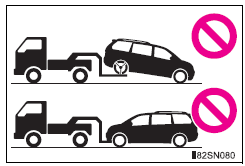
Towing with a sling-type truck
Do not tow with a sling-type truck to prevent body damage.
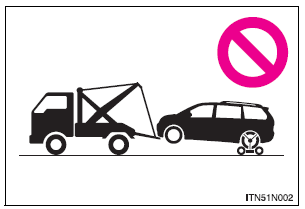
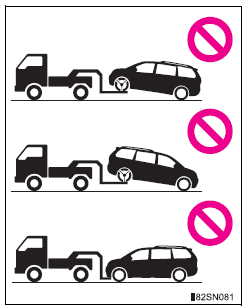
Towing with a wheel-lift type truck
- From the front (2WD models)
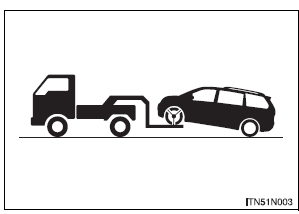
Release the parking brake.
- From the front (AWD models)
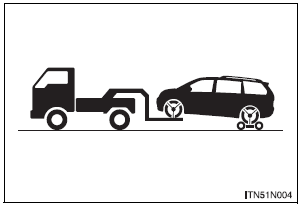
Use a towing dolly under the rear wheels.
- From the rear
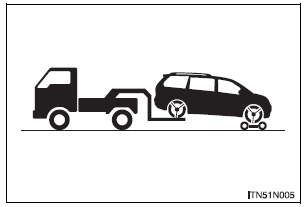
Use a towing dolly under the front wheels.
Using a flatbed truck
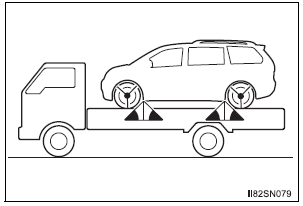
If you use chains or cables to tie down your vehicle, the angles shaded in black must be 45.
Do not overly tighten the tie downs or the vehicle may be damaged.
| WARNING
Observe the following precautions. Failure to do so may result in death or serious injury. When towing the vehicle
2WD models: Be sure to transport the vehicle with the front wheels raised or with all four wheels raised off the ground. If the vehicle is towed with the front wheels contacting the ground, the drivetrain and related parts may be damaged.
AWD models: Be sure to transport the vehicle with all four wheels raised off the ground. If the vehicle is towed with the tires contacting the ground, the drivetrain or related parts may be damaged, the vehicle may fly off the truck. While towing Do not turn the engine switch to the “LOCK” position (vehicles without a smart key system) or off (vehicles with a smart key system). There is a possibility that the steering wheel is locked and cannot be operated. |
| NOTICE
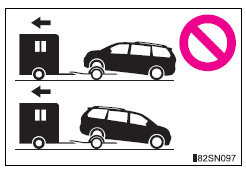
To prevent damage to the vehicle when towing using a wheel-lift type truck When raising the vehicle, ensure adequate ground clearance for towing at the opposite end of the raised vehicle. Without adequate clearance, the vehicle could be damaged while being towed. To prevent damage to the vehicle when towing with a sling-type truck Do not tow with a sling-type truck, either from the front or rear. Recreational towing (behind motor home, etc.) Never dinghy tow your vehicle to prevent causing serious damage to the Active Torque Control 4WD system (AWD models) and transaxle.
|
If you think something is wrong
If you notice any of the following symptoms, your vehicle probably needs adjustment or repair. Contact your Toyota dealer as soon as possible.
Visible symptoms
- Fluid leaks under the vehicle (Water dripping from the air conditioning after use is normal.)
- Flat-looking tires or uneven tire wear
- Engine coolant temperature gauge needle continually points higher than normal
Audible symptoms
- Changes in exhaust sound
- Excessive tire squeal when cornering
- Strange noises related to the suspension system
- Pinging or other noises related to the engine
Operational symptoms
- Engine missing, stumbling or running rough
- Appreciable loss of power
- Vehicle pulls heavily to one side when braking
- Vehicle pulls heavily to one side when driving on a level road
- Loss of brake effectiveness, spongy feeling, pedal almost touches the floor
Fuel pump shut off system
To minimize the risk of fuel leakage when the engine stalls or when an airbag inflates upon collision, the fuel pump shut off system stops the supply of fuel to the engine.
Follow the procedure below to restart the engine after the system is activated.
- Vehicles without a smart key system
- Turn the engine switch to the “ACC” or “LOCK” position.
- Restart the engine.
- Vehicles with a smart key system
- Turn the engine switch to ACCESSORY mode or turn it off.
- Restart the engine
| NOTICE
Before starting the engine Inspect the ground under the vehicle. If you find that fuel has leaked onto the ground, the fuel system has been damaged and is in need of repair. Do not restart the engine |
If a warning light turns on or a warning buzzer sounds
Calmly perform the following actions if any of the warning lights comes on or flashes. If a light comes on or flashes, but then goes off, this does not necessarily indicate a malfunction in the system. However, if this continues to occur, have the vehicle inspected by your Toyota dealer.
Warning light and warning buzzer list
|
Warning light |
Warning light/Details/Actions |
|
|
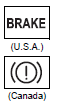
Brake system warning light (warning buzzer)*1 Indicates that:
This light also comes on when the parking brake is not released. If the light turns off after the parking brake is fully released the system is operating normally. - Immediately stop the vehicle in a safe place and contact your Toyota dealer. Continuing to drive the vehicle may be dangerous. |
|
|
Charging system warning light*2 Indicates a malfunction in the vehicle’s charging system
- Immediately stop the vehicle in a safe place and contact your Toyota dealer. |
|
|
Low engine oil pressure warning light (warning buzzer)*2 Indicates that the engine oil pressure is too low.
- Immediately stop the vehicle in a safe place and contact your Toyota dealer. |
|
|
Malfunction indicator lamp Indicates a malfunction in:
- Have the vehicle inspected by your Toyota dealer immediately |
|
|
SRS warning light Indicates a malfunction in:
- Have the vehicle inspected by your Toyota dealer immediately. |
|
|
ABS warning light Indicates a malfunction in:
- Have the vehicle inspected by your Toyota dealer immediately. |
|
|
Electric power steering system warning light (warning buzzer) Indicates a malfunction in the EPS (Electric Power Steering) system
- Have the vehicle inspected by your Toyota dealer immediately. |
|
|
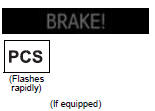
Pre-collision system warning light*2 Indicates a malfunction in the PCS (Pre-Collision System) The warning light will operate as follows, even when the system is not malfunctioning:
- Have the vehicle inspected by your Toyota dealer immediately. |
|
|
Slip indicator Indicates a malfunction in:
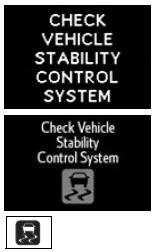
The light will flash when the VSC or the TRAC system is operating. - Have the vehicle inspected by your Toyota dealer immediately. |
|
|
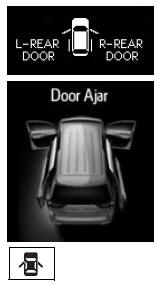
Open door warning light (warning buzzer)*2, 3 Indicates that one or more of the doors or the back door is not fully closed
- Check that all the doors and the back door are closed. |
|
|
Low fuel level warning light Indicates that remaining fuel is approximately 3.0 gal.
(11.4 L, 2.5 Imp.gal.) or less - Refuel the vehicle. |
|
|
Seat belt reminder light (warning buzzer)*4 Warns the driver and/or front passenger to fasten their seat belts
- Fasten the seat belt. If the front passenger’s seat is occupied, the front passenger’s seat belt also needs to be fastened to make the warning light (warning buzzer) turn off. |
|
|
Master warning light A buzzer sounds and the warning light comes on and flashes to indicate that the master warning system has detected a malfunction. |
|
|
Tire pressure warning light When the light comes on: Low tire inflation pressure such as
- Adjust the tire inflation pressure to the specified level. The light will turn off after a few minutes. In case the light does not turn off even if the tire inflation pressure is adjusted, have the system checked by your Toyota dealer. When the light comes on after blinking for 1 minute: Malfunction in the tire pressure warning system - Have the system checked by your Toyota dealer |
|
|
Third seat warning light*2 Indicates that the third seat operation is not yet complete.
- Complete the third seat operation |







*1: Parking brake engaged warning buzzer: *2: If equipped
*3: Open door warning buzzer: *4: Driver’s seat belt buzzer: The driver’s seat belt buzzer sounds to alert the driver that his or her seat belt is not fastened. Once the engine switch is turned to the “ON” position (vehicles without a smart key system) or IGNITION ON mode (vehicles with a smart key system), the buzzer sounds for 6 seconds. If the vehicle reaches a speed of 12 mph (20 km/h), the buzzer sounds once. If the seat belt is still unfastened after 30 seconds, the buzzer will sound intermittently for 10 seconds. Then, if the seat belt is still unfastened, the buzzer will sound in a different tone for 20 more seconds.
Front passenger’s seat belt buzzer: The front passenger’s seat belt buzzer sounds to alert the front passenger that his or her seat belt is not fastened. The buzzer sounds once if the vehicle reaches a speed of 12 mph (20 km/h). If the seat belt is still unfastened after 30 seconds, the buzzer will sound intermittently for 10 seconds.
Then, if the seat belt is still unfastened, the buzzer will sound in a different tone for 20 more seconds.
SRS warning light
This warning light system monitors the airbag sensor assembly, front impact sensors, side impact sensors (front door), side impact sensors (rear), driver’s seat position sensor, driver’s seat belt buckle switch, front passenger occupant classification system (ECU and sensors), “AIR BAG ON” indicator light, “AIR BAG OFF” indicator light, front passenger’s seat belt buckle switch, seat belt assemblies, airbags, interconnecting wiring and power sources.
Front passenger detection sensor, seat belt reminder and warning buzzer
- If luggage is placed on the front passenger seat, the front passenger detection sensor may cause the warning light to flash and the warning buzzer to sound even if a passenger is not sitting in the seat.
- If a cushion is placed on the seat, the sensor may not detect a passenger, and the warning light may not operate properly.
If the malfunction indicator lamp comes on while driving
First check the following:
- Is the fuel tank empty? If it is, fill the fuel tank immediately.
- Is the fuel tank cap loose? If it is, tighten it securely.
The light will go off after several driving trips.
If the light does not go off even after several trips, contact your Toyota dealer as soon as possible.
Electric power steering system warning light (warning buzzer)
When the battery charge becomes insufficient or the voltage temporarily drops, the electric power steering system warning light may come on and the warning buzzer may sound.
When the tire pressure warning light comes on
Check the tire inflation pressure and adjust to the appropriate level. Pushing the tire pressure warning reset switch will not turn off the tire pressure warning light.
The tire pressure warning light may come on due to natural causes
The tire pressure warning light may come on due to natural causes such as natural air leaks and tire inflation pressure changes caused by temperature.
In this case, adjusting the tire inflation pressure will turn off the warning light (after a few minutes).
When a tire is replaced with a spare tire (vehicles with compact spare tire)
The compact spare tire is not equipped with a tire pressure warning valve and transmitter. If a tire goes flat, the tire pressure warning light will not turn off even though the flat tire has been replaced with the spare tire.
Replace the spare tire with the repaired tire and adjust the tire inflation pressure. The tire pressure warning light will go off after a few minutes.
Conditions that the tire pressure warning system may not function properly
If the tire pressure warning light frequently comes on after blinking for 1 minute
If the tire pressure warning light frequently comes on after blinking for 1 minute when the engine switch is turned to the “ON” position (vehicles without a smart key system) or IGNITION ON mode (vehicles with a smart key system), have it checked by your Toyota dealer.
Customization that can be configured at Toyota dealer
The vehicle speed linked seat belt reminder buzzer can be disabled.
(Customizable features ) However, Toyota recommends that the seat belt reminder buzzer be operational to alert the driver and front passenger when seat belts are not fastened.
Warning buzzer
In some cases, the buzzer may not be heard because of noisy place or an audio sound.
| WARNING
If both the ABS and the brake system warning lights remain on Stop your vehicle in a safe place immediately and contact your Toyota dealer. The vehicle will become extremely unstable during braking, and the ABS system may fail, which could cause an accident resulting in death or serious injury. When the electric power steering system warning light comes on The steering wheel may become extremely heavy. If the steering wheel becomes heavier than usual when operating, hold firmly and operate using more force than usual. If the tire pressure warning light comes on Be sure to observe the following precautions. Failure to do so could cause a loss of vehicle control and result in death or serious injury. Vehicles with standard tires:
Vehicles with run-flat tires:
If a blowout or sudden air leakage should occur The tire pressure warning system may not activate immediately. Maintenance of the tires Each tire, including the spare (if provided), should be checked monthly when cold and inflated to the inflation pressure recommended by the vehicle manufacturer on the vehicle placard or tire inflation pressure label (tire and load information label). (If your vehicle has tires of a different size than the size indicated on the vehicle placard or tire inflation pressure label [tire and load information label], you should determine the proper tire inflation pressure for those tires.) As an added safety feature, your vehicle has been equipped with a tire pressure monitoring system (TPMS-tire pressure warning system) that illuminates a low tire pressure telltale (tire pressure warning light) when one or more of your tires is significantly under-inflated. Accordingly, when the low tire pressure telltale (tire pressure warning light) illuminates, you should stop and check your tires as soon as possible, and inflate them to the proper pressure. Driving on a significantly underinflated tire causes the tire to overheat and can lead to tire failure. Under-inflation also reduces fuel efficiency and tire tread life, and may affect the vehicle’s handling and stopping ability. Please note that the TPMS (tire pressure warning system) is not a substitute for proper tire maintenance, and it is the driver’s responsibility to maintain correct tire pressure, even if under-inflation has not reached the level to trigger illumination of the TPMS low tire pressure telltale (tire pressure warning light). Your vehicle has also been equipped with a TPMS (tire pressure warning system) malfunction indicator to indicate when the system is not operating properly. The TPMS (tire pressure warning system) malfunction indicator is combined with the low tire pressure telltale (tire pressure warning light). When the system detects a malfunction, the telltale will flash for approximately one minute and then remain continuously illuminated. This sequence will continue upon subsequent vehicle start-ups as long as the malfunction exists. When the malfunction indicator is illuminated, the system may not be able to detect or signal low tire pressure as intended. TPMS (tire pressure warning system) malfunctions may occur for a variety of reasons, including the installation of replacement or alternate tires or wheels on the vehicle that prevent the TPMS (tire pressure warning system) from functioning properly. Always check the TPMS (tire pressure warning system) malfunction telltale after replacing one or more tires or wheels on your vehicle to ensure that the replacement or alternate tires and wheels allow the TPMS (tire pressure warning system) to continue to function properly |
| NOTICE
To ensure the tire pressure warning system operates properly Do not install tires with different specifications or makers, as the tire pressure warning system may not operate properly. |
If a warning message is displayed
If a warning message is shown on the multi-information display, stay calm and perform the following actions:
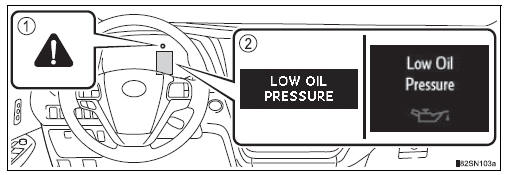
- Master warning light The master warning light also comes on or flashes in order to indicate that a message is currently being displayed on the multi-information display.
- Multi-information display If any of the warning message or indicator comes on again after the following actions have been performed, contact your Toyota dealer.
Warning message and warning buzzer list
|
Warning message |
Details/Actions |
|
|
Indicates that:
- Slow the vehicle by applying the brakes. |
|
|
Indicates that the driver’s door was opened with the shift position in any position other than P A buzzer also sounds.
- Shift the shift lever to P. |
|
|
Indicates that your vehicle is nearing the vehicle ahead (in vehicle-to-vehicle distance mode) A buzzer also sounds.
- Slow the vehicle by applying the brakes. |
|
|
Indicates that one or more of the doors is not fully closed The system also indicates which doors are not fully closed.
If the vehicle reaches a speed of 3 mph (5 km/h), - Make sure that all the doors are closed. |
|
|
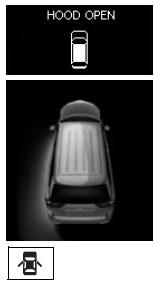
Indicates that the hood is not fully closed If the vehicle reaches a speed of 3 mph (5 km/h),  flashes and a buzzer flashes and a buzzersounds to indicate that the hood is not yet fully closed. - Close the hood. |
|
|
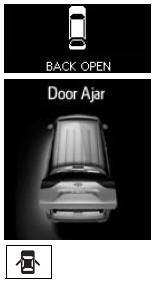
Indicates that the back door is not fully closed If the vehicle reaches a speed of 3 mph (5 km/h), flashes and a buzzer sounds to indicate that the back door is not yet fully closed. - Close the back door. |
|
|
Indicates a malfunction in the intuitive parking assist A buzzer also sounds.
- Have the vehicle inspected by your Toyota dealer. |
|
|
Indicates that the intuitive parking assist is dirty or covered with ice A buzzer also sounds.
- Clean the sensor. |
|
|
Indicates a malfunction in the EPS (Electric Power Steering) system A buzzer also sounds.
- Have the vehicle inspected by your Toyota dealer. |
|
|
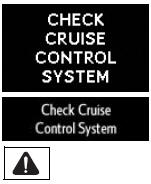
Indicates a malfunction in:
A buzzer also sounds. - Immediately stop the vehicle in a safe place and contact your Toyota dealer. Continuing to drive the vehicle may be dangerous. |
|
|
Indicates a malfunction in:
- Have the vehicle inspected by your Toyota dealer |
|
|
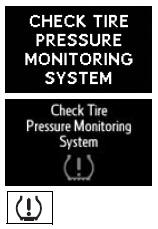
Indicates a malfunction in the tire pressure warning system
-Stop the vehicle in a safe place and turn the engine switch off then “ON” position (vehicles without a smart key system) or IGNITION ON mode (vehicles with a smart key system) again. If the tire pressure warning indicator flashes for 1 minute then illuminates, have the vehicle inspected by your Toyota dealer. |
|
|
Indicates that:
- Immediately stop the vehicle in a safe place and contact your Toyota dealer. Continuing to drive the vehicle may be dangerous. |
|
|
Indicates that the vehicle is being driven at 3 mph (5 km/h) or more with the parking brake still engaged A buzzer also sounds.
- Release the parking brake |
|
|
Indicates that the engine coolant temperature is too high A buzzer also sounds. |
|
|
Indicates a malfunction in the vehicle’s charging system.
- Immediately stop the vehicle in a safe place and contact your Toyota dealer. Continuing to drive the vehicle may be dangerous. |
|
|
Indicates that the radar sensor is dirty or covered with ice A buzzer also sounds.
- Clean the sensor. |
|
|
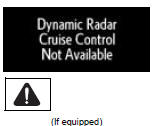
Indicates that the dynamic radar cruise control system is unable to judge vehicle-to-vehicle distance A buzzer also sounds.
- If the windshield wipers are on, turn them off or set them to a mode other than AUTO or high speed wiper operation. |
|
|
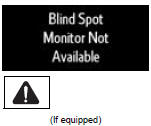
Indicates that a Blind Spot Monitor sensor or the surrounding area on the bumper is dirty or covered with ice A buzzer also sounds.
- Clean the sensor and its surrounding area on the bumper. |
|
|
Indicates a malfunction in:
Press the “ON/OFF” button once to deactivate the system, and then press the button again to reactivate the system. A buzzer also sounds. - Have the vehicle inspected by your Toyota dealer. |
|
|
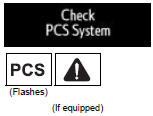
Indicates a malfunction in the PCS (Pre-Collision system) A buzzer also sounds.
- Have the vehicle inspected by your Toyota dealer. |
|
|
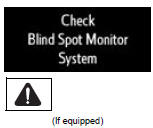
Indicates a malfunction in the BSM (Blind Spot Monitor) system A buzzer also sounds.
- Have the vehicle inspected by your Toyota dealer. |
|
|
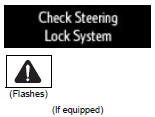
Indicates a malfunction in the steering lock system
- Have the vehicle inspected by your Toyota dealer. |
|
|
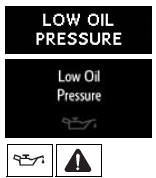
Indicates abnormal engine oil pressure A buzzer also sounds.
- Immediately stop the vehicle in a safe place and contact your Toyota dealer. |
|
|
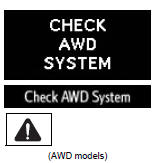
Indicates a malfunction in the Active Torque Control 4WD system A buzzer also sounds.
- Have the vehicle inspected by your Toyota dealer |
|
|
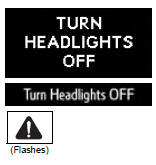
Vehicles without a smart key system: Indicates that the engine switch is turned to the “LOCK” position, the key is removed and the driver’s door is opened while the lights are turned on.
Vehicles with a smart key system: Indicates that the engine switch is turned off and the driver’s door is opened while the lights are turned on. A buzzer also sounds. - Turn the lights off. |
|
|
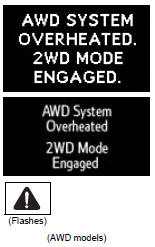
Indicates the Active Torque Control 4WD system has overheated A buzzer also sounds.
- Immediately stop the vehicle in a safe place and contact your Toyota dealer. |
|
|
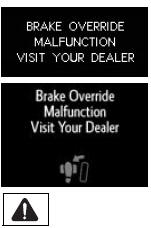
Indicates a malfunction in the brake override system A buzzer also sounds.
- Have the vehicle inspected by your Toyota dealer |
|
|
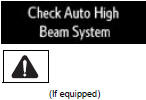
Indicates a malfunction in the Automatic High Beam system A buzzer also sounds.
- Have the vehicle inspected by your Toyota dealer. |
|
|
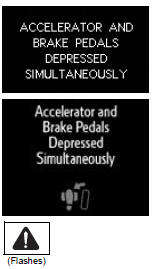
Indicates that the accelerator and brake pedal are being depressed simultaneously
- Release the accelerator or brake pedal. |
|
|
Indicates that the washer fluid level is low
- Add washer fluid. |
|
|
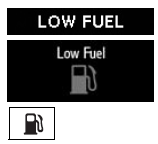
Indicates that remaining fuel is approximately 3.0 gal. (11.4 L, 2.5 Imp.gal.) or less
- Refuel the vehicle. |
|
|
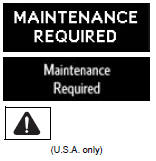
Indicates that all maintenance according to the driven distance on the maintenance schedule* should be performed soon.
Comes on approximately 4500 miles (7200 km) after the message has been reset. - If necessary, perform maintenance. |
|
|
Indicates that all maintenance is required to correspond to the driven distance on the maintenance schedule*.
Comes on approximately 5000 miles (8000 km) after the message has been reset. (The indicator will not work properly unless the message has been reset.) - Perform the necessary maintenance. Please reset the message after the maintenance is performed |
|
|
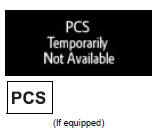
Indicates that the PCS (Pre-collision system) is not currently functional because the grille cover or the sensor is dirty
- Check the grille cover and the sensor and clean them if they are dirty. |




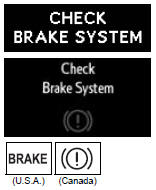

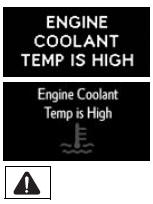
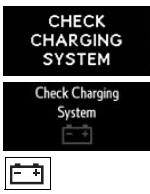
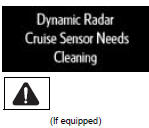


*: Refer to the separate “Scheduled Maintenance Guide” or “Owner’s Manual Supplement” for the maintenance interval applicable to your vehicle.
Messages displays
The message illustrations used are intended as examples, and may differ from the image that is actually displayed on the multi-information display
Warning message in dynamic radar cruise control mode (if equipped)
In the following situations, the warning message may not be displayed even if vehicle-to-vehicle distance decreases:
- When your vehicle and the vehicle ahead are traveling at the same speed or the vehicle ahead is traveling more quickly than your vehicle
- When the vehicle ahead is traveling at a very low speed
- Immediately after cruise control speed is set
- At the instant the accelerator pedal is depressed
Conditions that the tire pressure warning system may not function properly
Warning buzzer
|
Interior buzzer |
Exterior buzzer |
Warning message |
Details/Actions |
| - | - |
|
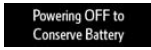
Power was turned off due to the automatic power off function.
- Next time when starting the engine, increase the engine speed slightly and maintain that level for approximately 5 minutes to recharge the battery. |
| Continuous |
- |
|
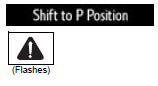
The driver’s door was opened while any shift position other than P was selected without turning off the engine switch.
- Shift the shift position to P. |
| Continuous | Continuous |
|
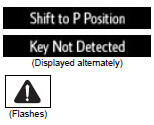
The electronic key was carried outside the vehicle and the driver’s door was opened and closed while any shift position other than P was selected without turning off the engine switch.
- Shift the shift position to P. - Bring the electronic key back into the vehicle. |
| Once |
- |
|
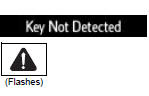
An attempt was made to start the engine without the electronic key being present, or the electronic key was not functioning normally.
- Start the engine with the electronic key present. |
| An attempt was made to drive when the regular key was not inside the vehicle.
- Confirm that the electronic key is inside the vehicle |
|||
| Once | 3 times |
|
The electronic key was carried outside the vehicle and a door other than the driver’s door was opened and closed while the engine switch was in a mode other than off.
- Bring the electronic key back into the vehicle |
| The electronic key was carried outside the vehicle and the driver’s door was opened and closed while the shift position P was selected without turning off the engine switch.
- Turn the engine switch off. - Bring the electronic key back into the vehicle. |
|||
| Once | Sounds once for 5 seconds |
|
An attempt was made to exit the vehicle with the electronic key and lock the doors without first turning the engine switch off.
- Turn the engine switch off and lock the doors again. |
| Once |
- |
|
An attempt was made to turn the engine switch off when the shift position was not in P.
- To turn off the engine, first shift the shift position to P and then turn the engine switch off. |
| Once | Sounds once for 5 seconds |
|
- Retrieve the electronic key from the vehicle and lock the doors again. |
| Once |
- |
|
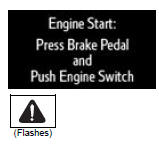
- Touch the electronic key to the engine switch while depressing the brake pedal. |
| Once | - |
|
The driver’s door was opened and closed with the engine switch turned off and then the engine switch was put in ACCESSORY mode twice without the engine being started.
- Press the engine switch while depressing the brake pedal. |
| During a engine starting procedure in the event that the electronic key was not functioning properly , the engine switch was touched with the electronic key.
- Press the engine switch within 10 seconds of the buzzer sounding. |
|||
| Once | - |
|
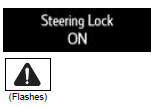
The steering lock could not be released within 3 seconds of the engine switch being pressed.
- Press the engine switch while depressing the brake pedal and moving the steering wheel left and right. |
| Once |
- |
|
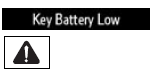
The electronic key has a low battery.
- Replace the electronic key battery. |
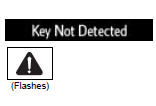
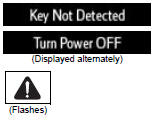

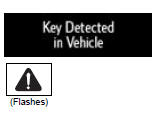
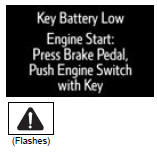
Messages displays
The message illustrations used are intended as examples, and may differ from the image that is actually displayed on the multi-information display.
Warning buzzer
If you have a flat tire (vehicles with run-flat tires)
Your vehicle is not equipped with a spare tire, but instead you can continue driving the vehicle with run-flat tires even if any tire goes flat.
In this case, slow down and drive with extra caution.
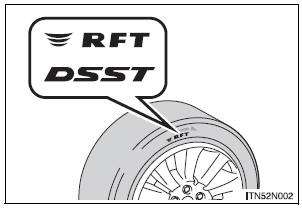
Run-flat tires (A “RFT” or “DSST” mark is molded on the sidewall)
Take your vehicle to the nearest Toyota dealer or authorized tire dealer as soon as possible if any tire goes flat.
The vehicle can be driven for a maximum of 100 miles (160 km) at a speed below 50 mph (80 km/h) after the tire pressure warning light comes on.
In some condition (such as at high temperatures)
You cannot continue driving for up to 100 miles (160 km).
For the detailed information on run-flat tires
See the tire warranty booklet.
| NOTICE
When replacing the tires When removing or fitting the wheels, tires or the tire pressure warning valve and transmitter, contact your Toyota dealer as the tire pressure warning valve and transmitter may be damaged if not handled correctly. When driving over bumps If a vehicle has a flat tire, the vehicle height will be lower than usual. Ensure that nothing strikes the bottom of the vehicle. To avoid damaging the tire pressure warning valves and transmitters When a tire is repaired with liquid sealants, the tire pressure warning valve and transmitter may not operate properly. If a liquid sealant is used, contact your Toyota dealer or other qualified service shop as soon as possible. Make sure to replace the tire pressure warning valve and transmitter when replacing the tire. |
If you have a flat tire (vehicles with a compact spare tire)
Your vehicle is equipped with a spare tire. The flat tire can be replaced with the spare tire.
For details about tires:
| WARNING
If you have a flat tire Do not continue driving with a flat tire. Driving even a short distance with a flat tire can damage the tire and the wheel beyond repair, which could result in an accident. |
Before jacking up the vehicle
- Stop the vehicle on a hard, flat surface.
- Set the parking brake.
- Shift the shift lever to P.
- Stop the engine.
- Turn on the emergency flashers.
Location of the spare tire, jack and tools

- Spare tire
- Jack handle
- Tire bag
- Jack
- Wheel nut wrench
- Adapter socket
- Tire strap
| WARNING
Using the tire jack Observe the following precautions. Improper use of the tire jack may cause the vehicle to suddenly fall off the jack, leading to death or serious injury.
|
Taking out the jack and tools
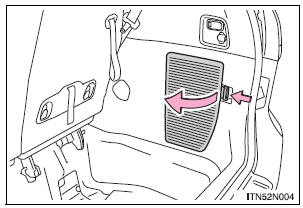
- Remove the cover.

- Remove the adapter socket.

- Remove the jack.
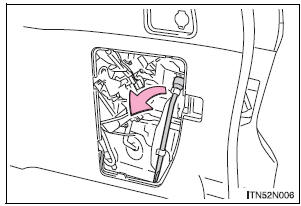
- Remove the wheel nut wrench.
Taking out the spare tire
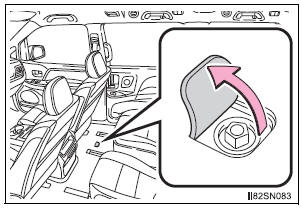
- Slide the front passenger’s seat to the frontmost lock position and the right side second seat to the rearmost lock position so they will not interfere with the jack handle.
- Open the right side sliding door and you will find the flap on the floor. Pull back the flap to find the spare tire clamp bolt.
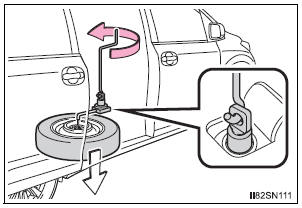
- Attach the adapter socket over the spare tire clamp bolt.
Connect the jack handle and the adapter socket. Turn the jack handle.
The tire will be lowered completely to the ground.

- Take the spare tire out from underneath the vehicle and remove the holding bracket.
| WARNING
When storing the compact spare tire Be careful not to catch fingers or other body parts between the compact spare tire and the body of the vehicle. |
Replacing a flat tire

- Chock the tires.
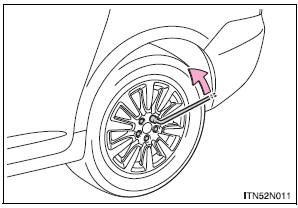
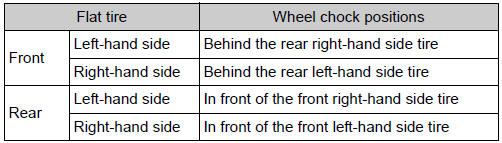
- Slightly loosen the wheel nuts (one turn).
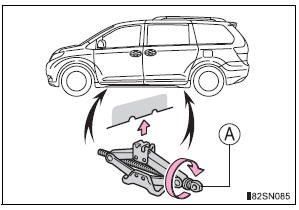
- Turn the tire jack portion A by hand until the notch of the jack is in contact with the jack point.
The jack point guides are located on the side of rocker moulding.
They indicate the jack point positions.
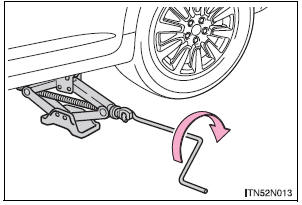
- Raise the vehicle until the tire is slightly raised off the ground.
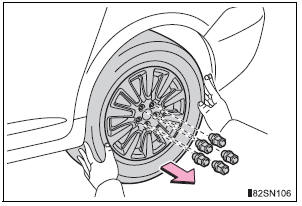
- Remove all the wheel nuts and the tire.
When resting the tire on the ground, place the tire so that the wheel design faces up to avoid scratching the wheel surface.
| WARNING
Replacing a flat tire
|
Installing the spare tire

- Remove any dirt or foreign matter from the wheel contact surface.
If foreign matter is on the wheel contact surface, the wheel nuts may loosen while the vehicle is in motion, causing the tire to come off.
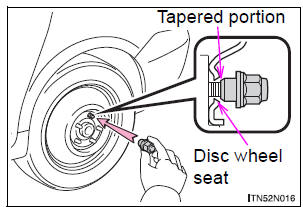
- Install the tire and loosely tighten each wheel nut by hand by approximately the same amount.
Tighten the wheel nuts until the tapered portion comes into loose contact with the disc wheel seat.
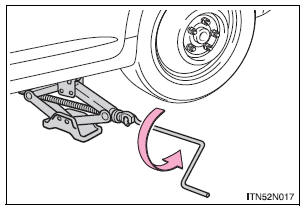
- Lower the vehicle.
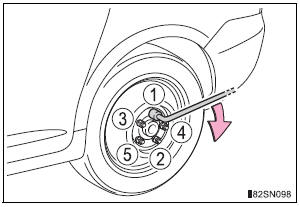
- Firmly tighten each wheel nut two or three times in the order shown in the illustration.
Tightening torque: 76 ft•lbf (103 N•m, 10.5 kgf•m)
- Stow the flat tire, tire jack and all tools.
Stowing the flat tire
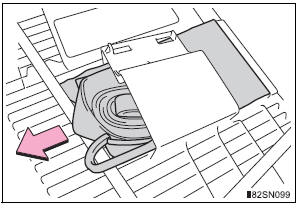
- Take out the strap and tire bag.
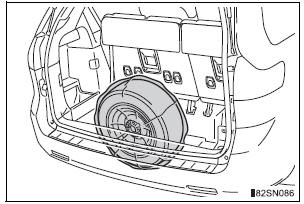
- Place tire standing up in rear tub, after putting the tire in the tire bag.
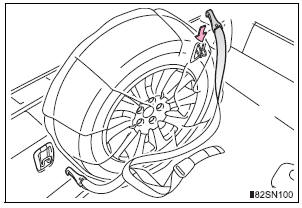
- Clip clasp to outboard hook.
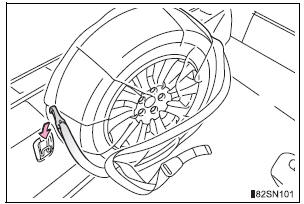
- Clip other clasp to center or opposite hook location.
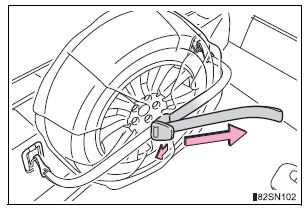
- Pull strap to tighten and secure tire.
Stowing the spare tire
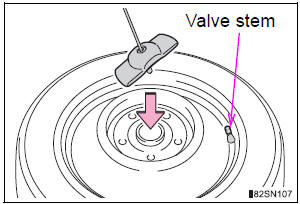
- Lay down the tire with the outer side (valve stem) facing up, and install the holding bracket.
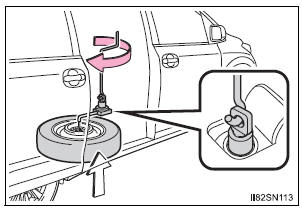
- Turn the jack handle clockwise to raise the tire until the tire is in the correct position as the jack handle skips.
- Stow the tools.
The compact spare tire
- The compact spare tire is identified by the label “TEMPORARY USE ONLY” on the tire sidewall.
- se the compact spare tire temporarily, and only in an emergency.
Make sure to check the tire inflation pressure of the compact spare tire.
After completing the tire change
The tire pressure warning system must be reset.
When using the compact spare tire
As the compact spare tire is not equipped with a tire pressure warning valve and transmitter, low inflation pressure of the spare tire will not be indicated by the tire pressure warning system. Also, if you replace the compact spare tire after the tire pressure warning light comes on, the light remains on.
When the compact spare tire is equipped
The vehicle becomes lower when driving with the compact spare tire compared to when driving with standard tires
If you have a flat front tire on a road covered with snow or ice
Install the compact spare tire on one of the rear wheels of the vehicle.
Perform the following steps and fit tire chains to the front tires:
- Replace a rear tire with the compact spare tire.
- Replace the flat front tire with the tire removed from the rear of the vehicle.
- Fit tire chains to the front tires.
| WARNING
When using the compact spare tire
When the compact spare tire is attached The vehicle speed may not be correctly detected, and the following systems may not operate correctly:
Also, not only can the following system not be utilized fully, but it may even negatively affect the drive-train components:
Speed limit when using the compact spare tire Do not drive at speeds in excess of 50 mph (80 km/h) when a compact spare tire is installed on the vehicle. The compact spare tire is not designed for driving at high speeds. Failure to observe this precaution may lead to an accident causing death or serious injury. After using the tools and jack Before driving, make sure all the tools and jack are securely in place in their storage location to reduce the possibility of personal injury during a collision or sudden braking. When stowing the flat tire
|
| NOTICE
When loosening or tightening the spare tire clamp bolt Do not use an impact wrench. Use the adapter socket and jack handle. Be careful when driving over bumps with the compact spare tire installed on the vehicle The vehicle becomes lower when driving with the compact spare tire compared to when driving with standard tires. Be careful when driving over uneven road surfaces. Driving with tire chains and the compact spare tire Do not fit tire chains to the compact spare tire. Tire chains may damage the vehicle body and adversely affect driving performance. When replacing the tires When removing or fitting the wheels, tires or the tire pressure warning valve and transmitter, contact your Toyota dealer as the tire pressure warning valve and transmitter may be damaged if not handled correctly. To avoid damage to the tire pressure warning valves and transmitters When a tire is repaired with liquid sealants, the tire pressure warning valve and transmitter may not operate properly. If a liquid sealant is used, contact your Toyota dealer or other qualified service shop as soon as possible. Make sure to replace the tire pressure warning valve and transmitter when replacing the tire. After taking out or stowing the spare tire Make sure to secure the tire carrier by tightening the clamp bolt to prevent the holding bracket from hitting the under body of the vehicle during driving. Using the tire carrier
|
If the engine will not start
If the engine will not start even though correct starting procedures are being followed (, 228), consider each of the following points:
The engine will not start even though the starter motor operates normally.
One of the following may be the cause of the problem:
- There may not be sufficient fuel in the vehicle’s tank.
Refuel the vehicle.
- The engine may be flooded.
Try to restart the engine again following correct starting procedures.
(, 228)
- There may be a malfunction in the engine immobilizer system.
The starter motor turns over slowly, the interior lights and headlights are dim, or the horn does not sound or sounds at a low volume.
One of the following may be the cause of the problem:
- The battery may be discharged.
- The battery terminal connections may be loose or corroded.
The starter motor does not turn over (vehicles with a smart key system)
The engine starting system may be malfunctioning due to an electrical problem such as an electronic key battery depletion or a blown fuse.
However, an interim measure is available to start the engine.
The starter motor does not turn over, the interior lights and headlights do not turn on, or the horn does not sound.
One of the following may be the cause of the problem:
- One or both of the battery terminals may be disconnected.
- The battery may be discharged.
- There may be a malfunction in the steering lock system (vehicle with a smart key system).
Contact your Toyota dealer if the problem cannot be repaired, or if repair procedures are unknown.
Emergency start function (vehicles with a smart key system)
When the engine does not start, the following steps can be used as an interim measure to start the engine if the engine switch is functioning normally:
- Set the parking brake.
- Shift the shift lever to P.
- Turn the engine switch to ACCESSORY mode.
- Press and hold the engine switch for about 15 seconds while depressing the brake pedal firmly.
Even if the engine can be started using the above steps, the system may be malfunctioning. Have the vehicle inspected by your Toyota dealer.
If the shift lever cannot be shifted from P
If the shift lever cannot be shifted with your foot on the brake pedal, there may be a problem with the shift lock system (a system to prevent accidental operation of the shift lever). Have the vehicle inspected by your Toyota dealer immediately.
The following steps may be used as an emergency measure to ensure that the shift lever can be shifted:

- Set the parking brake.
- Turn the engine switch to the “ACC” position (vehicles without a smart key system) or ACCESSORY mode (vehicles with a smart key system).
- Depress the brake pedal.
- Pry the cover up with a flathead screwdriver or equivalent tool.
To prevent damage to the cover, cover the tip of the screwdriver with a rag.
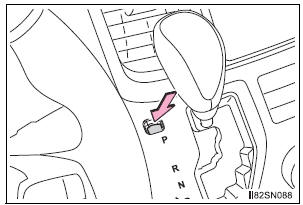
- Press the shift lock override button.
The shift lever can be shifted while the button is pressed
If the beep sounds continuously when the shift lever is shifted from P (vehicles with an AUTO ACCESS SEAT)
The AUTO ACCESS SEAT may not be locked in place.
For details, refer to “AUTO ACCESS SEAT OWNER’S MANUAL”.
If the electronic key does not operate properly (vehicles with a smart key system)
If communication between the electronic key and vehicle is interrupted or the electronic key cannot be used because the battery is depleted, the smart key system and wireless remote control cannot be used. In such cases, the doors can be opened or the engine can be started by following the procedure below.
Locking and unlocking the doors and key linked functions
Using the mechanical key in order to perform the following operations.
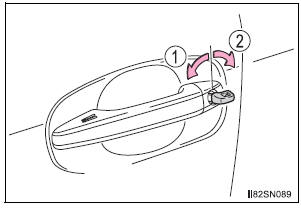
- Locks all the doors
- Unlocks the door(s)
Turning the key rearward unlocks the driver’s door. Turning the key once again within 3 seconds unlocks the other doors.
Starting the engine
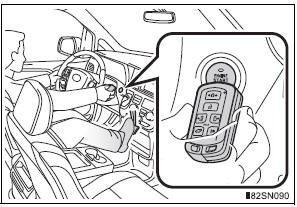
- Shift the shift lever to P and apply the brakes.
- Touch the Toyota emblem side of the electronic key to the engine switch.
An alarm will sound to indicate that the start function cannot detect the electronic key that is touched to the engine switch if any of the doors is opened and closed while the key is touched to the switch.
- Press the engine switch within 10 seconds after the buzzer sounds, keeping the brake pedal depressed.
In the event that the engine switch cannot be operated, contact your Toyota dealer.
Stopping the engine
Shift the shift lever to P and press the engine switch as you normally do when stopping the engine.
Replacing the key battery
As this above procedure is a temporary measure, it is recommended that the electronic key battery be replaced immediately when the battery depletes.
Alarm (if equipped)
Using the mechanical key to lock the doors will not set the alarm system.
If a door is unlocked using the mechanical key when the alarm system is set, the alarm may be triggered.
Changing engine switch modes
Within 10 seconds of the buzzer sounding, release the brake pedal and press the engine switch.
The engine does not start and modes will be changed each time the switch is pressed.
When the electronic key does not work properly
- Check if the battery-saving mode is set. If it is set, cancel the function.
- Make sure that the smart key system has not been deactivated in the customization setting. If it is off, turn the function on.
If the battery is discharged
The following procedures may be used to start the engine if the vehicle’s battery is discharged.
You can call your Toyota dealer or qualified repair shop.
If you have a set of jumper (or booster) cables and a second vehicle with a 12-volt battery, you can jump start your vehicle by following the steps below.
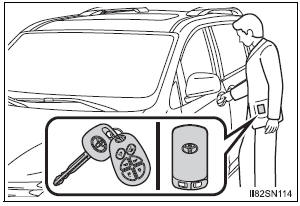
- Vehicles with an alarm system: Confirm that the electronic key is being carried.
When connecting the jumper (or booster cables, depending on the situation, the alarm may activate and doors locked.
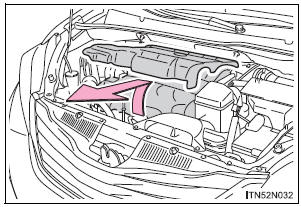
- Open the hood.
- Remove the engine cover.
Lift the edge of the cover to fixed pins, and then pull the cover towards you to remove.
- Connect the jumper cables according to the following procedures:
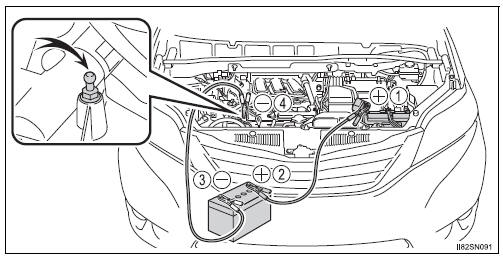
- Connect a positive jumper cable clamp to the positive (+) battery terminal on your vehicle
- Connect the clamp on the other end of the positive cable to the positive (+) battery terminal on the second vehicle
- Connect a negative cable clamp to the negative (-) battery terminal on the second vehicle
- Connect the clamp at the other end of the negative cable to a solid, stationary, unpainted metallic point away from the battery and any moving parts, as shown in the illustration.
- Start the engine of the second vehicle. Increase the engine speed slightly and maintain at that level for approximately 5 minutes to recharge the battery of your vehicle.
- Vehicles with a smart key system only: Open and close any of the doors of your vehicle with the engine switch off.
- Maintain the engine speed of the second vehicle and start the engine of your vehicle by turning the engine switch to the “ON” position (vehicles without a smart key system) or turning the engine switch to IGNITION ON mode (vehicles with a smart key system).
- Once the vehicle’s engine has started, remove the jumper cables in the exact reverse order from which they were connected.
- To install the engine cover, conduct the removal procedure in reverse. After installing, check that the fixed pins are inserted securely.
Once the engine starts, have the vehicle inspected at your Toyota dealer as soon as possible.
Starting the engine when the battery is discharged
The engine cannot be started by push-starting.
To prevent battery discharge
- Turn off the headlights and the audio system while the engine is off.
- Turn off any unnecessary electrical components when the vehicle is running at a low speed for an extended period, such as in heavy traffic.
When the battery is removed or discharged
- The power sliding door (if equipped) must be initialized.
- The power back door (if equipped) must be initialized.
Charging the battery
The electricity stored in the battery will discharge gradually even when the vehicle is not in use, due to natural discharge and the draining effects of certain electrical appliances. If the vehicle is left for a long time, the battery may discharge, and the engine may be unable to start. (The battery recharges automatically during driving.)
| WARNING
Avoiding battery fires or explosions Observe the following precautions to prevent accidentally igniting the flammable gas that may be emitted from the battery:
Battery precautions The battery contains poisonous and corrosive acidic electrolyte, while related parts contain lead and lead compounds. Observe the following precautions when handling the battery:
|
| NOTICE
When handling jumper cables When connecting the jumper cables, ensure that they do not become entangled in the cooling fans or belt. To prevent damage to the engine cover
|
If your vehicle overheats
The following may indicate that your vehicle is overheating.
- The needle of the engine coolant temperature gauge enters the red zone or a loss of engine power is experienced. (For example, the vehicle speed does not increase.)
- The warning message indicating overheats is shown on the multiinformation display.
- Steam is coming from under the hood.
Correction procedures
- Stop the vehicle in a safe place and turn off the air conditioning system, and then stop the engine.
- If you see steam: Carefully lift the hood after the steam subsides.
If you do not see steam: Carefully lift the hood.
- After the engine has cooled down sufficiently, inspect the hoses and radiator core (radiator) for any leaks.
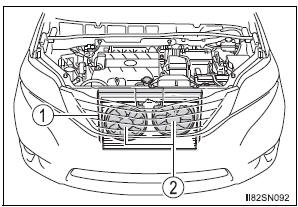
- Radiator
- Cooling fans
If a large amount of coolant leaks, immediately contact your Toyota dealer.
- The coolant level is satisfactory if it is between the “FULL” and “LOW” lines on the reservoir.
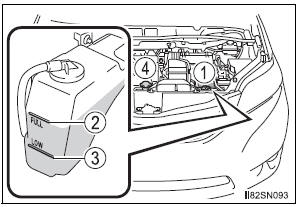
- Reservoir
- “FULL” line
- “LOW” line
- Radiator cap
- Add coolant if necessary.
Water can be used in an emergency if coolant is unavailable.
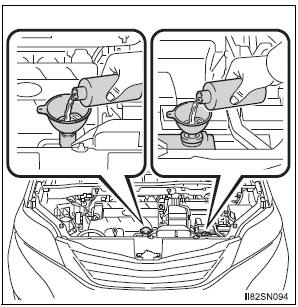
- Start the engine and turn the air conditioning system on to check that the radiator cooling fans operate and to check for coolant leaks from the radiator or hoses.
The fans operate when the air conditioning system is turned on immediately after a cold start. Confirm that the fans are operating by checking the fan sound and air flow. If it is difficult to check these, turn the air conditioning system on and off repeatedly. (The fans may not operate in freezing temperatures.)
- If the fans are not operating: Stop the engine immediately and contact your Toyota dealer.
If the fans are operating: Have the vehicle inspected at the nearest Toyota dealer.
| WARNING
When inspecting under the hood of your vehicle Observe the following precautions. Failure to do so may result in serious injury such as burns.
|
| NOTICE
When adding engine coolant Add coolant slowly after the engine has cooled down sufficiently. Adding cool coolant to a hot engine too quickly can cause damage to the engine. To prevent damage to the cooling system Observe the following precautions:
|
If the vehicle becomes stuck
Carry out the following procedures if the tires spin or the vehicle becomes stuck in mud, dirt, or snow:
- Stop the engine. Set the parking brake and shift the shift lever to P.
- Remove the mud, snow, or sand from around the stuck tire.
- Place wood, stones or some other material under the tires to help provide traction.
- Restart the engine.
- Shift the shift lever to the D or R and release the parking brake.
Then, while exercising caution, depress the accelerator pedal.
When it is difficult to free the vehicle
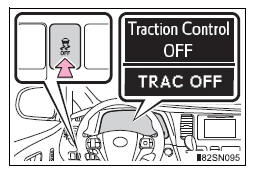
Press  to turn off TRAC.
| WARNING
When attempting to free a stuck vehicle If you choose to push the vehicle back and forth to free it, make sure the surrounding area is clear to avoid striking other vehicles, objects or people. The vehicle may also lunge forward or lunge back suddenly as it becomes free. Use extreme caution. When shifting the shift lever Be careful not to shift the shift lever with the accelerator pedal depressed. This may lead to unexpected rapid acceleration of the vehicle that may cause an accident resulting in death or serious injury. |
| NOTICE
To avoid damaging the transaxle and other components
|
Download Manual