Operating the lights and wipers
Headlight switch
The headlights can be operated manually or automatically.
Operating instructions
Turning the end of the lever turns on the lights as follows: The illustration is intended as an example.
- U.S.A.

- Canada

 The headlights, side marker, parking lights, daytime running lights (if equipped) and so on turn on and off automatically (when the engine switch is in the “ON” position [vehicles without a smart key system] or IGNITION ON mode [vehicles with a smart key system]).
 The side marker, parking, tail, license plate, daytime running lights (if equipped) and instrument panel lights turn on.
 The headlights and all lights listed above (except daytime running lights) turn on.
 Off.
Off.  The daytime running light system is off. (Canada)
  The daytime running light system is on.
*1: Vehicles without a daytime running light system *2: Vehicles with a daytime running light system.
Turning on the high beam headlights

- With the headlights on, push the lever away from you to turn on the high beams.
When the light switch is in

position, the Automatic High Beam system will be activated. Pull the lever toward you to the center position to turn the high beams off. - Pull the lever toward you and release it to flash the high beams once.
You can flash the high beams with the headlights on or off.
Manual headlight leveling dial (vehicles with discharge headlights)
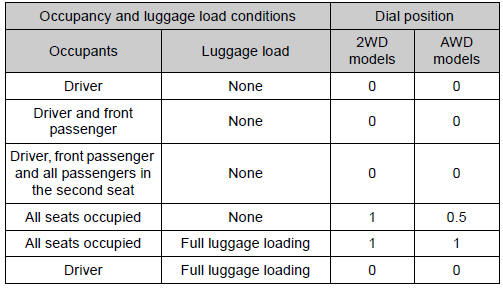
The level of the headlight aim can be adjusted according to the number of passengers and the loading condition of the vehicle.
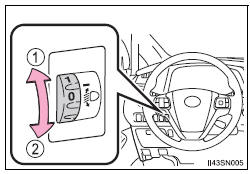
- Raises the level of the headlights
- Lowers the level of the headlights
Guide to dial settings
Daytime running light system (if equipped)
- Bulb type: To make your vehicle more visible to other drivers during daytime driving, the daytime running lights turn on automatically whenever the engine is started and the parking brake is released with the headlight switch off or in the “AUTO” position. (illuminate dimmer than the headlights) Daytime running lights are not designed for use at night.
For the U.S.A.: Daytime running lights can be turned off by operating the headlight switch.
LED type: To make your vehicle more visible to other drivers during daytime driving, the daytime running lights turn on automatically whenever the engine is started and the parking brake is released with the headlight switch off. Daytime running lights are not designed for use at night.
For the U.S.A.: Daytime running lights can be turned off by operating the headlight switch.
- Compared to turning on the headlights, the daytime running light system offers greater durability and consumes less electricity, so it can help improve fuel economy.
Headlight control sensor
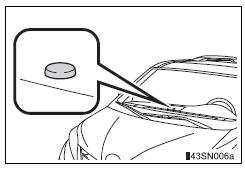
The sensor may not function properly if an object is placed on the sensor, or anything that blocks the sensor is affixed to the windshield.
Doing so interferes with the sensor detecting the level of ambient light and may cause the automatic headlight system to malfunction.
Automatic light off system
- Vehicles without a smart key system
- When the headlights are on: The headlights and tail lights turn off 30 seconds after a door is opened and closed if the engine switch is turned to the “ACC” or “LOCK” position. (The lights turn off immediately if
 on the
key is pressed after all the doors are locked.) - When only the tail lights are on: The tail lights turn off automatically if the engine switch is turned to the “ACC” or “LOCK” position and the driver’s door is opened.
To turn the lights on again, turn the engine switch to the “ON” position, or turn the light switch off once and then back to the
 or
or  .
. - Vehicles with a smart key system
- When the headlights are on: The headlights and tail lights turn off 30 seconds after a door is opened and closed if the engine switch is turned to ACCESSORY mode or turned off. (The lights turn off immediately if
on the key is pressed after all the doors are locked.) - When only the tail lights are on: The tail lights turn off automatically if the engine switch is turned to ACCESSORY mode or turned off and the driver’s door is opened.
To turn the lights on again, turn the engine switch to IGNITION ON mode, or turn the light switch off and then back to
or  .
.
Light reminder buzzer
- Vehicles without a smart key system A buzzer sounds when the engine switch is turned to the “LOCK” position, the key is removed and the driver’s door is opened while the lights are turned on.
- Vehicles with a smart key system A buzzer sounds when the engine switch is turned off and the driver’s door is opened while the lights are turned on.
Customization
Settings (e.g. light sensor sensitivity) can be changed.
(Customizable features: )
| NOTICE
To prevent battery discharge Do not leave the lights on longer than necessary when the engine is not running. |
Automatic High Beam
The Automatic High Beam uses an in-vehicle camera sensor to assess the brightness of streetlights, the lights of oncoming and preceding vehicles, etc., and automatically turns high beam on or off as necessary.
Activating the Automatic High Beam system
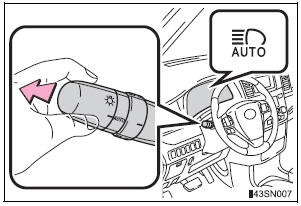
Push the lever away from you with the headlight switch in the  position.
The Automatic High Beam indicator will come on when the headlights are turned on automatically to indicate that the system is active.
High beam automatic turning on or off conditions
When all of the following conditions are fulfilled, high beam will be automatically turned on (after approximately 1 second):
- Vehicle speed is above approximately 20 mph (32 km/h).
- The area ahead of the vehicle is dark.
- There are no oncoming or preceding vehicles with headlights or tail lights turned on.
If any of the following conditions are fulfilled, high beam will be automatically turned off:
- Vehicle speed drops below approximately 20 mph (32 km/h).
- The area ahead of the vehicle is not dark.
- Oncoming or preceding vehicles have headlights or tail lights turned on.
Turning the high beam on/off manually
Switching to low beam
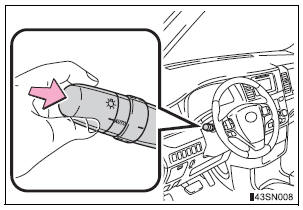
Pull the lever to the original position.
Switching to high beam
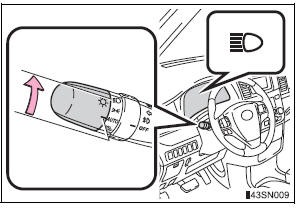
Turn the light switch to the  position.
The Automatic High Beam can be operated when
The engine switch is in the “ON” position (vehicles without a smart key system) or IGNITION ON mode (vehicles with a smart key system).
Camera sensor detection information
- High beam may not be automatically turned off in the following situations:
- When oncoming vehicles suddenly appear from a curve.
- When the vehicle is cut in front of by another.
- High beam may be turned off if an oncoming vehicle that is using fog lights without using the headlights is detected.
- Houselights, streetlights, red traffic signals, and illuminated billboards or signs may cause the high beam to turn off.
- The following factors may affect the amount of time taken to turn high beam on or off:
- The brightness of headlights, fog lights, and tail lights of oncoming and preceding vehicles
- Road conditions (wetness, ice, snow etc.)
- The number of passengers and amount of baggage
- High beam may be turned on or off when unexpected by the driver.
- In the situations below, the system may not be able to correctly detect the surrounding brightness levels, and may flash or expose nearby pedestrians to the high beam. Therefore, you should consider turning the high beam on or off manually rather than relying on the Automatic High Beam system.
- In bad weather (rain, snow, fog, sandstorms etc.)
- The windshield is obscured by fog, mist, ice, dirt etc.
- The windshield is cracked or damaged.
- The camera sensor is deformed or dirty.
- Surrounding brightness levels are equal to those of headlights, tail lights or fog lights.
- Vehicles ahead have headlights that are either switched off, dirty, are changing color, or are not aimed properly.
- When driving through an area of intermittently changing brightness and darkness
- When frequently and repeatedly driving ascending/descending roads, or roads with rough, bumpy or uneven surfaces (such as stone-paved roads, gravel tracks etc.)
- When frequently and repeatedly taking curves or driving on a winding road
- There is a highly reflective object ahead of the vehicle, such as a sign or a mirror.
- The vehicle’s headlights are damaged or dirty.
- The vehicle is lifting or tilting, due to a flat tire, a trailer being towed etc.
- The high beam and low beam are repeatedly being switched between in an abnormal manner.
- The driver believes that the high beam may be causing problems or distress to other drivers or pedestrians nearby.
When the warning message is shown on the multi-information display
Temporary lowering sensor sensitivity
The sensitivity of the sensor can be temporarily lowered.
To lower the sensitivity, push and hold  on the inside rear view mirror for
15 to 20 seconds, and release. The indicator light on the inside rear view mirror will flash to indicate that the sensitivity has been lowered.
When the engine switch is turned to the “LOCK” position (vehicles without a smart key system) or turned off (vehicles with a smart key system), the sensitivity will be returned to its normal level.
Customization
The Automatic High Beam can be turned off.
(Customizable features: )
| WARNING
Limitations of the Automatic High Beam Do not rely on the Automatic High Beam. Always drive safely, taking care to observe your surroundings and turning high beam on or off manually if necessary. |
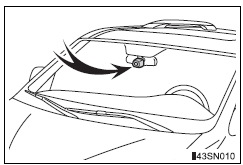
| NOTICE
Camera sensor Observe the following to ensure that the Automatic High Beam functions correctly.
Headlight leveling When the vehicle is loaded, headlight level should be adjusted to appropriate dial setting. |
Fog light switch
The fog lights secure excellent visibility in difficult driving conditions, such as in rain and fog.
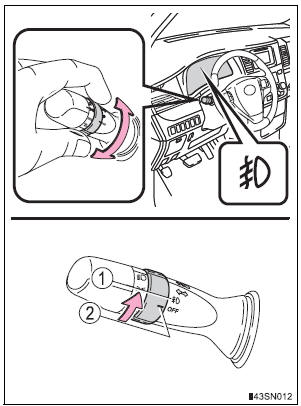
The illustration is intended as an example.
- Turns the fog lights on
 *1 or
*1 or  *2
*2
Turns the fog lights off
*1: For U.S.A.
*2: For Canada
Fog lights can be used when
The headlights are on in low beam.
Windshield wipers and washer
Operating the wiper lever
The wiper operation is selected by moving the lever as follows.
The illustration is intended as an example.
- Intermittent windshield wipers with interval adjuster
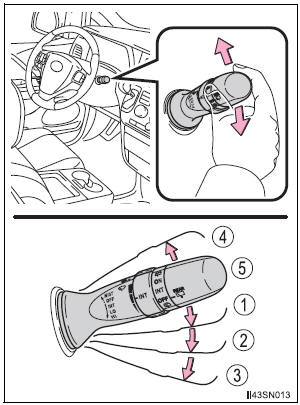
 *1 or
*1 or  *2 Intermittent windshield wiper operation
 *1 or
*1 or  *2 Low speed windshield wiper operation
 *1 or
*1 or  *2 High speed windshield wiper operation
 *1 or
*1 or  *2 Temporary operation
 *1 or
*1 or  *2 Off
*1: For U.S.A.
*2: For Canada
Wiper intervals can be adjusted when intermittent operation is selected.
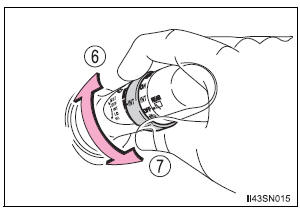
- Increases the intermittent windshield wiper frequency
- Decreases the intermittent windshield wiper frequency
- Washer/wiper dual operation
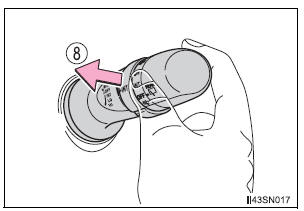
The wipers will automatically operate a couple of times after the washer squirts.
- Rain-sensing windshield wipers (if equipped)
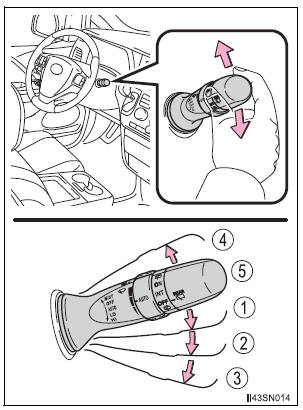
- Rain-sensing wiper operation (“AUTO”) When “AUTO” is selected, the wipers will operate automatically when the sensor detects falling rain.
The system automatically adjusts wiper timing in accordance with rain volume.
 *1 or
*1 or  *2 Low speed wiper operation
 *1 or
*1 or  *2 High speed wiper operation
 *1 or
*1 or  *2 Temporary operation
 *1 or
*1 or  *2 Off
*1: For U.S.A.
*2: For Canada
The sensor sensitivity can be adjusted when “AUTO” is selected.
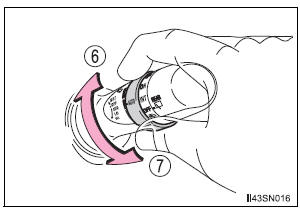
- Increases the sensitivity
- Decreases the sensitivity
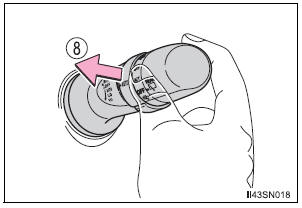
- Washer/wiper dual operation
The wipers will automatically operate a couple of times after the washer squirts.
The windshield wipers and washer can be operated when
The engine switch is in the “ON” position (vehicles without a smart key system) or IGNITION ON mode (vehicles with a smart key system).
Raindrop sensor (vehicles with rain-sensing windshield wipers)
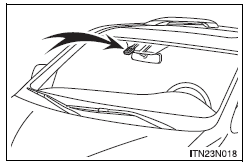
- The raindrop sensor judges the amount of raindrops.
- If the wiper switch is turned to “AUTO” position while the engine switch is in IGNITION ON mode, the wiper will operate once to show that “AUTO” mode is activated.
- If the temperature of the raindrop sensor is 185°F (85°C) or higher, or 14°F (-10°C) or lower, automatic operation may not occur. In this case, operate the wipers in any mode other than “AUTO”.
If no windshield washer fluid sprays
Check that the washer nozzles are not blocked if there is washer fluid in the windshield washer fluid reservoir.
| WARNING
Caution regarding the use of windshield wipers in “AUTO” mode The windshield wipers may operate unexpectedly if the sensor is touched or the windshield is subject to vibration in “AUTO” mode. Take care that your fingers etc. do not become caught in the windshield wipers. Caution regarding the use of washer fluid When it is cold, do not use the washer fluid until the windshield becomes warm. The fluid may freeze on the windshield and cause low visibility. This may lead to an accident, resulting in death or serious injury. |
| NOTICE
When the windshield is dry Do not use the wipers, as they may damage the windshield. When the washer fluid tank is empty Do not operate the switch continually as the washer fluid pump may overheat. When a nozzle becomes blocked In this case, contact your Toyota dealer. Do not try to clear it with a pin or other object. The nozzle will be damaged. |
Rear window wiper and washer
Operating the wiper lever
Turning the end of the lever turns on the rear window wiper and washer.
The illustration is intended as an example.
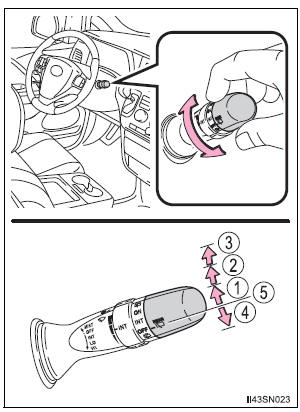
 *1 or
*1 or  *2
*2
Intermittent window wiper operation *1 or
*1 or *2
*2
Normal window wiper operation Washer/wiper dual operation
 Washer/wiper dual operation
 *1 or
*1 or *2
*2
Off
*1: For U.S.A.
*2: For Canada
The rear window wiper and washer can be operated when
The engine switch is in the “ON” position (vehicles without a smart key system) or IGNITION ON mode (vehicles with a smart key system).
If no windshield washer fluid sprays
Check that the washer nozzles are not blocked if there is washer fluid in the windshield washer fluid reservoir.
| NOTICE
When the rear window is dry Do not use the wiper, as it may damage the rear window. When the washer fluid tank is empty Do not operate the switch continually as the washer fluid pump may overheat. When a nozzle becomes blocked In this case, contact your Toyota dealer. Do not try to clear it with a pin or other object. The nozzle will be damaged. |
Download Manual