Forward Collision-avoidance Assist (FCA) (Camera + Radar type)
The FCA system is designed to detect and monitor the vehicle ahead or detect a pedestrian in the roadway through radar signals and camera recognition to warn the driver that a collision is imminent, and if necessary, apply emergency braking.
WARNING
Take the following precautions when using the Forward Collision-Avoidance Assist (FCA) system:
- This system is only a supplemental system, and it is not intended to, nor does it, replace the need for the driver's extreme care and attention. The sensing range and objects detectable by the sensors are limited. Pay attention to road conditions at all times.
- NEVER drive too fast for the road conditions or whilst cornering.
- Always drive cautiously to help prevent unexpected and sudden situations from occurring. FCA does not guarantee to stop the vehicle completely and does not guarantee to avoid all collisions.
System setting and activation
System setting
When the ignition switch is turned on, Forward Collision-Avoidance Assist (FCA) automatically gets activated. The system can be deactivated if the driver cancels the system from the instrument panel as follows : 'User settings → Driving assist → Forward Collision-Avoidance Assist'

The warning light illuminates on the LCD display when you cancel the FCA system. The driver can monitor the FCA ON/OFF status on the LCD display. Also, the warning light illuminates when the ESC (Electronic Stability Control) is turned off. When the warning light remains ON with the FCA activated, have the system checked by a professional workshop. Kia recommends to visit an authorized Kia dealer/service partner.
The driver can select the initial warning activation time in the User Settings in the instrument cluster LCD display. The options for the initial Forward Collision Warning include the following:
• EARLY - When this option is selected, the initial Forward Collision Warning is activated earlier than normal. This setting maximizes the amount of distance between your vehicle and the vehicle or pedestrian ahead before the initial warning occurs. If the ‘EARLY’ option feels too sensitive, change it to ‘NORMAL’. When the vehicle ahead suddenly stops, the warning may seem to activate later even if the ‘EARLY’ condition was selected.
• NORMAL - When this option is selected, the initial Forward Collision Warning is activated normally. Compared to EARLY mode, this setting allows for a shorter amount of distance between your vehicle and the vehicle or pedestrian ahead before the initial warning occurs.
• LATE - When this option is selected, the initial Forward Collision Warning is activated later than normal. This setting reduces the amount of distance between your vehicle and the vehicle or pedestrian ahead before the initial warning occurs. Select this option only when traffic is light and you are driving slowly.
Prerequisite for activation
The FCA gets ready to be activated when the FCA is selected on the LCD display and when the following prerequisites are satisfied.
- The ESC is ON.
- The driving speed is over 10 km/h (6 mph). (However, FCA is activated within a certain driving speed.)
- When recognizing a vehicle or the pedestrian in front. (However, FCA deactivates according to conditions in front and vehicle systems, but it notices only certain warnings.)
- The FCA automatically deactivates upon canceling the ESC. When the ESC is cancelled, the FCA cannot be activated on the LCD display. In this situation, the FCA warning light will illuminate.
WARNING
- The FCA automatically activates upon placing the ignition switch to the ON position. The driver can deactivate the FCA by canceling the system setting on the LCD display.
- The FCA automatically deactivates upon canceling the ESC. When the ESC is cancelled, the FCA cannot be activated on the LCD display. The FCA warning light will illuminate, but it does not indicate a malfunction of the system.
- Set or cancel FCA with control switches on the steering wheel after stopping the vehicle in a safe place.
FCA warning message and system control
The FCA system produces warning messages, warning alarms, and emergency braking based on the risk of a frontal collision, such as when a vehicle ahead suddenly brakes.
The driver can select the initial warning activation time in the User Settings in the LCD display. The options for the initial Forward Collision-Avoidance Assist include Early, Normal or Late initial warning time.
Collision Warning! (1st warning)
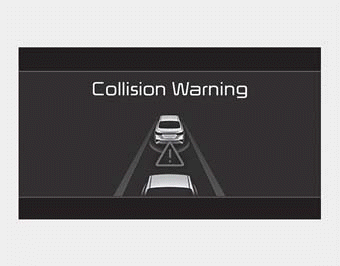
This warning message appears on the LCD display with a warning chime.
Additionally, the engine management system intervenes to help decelerate the vehicle.
- Your vehicle speed may decelerate moderately.
- The FCA system limitedly controls the brakes to preemptively mitigate impact from a collision.
Emergency braking! (2nd warning)
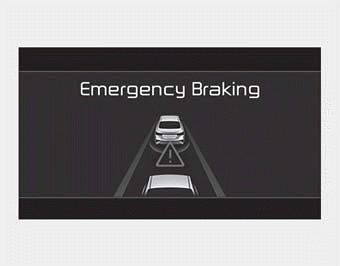
This warning message appears on the LCD display with a warning chime.
Additionally, the engine management system intervenes to help decelerate the vehicle.
- The FCA system limitedly controls the brakes to preemptively mitigate impact from a collision. The brake control is maximized just before a collision.
Brake operation
- In an emergency situation, the braking system enters in ready status for prompt reaction upon the driver depressing the brake pedal.
- The FCA system provides additional braking power for optimum braking performance when the driver depresses the brake pedal.
- The braking control is automatically deactivated when the driver sharply depresses the accelerator pedal or when the driver abruptly operates the steering wheel.
- The braking control is automatically cancelled when risk factors disappear.
CAUTION
The driver should always exercise great caution during vehicle operation even though there is no warning message or warning alarm.
WARNING
The FCA system is a supplemental system and cannot completely stop the vehicle in all situations and avoid all collisions. It is the responsibility of the driver to drive safely and control the vehicle.
WARNING
The FCA system assesses the risk of a collision by monitoring several variables, such as the distance to the vehicle ahead, the speed of the vehicle ahead, and the driver's operation of the vehicle.
Certain conditions such as inclement weather and road conditions may affect the operation of the FCA system.
WARNING
Never deliberately drive dangerously to activate the system as such conduct increases the risk of an accident.
Sensor to detect the distance from the vehicle in front (front radar/camera)
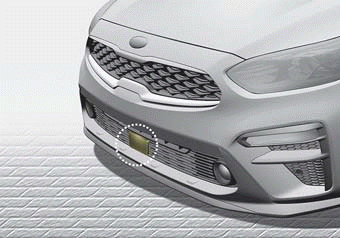
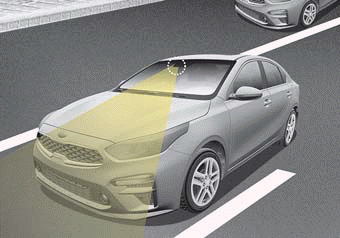
By detecting the vehicle or pedestrian ahead of the vehicle, the sensor helps to operate the Forward Collision-Avoidance Assist when the vehicle is at risk of a collision.
In order for the FCA system to operate properly, always make sure the sensor or sensor cover is clean and free of dirt, snow, and debris. Dirt, snow, or foreign substances on the lens may adversely affect the sensing performance of the sensor.
Warning message and warning light
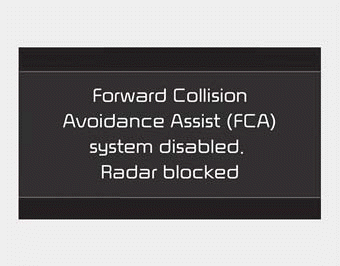
When the sensor is covered or the sensor lens is dirty with foreign substances, such as snow or rain, the FCA system may not be able to detect vehicles. In this situation, a warning message (“Forward Collision-Avoidance Assist (FCA) system disabled. Radar blocked”) will appear to notify the driver. Remove the foreign substances to allow the FCA system to function property.
This is not a malfunction with the FCA. To operate the FCA again, remove the foreign substances.
The FCA may not properly operate in an area (e.g. open terrain), where vehicles or objects are not detected after turning ON the engine.
✽ NOTICE
- Do not install any accessories, such as license plate molding or sticker, on the sensor area. Nor arbitrarily replace the bumper. Those may adversely affect the sensing performance.
- Always keep the sensor/bumper area clean.
- Use only soft materials to wash the vehicle. Also, do not spray highlypressurized water on the sensor installed on the bumper.
- Be careful not to apply unnecessary force on the frontal sensor area. When the sensor moves out of the correct position due to external force, the system may not operate normally and may not provide a warning light or message. In this situation, have the vehicle inspected by an authorized Kia dealer.
- Use only a genuine Kia sensor cover, and do not apply any paint on the sensor cover.
- Do not tint the window or install stickers, or accessories around the inside mirror where the camera is installed.
- Make sure the frontal camera installation point does not get wet.
- Do not impact, apply excessive force to, or remove any radar/camera components.
- Do not place reflective objects(white paper or mirrors etc.) on the dashboard. The system may unnecessarily activate or deactivate due to the reflection of sunlight.
- Excessive audio system volume may prevent occupants from hearing the FCA system warning alarm.
System malfunction
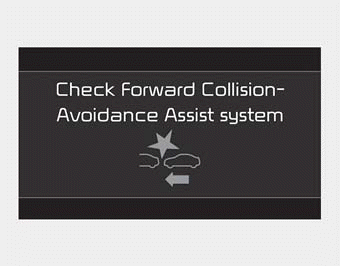
- When the FCA is not working properly, the FCA warning light (
 ) will illuminate and the warning message will appear for a few seconds. After the message disappears, the master warning light (
 ) will illuminate. In this situation, have the vehicle inspected by an authorized Kia dealer.
 - The FCA system will get deactivated for the sake of driver's safety when the ESC warning light comes on. The FCA warning message will appear at the same time, too. But that doesn't necessarily mean a malfunction of the FCA system. Both the FCA warning light and warning message will disappear once the ESC warning light issue is resolved.
WARNING
- The FCA is only a supplemental system for the driver’s convenience. It is the driver's responsibility to control the vehicle. Do not solely depend on the FCA system. Rather, maintain a safe braking distance, and, if necessary, depress the brake pedal to lower the driving speed.
- The FCA may unnecessarily produce the warning message and the warning alarms. Also, due to sensing limitations the FCA may not produce alarms in certain situations. Read the section “Limitation of the system” for more information.
- When there is a malfunction with the FCA, the FCA braking control does not operate upon detecting a collision risk, even with other braking systems operating normally.
- The FCA system only recognizes vehicles and pedestrians in front of it while driving forward. It does not identify any animals or vehicles in the opposite direction.
- The FCA does not recognize cross-traffic or parked vehicles presenting a side profile.
- If the vehicle in front stops suddenly, you may have less to apply the brakes system. Therefore, always keep a safe distance between your vehicle and the vehicle in front of you.
- The FCA system may activate during braking and the vehicle may stop suddenly. If this occurs, any load in the vehicle may endanger passengers. Therefore, always be mindful of the load volume in the vehicle.
- The FCA system may not activate if the driver applies the brake pedal to avoid the risk of a collision.
- The FCA system does not operate when the vehicle is in reverse. In these cases, you must maintain a safe braking distance, and if necessary, depress the brake pedal to reduce the driving speed in order to maintain a safe dis tance.
- The regular braking function will operate normally even if there is a problem with the FCA brake control system or other functions. In this case, the braking control will not operate in the risk of a collision.
- The FCA system may not activate in certain situations and according to driving condition, traffic on the road, weather, road conditions, etc.
- The FCA system may not activate in response to all types of vehicles.
Limitation of the system
The FCA system is designed to monitor the vehicle ahead through radar signals and camera recognition to warn the driver that a collision is imminent, and if necessary, apply emergency braking. In certain situations, the radar sensor or the camera may not be able to detect the vehicle ahead. In these cases, the FCA system may not operate. The driver must pay careful attention in the following situations where the FCA operation may be limited:
Recognizing vehicles
- The radar or the camera is contaminated with foreign substances.
- It heavily rains or snows.
- There is electromagnetic interference
- Something in the path of travel deflects the radar waves
- The vehicle in front has a narrow body. (i.e. motorcycles and bicycles)
- The driver’s view is not clear due to backlight, reflected light, or darkness.
- The camera cannot contain the full image of the vehicle in front.
- The vehicle in front is a special vehicle, such as a heavily-loaded truck or a trailer.
- The outside brightness is greatly changed, such as entering/exiting a tunnel.
- The vehicle driving is unstable.
- The radar/camera sensor recognition is limited.
- The driver's field of view is not well illuminated (either too dark, too much reflection, or too much backlight that obscures the field of view)
- There is severe irregular reflection from the radar sensor
- The vehicle in front is driving erratically
- The vehicle is driven near areas containing metal substances such as a construction zone, railroad, etc.
- Backlight is reflected in the direction of the vehicle (including front light from the vehicle ahead)
- Moisture on the windshield is not completely removed or is frozen.
- The weather is misty.
- The vehicle in front does not turn ON the rear lights, does not have rear lights, has asymmetric rear lights, or has rear lights out of angle.
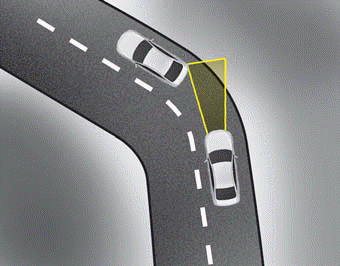
- Driving on a curve
The FCA performance may be limited while driving on a curve. The FCA may not recognize the vehicle in front even if in the same lane. It may produce the warning message and the warning alarm prematurely, or it may not produce the warning message or the warning alarm at all. When driving on a curve, exercise caution, maintain a safe braking distance, and if necessary, depress the brake pedal to reduce your driving speed in order to maintain a safe distance.
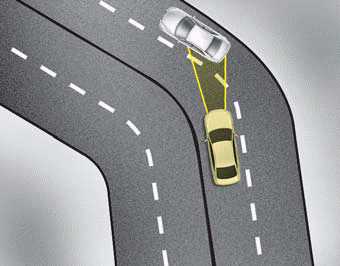
The FCA system may recognize a vehicle in an adjacent lane when driving on a curved road. In this situation, the system may apply the brake. Always pay attention to road and driving conditions while driving. If necessary, depress the brake pedal to reduce your driving speed in order to maintain a safe distance. Also, when necessary, you may depress the accelerator pedal to prevent the system from unnecessarily decelerating your vehicle. Always check the traffic conditions around the vehicle.
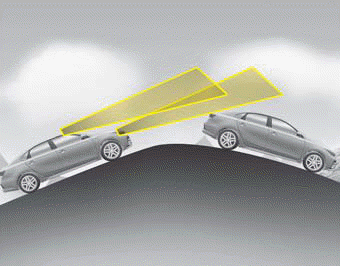
- Driving on a slope
The FCA performance may be limited while driving upward or downward on a slope, and may not recognize a vehicle in front in the same lane. It may produce the warning message and the warning alarm prematurely, or it may not produce the warning message and the warning alarm at all.
When the FCA suddenly recognizes the vehicle in front while passing over a slope, you may experience sharp deceleration.
Always keep your eyes forward while driving upward or downward on a slope, and, if necessary, depress the brake pedal.
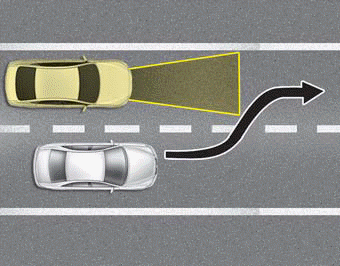
- Changing lanes
When a vehicle changes lanes in front of you, the FCA system may not immediately detect the vehicle, especially if the vehicle changes lanes abruptly. In this situation, you must maintain a safe braking distance, and if necessary, depress the brake pedal to reduce your driving speed in order to maintain a safe distance.
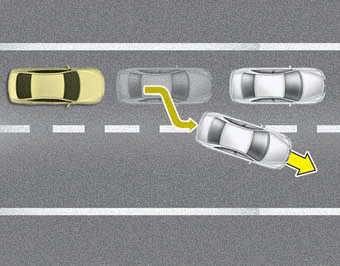
When driving in stop-and-go traffic, and a stopped vehicle in front of you merges out of the lane, the FCA system may not immediately detect the new vehicle that is now in front of you. In this situation, you must maintain a safe braking distance, and if necessary, depress the brake pedal to reduce your driving speed in order to maintain a safe distance.
- Recognizing the vehicle
If the vehicle in front of you has cargo that extends rearward from the cab, or when the vehicle in front of you has higher ground clearance, additional special attention is required. The FCA system may not be able to recognize the cargo extending from the vehicle. In these instances, you must maintain a safe braking distance from the rearmost object, and if necessary, depress the brake pedal to reduce your driving.
Recognizing pedestrians
The pedestrian is not fully detected by the camera sensor, or the pedestrian is not walking in the upright position.
- The pedestrian moves very fast.
- The pedestrian abruptly appears in front.
- The pedestrian is wearing clothing that easily blends into the background, making it difficult to be detected.
- The outside is too bright or too dark.
- The vehicle drives at night or in the darkness.
- There is an item similar to a person’s body structure.
- The pedestrian is small.
- The pedestrian has impaired mobility.
- It is difficult to distinguish the pedestrian from the surroundings.
- The sensor recognition is limited.
- There is a group of pedestrians.
- If a sudden change in the sensor recognition takes place while passing through a speed bump,
- When the vehicle is severely shaken,
- When driving around a circular intersection or traffic circle while following a vehicle in front.
- If the front of the camera lens is contaminated by front glass tinting, film, water repellent coating, damage on glass, or foreign matter (sticker, insect, etc.)
- The radar, camera, or camera lens is damaged.
- If the headlights of a vehicle are not used at night or in a tunnel section, or the light is too weak
- If street light or the light of a vehicle coming from a opposite direction is reflected or when sunlight is reflected by water on the road surface
- When back light is projected in the direction of the vehicle's motion (including the headlights of vehicles)
- When road signs, shadows on the road, tunnel entrances, toll gates, or partial pavement affect the system.
- If the windshield has moisture on its surface or if the windshield freezes.
- Driving in the fog.
- When objects are out of the sensing range of the sensor or radar.
WARNING
- Do not use the FCA system when towing a vehicle. Cancel the FCA in the User Settings on the LCD display before towing. Brake application by the FCA system while towing may adversely affect your safety.
- Use extreme caution when the vehicle in front of you has cargo that extends rearward from the cab, or when the vehicle in front of you has higher ground clearance.
- The FCA system is designed to detect and monitor the vehicle ahead or detect a pedestrian in the roadway through radar signals and camera recognition. It is not designed to detect bicycles, motorcycles, or smaller wheeled objects such as luggage bags, shopping carts, or strollers.
- The FCA system may not operate in certain situations. Therefore, never test the operation of the FCA system using a person or object, as doing so may cause severe injury or even death.
✽ NOTICE
- When replacing or reinstalling the windscreen, front bumper or radar/camera after removal, have the vehicle inspected by an authorized Kia dealer.
- In some instances, the FCA system may be canceled when subjected to electromagnetic interference.
Download Manual