Blind-spot Collision Warning (BCW)
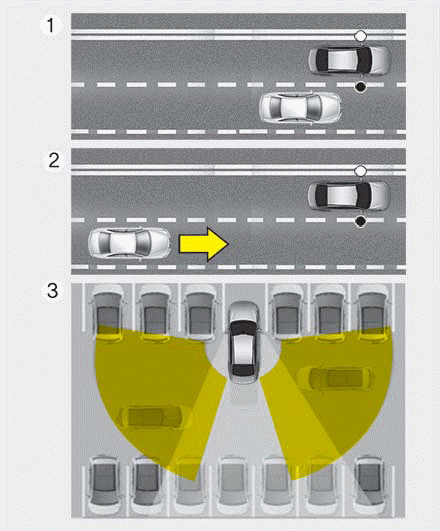
The Blind-Spot Collision Warning (BCW) system uses radar sensors in the rear bumper to monitor and warn the driver of an approaching vehicle in the driver's blind spot area.
The system monitors the rear area of the vehicle and provides information to the driver with an audible alert and an indicator on the outside rearview mirrors.
WARNING
- Always be aware of road conditions while driving and be alert for unexpected situations even though the BCW system is operating.
- The BCW is not a substitute for proper and safe driving. Always drive safely and use caution when changing lanes or backing up the vehicle. The BCW may not detect every object alongside the vehicle.
(1) Blind spot area
The BCW range varies relative to vehicle speed. Note that if your vehicle is traveling much faster than the vehicles around you, the warning will not occur.
(2) Closing at high speed
The BCW-Closing at high speed feature will alert you when a vehicle is approaching in an adjacent lane at a high rate of speed. If the driver activates the turn signal when the system detects an oncoming vehicle, the system sounds an audible alert. Distance from an approaching vehicle can be seen differently according to the relative speed.
(3) RCCW (Rear Cross-Traffic Collision Warning)
The RCCW feature monitors approaching cross traffic from the left and right side of the vehicle when your vehicle is in reverse. The feature will operate when the vehicle is moving in reverse below about 10 km/h (6 mph). If oncoming cross traffic is detected, a warning chime will sound. Distance from an approaching vehicle can be seen differently according to the relative speed.
WARNING
- Always check the road conditions while driving for unexpected situations even though the BCW (Blind-Spot Collision Warning) system is operating.
- BCW (Blind-Spot Collision Warning) system is a system made for convenience. Do not solely rely on the system but always pay attention to drive safely.
- Distance from an approaching vehicle can be seen differently according to the relative speed.
BCW (Blind-Spot Collision Warning) / LCA (Lane Change Assist)
Operating conditions
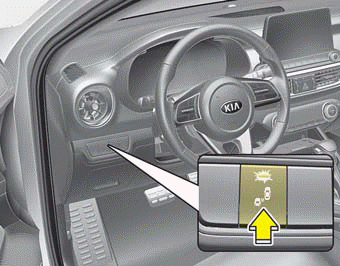
The indicator on the switch will illuminate when the BCW (Blind-Spot Collision Warning) system switch is pressed with the ignition switch ON. If the vehicle speed exceeds 30 km/h (20 mph), the system will activate.
If you press the switch again, the switch indicator and system will be turned off.
If the ignition switch is turned OFF and ON, the system returns to the previous state.
When the system is not being used, turn the system off by pressing the switch.
When the system is turned on, the warning light will illuminate for 3 seconds on the outside rearview mirror.
Warning type
The system will activate when:
1.The system is on
2.Vehicle speed is above 30 km/h (20 mph)
3.Other vehicles are detected in the blind spot area
WARNING
- Always check the road conditions while driving for unexpected situations even though the Blind-Spot Collision Warning System (BCW) is operating.
- The Blind-Spot Collision Warning System (BCW) is a supplemental system to assist you. Do not rely entirely on the system. For your safety, always pay attention while driving.
- The Blind-Spot Collision Warning System (BCW) is not a substitute for proper and safe driving. Always drive safely and use caution when changing lanes or backing the vehicle up. The Blind-Spot Collision Warning System (BCW) may not detect every object alongside the vehicle.
First stage alert
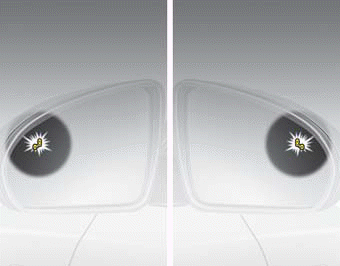
1st stage
If a vehicle is detected within the boundary of the system, a yellow warning light will illuminate on the outside rearview mirror.
Once the detected vehicle is no longer within the blind spot area, the warning will turn off according to the driving conditions of the vehicle.
Second stage alert
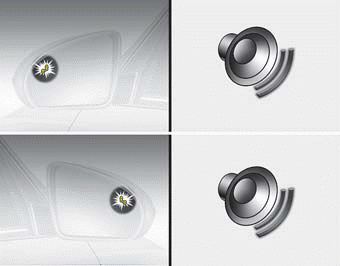
2nd stage
A warning chime to alert the driver will activate when:
1. A vehicle has been detected in the blind spot area by the radar system (the warning light will illuminate on the outside rearview mirror, i.e., in the first stage alert)
AND
2. The turn signal is applied (same side as where the vehicle is being detected).
When this alert is activated, the warning light on the outside rearview mirror will also blink.
If you turn off the turn signal indicator, the second stage alert (the warning chime and the blinking warning light on the outside rearview mirror) will be deactivated.
- The second stage alarm can be activated and deactivated.
- To activate the alarm: Go to the User Settings Mode → Driver Assistance and select “Blind-Spot Collision Warning” on the LCD display.
- To deactivate the alarm: Go to the User Settings Mode → Driver Assistance and deselect “Blind-Spot Collision Warning” on the LCD display.
CAUTION
The warning chime function helps alert the driver. Deactivate this function only when it is necessary, and refer to the “User Settings Mode” section in Chapter 4.
Detecting sensor
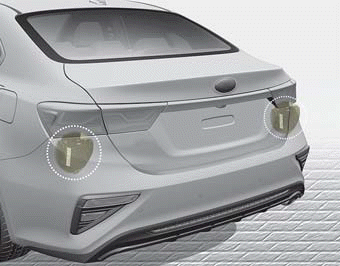
The sensors are located inside the rear bumper.
Always keep the rear bumper clean for the system to work properly.
RCCW (Rear Cross-Traffic Collision Warning)
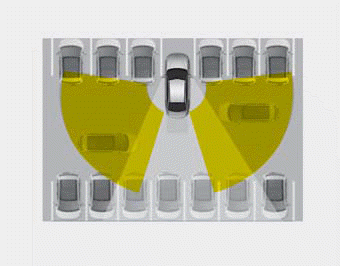
When your vehicle moves backwards from a parking position, the sensor detects approaching vehicles to the left or right side and gives information to the driver.
Operating conditions to operate
• Go to “User Settings → Driving Assist and select Rear Cross Traffic Collision Warning” on the LCD display.
The system will turn on and standby to activate. If you deactivate this function in the cluster, the system will stop.
✽ NOTICE
- If the vehicle is turned off and on again, the RCCW system will return to the state right before the vehicle was turned off.
- The system will activate when vehicle speed is below 10 km/h (6.2 mph) and with the shift lever in R (Reverse).
- The Rear Cross-Traffic Collision Warning (RCCW) detecting range is approximately 0.5 m ~ 20 m (1 ft ~ 65 ft) in the direction of both lateral sides of the car.
An approaching vehicle will be detected if its vehicle speed is within 4 km/h ~ 36 km/h (2.5 ~ 22.5 mph).
Note that the detecting range may vary under certain conditions. As always, use caution and pay close attention to your surroundings when backing up your vehicle.
Warning type
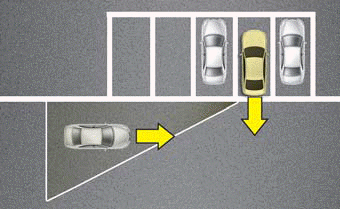
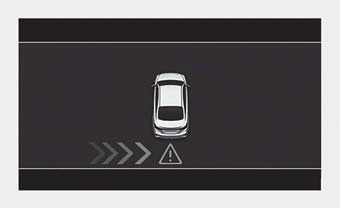
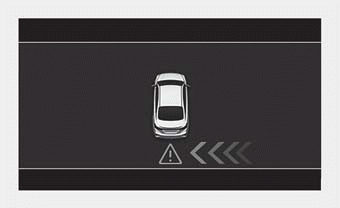
If the vehicle detected by the sensors approaches your vehicle, the warning chime will sound, the warning light on the outside rearview mirror will blink and a message will appear on the LCD display.
✽ NOTICE
- The warning chime will turn off:
- When the detected vehicle moves out of the sensing area or
- If your vehicle is moved away from the detected vehicle or
- When the vehicle is right behind your vehicle or
- When the vehicle is not approaching your vehicle or
- When the other vehicle slows down. - The system may not operate properly due to other factors or circumstances. Always pay attention to your surroundings.
- If the sensing area near the rear bumper is blocked by either a wall, barrier, or parked vehicle, the system sensing area may be reduced.
WARNING
- When the BCW system is activated, the warning light on the outside rearview mirror will illuminate whenever a vehicle is detected at the rear side by the system. To avoid accidents, do not focus only on the warning light and neglect to see the surroundings of the vehicle.
- Drive safely even though the vehicle is equipped with a BCW (Blind-Spot Collision Warning) system. Do not solely rely on the system but check the blind spot area for yourself before changing lanes. The system may not alert the driver in some conditions, so always check the surroundings while driving.
- The Blind-Spot Collision Warning system (BCW) and Rear Cross-Traffic Collision Warning (RCCW) are not substitutes for proper and safe driving practices. Always drive safely and use caution when changing lanes or backing up your vehicle.The Blind- Spot Collision Warning system (BCW) may not detect every object alongside the vehicle.
CAUTION
- The system may not work properly if the bumper has been replaced or if repair work has been done near the sensor.
- The detection area differs according to the width of the road. If the road is narrow, the system may detect other vehicles two lanes away.
- Also, if the road is very wide, the system may not detect other vehicles in the next lane.
- The system might be turned off due to strong electromagnetic waves.
Warning message
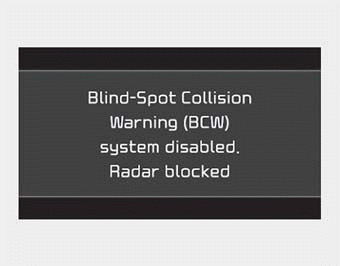
The sensor may be limited when the conditions below exist.
If there is a problem with the BCW system, a warning message will appear and the light on the switch will turn off. The system will turn off automatically.
- One or both of the sensors on the rear bumper is blocked by dirt, snow, or a foreign object.
- Driving in rural areas where the BCW sensor does not detect another vehicle for an extended period of time.
- When there is inclement weather such as heavy snow or rain.
- A trailer or carrier is installed. (To use the BCW system, remove the trailer or carrier from your vehicle.)
Turn off the system by pressing the BCW switch and deselecting Rear Cross-Traffic Collision Warning (RCCW) from the User Settings mode on the cluster, when using a trailer or carrier behind your vehicle.
If any of these conditions occur, the light on the BCW switch and the system will turn off automatically.
When the BCW canceled warning message is displayed in the cluster, check to make sure that the rear bumper is free from any dirt or snow in the areas where the sensor is located. Remove any dirt, snow, or foreign material that could interfere with the radar sensors.
After any dirt or debris is removed, the BCW system should operate normally after about 10 minutes of driving the vehicle.
If the system still does not operate normally, have your vehicle inspected by an authorized Kia dealer.
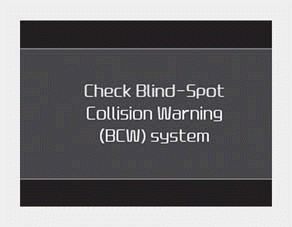
■ Type A
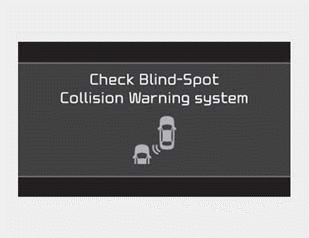
■ Type B
If the system does not work properly, a warning message will appear and the light on the switch will turn off.The system will turn off automatically.
In this situation, take your vehicle to an authorized Kia dealer and have the system checked.
Non-operating condition
The outside rearview mirror may not alert the driver when:
- The outside rearview mirror housing is damaged or covered with debris.
- The mirror is covered with dirt, snow, or debris.
- The window is covered with debris.
- The windows are darkly tinted.
Driver's Attention
The driver must be cautious in the situations below, because the system may not detect other vehicles or objects in certain circumstances.
- When a trailer or carrier is installed.
- The vehicle drives in inclement weather such as heavy rain or snow.
- The sensor is polluted with rain, snow, mud, etc.
- The rear bumper where the sensor is located is covered with a foreign object such as a bumper sticker, a bumper guard, a bike rack, etc.
- The rear bumper is damaged, or the sensor is out of the original default position.
- The vehicle height gets lower or higher due to heavy loading in the luggage compartment, abnormal tire pressure, etc.
- When the temperature near the rear bumper area is high or low.
- When the sensors are blocked by other vehicles, walls or parking- lot pillars.
- The vehicle drives on a curved road or through a tollgate.
- The vehicle is driven near areas containing metal substances such as a construction zone, railroad, etc.
- There is a fixed object near the vehicle, such as a guardrail, person, animal, etc.
- While going down or up a steep road where the height of the lane is different.
- When driving through a narrow road with many trees or bushes.
- When driving on wet surfaces.
- When driving through a large area with few vehicles or structures around, such as a desert, rural area, etc.
- A large vehicle, such as a bus or truck, is nearby.
- When other vehicles are close to your vehicle.
- When the other vehicle approaches very close.
- When the detected vehicle also moves back, as your vehicle drives back.
- While changing lanes.
- If the vehicle has started at the same time as the vehicle next to you and has accelerated.
- When the other vehicle passes at a very fast speed.
- When the vehicle in the next lane moves two lanes away from you OR when the vehicle two lanes away moves to the next lane to you.
- The vehicle is turning left or right at a crossroads.
Download Manual