Warning Lights, Gauges, and Indicators
Warning lights and gauges can signal that something is wrong before it becomes serious enough to cause an expensive repair or replacement. Paying attention to the warning lights and gauges could prevent injury.
Some warning lights come on briefly when the engine is started to indicate they are working. When one of the warning lights comes on and stays on while driving, or when one of the gauges shows there may be a problem, check the section that explains what to do. Waiting to do repairs can be costly and even dangerous.
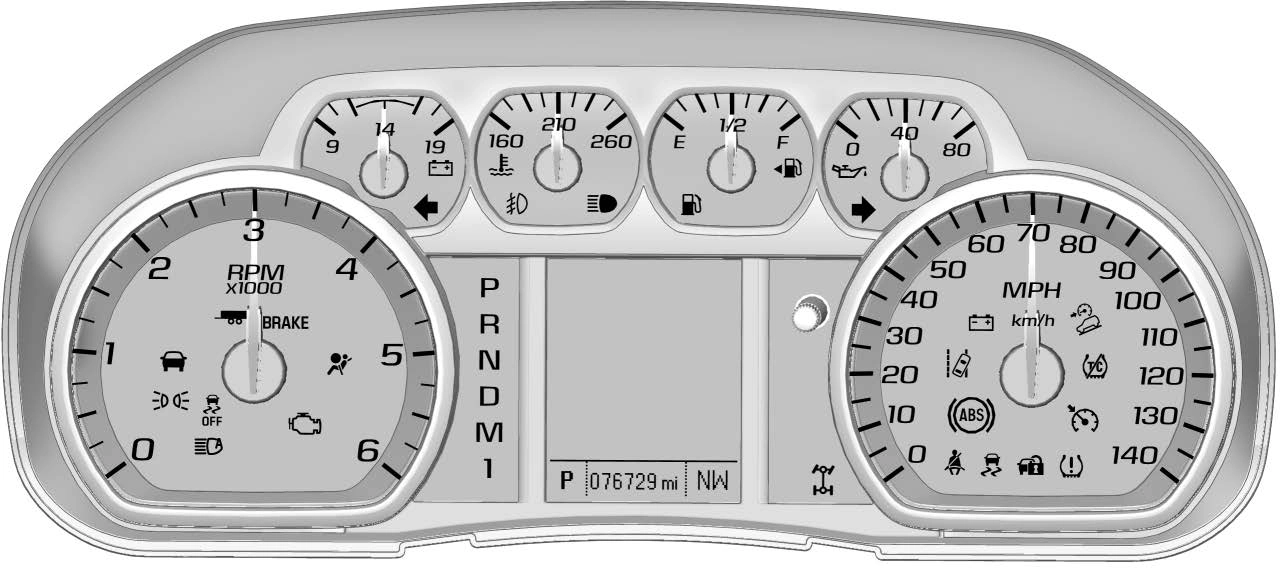
Base Cluster (English Shown, Metric Similar)
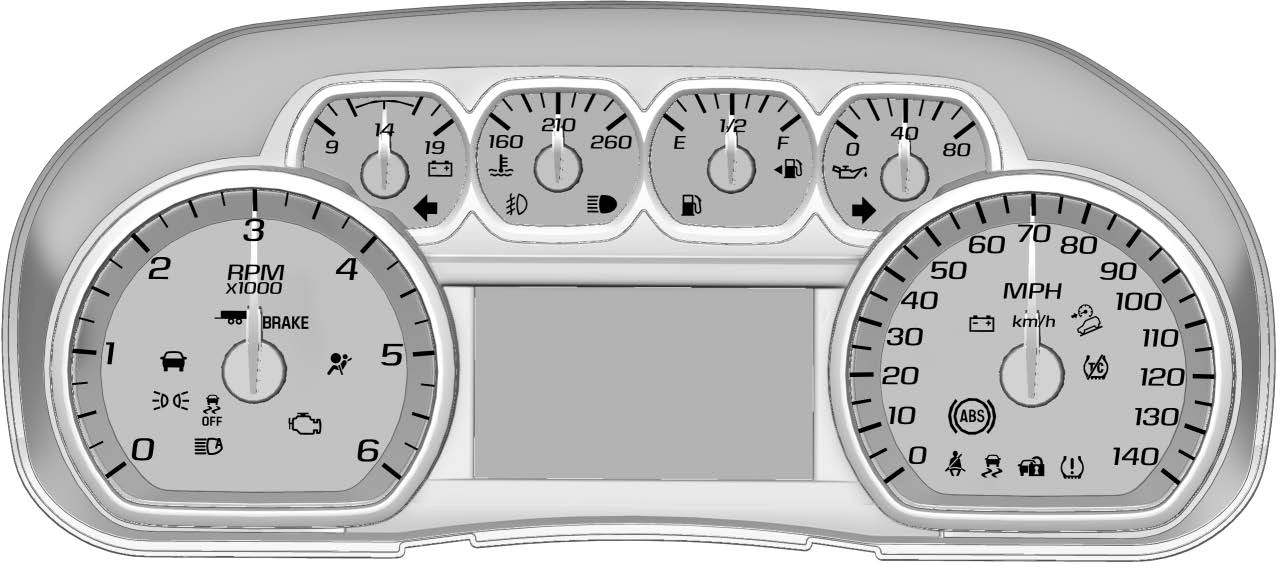
Uplevel Cluster (English Shown, Metric Similar)
There is an interactive display area in the center of the instrument cluster.
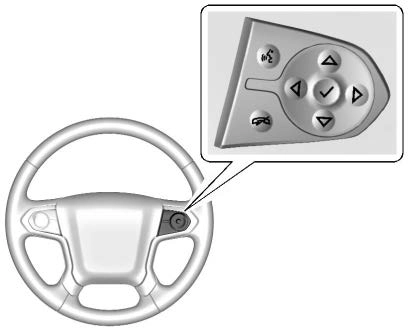
Use the right steering wheel control to open and scroll through the different items and displays.
Press o to access the cluster applications. Use w or x to scroll through the list of available
applications. Not all applications will be available on all vehicles.
Audio
Press V to select the Audio app, then press p to enter the Audio menu. In the Audio menu browse for music, select from the favorites,
or change the audio source. In the main view, use w or x to change the station or go to the next or previous track.
Phone
Press V to select the Phone app, then press p to enter the Phone menu. In the Phone menu, if there is no active phone call, view recent calls, scroll through contacts, select
from the favorites, or change the phone source. If there is an active call, mute the phone or switch to handset operation.
Navigation
Press V to select the Navigation app, then press p to enter the Navigation menu. If there is no active route, you can resume the
last route and turn the voice prompts on/off. If there is an active route, you can cancel the route.
Settings
Press V to select the Settings app. Use w or x to scroll through items in the Settings menu.
Units : Press p while Units is displayed to enter the Units menu. Choose English or metric units by pressing V while the desired item is
highlighted. A checkmark will be displayed next to the selected item.
Info Pages : Press p while Info Pages is displayed to enter the Info Pages menu and select the items to
be displayed in the Info app. See “Driver Information Center (DIC) (Uplevel)” in the Index.
Speed Warning : The Speed Warning display allows the driver to set a speed that they do not want to exceed. To set the Speed Warning, press p when Speed Warning is
displayed, or press V on the main
view to set the speed value. Press w or x to adjust the value. Press V to set the speed. Once the speed
is set, this feature can be turned off by pressing V while viewing this page. If the selected speed limit is exceeded, a pop-up warning is displayed with a chime.
Software Information : Press p while Software Information is
highlighted to display open source software information.
The speedometer shows the vehicle's speed in either kilometers per hour (km/h) or miles per
hour (mph).
The odometer shows how far the vehicle has been driven, in either kilometers or miles.
The trip odometer shows how far the vehicle has been driven since the trip odometer was last reset.
The trip odometer is accessed and reset through the Driver Information Center (DIC). See Driver Information Center (DIC) (Base Level) 0 155 or Driver Information
Center (DIC) (Uplevel) 0 156.
The tachometer displays the engine speed in revolutions per minute (rpm).
Metric
English
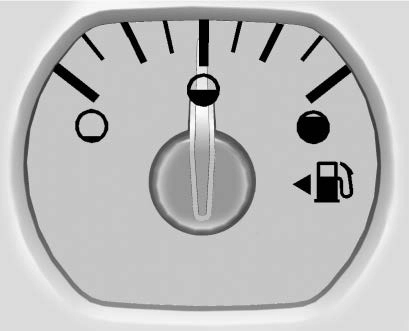
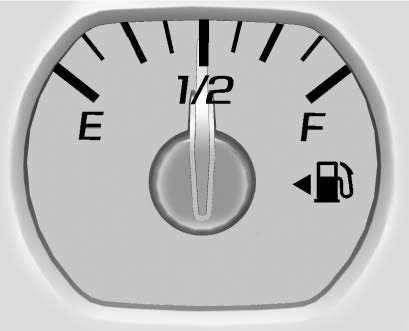
When the ignition is on, the fuel gauge indicates about how much fuel is left in the tank.
There is an arrow near the fuel gauge pointing to the side of the vehicle the fuel door is on.
When the indicator nears empty, the low fuel light comes on. There still is a little fuel left, but the vehicle should be refueled soon.
Here are four things that some owners ask about. None of these show a problem with the fuel gauge:
Metric
English
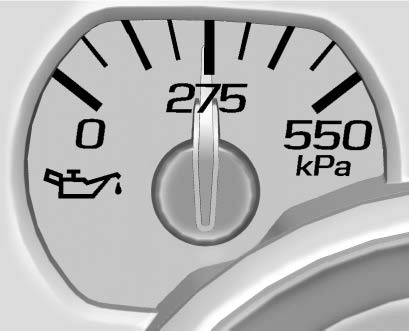
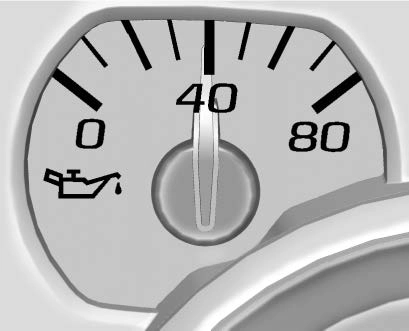
The engine oil pressure gauge shows the engine oil pressure
in kPa (kilopascals) or psi (pounds per square inch) when the engine is running.
Oil pressure can vary with engine speed, outside temperature, coolant temperature, and oil viscosity.
On some models, the oil pump will vary engine oil pressure according to engine needs. Oil pressure may change quickly as the engine speed or load varies. This is normal. If the oil pressure warning light or Driver Information Center (DIC) message
indicates oil pressure outside the normal operating range, check the vehicle's oil as soon as possible.
See Engine Oil 0 343.
If the vehicle has a diesel engine, see the Duramax diesel supplement.
Metric
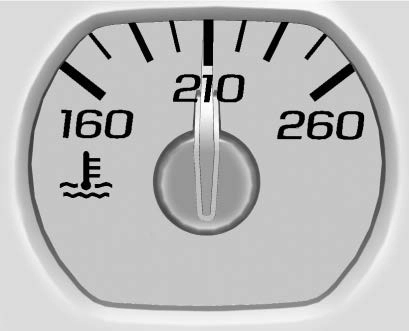
English
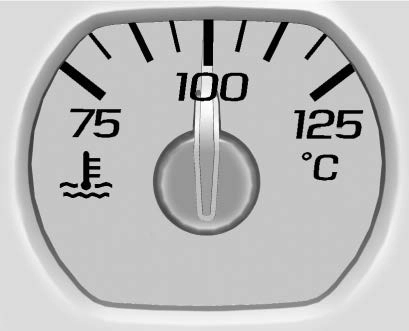
This gauge measures the temperature of the vehicle's engine coolant.
While driving under normal operating conditions, if the needle moves into the red warning area, the engine is too hot. Pull off the road, stop the vehicle, and turn off the engine as soon as possible.
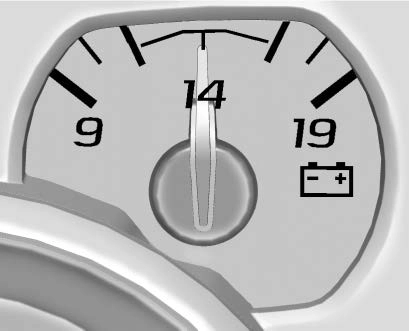
When the ignition is on, this gauge indicates the battery voltage.
When the engine is running, this gauge shows the condition of the charging system. The gauge can transition from a higher to lower or a lower to higher reading. This is normal. If the vehicle is operating outside the normal operating range, the charging system light comes on. See Charging System Light 0 147 for more information. The voltmeter gauge may also read lower when in fuel economy mode. This is normal.
Readings outside the normal operating range can also occur when a large number of electrical accessories are operating in the vehicle and the engine is left idling for an extended period. This condition is normal since the charging system is not able to provide full power at engine idle. As engine speeds are increased, this condition should correct itself as higher engine speeds allow the charging system to create maximum power.
The vehicle can only be driven for a short time with the readings outside the normal operating range. If the vehicle must be driven, turn off all accessories, such as the radio and air conditioner.
Readings outside the normal operating range indicate a possible problem in the electrical system.
Have the vehicle serviced as soon as possible.
There is a driver seat belt reminder light on the instrument cluster.
When the vehicle is started, this light flashes and a chime may come on to remind the driver to fasten their seat belt. Then the light stays on solid until the belt is buckled.
This cycle may continue several times if the driver remains or becomes unbuckled while the vehicle is moving.
If the driver seat belt is buckled, neither the light nor the chime comes on.
There may be a passenger seat belt reminder light near the passenger airbag status indicator. See Passenger Sensing System 0 86.
For vehicles equipped with the passenger seat belt reminder light, when the vehicle is started this light flashes and a chime may come on to remind passengers to fasten their seat belt. Then the light stays on solid until the belt is buckled. This cycle continues several times if the passenger remains or becomes unbuckled while the vehicle is moving.
If the passenger seat belt is buckled, neither the chime nor the light comes on.
The front passenger seat belt reminder light and chime may turn on if an object is put on the seat such as a briefcase, handbag, grocery bag, laptop, or other electronic device. To turn off the reminder light and/or chime, remove the object from the seat or buckle the seat belt.
This light shows if there is an electrical problem with the airbag system. The system check includes the airbag sensor(s), passenger sensing system (if equipped), the pretensioners, the airbag modules, the wiring, and the crash sensing and diagnostic module. For more information on the airbag system, see Airbag System 0 77.

The airbag readiness light comes on for several seconds when the vehicle is started. If the light does not come on then, have it fixed immediately.
If there is a problem with the airbag system, a Driver Information Center (DIC) message may also come on.
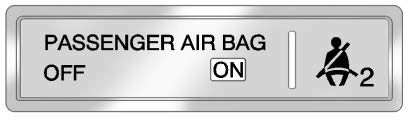
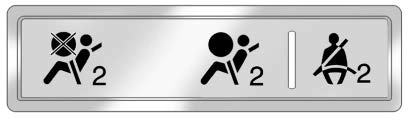
If the vehicle has an airbag on-off switch, it also has a passenger airbag status indicator located in the overhead console.
United States
Canada and Mexico
When the vehicle is started, the passenger airbag status indicator
and off, will light for several seconds as a system check. Then, after several more seconds, the status indicator ON or OFF, or either the on or off symbol, will light to let you know the status of the front outboard passenger frontal airbag.
When the front outboard passenger frontal airbag is manually turned off using the airbag on-off switch on the instrument panel endcap, the OFF
indicator light or the off symbol will come on and stay on as a reminder that the airbag has been turned off. This light will go off when the airbag has been turned on. See Airbag
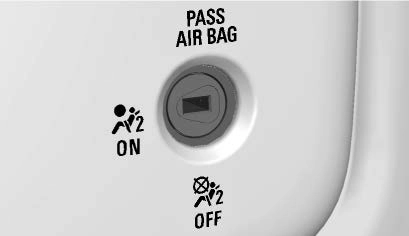 On-Off Switch 0 84 for more information, including important safety information.
If the word ON or the on symbol is lit, it means that the front outboard passenger frontal airbag is enabled (may inflate). See Airbag On-Off Switch 0 84 for more information, including important safety information.
If, after several seconds, both status indicator lights remain on, or if there are no lights at all, there may be a problem with the lights or the airbag on-off switch. See your dealer for service.
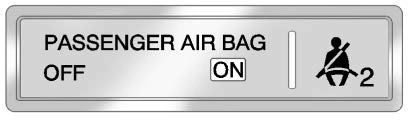
If the vehicle has the passenger sensing system, the overhead console will have a passenger airbag status indicator. See Passenger Sensing System 0 86 for important safety information.
United States
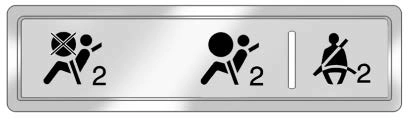
Canada and Mexico
When the vehicle is started, the passenger airbag status indicator will light ON and OFF, or the symbol for on and off, for several seconds as a system check. Then, after
several more seconds, the status indicator will light either ON or OFF, or either the on or off symbol, to let you know the status of the front outboard passenger frontal airbag.
If the word ON or the on symbol is lit on the passenger airbag status indicator, it means that the front outboard passenger frontal airbag is allowed to inflate.
If the word OFF or the off symbol is lit on the airbag status indicator, it means that the passenger sensing system has turned off the front outboard passenger frontal airbag.
If, after several seconds, both status indicator lights remain on, or if there are no lights at all, there may be a problem with the lights or the passenger sensing system. See your dealer for service.

The charging system light comes on briefly when the ignition is turned on, but the engine is not running, as a check to show the light is working. It should go out when the engine is started.
If the light stays on, or comes on while driving, there may be a problem with the electrical charging
system. Have it checked by your dealer. Driving while this light is on could drain the battery.
When this light comes on, or is flashing, the Driver Information Center (DIC) also displays a message.
If a short distance must be driven with the light on, be sure to turn off all accessories, such as the radio and air conditioner.
This light is part of the vehicle’s emission control on-board diagnostic system. If this light is on while the engine is running, a malfunction has been detected and the vehicle may require service. The light should come on to show that it is working when the ignition is on and the engine is not running. See Ignition Positions 0 248.

Malfunctions are often indicated by the system before any problem is noticeable. Being aware of the light and seeking service promptly when it comes on may prevent damage.
If the light is flashing : A malfunction has been detected that could damage the emission control system and increase vehicle emissions. Diagnosis and service may be required.
To help prevent damage, reduce vehicle speed and avoid hard accelerations and uphill grades.
If towing a trailer, reduce the amount of cargo being hauled as soon as possible.
If the light continues to flash, find a safe place to park. Turn the vehicle off and wait at least 10 seconds before restarting the engine. If the light is still flashing, follow the previous guidelines and see your dealer for service as soon as possible.
If the light is on steady : A malfunction has been detected. Diagnosis and service may be required.
Check the following:
The diagnostic system can detect if the adapter has been left installed in the vehicle, allowing fuel to evaporate into
the atmosphere. A few driving trips with the adapter removed may turn off the light.
If the light remains on, see your dealer.
If the vehicle requires an Emissions Inspection/Maintenance test, the test equipment will likely connect to the vehicle's Data Link
Connector (DLC).
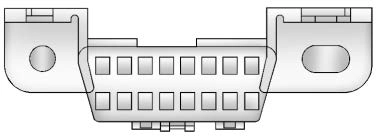
The DLC is under the instrument panel to the left of the steering wheel. Connecting devices that are not used to perform an Emissions Inspection/Maintenance test or to service the vehicle may affect vehicle operation. See Add-On Electrical Equipment 0 329. See your dealer if assistance is needed.
The vehicle may not pass inspection if:
before the system is ready for inspection. This can happen if the 12-volt battery has recently been replaced or run down, or if the vehicle has been recently serviced.
See your dealer if the vehicle will not pass or cannot be made ready for the test.
The vehicle brake system consists of two hydraulic circuits. If one circuit is not working, the remaining circuit can still work to stop the vehicle. For normal braking performance, both circuits need to be working.
If the warning light comes on, there is a brake problem. Have the brake system inspected right away.


Metric English
This light should come on briefly when the engine is started. If it does not come on then, have it fixed so it will be ready to warn you if there is a problem.
When the ignition is on, the brake system warning light also comes on when the parking brake is set. The light stays on if the parking brake does not fully release. If it stays on after the parking brake is fully released, it means the vehicle has a brake problem.
If the light comes on while driving, pull off the road and stop carefully. The pedal might be harder to push, or the pedal can go closer to the floor. It may take longer to stop.
If the light is still on, have the vehicle towed for service. See Towing the Vehicle 0 425.
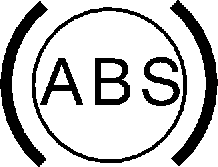
This light comes on briefly when the engine is started.
If the light does not come on, have it fixed so it will be ready to warn if there is a problem.
If the light comes on while driving, stop as soon as it is safely possible and turn off the vehicle. Then start the engine again to reset the system. If the ABS light stays on,
or comes on again while driving, the vehicle needs service. A chime may also sound when the light comes on steady.
If the ABS light is the only light on, the vehicle has regular brakes, but the antilock brakes are not functioning.
If both the ABS and the brake system warning light are on, the vehicle's antilock brakes are not functioning and there is a problem with the regular brakes. See your dealer for service.
See Brake System Warning Light
0 149.

The four-wheel-drive light comes on when a vehicle with a manual transfer case is shifted into
four-wheel drive and the front axle engages.
Some delay between the shifting and the light coming on is normal.
See Four-Wheel Drive 0 265 for more information.

For vehicles with the Tow/Haul Mode feature, this light comes on when the Tow/Haul Mode has been activated.
See Tow/Haul Mode 0 262.
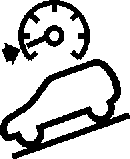
If equipped, the Hill Descent Control light comes on when the system is ready for use. When the light flashes, the system is active.
See Hill Descent Control (HDC)
0 277.
Series)
If equipped, this light comes on briefly while starting the vehicle. If it does not come on, have the vehicle serviced.
This light is green if LDW is on and ready to operate.
This light changes to amber and flashes to indicate that the lane marking has been crossed without using a turn signal in that direction.
See Lane Departure Warning (LDW) (2500/3500 Series) 0 288.
If available, this light comes on briefly while starting the vehicle.
If it does not come on, have the vehicle serviced.
This light is green if LKA is available to assist.
LKA may assist by gently turning the steering wheel if the vehicle approaches a detected lane marking without using the turn signal in that direction. The LKA light will turn amber.
This light is amber and flashes as a Lane Departure Warning (LDW) alert, to indicate that the lane marking has been crossed.
See Lane Keep Assist (LKA) (1500 Series) 0 290.

If equipped, this indicator will display green when a vehicle is detected ahead and amber when you are following a vehicle ahead much too closely.
See Forward Collision Alert (FCA) System 0 285.

This light comes on briefly while starting the engine. If it does not, have the vehicle serviced by your
dealer. If the system is working normally, the indicator light then turns off.
The traction off light comes on when the Traction Control System (TCS) has been turned off by pressing and releasing the TCS/StabiliTrak button.
This light and the StabiliTrak OFF light come on when StabiliTrak is turned off.
If the TCS is off, wheel spin is not limited. Adjust driving accordingly.
See Traction Control/Electronic Stability Control 0 276.
This light comes on briefly while starting the engine. If it does not, have the vehicle serviced by your dealer.
This light comes on when the StabiliTrak system is turned off. If StabiliTrak is off, the Traction Control System (TCS) is also off.
If StabiliTrak and TCS are off, the system does not assist in controlling the vehicle. Turn on the TCS and the StabiliTrak systems, and the warning light turns off.
See Traction Control/Electronic Stability Control 0 276.
This light comes on briefly when the engine is started.
If the light does not come on, have the vehicle serviced by your dealer. If the system is working normally, the indicator light turns off.
If the light is on and not flashing, the TCS and potentially the StabiliTrak system have been disabled.
A Driver Information Center (DIC) message may display. Check the DIC messages to determine which feature(s) is no longer functioning and whether the vehicle requires service.
If the light is on and flashing, the TCS and/or the StabiliTrak system is actively working.
See Traction Control/Electronic Stability Control 0 276.
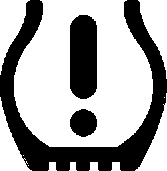
For vehicles with the Tire Pressure Monitor System (TPMS), this light comes on briefly when the engine is started. It provides information about tire pressures and the TPMS.
When the Light Is On Steady
This indicates that one or more of the tires are significantly underinflated.
A Driver Information Center (DIC) tire pressure message may also display. Stop as soon as possible, and inflate the tires to the pressure value shown on the Tire and Loading Information label. See Tire Pressure 0 392.
When the Light Flashes First and Then Is On Steady
If the light flashes for about a minute and then stays on, there may be a problem with the TPMS. If the problem is not corrected, the light will come on at every ignition cycle. See Tire Pressure Monitor Operation 0 395.

This light is near the fuel gauge and comes on briefly when the ignition is turned on as a check to show it is working.
It also comes on when the fuel tank is low on fuel. The light turns off when fuel is added. If it does not, have the vehicle serviced.

The security light should come on briefly as the engine is started. If it does not come on, have the vehicle
serviced by your dealer. If the system is working normally, the indicator light turns off.
If the light stays on and the engine does not start, there could be a problem with the theft-deterrent system. See Immobilizer Operation 0 46.

This light comes on when the high-beam headlamps are in use.
See Headlamp High/Low-Beam Changer 0 173.

This light comes on when the IntelliBeam system, if equipped, is enabled.
See Exterior Lamp Controls 0 171.

For vehicles with fog lamps, this light comes on when the fog lamps are on.
The light goes out when the fog lamps are turned off. See Fog Lamps 0 176.

This light comes on when the exterior lamps are in use. See Exterior Lamp Controls 0 171.

For vehicles with cruise control, the cruise control light is white when the cruise control is on and ready, and turns green when the cruise control is set and active.
The light turns off when the cruise control is turned off. See Cruise Control 0 279.
Download Manual