Specifications
|
Overall length |
183.1 in. (4650 mm) |
|
|
Overall width |
69.9 in. (1776 mm) |
|
|
Overall height*1 |
57.3 in. (1455 mm) |
|
|
Wheelbase |
106.3 in. (2700 mm) |
|
|
Tread |
Front |
60.3 in. (1531 mm)*2 59.8 in. (1519 mm)*3 |
|
Rear |
60.4 in. (1534 mm)*2 59.9 in. (1522 mm)*3 |
|
|
Vehicle capacity weight (occupants + luggage) |
865 lb. (390 kg) |
*1: Unladen vehicles
*2: 195/65R15 tires
*3: P205/55R16 and P215/45R17 tires
This number is stamped on the top left of the instrument panel.
This number is also on the Certifi- cation Label on the driver’s side center pillar.
The engine number is stamped on the engine block as shown.
9-1. Specifications
539
540 9-1. Specifications
|
Model |
1.8 L 4-cylinder (2ZR-FE and 2ZR-FAE) engines |
|
Type |
4 cylinder in line, 4 cycle, gasoline |
|
Bore and stroke |
3.17 x 3.48 in. (80.5 x 88.3 mm) |
|
Displacement |
109.7 cu. in. (1798 cm3) |
|
Drive belt tension |
2ZR-FE* 143 ”± 22 lbf (650 ”± 100 N, 65 ”± 10 kgf) 2ZR-FAE Automatic adjustment |
|
Valve clearance |
Automatic adjustment |
*: Drive belt tension measured with Borroughs drive belt tension gauge No.
BT-33-73F (used belt), lbf
|
Fuel type |
Unleaded gasoline only |
|
Octane rating |
87 (Research Octane Number 91) or higher |
|
Fuel tank capacity (Reference) |
13.2 gal. (50 L, 10.9 Imp. gal.) |
|
Oil capacity |
|
|
(Drain and refill - |
|
|
reference*) |
|
|
With filter |
4.4 qt. (4.2 L, 3.7 Imp. qt.) |
|
Without filter |
4.1 qt. (3.9 L, 3.4 Imp. qt.) |
*: The engine oil capacity is a reference quantity to be used when changing the engine oil. Warm up and turn off the engine, wait more than 5 minutes, and check the oil level on the dipstick.
9-1. Specifications
541
Oil grade: ILSAC GF-5 multigrade engine oil Recommended viscosity:
SAE 0W-20
SAE 0W-20 is the best choice for good fuel economy and good start- ing in cold weather.
If SAE 0W-20 is not available, SAE 5W-20 oil may be used. However, it must be replaced with SAE 0W- 20 at the next oil change.

Oil viscosity (0W-20 is explained here as an example):
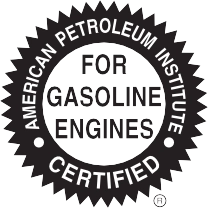 The International Lubricant Specification Advisory Committee (ILSAC) Certification Mark is added to some oil containers to help you select the oil you should use.
542 9-1. Specifications
|
Capacity (Reference) |
5.8 qt. (5.5 L, 4.8 Imp. qt.) |
|
Coolant type |
Use either of the following. “Toyota Super Long Life Coolant”
Similar high-quality ethylene glycol-based non-silicate, non-amine, non-nitrite, and non- borate coolant with long-life hybrid organic acid technology
Do not use plain water |
|
Spark plug Make Gap |
DENSO SC20HR11 DENSO SC16HR11 0.043 in. (1.1 mm) |
9-1. Specifications
543
|
Battery Open voltage at 68°F (20°C): |
12.3 V or More If the voltage is lower than the standard value, charge the battery. (Voltage checked 20 minutes after the engine and all the lights turned off) |
|
Charging rates |
5 A max. |
|
Gear oil capacity (Reference) |
2.5 qt. (2.4 L, 2.1 Imp. qt.) |
|
Gear oil type |
“TOYOTA Genuine Manual Transmission Gear Oil LV GL-4 75W” or equivalent |
544 9-1. Specifications
|
Fluid capacity* |
7.9 qt. (7.5 L, 6.6 Imp. qt.) |
|
Fluid type |
Toyota Genuine CVTF FE |
*: The fluid capacity is a reference quantity.
If replacement is necessary, contact your Toyota dealer.
|
Pedal free play |
0.2 - 0.6 in. (5 - 15 mm) |
|
Fluid type |
SAE J1703 or FMVSS No.116 DOT 3 |
9-1. Specifications
545
|
Pedal clearance*1 |
1.8 L 4-cylinder (2ZR-FE) engine 2.9 in. (74 mm) 1.8 L 4-cylinder (2ZR-FAE) engine 2.8 in. (71 mm) |
|
Pedal free play |
0.04 - 0.24 in. (1 - 6 mm) |
|
Brake pad wear limit |
0.04 in. (1.0 mm) |
|
Parking brake lining wear limit |
0.04 in. (1.0 mm) |
|
Parking brake lever travel*2 |
6 - 9 clicks |
|
Fluid type |
SAE J1703 or FMVSS No.116 DOT 3 |
*1: Minimum pedal clearance when depressed with a force of 66 lbf (294 N, 30 kgf) while the engine is running
*2: Parking brake lever travel when pulled up with a force of 44 lbf (200 N, 20 kgf)
546 9-1. Specifications
|
Free play |
Less than 1.2 in. (30 mm) |
Type A
|
Tire size |
195/65R15 91S, T135/80R16 101M |
|
Tire inflation pressure (Recommended cold tire inflation pressure) |
Front: 35 psi (240 kPa, 2.4 kgf/cm2 or bar) Rear: 35 psi (240 kPa, 2.4 kgf/cm2 or bar) Spare: 60 psi (420 kPa, 4.2 kgf/cm2 or bar) |
|
Wheel size |
15 x 6 J, 16 x 4T (compact spare) |
|
Wheel nut torque |
76 ftlbf (103 Nm, 10.5 kgfm) |
Type B
|
Tire size |
P205/55R16 89H, T135/80R16 101M |
|
Tire inflation pressure (Recommended cold tire inflation pressure) |
Front: 32 psi (220 kPa, 2.2 kgf/cm2 or bar) Rear: 32 psi (220 kPa, 2.2 kgf/cm2 or bar) Spare: 60 psi (420 kPa, 4.2 kgf/cm2 or bar) |
|
Wheel size |
16 x 6 1/2 J, 16 x 4T (compact spare) |
|
Wheel nut torque |
76 ftlbf (103 Nm, 10.5 kgfm) |
Type C
|
Tire size |
P215/45R17 87W, T135/80R16 101M |
|
Tire inflation pressure (Recommended cold tire inflation pressure) |
Front: 32 psi (220 kPa, 2.2 kgf/cm2 or bar) Rear: 32 psi (220 kPa, 2.2 kgf/cm2 or bar) Spare: 60 psi (420 kPa, 4.2 kgf/cm2 or bar) |
|
Wheel size |
17 x 7 J, 16 x 4T (compact spare) |
|
Wheel nut torque |
76 ftlbf (103 Nm, 10.5 kgfm) |
9-1. Specifications
547
|
Light bulbs |
Bulb No. |
W |
Type |
|
|
Exterior |
Front side marker lights |
W5W |
5 |
B |
|
Front turn signal/park- ing lights Type A Type B |
7444NA WY21W |
28/8 21 |
B |
|
|
Side turn signal lights*2 |
- |
5 |
B |
|
|
Rear turn signal lights |
- |
21 |
B |
|
|
Stop/tail and rear side marker lights |
7443 |
21/5 |
A |
|
|
License plate lights |
- |
5 |
A |
|
|
Back-up lights (bulb type)*2 |
921 |
16 |
A |
|
|
Interior |
Vanity lights |
- |
8 |
A |
|
Front personal/inte- rior lights (vehicles without a moon roof) |
- |
8 |
A |
|
|
Front personal/inte- rior lights (vehicles with a moon roof) |
- |
5 |
A |
|
|
Rear interior light |
- |
8 |
C |
|
|
Trunk light |
- |
3.8 |
A |
A: Wedge base bulbs (clear) C: Double end bulbs
B: Wedge base bulbs (amber)
*1: Light bulbs not listed in this table are LED bulbs.
*2: If equipped
548 9-1. Specifications
In very few cases, driveability problems may be caused by the brand of gaso- line you are using. If driveability problems persist, try changing the brand of gasoline. If this does not correct the problem, consult your Toyota dealer.
9-1. Specifications
549
Gasolines containing oxygenates such as ethers and ethanol, as well as reformulated gasolines, are available in some cities. These fuels are typically acceptable for use, providing they meet other fuel requirements.
Toyota recommends these fuels, since the formulations allow for reduced vehicle emissions.
DO NOT use any flex-fuel or gasoline that could contain more than 15% etha- nol, including from any pump labeled E30, E50, E85 (which are only some examples of fuel containing more than 15% ethanol).
Some gasoline contains an octane enhancing additive called MMT (Methylcy- clopentadienyl Manganese Tricarbonyl).
Toyota does not recommend the use of gasoline that contains MMT. If fuel containing MMT is used, your emission control system may be adversely affected.
The malfunction indicator lamp on the instrument cluster may come on. If this happens, contact your Toyota dealer for service.
550 9-1. Specifications
9-1. Specifications
551
|
|

Compact spare tire
552 9-1. Specifications
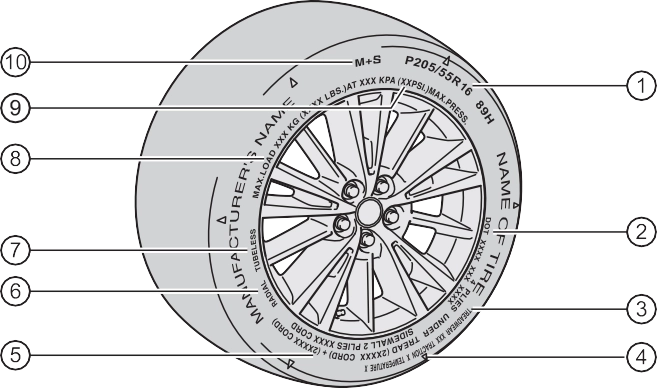
DOT and Tire Identification Number (TIN) (P. 553) Uniform tire quality grading
For details, see “Uniform Tire Quality Grading” that follows.
Location of treadwear indicators (P. 440) Tire ply composition and materials
Plies are layers of rubber-coated parallel cords. Cords are the strands which form the plies in a tire.
Radial tires or bias-ply tires
A radial tire has “RADIAL” on the sidewall. A tire not marked “RADIAL” is a bias-ply tire.
TUBELESS or TUBE TYPE
A tubeless tire does not have a tube and air is directly put into the tire. A tube type tire has a tube inside the tire and the tube maintains the air pressure.
Load limit at maximum cold tire inflation pressure (P. 558) Maximum cold tire inflation pressure (P. 558)
This means the pressure to which a tire may be inflated.
Summer tires or all season tires (P. 444)
An all season tire has “M+S” on the sidewall. A tire not marked “M+S” is a summer tire.
“TEMPORARY USE ONLY”
A compact spare tire is identified by the phrase “TEMPORARY USE ONLY” molded on its sidewall. This tire is designed for temporary emergency use only.
9-1. Specifications
553
Type A Type B
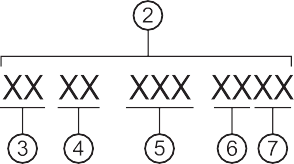
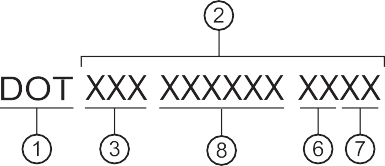 Tire Identification Number (TIN)
Tire manufacturer’s identification mark Tire size code
Manufacturer’s optional tire type code (3 or 4 letters) Manufacturing week
Manufacturing year Manufacturer's code
*: The DOT symbol certifies that the tire conforms to applicable Federal Motor Vehicle Safety Standards.
554 9-1. Specifications
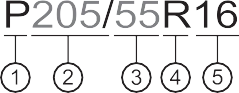 Tire use (P = Passenger car, T = Temporary use)
Section width (millimeters)
Aspect ratio
(tire height to section width)
Tire construction code
(R = Radial, D = Diagonal) Wheel diameter (inches)
Load index
(2 digits or 3 digits)
Speed symbol
(alphabet with one letter)
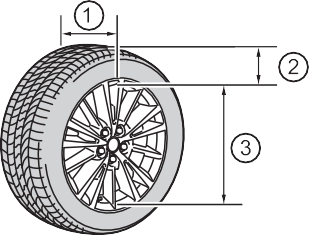 Tire dimensions Section width Tire height Wheel diameter
9-1. Specifications
555
Sidewall Shoulder Tread Belt
Inner liner Reinforcing rubber Carcass
Rim lines Bead wires Chafer
556 9-1. Specifications
U.S. Department of Transportation.
It provides the purchasers and/or prospective purchasers of Toyota vehicles with information on uniform tire quality grading.
Your Toyota dealer will help answer any questions you may have as you read this information.
All passenger vehicle tires must conform to Federal Safety Require- ments in addition to these grades. Quality grades can be found where applicable on the tire sidewall between tread shoulder and maximum section width.
For example: Treadwear 200 Traction AA Temperature A
The treadwear grade is a comparative rating based on the wear rate of the tire when tested under controlled conditions on a speci- fied government test course.
For example, a tire graded 150 would wear one and a half (1 - 1/2) times as well on the government course as a tire graded 100.
The relative performance of tires depends upon the actual condi- tions of their use. Performance may differ significantly from the norm due to variations in driving habits, service practices and differences in road characteristics and climate.
The traction grades, from highest to lowest, are AA, A, B and C, and they represent the tire’s ability to stop on wet pavement as measured under controlled conditions on specified government test surfaces of asphalt and concrete.
A tire marked C may have poor traction performance.
Warning: The traction grade assigned to this tire is based on braking (straight ahead) traction tests and does not include cornering (turn- ing) traction.
9-1. Specifications
557
Sustained high temperature can cause the material of the tire to degenerate and reduce tire life, and excessive temperature can lead to sudden tire failure.
Grade C corresponds to a level of performance which all passenger car tires must meet under the Federal Motor Vehicle Safety Stan- dard No. 109.
Grades B and A represent higher levels of performance on the labo- ratory test wheel than the minimum required by law.
Warning: The temperature grades of a tire assume that it is properly inflated and not overloaded.
Excessive speed, underinflation, or excessive loading, either sepa- rately or in combination, can cause heat buildup and possible tire failure.
558 9-1. Specifications
|
Tire related term |
Meaning |
|
Cold tire inflation pres- sure |
Tire pressure when the vehicle has been parked for three hours or more, or has not been driven more than 1 mile or 1.5 km under that condition |
|
Maximum inflation pressure |
The maximum cold inflated pressure to which a tire may be inflated, shown on the sidewall of the tire |
|
Recommended infla- tion pressure |
Cold tire inflation pressure recommended by a manufacturer |
|
Accessory weight |
The combined weight (in excess of those stan- dard items which may be replaced) of auto- matic transmission, power steering, power brakes, power windows, power seats, radio and heater, to the extent that these items are available as factory-installed equipment (whether installed or not) |
|
Curb weight |
The weight of a motor vehicle with standard equipment, including the maximum capacity of fuel, oil and coolant, and if so equipped, air conditioning and additional weight optional engine |
|
Maximum loaded vehi- cle weight |
The sum of: Curb weight
Accessory weight
Vehicle capacity weight
Production options weight
|
|
Normal occupant weight |
150 lb. (68 kg) times the number of occupants specified in the second column of Table 1* that follows |
|
Occupant distribution |
Distribution of occupants in a vehicle as speci- fied in the third column of Table 1* below |
9-1. Specifications
559
560 9-1. Specifications
|
Tire related term |
Meaning |
|
Bias ply tire |
A pneumatic tire in which the ply cords that extend to the beads are laid at alternate angles substantially less than 90 degrees to the centerline of the tread |
|
Carcass |
The tire structure, except tread and sidewall rubber which, when inflated, bears the load |
|
Chunking |
The breaking away of pieces of the tread or sidewall |
|
Cord |
The strands forming the plies in the tire |
|
Cord separation |
The parting of cords from adjacent rubber compounds |
|
Cracking |
Any parting within the tread, sidewall, or inner- liner of the tire extending to cord material |
|
CT |
A pneumatic tire with an inverted flange tire and rim system in which the rim is designed with rim flanges pointed radially inward and the tire is designed to fit on the underside of the rim in a manner that encloses the rim flanges inside the air cavity of the tire |
|
Extra load tire |
A tire designed to operate at higher loads and at higher inflation pressures than the corre- sponding standard tire |
|
Groove |
The space between two adjacent tread ribs |
|
Innerliner |
The layer(s) forming the inside surface of a tubeless tire that contains the inflating medium within the tire |
|
Innerliner separation |
The parting of the innerliner from cord material in the carcass |
|
Intended outboard sidewall |
The sidewall that contains a whitewall, bears white lettering, or bears manufac- turer, brand, and/or model name molding that is higher or deeper than the same molding on the other sidewall of the tire, or
The outward facing sidewall of an asym- metrical tire that has a particular side that must always face outward when mounted on a vehicle
|
9-1. Specifications
561
|
Tire related term |
Meaning |
|
Light truck (LT) tire |
A tire designated by its manufacturer as pri- marily intended for use on lightweight trucks or multipurpose passenger vehicles |
|
Load rating |
The maximum load that a tire is rated to carry for a given inflation pressure |
|
Maximum load rating |
The load rating for a tire at the maximum per- missible inflation pressure for that tire |
|
Maximum permissible inflation pressure |
The maximum cold inflation pressure to which a tire may be inflated |
|
Measuring rim |
The rim on which a tire is fitted for physical dimension requirements |
|
Open splice |
Any parting at any junction of tread, sidewall, or innerliner that extends to cord material |
|
Outer diameter |
The overall diameter of an inflated new tire |
|
Overall width |
The linear distance between the exteriors of the sidewalls of an inflated tire, including ele- vations due to labeling, decorations, or protec- tive bands or ribs |
|
Passenger car tire |
A tire intended for use on passenger cars, multipurpose passenger vehicles, and trucks, that have a gross vehicle weight rating (GVWR) of 10,000 lb. or less. |
|
Ply |
A layer of rubber-coated parallel cords |
|
Ply separation |
A parting of rubber compound between adja- cent plies |
|
Pneumatic tire |
A mechanical device made of rubber, chemi- cals, fabric and steel or other materials, that, when mounted on an automotive wheel, pro- vides the traction and contains the gas or fluid that sustains the load |
|
Radial ply tire |
A pneumatic tire in which the ply cords that extend to the beads are laid at substantially 90 degrees to the centerline of the tread |
|
Reinforced tire |
A tire designed to operate at higher loads and at higher inflation pressures than the corre- sponding standard tire |
562 9-1. Specifications
|
Tire related term |
Meaning |
|
Section width |
The linear distance between the exteriors of the sidewalls of an inflated tire, excluding ele- vations due to labeling, decoration, or protec- tive bands |
|
Sidewall |
That portion of a tire between the tread and bead |
|
Sidewall separation |
The parting of the rubber compound from the cord material in the sidewall |
|
Snow tire |
A tire that attains a traction index equal to or greater than 110, compared to the ASTM E- 1136 Standard Reference Test Tire, when using the snow traction test as described in ASTM F-1805-00, Standard Test Method for Single Wheel Driving Traction in a Straight Line on Snow-and Ice-Covered Surfaces, and which is marked with an Alpine Symbol ( |
|
Test rim |
The rim on which a tire is fitted for testing, and may be any rim listed as appropriate for use with that tire |
|
Tread |
That portion of a tire that comes into contact with the road |
|
Tread rib |
A tread section running circumferentially around a tire |
|
Tread separation |
Pulling away of the tread from the tire carcass |
|
Treadwear indicators (TWI) |
The projections within the principal grooves designed to give a visual indication of the degrees of wear of the tread |
|
Wheel-holding fixture |
The fixture used to hold the wheel and tire assembly securely during testing |
 ) on at least one sidewall
*: Table 1 - Occupant loading and distribution for vehicle normal load for various designated seating capacities
9-1. Specifications
563
|
Designated seating capacity, Number of occupants |
Vehicle normal load, Number of occupants |
Occupant distribution in a normally loaded vehicle |
|
2 through 4 |
2 |
2 in front |
|
5 through 10 |
3 |
2 in front, 1 in second seat |
|
11 through 15 |
5 |
2 in front, 1 in second seat, 1 in third seat, 1 in fourth seat |
|
16 through 20 |
7 |
2 in front, 2 in second seat, 2 in third seat, 1 in fourth seat |
Download Manual