Maintenance
Maintenance requirements
To ensure safe and economical driving, day-to-day care and regular maintenance are essential. It is the owner's responsibility to perform regular checks.
Toyota recommends the maintenance below.
■Repair and replacement
It is recommended that genuine Toyota parts be used for repairs to ensure performance of each system.
If non-Toyota parts are used in replacement or if a repair shop other than a Toyota dealer performs repairs, confirm the warranty coverage.
■Allow inspection and repairs to be performed by a Toyota dealer
- Toyota technicians are well-trained specialists and are kept up to date with the latest service information. They are well informed about the operation of all systems on your vehicle.
- Keep a copy of the repair order. It proves that the maintenance that has been performed is under warranty coverage. If any problem should arise while your vehicle is under warranty, your Toyota dealer will promptly take care of it.
WARNING
■If your vehicle is not properly maintained
Improper maintenance could result in serious damage to the vehicle and possible death or serious injury.
■Handling of the battery
- Engine exhaust, some of its constituents, and a wide variety of automobile components contain or emit chemicals known to the State of California to cause cancer and birth defects and other reproductive harm. Work in a well ventilated area.
- Oils, fuels and fluids contained in vehicles as well as waste produced by component wear contain or emit chemicals known to the State of California to cause cancer and birth defects or other reproductive harm. Avoid exposure and wash any affected area immediately.
- Battery posts, terminals and related accessories contain lead and lead compounds which are known to cause brain damage.
Wash your hands after handling.
General maintenance
General maintenance should be performed on a daily basis. This can be done by yourself or by a Toyota dealer.
Scheduled maintenance
Scheduled maintenance should be performed at specified intervals according to the maintenance schedule.
For details about maintenance items and schedules, refer to the "Scheduled Maintenance Guide" or "Owner's Manual Supplement".
■Resetting the message indicating maintenance is required
After the required maintenance is performed according to the maintenance schedule, please reset the message.
To reset the message, follow the procedure described below:
4.2-inch display
1. Press .gif) or
or .gif) of the meter control switch to select
of the meter control switch to select .gif) .
.
2. Press .gif) or
or .gif) to select "Vehicle Settings" and then press and hold
to select "Vehicle Settings" and then press and hold  .
.
3. Press or to select "Scheduled Maintenance" and then press .
4. Press or to select "Yes" and then press .
A message will be displayed on the multi-information display when the reset procedure has been completed.
7-inch display
1. Press or of the meter control switch to select .gif) .
.
2. Press or to select "Vehicle Settings" and then press and hold .
3. Press or to select "Scheduled Maintenance" and then press .
4. Press or to select "Yes" and then press .
A message will be displayed on the multi-information display when the reset procedure has been completed.
Do-it-yourself maintenance
You can perform some maintenance procedures by yourself.
Please be aware that do-it-yourself maintenance may affect warranty coverage.
The use of Toyota repair manuals is recommended.
For details about warranty coverage, refer to the separate "Owner's Warranty Information Booklet" or "Owner's Manual Supplement".
General maintenance
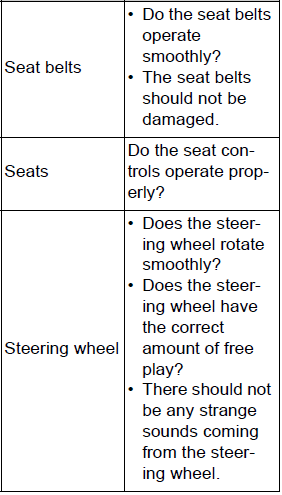
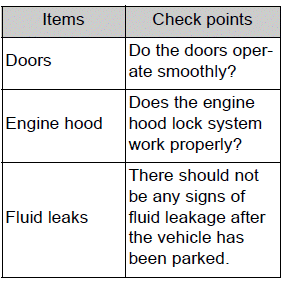
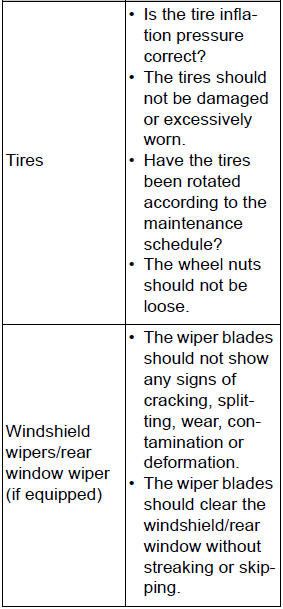
Listed below are the general maintenance items that should be performed at the intervals specified in the "Owner's Warranty Information Booklet" or "Owner's Manual Supplement/Scheduled Maintenance Guide". It is recommended that any problem you notice should be brought to the attention of your Toyota dealer or qualified service shop for advice.
WARNING
■If the engine is running
Turn the engine off and ensure that there is adequate ventilation before performing maintenance checks.
Engine compartment
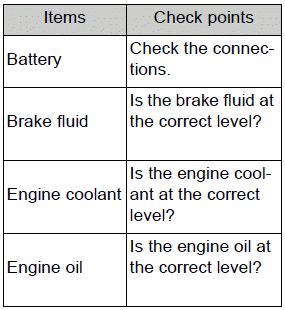
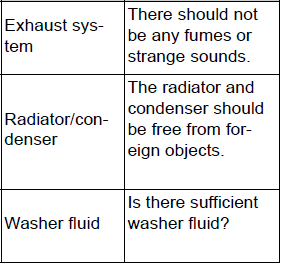
Vehicle interior
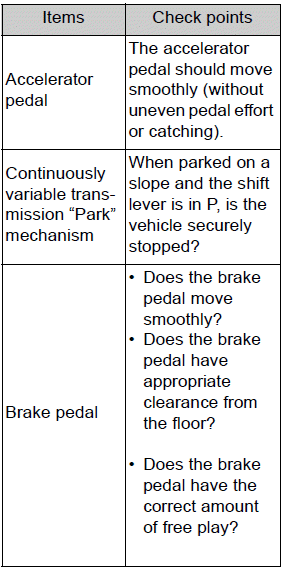
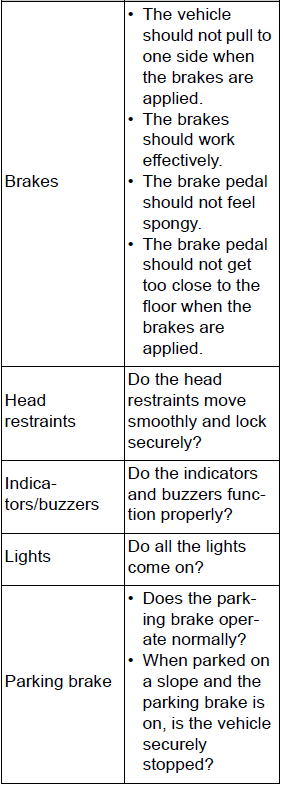
Vehicle exterior
Emission inspection and maintenance (I/M) programs
Some states have vehicle emission inspection programs which include OBD (On Board Diagnostics) checks. The OBD system monitors the operation of the emission control system.
If the malfunction indicator lamp comes on
The OBD system determines that a problem exists somewhere in the emission control system. Your vehicle may not pass the I/M test and may need to be repaired. Contact your Toyota dealer to service the vehicle.
Your vehicle may not pass the I/M test in the following situations:
- When the battery is disconnected or discharged
Readiness codes that are set during ordinary driving are erased.
Also, depending on your driving habits, the readiness codes may not be completely set.
- When the fuel tank cap is loose
The malfunction indicator lamp comes on indicating a temporary malfunction and your vehicle may not pass the I/M test.
When the malfunction indicator lamp still remains on after several driving trips
The error code in the OBD system will not be cleared unless the vehicle is driven 40 or more times.
If your vehicle does not pass the I/M test
Contact your Toyota dealer to prepare the vehicle for re-testing.
Download Manual