Lighting
Battery saver function
- The purpose of this feature is to prevent the battery from being discharged if the lights are left in the ON position. The system automatically shuts off the parking lights 30 seconds after the ignition key is removed and the driver’s door is opened and closed.
- With this feature, the parking lights will turn off automatically if the driver parks on the side of the road at night and opens the driver’s side door. If necessary, to keep the parking lights on when the ignition key is removed, perform the following:
1) Open the driver-side door.
2) Turn the parking lights OFF and ON again using the light switch on the steering column.
Daytime running light
The Daytime Running Lights (DRL) can make it easier for others to see the front of your vehicle during the day. DRL can be helpful in many different driving conditions, and it is especially helpful after dawn and before sunset.
The DRL system turns OFF when:
1. The headlight switch is ON.
2. The engine is OFF.
3. The parking brake is engaged.
Lighting control
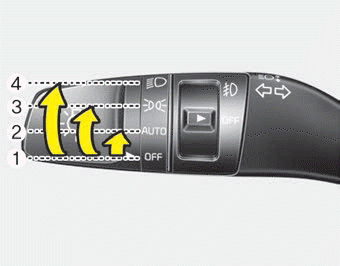
The light switch has a Headlight and a Parking light position.
To operate the lights, turn the knob at the end of the control lever to one of the following positions:
(1) OFF position
(2) Auto light position
(3) Parking & Tail light
(4) Headlight position
Parking & Tail light

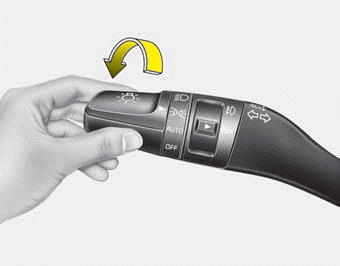
When the light switch is in the parking light position, the tail, license and instrument panel lights will turn ON.
Headlight position

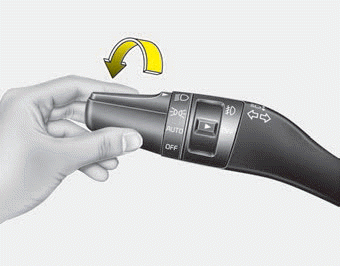
When the light switch is in the headlight position, the head, tail, license lights will turn ON.
✽ NOTICE
The ignition switch must be in the ON position to turn on the headlights.
Auto light position
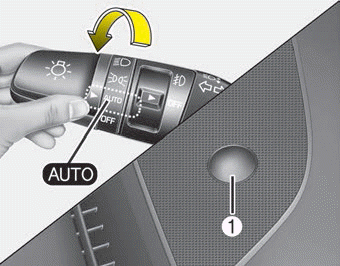
When the light switch is in the AUTO light position, the taillights and headlights will turn ON or OFF automatically depending on the amount of outside light the auto light sensor receives.
CAUTION
- Never put anything over the light sensor (1). This will impede operation of the autolight system control.
- Do not clean the sensor using a window cleaner as the cleaner may leave a light film which could interfere with the sensor's operation.
- If your vehicle has window tint or other types of metallic coating on the front windshield, the Auto light system may not work properly.
High beam operation
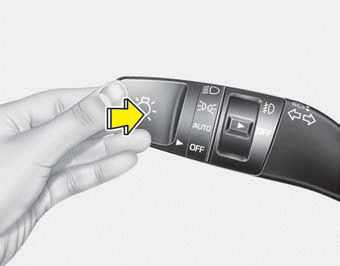
To turn on the high beam headlamp, push the lever away from you. The lever will return to its original position.
To turn off the high beam headlamps, pull the lever towards you. It will return to the normal (low beam) position when released.
The high beam indicator will light when the headlight high beams are switched on. To prevent the battery from being discharged, do not leave the lights on for a prolonged time while the engine is not running.
WARNING - High beams
Do not use high beam when there are other vehicles in front of your vehicle. Using high beam could obstruct the other driver’s vision.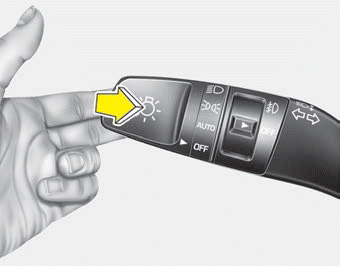
To flash the headlight high beams, pull the lever towards you. It will return to the normal (low beam) position when released. The headlight switch does not need to be on to use this flashing feature.
High Beam Assist
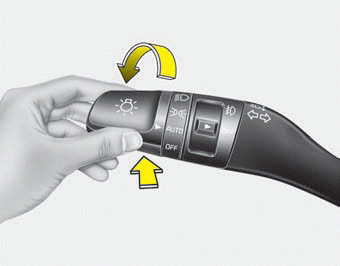
The High Beam Assist is a system that automatically adjusts the headlamp range (switches between high beam and low beam) according to the brightness of other vehicles and road conditions.
Operating condition
1.Place the light switch in the AUTO position.
2.Turn on the high beam by pushing the lever away from you.
3.The High Beam Assist ( ) indicator will illuminate.
4.The High Beam Assist will turn on when vehicle speed is above 40 km/h (25 mph).
5.The details of operation with the light switch while the High Beam Assist is on are below.
(1) If the light switch is pushed away, the High Beam Assist will turn off and the high beam will be on.
(2) If the light switch is pulled towards you when the high beam is off, the high beam will be on without cancellation of the High Beam Assist. (When you hands off, the lever will move to the middle and the high beam will turn off.)
(3) If the light switch is pulled towards you when the high beam is on by the High Beam Assist, the low beam will be on and the High Beam Assist will turn off.
(4) If the light switch is turned to the headlamp position ( ) from AUTO position, the High Beam Assist will turn off and the low beam will be on.
When the High Beam Assist is operating, the high beam switches to low beam in the following conditions.
- When the headlamp is detected from the on-coming vehicle.
- When the tail lamp is detected from the front vehicle.
- When headlamp/tail lamp of bicycle/ motorcycle is detected.
- When the surrounding is so bright that high beams are not needed.
- When streetlights or other lights are detected.
- When the light switch is not in the AUTO position.
- When the High Beam Assist is off.
- When vehicle speed is below 24 km/h (15 mph).
Warning light and message
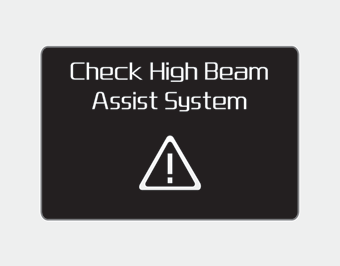
When the High Beam Assist System is not working properly, the warning message will come on for a few second. After the message disappears, the master warning light ( ) will illuminate. Take your vehicle to an authorized Kia dealer and have the system checked.
CAUTION
The High Beam Assist system may not work properly in the following situations:
- When the light from on-coming or front vehicle is poor
- When the light from the oncoming or front vehicle is not detected because of lamp damage, hidden from sight, etc.
- When the lamp of the on-coming or front vehicle is covered with dust, snow or water.
- When the front vehicle's headlamps are off but the fog lamps on and etc. - When external condition is intervened
- When there is a similar shape lamp with the front vehicle's lamps.
- When the headlamp is not repaired or replaced at an authorized dealer.
- When headlamp aiming is not properly adjusted.
- When driving on a narrow curved road, rough road, downhill or uphill.
- When only part of the vehicle in front is visible on a crossroad or curved road.
- When there is a traffic light, reflecting sign, flashing sign or mirror ahead.
- When there is a temporary reflector or flash ahead (construction area).
- When the road conditions are bad such as being wet, iced or covered with snow.
- When a vehicle suddenly appears from a curve.
- When the vehicle is tilted from a flat tire or being towed. - When front visibility is poor
- When the lamp of the on-coming or front vehicle is covered with dust, snow or water.
- When the light from the oncoming or front vehicle is not detected because of exhaust fume, smoke, fog, snow, etc.
- When the front window is covered with foreign matters.
- When it is hard to see because of fog, heavy rain or snow and etc.
✽ NOTICE
- Do not disassemble a front view camera temporarily for tinted window or attaching any types of coatings and accessories. If you disassemble the camera and assemble it again, take your vehicle to an authorized Kia dealer and have the system checked to need a calibration.
- When you replace or reinstall the windshield glass or front view camera, take your vehicle to an authorized Kia dealer and have the system checked.
- Be careful that water doesn't get into the High Beam Assist unit and do not remove or damage parts of the High Beam Assist system.
- Do not place objects on the dash board that reflect light such as mirrors, white paper, etc. The system may not be able to function if sunlight is reflected.
- At times, the High Beam Assist may not operate due to system limitations. The system is for your convenience only. It is the responsibility of the driver to drive safely and always check the road conditions.
- When the system does not operate normally, change the lamp position manually between the high beam and low beam.
Turn signals and lane change signals
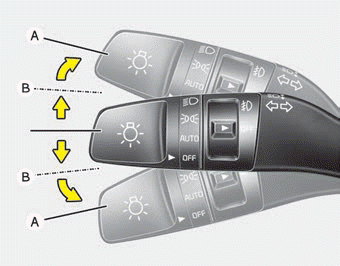
The ignition switch must be on for the turn signals to function. To turn on the turn signals, move the lever up or down (A). The green arrow indicators on the instrument panel indicate which turn signal is operating.
They will self-cancel after a turn is completed. If the indicator continues to flash after a turn, manually return the lever to the OFF position.
To signal a lane change, move the turn signal lever slightly and hold it in position (B). The lever will return to the OFF position when released.
If an indicator stays on and does not flash or if it flashes abnormally, one of the turn signal bulbs may be burned out and will require replacement.
✽ NOTICE
If an indicator flash is abnormally quick or slow, a bulb may be burned out or have a poor electrical connection in the circuit.
Check headlight
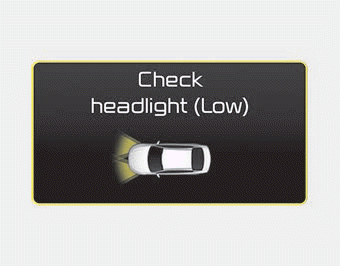
This warning message illuminates if there is a malfunction (burned-out bulb except LED lamp or circuit malfunction) with the headlamp. In this case, have your vehicle inspected by an authorized Kia dealer.
✽ NOTICE
- When replacing the bulb, use the same wattage bulb. For more information, refer to “BULB WATTAGE” in chapter 8.
- If a different wattage bulb is installed on the vehicle, this warning message is not displayed.
Front fog light
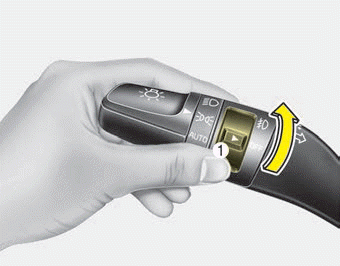
Fog lights are used to provide improved visibility when visibility is poor due to fog, rain or snow, etc. The fog lights will turn on when the fog light switch (1) is turned to the on position after the headlights are turned on.
To turn off the fog lights, turn the switch (1) to the off position.
When in operation, the fog lights consume large amounts of vehicle electrical power. Only use the fog lights when visibility is poor.
Download Manual