Honda Sensing®
Models with Low Speed Braking Control
Honda Sensing® is a driver support system which employs the use of three distinctly different kinds of sensors: a radar sensor located at the lower part of the front bumper, a front sensor camera mounted to the interior side of the windshield, behind the rearview mirror, and the sonar sensors located in the front and rear bumpers.
Models without Low Speed Braking Control
Honda Sensing® is a driver support system which employs the use of two distinctly different kinds of sensors: a radar sensor located at the lower part of the front bumper and a front sensor camera mounted to the interior side of the windshield, behind the rearview mirror.
Honda Sensing® has following functions.
Continued
455
uuHonda Sensing® u
 Button
Press to activate standby mode for ACC with Low Speed Follow. Or press to cancel the system.
Press to activate standby mode for LKAS. Or press to cancel the system.
Press RES/+ button to resume the ACC with Low Speed Follow or increase the vehicle speed.
Press SET/− button to set the ACC with Low Speed Follow or decrease the vehicle speed.
Press to change the ACC with Low Speed Follow following-interval.
Press to cancel ACC with Low Speed Follow.
uuHonda Sensing® u
Driver Information Interface Content
You can see the current state of ACC with Low Speed Follow and LKAS.
a Indicates that ACC with Low Speed Follow is ready to be activated.
b Indicates that LKAS is ready to be activated.
c Indicates that LKAS is activated and whether or not traffic lane lines are detected.
d Indicates whether or not ACC with Low Speed Follow detects the vehicle ahead.
e Shows vehicle set speed in ACC with Low Speed Follow.
f Shows set vehicle interval in ACC with Low Speed Follow.
uuHonda Sensing® uCollision Mitigation Braking SystemTM (CMBSTM)
Can assist you when there is a possibility of your vehicle colliding with a vehicle or a pedestrian detected in front of yours. The CMBSTM is designed to alert you when the potential for a collision is determined, as well as to reduce your vehicle speed to help minimize collision severity when a collision is deemed unavoidable.
When to use
The camera is located behind the rearview mirror.
The radar sensor is at the lower part of the front bumper.
The system starts monitoring the roadway ahead when your vehicle speed is about 3 mph (5 km/h) and there is a vehicle in front of you.
The CMBSTM activates when:
458
uuHonda Sensing® uCollision Mitigation Braking SystemTM (CMBSTM)
You can change the distance (Long/Normal/Short) between vehicles at which the system's earliest collision alert will come on through audio/information screen setting options.
2 Customized Features P. 352
Continued 459
uuHonda Sensing® uCollision Mitigation Braking SystemTM (CMBSTM)
|
Distance between vehicles |
CMBSTM |
|||
|
The radar sensor detects a vehicle |
Audible & Visual WARNINGS |
Braking |
||
|
Stage one |
Normal Long Short Your Vehicle Vehicle Ahead |
There is a risk of a collision with the vehicle ahead of you. |
When in Long, visual and audible alerts come on at a longer distance from a vehicle ahead than in Normal setting, and in Short, at a shorter distance than in Normal. |
— |
|
Stage two |
Your Vehicle Vehicle Ahead |
The risk of a collision has increased, time to respond is reduced. |
Visual and audible alerts. |
Lightly applied |
|
Stage three |
Your Vehicle Vehicle Ahead |
The CMBSTM determines that a collision is unavoidable. |
Forcefully applied |
uuHonda Sensing® uCollision Mitigation Braking SystemTM (CMBSTM)
When you turn the CMBSTM on and off, do the following.
 symbol and push it.
u The message appears on the driver information interface when the system becomes on or off.
The CMBSTM is turned on every time you start the engine, even if you turned it off the last time you drove the vehicle.
Continued 461
uuHonda Sensing® uCollision Mitigation Braking SystemTM (CMBSTM)
The system may automatically shut off and the safety support indicator (amber) will come on under certain conditions. Some examples of these conditions are listed below. Other conditions may reduce some of the CMBSTM functions.
2 Front Sensor Camera P. 506
2 Radar Sensor P. 508
• Driving in bad weather (rain, fog, snow, etc.).
• Sudden changes between light and dark, such as an entrance or exit of a tunnel.
• There is little contrast between objects and the background.
• Driving into low sunlight (e.g., at dawn or dusk).
• Strong light is reflected onto the roadway.
• Driving in the shadows of trees, buildings, etc.
• Roadway objects or structures are misinterpreted as vehicles and pedestrians.
• Reflections on the interior of the windshield.
• Driving at night or in a dark place such as a tunnel (due to low-light conditions, pedestrians or other vehicles may not be detected).
• Driving on a snowy or wet roadway (obscured lane marking, vehicle tracks, reflected lights, road spray, high contrast).
• Driving on curvy, winding, or undulating roads.
• The road is hilly or the vehicle is approaching the crest of a hill.
uuHonda Sensing® uCollision Mitigation Braking SystemTM (CMBSTM)
• Headlight lenses are dirty or the headlights are not properly adjusted.
• The outside of the windshield is blocked by dirt, mud, leaves, wet snow, etc.
• The inside of the windshield is fogged.
• An abnormal tire or wheel condition (wrong sized, varied size or construction, improperly inflated, compact spare tire, etc.).
• When tire chains* are installed.
• The vehicle is tilted due to a heavy load or suspension modifications.
• The camera temperature gets too high.
• Driving with the parking brake applied.
• When the radar sensor at the lower part of the front bumper gets dirty.
• The vehicle is towing a trailer*.
• Driving at night or in a dark place (e.g., a tunnel) with the headlights off.
• A vehicle or pedestrian suddenly crosses in front of you.
• The distance between your vehicle and the vehicle or pedestrian ahead of you is too short.
• A vehicle cuts in front of you at a slow speed, and it brakes suddenly.
• When you accelerate rapidly and approach the vehicle or pedestrian ahead of you at high speed.
• The vehicle ahead of you is a motorcycle, bicycle, mobility scooter or other small vehicle.
• When there are animals in front of your vehicle.
• When you drive on a curved, winding or undulating road that makes it difficult for the sensor to properly detect a vehicle in front of you.
• The speed difference between your vehicle and a vehicle or pedestrian in front of you is significantly large.
• An oncoming vehicle suddenly comes in front of you.
• Another vehicle suddenly comes in front of you at an intersection, etc.
• Your vehicle abruptly crosses over in front of an oncoming vehicle.
• When driving through a narrow iron bridge.
• When the lead vehicle suddenly slows down.
* Not available on all models
Continued
463
uuHonda Sensing® uCollision Mitigation Braking SystemTM (CMBSTM)
Limitations applicable to pedestrian detection only
The CMBSTM may automatically shut itself off and the safety support indicator (amber) comes and stays on when:
Once the conditions that caused the CMBSTM to shut off improve or are addressed (e.g., cleaning), the system comes back on.
uuHonda Sensing® uCollision Mitigation Braking SystemTM (CMBSTM)
With Little Chance of a Collision The CMBSTM may activate even when you are aware of a vehicle ahead of you, or when there is no vehicle ahead. Some examples of this are:
Your vehicle approaches another vehicle ahead of you and you change lanes to pass.
Your vehicle approaches or passes another vehicle that is making a left or right turn.
Continued
uuHonda Sensing® uCollision Mitigation Braking SystemTM (CMBSTM)
When driving through curves, your vehicle comes to a point where an oncoming vehicle is right in front of you.
You drive under a low or narrow bridge at high speed.
You drive over speed bumps, steel road plates, etc., or your vehicle approaches train tracks or roadside objects (such as a traffic sign and guard rail) on a curve or, when parking, stationary vehicles and walls.
uuHonda Sensing®uLow Speed Braking Control*
Using sonar sensors located on the front and rear bumpers, the vehicle detects if there is danger of a potential collision with a wall or other obstacle. The system is designed to alert you when a potential collision is determined, as well as assist in reducing speed, avoiding collisions, and reducing collision severity.
Continued
uuHonda Sensing® uLow Speed Braking Control*
How the System Works
The Low Speed Braking Control provides a visual and audible alert when the vehicle is moving between approximately 1 and 6 mph (2 and 10 km/h) and there is the possibility of a collision with a detected wall or other obstacle, as well as providing assistance with braking.
* Not available on all models
uuHonda Sensing®uLow Speed Braking Control*
When you turn the system on and off, do the following.
 symbol and push it.
u The message appears on the driver information interface when the system turns on or off.
The system is turned on every time you start the engine, even if you turned it off the last time you drove the vehicle.
Continued 469
uuHonda Sensing® uLow Speed Braking Control*
A certain amount of time has passed since activation.
The system may not operate correctly under the following conditions:
470
uuHonda Sensing®uLow Speed Braking Control*
uuHonda Sensing® uAdaptive Cruise Control (ACC) with Low Speed Follow
Helps maintain a constant vehicle speed and a set following-interval behind a vehicle detected ahead of yours and, if the detected vehicle comes to a stop, can decelerate and stop your vehicle, without you having to keep your foot on the brake or the accelerator.
When ACC with Low Speed Follow slows your vehicle by applying the brakes, your vehicle’s brake lights will illuminate.
uuHonda Sensing® uAdaptive Cruise Control (ACC) with Low Speed Follow
Continued 473
uuHonda Sensing® uAdaptive Cruise Control (ACC) with Low Speed Follow
When driving at about 25 mph (40 km/h) or above: Take your foot off the pedal and press the SET/– button when you reach the desired speed. The moment you release the button, the set speed is fixed, and ACC with Low Speed Follow begins. When driving slower than about 25 mph (40 km/h): If the vehicle is moving and the brake pedal is not depressed, pressing the button fixes the set speed to about 25 mph (40 km/h) regardless of current vehicle speed. If the vehicle is stationary, you can set the vehicle speed even with the brake pedal depressed.
When ACC with Low Speed Follow starts operating, the vehicle icon, interval bars and set speed appear on the driver information interface.
When you use ACC with Low Speed Follow, Straight Driving Assist (a feature of the Electric Power Steering system) is activated.
By enabling the steering system to automatically compensate for natural steering pull, Straight Driving Assist makes it easier for you to keep your vehicle in a straight line.
uuHonda Sensing® uAdaptive Cruise Control (ACC) with Low Speed Follow
ACC with Low Speed Follow monitors if a vehicle ahead of you enters the ACC with Low Speed Follow range. If a vehicle is detected doing so, the ACC with Low Speed Follow system maintains or decelerates your vehicle’s set speed in order to keep the vehicle’s set following interval from the vehicle ahead.
2 To Set or Change Following-interval P. 482
When a vehicle whose speed is slower than your set speed is detected in front of you, your vehicle starts to slow down.
* Not available on all models
Continued 475
uuHonda Sensing® uAdaptive Cruise Control (ACC) with Low Speed Follow
Your vehicle maintains the set speed without having to keep your foot on the brake or accelerator pedal.
If there previously was a vehicle detected ahead that kept your vehicle from traveling at the set speed, ACC with Low Speed Follow accelerates your vehicle to the set speed, and then maintains it.
You can temporarily increase the vehicle speed. In this case, there is no audible or visual alert even if a vehicle is in the ACC with Low Speed Follow range.
ACC with Low Speed Follow stays on unless you cancel it. Once you release the accelerator pedal, the system resumes an appropriate speed for keeping the following interval while a vehicle ahead is within the ACC with Low Speed Follow range.
476
uuHonda Sensing® uAdaptive Cruise Control (ACC) with Low Speed Follow
Your vehicle also stops, automatically. The Stopped message appears on the driver information interface.
When the vehicle ahead of you starts again, the vehicle icon on the driver information interface blinks. If you press the RES/+ or SET/
– button, or depress the accelerator pedal, ACC with Low Speed Follow operates again within the prior set speed.
If no vehicle is ahead of you before you resume driving, depressing the accelerator pedal will resume operation of ACC with Low Speed Follow within the prior set speed.
Continued 477
uuHonda Sensing® uAdaptive Cruise Control (ACC) with Low Speed Follow
The system may automatically shut off and the  indicator will come on under certain conditions. Some examples of these conditions are listed below. Other conditions may reduce some of the ACC with Low Speed Follow functions.
2 Front Sensor Camera P. 506
2 Radar Sensor P. 508
478
uuHonda Sensing® uAdaptive Cruise Control (ACC) with Low Speed Follow
Continued
479
uuHonda Sensing® uAdaptive Cruise Control (ACC) with Low Speed Follow
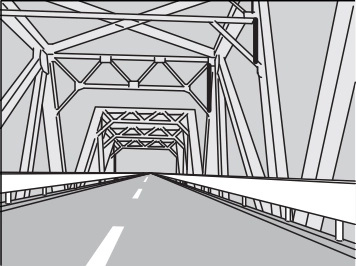 Driving through a narrow metal bridge.
uuHonda Sensing® uAdaptive Cruise Control (ACC) with Low Speed Follow
To Adjust the Vehicle Speed Increase or decrease the vehicle speed using the RES/+ or SET/– button on the steering wheel.
Continued 481
uuHonda Sensing® uAdaptive Cruise Control (ACC) with Low Speed Follow
Press the Interval button to change the ACC with Low Speed Follow following-interval. Each time you press the button, the following- interval (the interval behind a vehicle detected ahead of you) setting cycles through extra long, long, middle, and short following- intervals.
Determine the most appropriate following- interval setting based on your specific driving conditions. Be sure to adhere to any following-interval requirements set by local regulation.
uuHonda Sensing® uAdaptive Cruise Control (ACC) with Low Speed Follow
The higher your vehicle’s following-speed is, the longer the short, middle, long or extra long following-interval becomes. See the following examples for your reference.
|
Following Interval |
When the Set Speed is: |
||
|
50 mph (80 km/h) |
65 mph (104 km/h) |
||
|
Short |
|
83 feet 25 meters 1.1 sec |
100 feet 31 meters 1.1 sec |
|
Middle |
|
110 feet 33 meters 1.5 sec |
137 feet 42 meters 1.5 sec |
|
Long |
|
154 feet 47 meters 2.1 sec |
200 feet 61 meters 2.1 sec |
|
Extra Long |
|
207 feet 63 meters 2.9 sec |
272 feet 83 meters 2.9 sec |
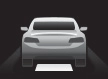
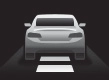
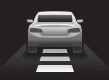
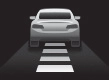
When your vehicle stops automatically because a vehicle detected ahead of you has stopped, the interval between the two vehicles will vary based on the ACC with Low Speed Follow interval setting.
Continued
483
uuHonda Sensing® uAdaptive Cruise Control (ACC) with Low Speed Follow
To cancel ACC with Low Speed Follow, do any of the following:
u The  indicator (green) on the driver information interface change to the
  indicator (white).
 button.
u  indicator (green) goes off.
u The  indicator (green) on the driver information interface change to the
  indicator (white).
uuHonda Sensing® uAdaptive Cruise Control (ACC) with Low Speed Follow
The beeper sounds and a message appears on the driver information interface when ACC with Low Speed Follow is automatically canceled. Any of these conditions may cause the ACC with Low Speed Follow to automatically cancel:
The ACC with Low Speed Follow automatic cancellation can be also triggered by the following causes. In these cases, the parking brake will be automatically applied.
Continued 485
uuHonda Sensing® uAdaptive Cruise Control (ACC) with Low Speed Follow
Press and hold the interval button for one second. Cruise Mode Selected appears on the driver information interface for two seconds, and then the mode switches to Cruise.
The  indicator comes on.
To switch back to ACC with Low Speed Follow, press and hold the interval button again for one second.
Desired speed in a range above roughly 25 mph (40 km/h) ~.
Take your foot off the pedal and press the SET/– button when you reach the desired speed.
The moment you release the SET/– button, the set speed is fixed, and cruise control begins. The color of  indicator changes from white to green.
When you use cruise control, Straight Driving Assist (a feature of the Electric Power Steering system) is activated.
By enabling the steering system to automatically compensate for natural steering pull, Straight Driving Assist makes it easier for you to keep your vehicle in a straight line.
uuHonda Sensing® uAdaptive Cruise Control (ACC) with Low Speed Follow
To Adjust the Vehicle Speed Each time you press the RES/+ or SET/– button, the vehicle speed is increased or decreased by about 1 mph or 1 km/h.
If you keep the RES/+ or SET/– button pressed, the vehicle speed increases or
decreases by about 5 mph or 5 km/h.
To cancel cruise control, do any of the following:
u The  indicator (green) on the driver information interface changes to the
  indicator (white).
u The indicator (green) goes off.
u The  indicator (green) on the driver information interface changes to the
  indicator (white).
uuHonda Sensing® uLane Keeping Assist System (LKAS)
Provides steering input to help keep the vehicle in the middle of a detected lane and provides tactile and visual alerts if the vehicle is detected drifting out of its lane.
The system applies torque to the steering to keep the vehicle between the left and right lane lines. The applied torque becomes stronger as the vehicle gets closer to either of the lane lines.
Rapid vibrations on the steering wheel and a warning display alert you that the vehicle is drifting out of a detected lane.
When you operate the turn signals to change lanes, the system is suspended, and resumes after the signals are off.
If you make a lane change without operating the turn signals, the LKAS alerts activate, and torque is applied to the steering.
uuHonda Sensing®uLane Keeping Assist System (LKAS)
Lane Keep Support Function Provides assistance to keep the vehicle in the center of the lane. When the vehicle nears a white or yellow line, steering force of the electric power steering will become
stronger.
Lane Departure Warning Function When the vehicle enters the warning area, the LKAS alerts you with slight steering wheel vibration as well as a warning display.
Continued 489
uuHonda Sensing® uLane Keeping Assist System (LKAS)
When the System can be Used
The system can be used when the following conditions are met.
u  indicator (white) and lane outlines appear on the driver information interface.
The system is activated.
490
uuHonda Sensing®uLane Keeping Assist System (LKAS)
2. Keep your vehicle near the center of the lane while driving.
u The  indicator changes from white to green and the dotted outer lines change to solid ones once the system starts operating after detecting the left and right lane markings.
Press the LKAS button.
The LKAS is turned off every time you stop the engine, even if you turned it on the last time you drove the vehicle.
Continued
491
uuHonda Sensing® uLane Keeping Assist System (LKAS)
u Turning the wipers off, setting it to LO, or the wipers are operating intermittently resumes the LKAS.
u Increasing the vehicle speed to about 45 mph (72 km/h) or more resumes the LKAS.
u The LKAS resumes and starts detecting the lane lines again once you release the brake pedal.
492
uuHonda Sensing®uLane Keeping Assist System (LKAS)
The beeper sounds if the LKAS is automatically canceled.
LKAS Conditions and Limitations The system may not detect lane markings and therefore may not keep the vehicle in the middle of a lane under certain conditions, including the following:
Continued
493
uuHonda Sensing® uLane Keeping Assist System (LKAS)
|
Very wide or narrow traffic lane |
uuHonda Sensing®uLane Keeping Assist System (LKAS)
495
uuHonda Sensing® uRoad Departure Mitigation (RDM) System
Alerts and helps to assist you when the system detects a possibility of your vehicle unintentionally crossing over detected lane markings and/or leaving the roadway altogether.
The front camera behind the rearview mirror monitors left and right lane markings (in white or yellow). If your vehicle is getting too close to detected lane markings without a turn signal activated, the system, in addition to a visual alert, applies steering torque and alerts you with rapid vibrations on the steering wheel, to help you remain within the detected lane.
2 Customized Features P. 352
As a visual alert, the Lane Departure message appears on the driver information interface.
If the system determines that its steering input is insufficient to keep your vehicle on the roadway, it may apply braking.
u Braking is applied only when the lane markings are solid continuous lines. The system cancels assisting operations when you turn the steering wheel to avoid crossing over detected lane markings.
If the system operates several times without detecting driver response, the system beeps to alert you.
uuHonda Sensing®uRoad Departure Mitigation (RDM) System
How the System Activates The system becomes ready to start searching for lane markings when all the following conditions are met:
• The vehicle is traveling between about 45 and 90 mph (72 and 145 km/h).
• The vehicle is on a straight or slightly curved road.
• The turn signals are off.
• The brake pedal is not depressed.
• The wipers are not in high speed operation.
• The vehicle is not accelerating or braking, and the steering wheel is not being turned.
• The system makes a determination that the driver is not actively accelerating, braking or steering.
Continued 497
uuHonda Sensing® uRoad Departure Mitigation (RDM) System
When you turn the RDM on and off, do the following.
u The message appears on the driver information interface when the system becomes on or off.
The RDM is in the previously selected ON or
OFF setting each time you start the engine.
RDM Conditions and Limitations The system may not properly detect lane markings and the position of your vehicle under certain conditions. Some examples of these conditions are listed below.
• Driving in bad weather (rain, fog, snow, etc.).
• Sudden changes between light and dark, such as an entrance or exit of a tunnel.
• There is little contrast between lane lines and the roadway surface.
• Driving into low sunlight (e.g., at dawn or dusk).
• Strong light is reflected onto the roadway.
• Driving in the shadows of trees, buildings, etc.
• Shadows of adjacent objects are parallel to lane markings.
• Roadway objects or structures are misinterpreted as lane markers.
• Reflections on the interior of the windshield.
• Driving at night or in a dark condition such as a tunnel.
498
uuHonda Sensing®uRoad Departure Mitigation (RDM) System
• Driving on a snowy or wet roadway (obscured lane marking, vehicle tracks, reflected lights, road spray, high contrast).
• Driving on a road with temporary lane markings.
• Faint, multiple, or varied lane markings are visible on the roadway due to road repairs or old lane markings.
• The roadway has merging, split, or crossing lines (e.g., such as at an intersection or crosswalk).
• The lane markings are extremely narrow, wide, or changing.
• The vehicle in front of you is driving near the lane lines.
• The road is hilly or the vehicle is approaching the crest of a hill.
• Driving on rough or unpaved roads, or over bumpy surfaces.
• When objects on the road (curb, guard rail, pylons, etc.) are recognized as white lines (or yellow lines).
• Driving on roads with double lines.
• Headlight lenses are dirty or the headlights are not properly adjusted.
• The outside of the windshield is streaked or blocked by dirt, mud, leaves, wet snow, etc.
• The inside of the windshield is fogged.
• The camera temperature gets too high.
• An abnormal tire or wheel condition (wrong sized, varied size or construction, improperly inflated, compact spare tire, etc.).
• The vehicle is tilted due to a heavy load or suspension modifications.
• When tire chains* are installed.
• The vehicle is towing a trailer*.
499
uuHonda Sensing® uTraffic Sign Recognition System
Reminds you of road sign information, such as the current speed limit, your vehicle has just passed through, showing it on the driver information interface and the head-up display*.
How the System Works When the camera located behind the rearview mirror captures traffic signs while driving, the system displays the ones that are recognized as designated for your
vehicle. The sign icon will be displayed until the vehicle reaches a predetermined
time and distance.
The sign icon also may switch to another one or disappear when:
• The other designated limit is detected.
• You make a turn with a turn signal at an intersection.
* Not available on all models
uuHonda Sensing® uTraffic Sign Recognition System
If the system does not detect any traffic signs while you are driving, the image below may appear.
* Not available on all models
Continued 501
uuHonda Sensing® uTraffic Sign Recognition System
Traffic Sign Recognition System Conditions and Limitations The traffic sign recognition system may not be able to recognize the traffic sign in the following cases.
uuHonda Sensing® uTraffic Sign Recognition System
Continued
503
uuHonda Sensing® uTraffic Sign Recognition System
The traffic sign recognition system may not operate correctly, such as displaying a sign that does not follow the actual regulation for the roadway or does not exist at all in the following cases.
u A speed limit sign may display at a higher or lower speed than the actual speed limit.
uuHonda Sensing® uTraffic Sign Recognition System
The speed limit sign icon is displayed on the right half of the screen.
You can continue displaying reduced-size traffic sign icon on the driver information interface and head-up display* even while the main mode is not selected.
2 Customized Features P. 352
* Not available on all models
505
uuHonda Sensing® uFront Sensor Camera
The camera, used in systems such as LKAS, RDM, ACC with Low Speed Follow, CMBSTM and traffic sign recognition system, is designed to detect an object that triggers any of the systems to operate their functions.
This camera is located behind the rearview mirror.
To help reduce the likelihood that high interior temperatures will cause the camera’s sensing system to shut off, when parking, find a shady area or face the front of the vehicle away from the sun. If you use a reflective sun shade, do not allow it to cover the camera housing.
Covering the camera can concentrate heat on it.
uuHonda Sensing®uFront Sensor Camera
uuHonda Sensing® uRadar Sensor
The radar sensor is at the lower part of the front bumper.
uuHonda Sensing® uSonar Sensors*
The sonar sensors are situated in the front and rear bumpers.
* Not available on all models
509
Download Manual