Child Safety
Protecting Child Passengers
Each year, many children are injured or killed in vehicle crashes because they are either unrestrained or not properly restrained. In fact, vehicle crashes are the number one cause of death of children ages 12 and under.
To reduce the number of child deaths and injuries, every state, Canadian province and territory requires that infants and children be properly restrained when they ride in a vehicle.
Children should sit properly restrained in a rear seat. This is because:
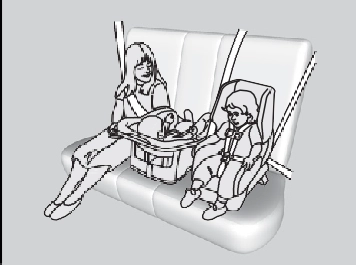 An inflating front or side airbag can injure or kill a child sitting in the front seat.
Continued 63
uuChild SafetyuProtecting Child Passengers
uuChild Safety uSafety of Infants and Small Children
infant is at least one year old.
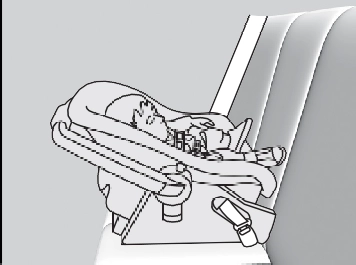 Positioning a rear-facing child seat
Child seats must be placed and secured in a rear seating position.
When properly installed, a rear-facing child seat may prevent the driver or a front passenger from moving their seat all the way back, or from locking their seat-back in the desired position. Make sure that there is no contact between the child seat and the seat in front of it.
It can also interfere with proper operation of the passenger's advanced front airbag system.
2 Airbags P. 49
If this occurs, we recommend that you install the child seat directly behind the front passenger's seat, move the seat as far forward as needed, and leave it unoccupied. Or, you may wish to get a smaller rear-facing child seat.
Continued 65
uuChild SafetyuSafety of Infants and Small Children
forward-facing child seat.
We strongly recommend placing a forward- facing child seat in a rear seating position.
Placing a forward-facing child seat in the front seat can be hazardous, even with advanced front airbags that automatically turn the passenger's front airbag off. A rear seat is the safest place for a child.
66
uuChild Safety uSafety of Infants and Small Children
are equally easy to use. Some existing and previously owned child seats can only be installed using the seat belt. Whichever type you choose, follow the child seat manufacturer's use and care instructions including recommended expiration dates as well as the instructions in this manual. Proper installation is key to maximizing your child's safety.
In seating positions and vehicles not equipped with LATCH, a LATCH-compatible child seat can be installed using the seat belt and a top tether for added security. This is because all child seats are required to be designed so that they can be secured with a lap belt or the lap part of a lap/shoulder belt. In addition, the child seat manufacturer may advise that a seat belt be used to attach a LATCH-compatible seat once a child reaches a specified weight. Please read the child seat owner’s manual for proper installation instructions.
Make sure the child seat meets the following three requirements:
Continued 67
uuChild SafetyuSafety of Infants and Small Children
u When installing the child seat, make sure that the lower anchors are not obstructed by the seat belt or any other object.
uuChild Safety uSafety of Infants and Small Children
Outer position
Center position
Continued 69
uuChild SafetyuSafety of Infants and Small Children
All models
uuChild Safety uSafety of Infants and Small Children
u Insert the latch plate fully until it clicks.
u If you are able to pull the shoulder belt out, the lockable retractor is not activated. Pull the seat belt all the way out, and repeat steps 3 – 4.
Continued 71
uuChild SafetyuSafety of Infants and Small Children
u When doing this, place your weight on the child seat and push it into the vehicle seat.
A tether anchorage point is provided behind each rear seating position.
If you have a child seat that comes with a tether but can be installed with a seat belt, the tether may be used for additional security.
uuChild Safety uSafety of Infants and Small Children
Make sure the strap is not twisted.
Make sure the strap is not twisted.
uuChild SafetyuSafety of Larger Children
must sit in front.
following questions.
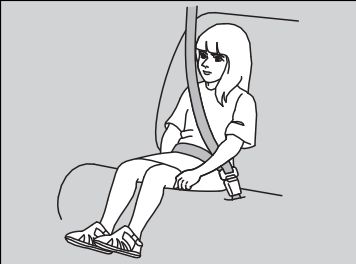 Checklist
If you answer yes to all these questions, the child is ready to wear the lap/shoulder seat belt correctly. If you answer no to any question, the child needs to ride on a booster seat until the seat belt fits properly without a booster seat.
74
uuChild SafetyuSafety of Larger Children
If a lap/shoulder seat belt cannot be used properly, position the child in a booster seat in the rear seat. For the child's safety, check that the child meets the booster seat manufacturer's recommendations.
We strongly recommend that you keep an eye on child passengers. Even older, more mature children sometimes need to be reminded to fasten their seat belts and sit up properly.
75
Download Manual