If you have a flat tire (with tire mobility kit)
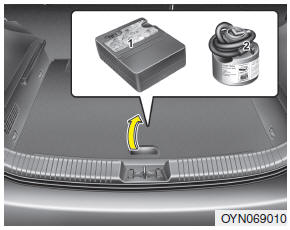
Please read the instructions before using the Tire Mobility Kit.
(1) Compressor
(2) Sealant bottle
WARNING
For safe operation, carefully read and follow the instructions in this manual before use.
Introduction
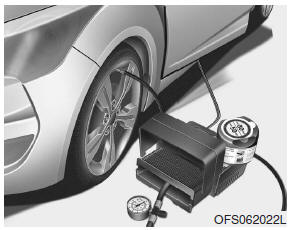
With the Tire Mobility Kit you stay mobile even after experiencing a tire puncture.
The system of compressor and sealing compound effectively and comfortably seals most punctures in a passenger car tire caused by nails or similar objects and reinflates the tire.
After you ensured that the tire is properly sealed you can drive cautiously on the tire (up to 120 miles (200 km)) at a max. speed of 50 mph (80 km/h) in order to reach a vehicle or tire dealer to have the tire replaced.
It is possible that some tires, especially with larger punctures or damage to the sidewall, cannot be sealed completely.
Air pressure loss in the tire may adversely affect tire performance.
For this reason, you should avoid abrupt steering or other driving maneuvers, especially if the vehicle is heavily loaded or if a trailer is in use.
The Tire Mobility Kit is not designed or intended as a permanent tire repair method and is to be used for one tire only.
This instruction shows you step by step how to temporarily seal the puncture simply and reliably.
Read the section "Notes on the safe use of the Tire Mobility Kit".
WARNING
- Do not use the Tire Mobility Kit if a tire is severely damaged by driving while flat or with insufficient air pressure.
- Only punctured areas located within the tread region of the tire can be sealed using the Tire Mobility Kit.
- Damage to the sidewall must not be repaired due to safety reasons.
Notes on the safe use of the Tire Mobility Kit
- Park your car at the side of the road so that you can work with the Tire Mobility Kit away from moving traffic. Place your warning triangle in a prominent place to make passing vehicles aware of your location.
- To be sure your vehicle will not move, even when you're on fairly level ground, always set your parking brake.
- Only use the Tire Mobility Kit for sealing/inflation passenger car tires. Do not use on motorcycles, bicycles or any other type of tires.
- Do not remove any foreign objects such as nails or screws that have penetrated the tire.
- Before using the Tire Mobility Kit, read the precautionary advice printed on the sealant bottle!
- Provided the car is outdoors, leave the engine running. Otherwise operating the compressor may eventually drain the car battery.
- Never leave the Tire Mobility Kit unattended while it is being used.
- Do not leave the compressor running for more than 10 min. at a time or it may overheat.
- Do not use the Tire Mobility Kit if the ambient temperature is below -22°F (-30°C).
- Do not use the sealing compound after its expiration date which can be found on the label of the bottle.
- Keep away from children.
CAUTION
The Tire Mobility Kit is a temporary fix to the tire and the tire should be inspected by an authorized HYUNDAI dealer as soon as possible.
WARNING
• Have your tire repaired as soon as possible. The tire may loose air pressure at any time after inflating with the TMK.
CAUTION
When using Tire Mobility Kit, the tire sealant can damage the tire pressure sensor. After using the Tire Mobility Kit, have the tire pressure sensor checked by an authorized HYUNDAI dealer.
Components of the Tire Mobility Kit
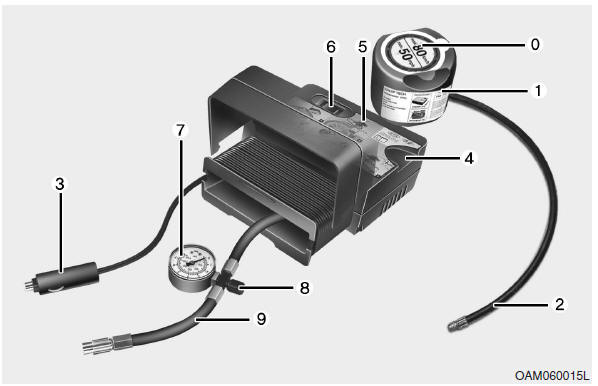
0. Speed restriction label
1. Sealant bottle and label with speed restriction
2. Filling hose from sealant bottle to wheel
3. Connectors and cable for the power outlet direct connection
4. Holder for the sealant bottle 5. Compressor
6. On/off switch
7. Pressure gauge for displaying the tire inflation pressure
8. Button for reducing tire inflation pressure
9. Hose to connect compressor and sealant bottle or compressor and wheel
Connectors, cable and connection hose are stored in the compressor housing.
WARNING
- • Before using the Tire Mobility Kit, follow the instructions on the sealant bottle.
- • Remove the label with the speed restriction from the sealant bottle and apply it to the steering wheel.
- • Check the expiration date on the Tire Mobility Kit container of sealant and replace it before it expires.
WARNING - Sealant
- • Keep out of reach of children.
- • Avoid contact with eyes.
- • Do not swallow.
CAUTION
Strictly follow the specified sequence, otherwise the sealant may escape under high pressure.
Using the Tire Mobility Kit
12. After driving approximately 2 miles (3 km), stop at a suitable location.
13. Connect connection hose (9) of the compressor directly to the tire valve.
14. Connect between compressor and the vehicle power outlet using the cable and connectors.
15. Adjust the tire inflation pressure to 32 psi (220 kPa). With the ignition switched on, proceed as follows.
- To increase the inflation pressure: Switch on the compressor, position I. To check the current inflation pressure setting, briefly switch off the compressor.
WARNING
Do not let the compressor run for more than 10 minutes, otherwise the device will overheat and may be damaged.
✽ NOTE
The pressure gauge may show higher than actual reading when the compressor is running. To get an accurate tire reading, the compressor needs to be turned off.
- To reduce the inflation pressure:
Press the button (8) on the compressor.
CAUTION
Be careful not to overinflate the tire and stay away from the tire when filling it.
16. Remove the speed restriction label(0) from the sealant bottle(1) and place it in a highly visible place in the vehicle such as on the steering wheel to remind you not to drive too fast.
CAUTION
If the inflation pressure is not maintained, drive the vehicle a second time, refer to Distributing the sealant. Then repeat steps 1 to 4.
Use of the Tire Mobility Kit may be ineffectual for tire damage larger than approximately 0.16 in (4 mm).
Please contact the nearest HYUNDAI dealer if the tire cannot be made roadworthy with the Tire Mobility Kit.
WARNING
The tire inflation pressure must be at least 32 psi (220 kPa). If it is not, do not continue driving. Call for road side service or towing.
Setting the tire inflation pressure
12. After driving approximately 2 miles (3 km), stop at a suitable location.
13. Connect connection hose (9) of the compressor directly to the tire valve.
14. Connect between compressor and the vehicle power outlet using the cable and connectors.
15. Adjust the tire inflation pressure to 32 psi (220 kPa). With the ignition switched on, proceed as follows.
- To increase the inflation pressure: Switch on the compressor, position I. To check the current inflation pressure setting, briefly switch off the compressor.
WARNING
Do not let the compressor run for more than 10 minutes, otherwise the device will overheat and may be damaged.
✽ NOTE
The pressure gauge may show higher than actual reading when the compressor is running. To get an accurate tire reading, the compressor needs to be turned off.
- To reduce the inflation pressure:
Press the button (8) on the compressor.
CAUTION
Be careful not to overinflate the tire and stay away from the tire when filling it.
16. Remove the speed restriction label(0) from the sealant bottle(1) and place it in a highly visible place in the vehicle such as on the steering wheel to remind you not to drive too fast.
CAUTION
If the inflation pressure is not maintained, drive the vehicle a second time, refer to Distributing the sealant. Then repeat steps 1 to 4.
Use of the Tire Mobility Kit may be ineffectual for tire damage larger than approximately 0.16 in (4 mm).
Please contact the nearest HYUNDAI dealer if the tire cannot be made roadworthy with the Tire Mobility Kit.
WARNING
The tire inflation pressure must be at least 32 psi (220 kPa). If it is not, do not continue driving. Call for road side service or towing.
Technical Data
System voltage: DC 12 V
Working voltage: DC 10 - 15 V
Amperage rating: max. 15 A
Suitable for use at temperatures: -22 ~ +158°F (-30 ~ +70°C)
Max. working pressure: 6 bar (87 psi)
Size
Compressor: 6.7 x 5.9 x 2.4 in. (170 x 150 x 60 mm)
Sealant bottle: 3.3 x 3.0 ø in. (85 x 77 ø mm)
Compressor weight: 1.8 lbs (0.8 kg)
Sealant volume: 12.2 cu. in. (200 ml)
WARNING
It is important to replace the sealant compound bottle after it is used in case of another tire emergency. Sealing compound and spare parts can be obtained and replaced at an authorized vehicle or tire dealer. And, empty sealing compound bottles, liquid residue from the sealing compound should be disposed of at an authorized HYUNDAI dealer or in accordance with local waste disposal regulations for safe disposal.
Download Manual