Driving procedures
Check that the parking brake is set. Shift the shift lever to P.
Check that “Turn Power OFF” is displayed on the multi-information display and then press the engine switch once.
Check that “Turn Power OFF” on the multi-information display is off.
If the vehicle is left in ACC for more than 20 minutes or ON (the engine is not running) for more than an hour with the shift lever in P, the engine switch will automatically turn off. However, this function cannot entirely prevent battery discharge. Do not leave the vehicle with the engine switch in ACC or ON for long periods of time when the engine is not running.
P. 124
P. 142
P. 142
After turning the engine switch off and opening and closing the doors, the steering wheel will be locked due to the steering lock function. Operating the engine switch again automatically cancels the steering lock.
A message will be displayed on the multi- information display.
Check that the shift lever is in P. Press the engine switch while turning the steering wheel left and right.
To prevent the steering lock motor from overheating, operation of the motor may be suspended if the engine is turned on and off repeatedly in a short period of time. In this case, refrain from running the engine. After about 10 seconds, the steering lock motor will resume functioning.
The system may be malfunctioning. Have the vehicle inspected by your Toyota dealer immediately.
P. 447
P. 519
WARNING
Always start the engine while sitting in the driver’s seat. Do not depress the accelerator pedal while starting the engine under any circumstances.
Doing so may cause an accident resulting in death or serious injury.
If engine failure occurs while the vehicle is moving, do not lock or open the doors until the vehicle reaches a safe and complete stop. Otherwise, the steering lock function will activate and this may lead to an accident, result- ing in death or serious injury.
If you want to stop the engine in an emergency while driving the vehicle, press and hold the engine switch for more than 2 seconds, or press it briefly 3 times or more in succession. (P. 471)
However, do not touch the engine switch while driving except in an emer- gency. Turning the engine off while driving will not cause loss of steering or braking control, however, power assist to the steering will be lost. This will make it more difficult to steer smoothly, so you should pull over and stop the vehicle as soon as it is safe to do so.
Exhaust gases include harmful carbon monoxide (CO), which is colorless and odorless. Observe the following precautions.
Failure to do so may cause exhaust gases to enter the vehicle and may lead to an accident caused by light-headedness, or may lead to death or a serious health hazard.
NOTICE
If the engine switch seems to be operating somewhat differently than usual, such as the switch sticking slightly, there may be a malfunction. Contact your Toyota dealer immediately.
 While the engine switch is in ON, move the shift lever with the brake pedal depressed.
When shifting the shift lever between P and D, make sure that the vehi- cle is completely stopped.
 While the engine switch is in ON, move the shift lever with the brake pedal depressed.
When shifting the shift lever between P and D, make sure that the vehi- cle is completely stopped.
|
Shift position |
Function |
|
P |
Parking the vehicle/starting the engine |
|
R |
Reversing |
|
N |
Neutral (Condition in which the power is not transmitted) |
|
D |
Normal driving*1 |
|
S |
S mode driving*2 (P. 227) |
*1: To improve fuel efficiency and reduce noises, set the shift lever in the D position for normal driving.
*2: Selecting shift ranges using S mode restricts the upper limit of the possible gear ranges, controls engine braking forces, and prevents unnecessary upshifting.
Floor shift type Column shift type
Upshifting Downshifting
The selected shift range, from 1 to 6, will be displayed in the meter.
The initial shift range in S mode is set automatically to 5 or 4 accord- ing to vehicle speed. However, the initial shift range may be set to 3 or 2 if the AI-SHIFT (P. 229) has operated while the shift lever was in the D position.
Use TOW/HAUL mode when pulling a trailer or hauling a heavy load. Press the TOW/HAUL switch. The indicator will come on.
Press the switch once more to cancel the mode.
AI-SHIFT automatically selects the suitable gear according to the driver per- formance and driving conditions.
AI-SHIFT automatically operates when the shift lever is in the D position. (Shifting the shift lever to the S position cancels the function.)
Even when performing the following actions with the intent of enabling engine braking, engine braking will not activate while driving in S mode and down- shifting to 5 or 4 because cruise control will not be canceled. (P. 280—¬ 294)
The shift lock system is a system to prevent accidental operation of the shift lever in starting.
The shift lever can be shifted from P only when the engine switch is in ON and the brake pedal is being depressed.
First, check whether the brake pedal is being depressed.
If the shift lever cannot be shifted with your foot on the brake pedal, there may be a problem with the shift lock system. Have the vehicle inspected by your Toyota dealer immediately.
The following steps may be used as an emergency measure to ensure that the shift lever can be shifted.
Releasing the shift lock:
1 Set the parking brake.
2 Turn the engine switch to OFF.
3 Depress the brake pedal.
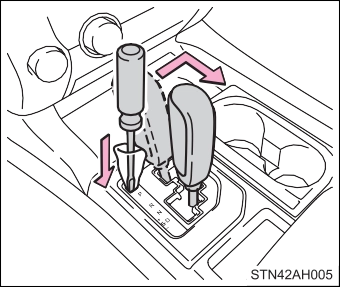
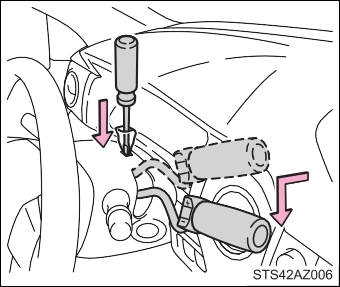
4 Pry the cover up with a flathead screwdriver or equivalent tool.
To prevent damage to the cover, cover the tip of the screwdriver with a rag.
Floor shift type Column-shift type
5 Press the shift lock override button.
The shift lever can be shifted while the button is pressed.
Floor shift type Column-shift type
This may indicate a malfunction in the automatic transmission system. Have the vehicle inspected by your Toyota dealer, immediately.
(In this situation, the transmission will operate in the same manner as when the shift lever is in D.)
To help ensure safety and driving performance, downshifting operation may sometimes be restricted. In some circumstances, downshifting may not be possible even when the shift lever is operated. (A buzzer will sound twice.)
If the tires spin continually when the vehicle becomes stuck in mud, dirt or snow, the automatic transmission temperature may become too high and cause damage.
To avoid the damaging the automatic transmission, the system may tempo- rarily lock the gear in 1st.
If the automatic transmission temperature falls, the gear locking is canceled and returns the automatic transmission to the normal operation.
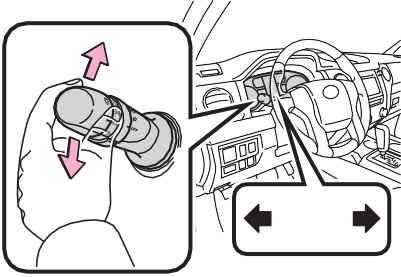 Lane change to the right (move the lever partway and release it)
The right hand signals will flash 3 times.
The left hand signals will flash 3 times.
The engine switch is in ON.
Check that a light bulb in the front or rear turn signal lights has not burned out.
(Depressing the pedal again releases the parking brake.)
P. 184
P. 332
Download Manual