Roadside Emergencies
To fully assist you should you have a vehicle concern, Ford Motor Company offers a complimentary roadside assistance program. This program is separate from the New Vehicle Limited Warranty.
The service is available:
24 hours a day, seven days a week.
For the coverage period listed on the Roadside Assistance Card included in your Owner's Manual portfolio.
Roadside Assistance covers:
A flat tire change with a good spare (except vehicles supplied with a tire inflation kit).
Battery jump start.
Lock-out assistance (key replacement cost is the customer's responsibility).
Fuel delivery — independent service contractors, if not prohibited by state, local or municipal law, shall deliver up to 2 gal (8 L) of gasoline or 5 gal (20 L) of diesel fuel to a disabled vehicle. Roadside Assistance limits fuel delivery service to two no-charge occurrences within a 12-month period.
Winch out — available within 100 ft (30 m) of a paved or county maintained road, no recoveries.
Towing — independent service contractors, if not prohibited by state, local or municipal law, shall tow Ford eligible vehicles to an authorized dealer within 35 mi (56 km) of the disablement location or to the nearest authorized dealer. If a member requests a tow to an authorized dealer that is more than 35 mi (56 km) from the disablement location, the member shall be responsible for any mileage costs in excess of 35 mi (56 km).
Roadside Assistance includes up to
$200 for a towed trailer if the disabled eligible vehicle requires service at the nearest authorized dealer. If the towing vehicle is operational but the trailer is not, then the trailer does not qualify for any roadside services.
Complete the roadside assistance identification card and place it in your wallet for quick reference. This card is in the owner's information portfolio in the glove compartment.
United States vehicle customers who require Roadside Assistance, call
1-800-241-3673.
If you need to arrange roadside assistance for yourself, Ford Motor Company reimburses a reasonable amount for towing to the nearest dealership within 35 mi (56 km). To obtain reimbursement information, United States vehicle customers call 1-800-241-3673.
Customers need to submit their original receipts.
231
To fully assist you should you have a vehicle concern, Ford Motor Company of Canada, Limited offers a complimentary roadside assistance program. This program is eligible within Canada or the continental United States.
This program is separate from the New Vehicle Limited Warranty, but the coverage is concurrent with the powertrain coverage period of your vehicle.
Canadian customers who require roadside assistance, call 1-800-665-2006.
Complete the roadside assistance identification card and place it in your wallet for quick reference.
In Canada, this card is found in the Warranty Guide in the glove compartment of your vehicle.
The service is available 24 hours a day, seven days a week.
Canadian roadside coverage and benefits may differ from the U.S. coverage.
If you require more information, please refer to the coverage section of your warranty guide, call us in Canada at
1-800-665-2006, or visit our website at www.ford.ca.
Note: The hazard flashers operate when the ignition is in any position, or if the key is not in the ignition. If used when the vehicle is not running, the battery loses charge. As a result, there may be insufficient power to restart your vehicle.
The flasher control is on the instrument panel. Use your hazard flashers when your
vehicle is creating a safety hazard for other motorists.
Press the flasher control and all front and rear direction indicators flash.
Press the button again to switch them off.
If your vehicle has been involved in a crash, have the fuel system checked.
 Failure to follow this instruction could result in fire, personal injury or death.
Note: When you try to restart your vehicle after a fuel shutoff, the vehicle makes sure that various systems are safe to restart.
Once the vehicle determines the systems are safe, then the vehicle allows you to restart.
Note: In the event that your vehicle does not restart after your third attempt, contact a qualified technician.
The fuel pump shutoff stops the flow of fuel to the engine in the event of a moderate to severe crash. Not every impact causes a shutoff.
Should your vehicle shut off after a crash, you may restart your vehicle.
232
Batteries normally produce explosive gases which can cause personal injury. Therefore, do not allow
flames, sparks or lighted substances to come near the battery. When working near the battery, always shield your face and protect your eyes. Always provide correct ventilation.
 Keep batteries out of reach of children. Batteries contain sulfuric acid. Avoid contact with skin, eyes or
clothing. Shield your eyes when working near the battery to protect against possible splashing of acid solution. In case of acid contact with skin or eyes, flush immediately with water for a minimum of 15 minutes and get prompt medical attention. If acid is swallowed, call a physician immediately.
 Use only adequately sized cables with insulated clamps.
Do not attempt to push-start your automatic transmission vehicle.
Note: Attempting to push-start a vehicle with an automatic transmission may cause transmission damage.
Note: Use only a 12-volt supply to start your vehicle.
Note: Do not disconnect the battery of the disabled vehicle as this could damage the vehicle electrical system.
Park the booster vehicle close to the hood of the disabled vehicle, making sure the two vehicles do not touch.
Do not connect the end of the second cable to the negative (-) terminal of the battery to be jumped.
A spark may cause an explosion of the gases that surround the battery.
 Do not use fuel lines, engine valve covers, windshield wiper arms, the intake manifold, or hood latch as
ground points.
Note: Do not attach the end of the positive cable to the studs or L-shaped eyelet located above the positive (+) terminal of your vehicle’s battery. High current may flow through and cause damage to the fuses.
Note: To avoid reverse polarity connections, make sure that you correctly identify the positive (+) and negative (-) terminals on both the disabled and booster vehicles before connecting the cables.
Note: Remove the red cap from the positive prong (B) on your vehicle before connecting the cables.
233
Remove the jumper cables in the reverse order that they were connected.
Note: In the illustration, the bottom vehicle represents the booster vehicle.
234
The system flashes the direction indicators and sounds the horn (intermittently) in the event of a serious impact that deploys an airbag (front, side, side curtain or Safety Canopy) or the seatbelt pretensioners.
The horn and indicators turn off when:
E143886
235
If you need to have your vehicle towed, contact a professional towing service or, if you are a member of a roadside assistance program, your roadside assistance service provider.
We recommend the use of a wheel lift and dollies or flatbed equipment to tow your vehicle. Do not tow with a slingbelt. Ford Motor Company has not approved a slingbelt towing procedure. Vehicle damage may occur if towed incorrectly, or by any other means.
Ford Motor Company produces a towing manual for all authorized tow truck operators. Have your tow truck operator refer to this manual for proper hook-up and towing procedures for your vehicle.
It is acceptable to have your front-wheel drive vehicle towed from the front if using proper wheel lift equipment to raise the front wheels off the ground. When towing in this manner, the rear wheels can remain on the ground.
Front-wheel drive vehicles must have the front wheels placed on a tow dolly when towing your vehicle from the rear using wheel lift equipment. This prevents damage to the transmission.
Towing an all-wheel or four-wheel drive vehicle requires that all wheels be off the ground, such as using a wheel lift and dollies or flatbed equipment. This prevents damage to the transmission, all-wheel or four-wheel drive system and vehicle.
Due to local market requirements in some countries, some vehicles may be equipped with a recovery hook.
If your vehicle is equipped with a screw-in recovery hook, it is with the spare tire kit or the rear under floor storage.
There is an installation point for the recovery hook located behind the fascia.
Note: The screw-in recovery hook has a left-hand thread. Turn it counterclockwise to install it. Make sure that the recovery hook is fully tightened.
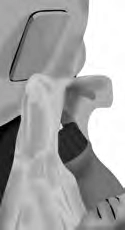
E188420
Remove the recovery hook cover by prying it off at the notch with a screwdriver or similar object.
Note: Use a soft cloth to cover the prying tool. This helps prevent scratch marks to the vehicle's paint.
236
Download Manual