Before driving
Driving the vehicle
P.194, 195
If the parking brake is in automatic mode, the parking brake is released automatically when shift- ing the shift lever to any position other than P. (P.205)
If the vehicle is to be stopped for an extended period of time, shift the shift lever to P. (P.199)
If parking on a hill, block the wheels as needed.
The hill-start assist control will acti- vate. (P.362)
layer of water between the tires and the road surface, preventing the steering and brakes from operating properly.
In the following conditions, the engine speed may become high while driving. This is due to auto- matic up-shifting control or down- shifting implementation to meet driv- ing conditions. It does not indicate sudden acceleration.
vate TRAC (P.362) to cancel Drive-Start Control so that the vehicle may be able to escape from the mud or fresh snow.
To extend the life of the vehicle, observing the following precautions is recommended:
Comply with the relevant vehicle registration laws and confirm the availability of the correct fuel. (P.660)
|
|
|
Observe the following precau- tions. Failure to do so may result in death or serious injury. When starting the vehicle
Always keep your foot on the brake pedal while stopped with the engine running. This prevents the vehicle from creeping. |
 WARNING

|
|
|
Things that must not be car- ried in the luggage compart- ment
The following things may cause a fire if loaded in the luggage com- partment: Receptacles containing gaso- line
Aerosol cans
Storage precautions
Observe the following precau- tions. Failure to do so may prevent the pedals from being depressed properly, may block the driver’s vision, or may result in items hit- ting the driver or passengers, pos- sibly causing an accident. Stow cargo and luggage in the luggage compartment when- ever possible.
Do not stack anything in the lug- gage compartment higher than the seatbacks.
Do not place cargo or luggage in or on the following locations.
At the feet of the driver
On the front passenger or rear seats (when stacking items)
On the luggage cover (if equipped)
On the instrument panel
On the dashboard
|
 WARNING
|
Secure all items in the occupant compartment.
When you fold down the rear seats, long items should not be placed directly behind the front seats.
Never allow anyone to ride in the luggage compartment. It is not designed for passengers. They should ride in their seats with their seat belts properly fastened. Otherwise, they are much more likely to suffer death or serious bodily injury, in the event of sudden braking, sud- den swerving or an accident.
|
(Cargo capacity) = (Total load capacity) - (Total weight of occu- pants)
Steps for Determining Cor- rect Load Limit -
For example, if the “XXX” amount equals 1400 lbs. and there will be five 150 lb passen- gers in your vehicle, the amount of available cargo and luggage load capacity is 650 lbs. (1400 - 750 (5 x 150) = 650 lbs.)

|
Calculation formula for your vehicle |
|
|
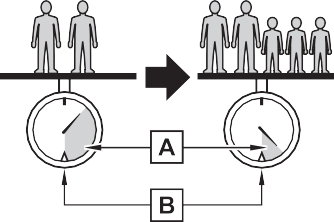
Cargo capacity
Total load capacity (vehicle capacity weight) (P.658)
When 2 people with the com- bined weight of A lb. (kg) are rid- ing in your vehicle, which has a total load capacity (vehicle capacity weight) of B lb. (kg), the available amount of cargo and luggage load capacity will be C lb. (kg) as follows:
B*2 lb. (kg) - A*1 lb. (kg) = C*3 lb. (kg)
*1: A = Weight of people
*2: B = Total load capacity
*3: C = Available cargo and luggage load
In this condition, if 3 more passen- gers with the combined weight of D lb. (kg) get on, the available cargo and luggage load will be reduced E lb. (kg) as follows:
*4: D = Additional weight of people
*5: E = Available cargo and luggage
load
|
|
|
When loading cargo on the roof luggage carrier (if equipped)
Observe the following precau- tions: Place the cargo so that its weight is distributed evenly between the front and rear axles.
If loading long or wide cargo, never exceed the vehicle overall length or width. (P.658)
Before driving, make sure the cargo is securely fastened on the roof luggage carrier.
Loading cargo on the roof lug- gage carrier will make the cen- ter of gravity of the vehicle higher. Avoid high speeds, sud- den starts, sharp turns, sudden braking or abrupt maneuvers, otherwise it may result in loss of control or vehicle rollover due to failure to operate this vehicle correctly and result in death or serious injury.
|
 WARNING
 Vehicle load limits 
These details are also described on the tire and loading information label. (P.585)
Check that the following conditions are met:
Do not drive if the trailer is not level, and check for improper tongue weight, overloading, worn suspension, or other possible causes.
’ Vehicles without towing pack- age
’ Vehicles with towing package
|
|
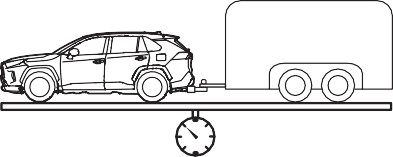
The maximum allowable gross vehicle weight. The gross vehi- cle weight is the total weight of the vehicle. When towing a trailer, it is the sum of the vehicle weight (including the occu- pants, cargo and any optional equipment installed on the vehi- cle) and the tongue weight.
’ Vehicles without towing pack- age
|
|
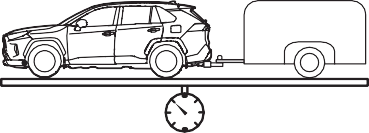
’ Vehicles with towing package
The maximum allowable gross axle weight. The gross axle weight is the load placed on each axle (front and rear).
’ Vehicles without towing pack- age
Front GAWR Rear GAWR
’ Vehicles with towing package
Front GAWR Rear GAWR
The maximum allowable gross trailer weight. The gross trailer weight is the sum of the trailer weight and the weight of the cargo in the trailer.
TWR is calculated assuming base vehicle with one driver, one front passenger, towing package (if available), hitch and hitch systems (if required).
Additional optional equipment, pas- sengers and cargo in the vehicle will reduce the trailer weight rating so as not to exceed GCWR, GVWR and GAWR.
Vehicles with towing package: If the gross trailer weight exceeds 3000 lb. (1360 kg), it is recommended to use a trailer with 2 or more axles.
(With brakes)
’ Vehicles with towing package
(With brakes)
The trailer weight rating for tow- ing a trailer without a trailer ser- vice brake system.
(Without brakes)
The load placed on the trailer hitch ball. (P.188)
’ Vehicles without towing pack- age
’ Vehicles with towing package
|
Weight limits |
’ Without towing package 1500 lb. (680 kg)
’ With towing package 3500 lb. (1590 kg)
’ Without towing package Vehicles without Dynamic Torque
Vectoring AWD system: 6110 lb. (2770 kg)
Vehicles with Dynamic Torque Vec- toring AWD system: 6205 lb. (2815 kg)
’ With towing package 8205 lb. (3725 kg)
Confirm that the gross trailer weight, gross combination
weight, gross vehicle weight, gross axle weight and tongue weight are all within the limits.
’ Without towing package
Vehicles without Dynamic Torque Vectoring AWD system: 6110 lb. (2770 kg)
Vehicles with Dynamic Torque Vectoring AWD system: 6205 lb. (2815 kg)
’ With towing package 8205 lb. (3725 kg)
*: These models meet the tow-vehi- cle trailering requirement of SAE International per SAE J2807.
’ With towing package 3500 lb. (1590 kg)
*: These models meet the tow-vehi- cle trailering requirement of SAE International per SAE J2807.
*: These models meet the tow-vehi- cle trailering requirement of SAE International per SAE J2807.
|
Trailer Tongue Weight |
The gross trailer weight should be distributed so that the tongue weight is 9% to 11%.
(Tongue weight /Gross trailer weight x 100 = 9% to 11%)
Gross trailer weight Tongue weight
’ Vehicles with towing package
The gross trailer weight, gross
axle weight and tongue weight
can be measured with platform scales found at a highway weighing station, building supply company, trucking company, junk yard, etc.
|
Hitch |
Trailer hitch assemblies have different weight capacities. Toy- ota recommends the use of Toy- ota hitch/bracket for your vehicle. For details, contact your Toyota dealer.
|
|
|
Hitch
Trailer hitch assemblies have dif- ferent weight capacities estab- lished by the hitch manufacturer. Even though the vehicle may be physically capable of towing a higher weight, the operator must determine the maximum weight rating of the particular hitch assembly and never exceed the maximum weight rating specified for the trailer-hitch. Exceeding the maximum weight rating set by the trailer-hitch manufacturer can cause an accident resulting in death or serious personal injuries. |
 WARNING
|
|
|
When installing a trailer hitch
Use only the position recom- mended by your Toyota dealer. Do not install the trailer hitch on the bumper; this may cause body damage. |
 NOTICE
Use the correct trailer ball for your application.
Trailer ball load rating
Matches or exceeds the gross trailer weight rating of the trailer.
Protrudes beyond the bottom of the lock washer and nut by at least 2 threads.
Matches the ball mount hole diame- ter size.
Matches the size of the trailer cou- pler. Most couplers are stamped with the required trailer ball size.
Hitch receiver pin hole posi- tion: 38.1 in. (969 mm)
No matter which class of tow hitch applies, for a more safe trailer hookup, the trailer ball setup must
be the proper height for the coupler on the trailer.
Coupler Trailer ball

Your vehicle will handle differ- ently when towing a trailer. Help
to avoid an accident, death or serious injury, keep the following in mind when towing:
left. Move your hand to the right to move the trailer to right. (This is generally oppo- site to reversing without a trailer attached.) Avoid sharp or prolonged turning. Have someone guide you when reversing to reduce the risk of an accident.
Increasing vehicle speed can destabilize the trailer.
tioning (if in use), pull your vehicle off the road and stop in a safe spot. (P.653)
parking. Apply the parking
brake firmly, and put the transmission in P. Avoid park- ing on a slope, but if unavoid- able, do so only after performing the following:
If your vehicle is new or equipped with any new power train compo- nents (such as an engine, transmis- sion, differential or wheel bearing), Toyota recommends that you do not tow a trailer until the vehicle has been driven for over 500 miles (800 km).
After the vehicle has been driven for over 500 miles (800 km), you can start towing. However, for the next 500 miles (800 km), drive the vehi- cle at a speed of less than 45 mph (72 km/h) when towing a trailer, and avoid full throttle acceleration.
One or more factors (crosswinds, passing vehicles, rough roads, etc.) can adversely affect handling of your vehicle and trailer, causing instability.
Do not try to control trailer sway- ing by turning the steering wheel.
Do not increase speed. Do not apply vehicle brakes.
If you make no extreme correction with the steering or brakes, your vehicle and trailer should stabilize (if enabled, Trailer Sway Control can also help to stabilize the vehicle and trailer.).
Make sure the tongue weight is appropriate, if possible.
If you cannot find any problems, the speed at which trailer swaying occurred is beyond the limit of your particular vehicle-trailer combina- tion. Drive at a lower speed to pre- vent instability. Remember that swaying of the towing vehicle-trailer increases as speed increases.
Download Manual