STARTING THE ENGINE — GAS ENGINE
Before starting your vehicle, adjust your seat, adjust both inside and outside mirrors, and fasten your seat belt.
The starter should not be operated for more than 10-second intervals. Waiting a few seconds between such intervals will protect the starter from overheating.
|
WARNING! |
|
When leaving the vehicle, always make sure the keyless ignition node is in the "OFF" mode, remove the key fob from the vehicle and lock the vehicle.
Never leave children alone in a vehicle, or with access to an unlocked vehicle. Allowing children to be in a vehicle unat- tended is dangerous for a number of reasons. A child or others could be seriously or fatally injured. Children should be warned not to touch the parking brake, brake pedal or the gear selector.
|
|
WARNING! |
|
Do not leave the key fob in or near the vehicle, or in a location accessible to chil- dren, and do not leave the ignition of a vehicle equipped with Keyless Enter-N-Go in the ACC or ON/RUN mode. A child could operate power windows, other controls, or move the vehicle.
Do not leave children or animals inside parked vehicles in hot weather. Interior heat build-up may cause serious injury or death.
|
Start the engine with the transmission in PARK position. Apply the brake before shifting into any driving range.
Do not press the accelerator. Cycle the ignition switch briefly to the START position and release 5 it. The starter motor will continue to run and will automatically disengage when the engine is running.
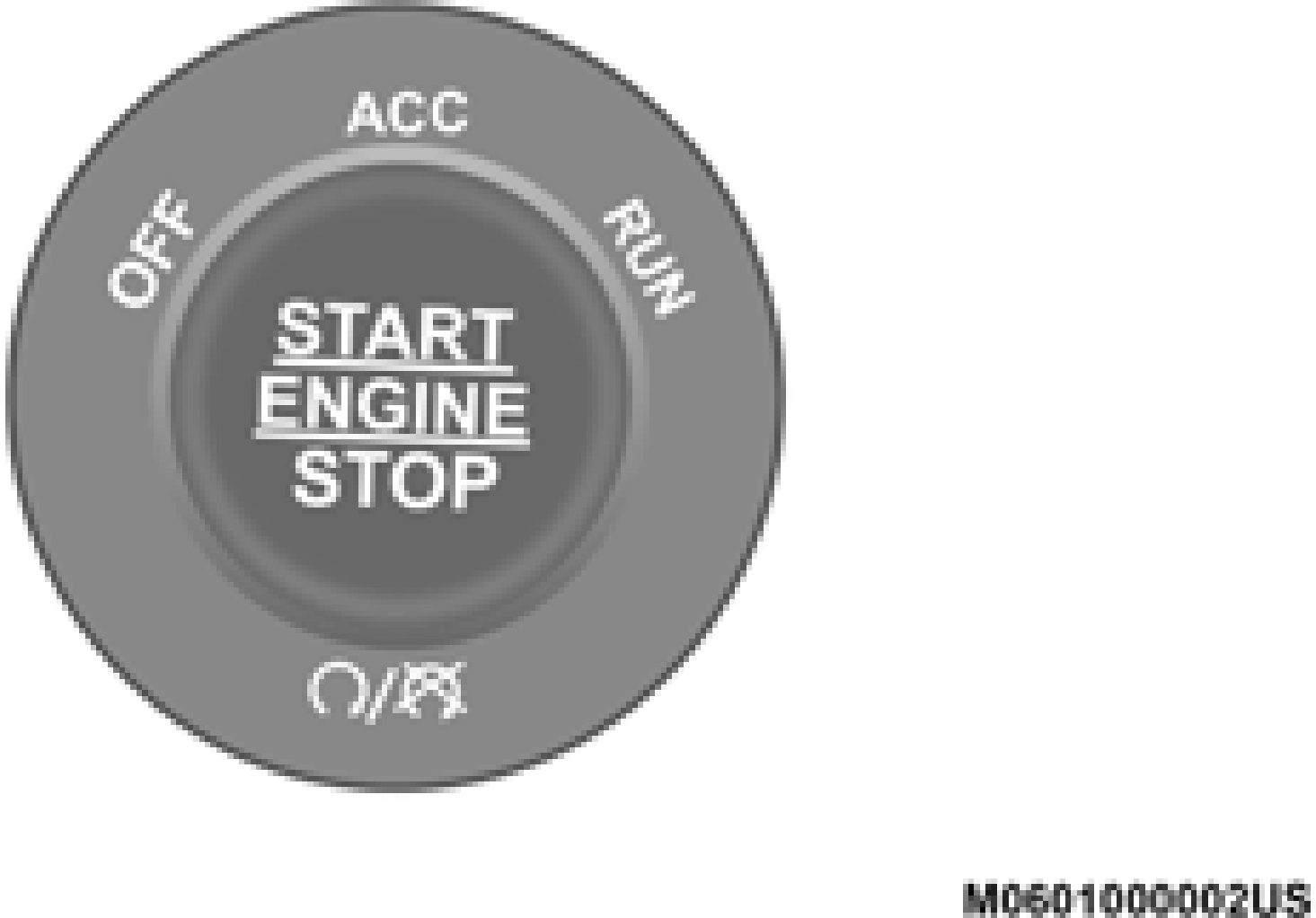
Keyless Push Button Ignition
This feature allows the driver to operate the igni- tion switch with the push of a button, as long as the Remote Start/Keyless Enter-N-Go key fob is in the passenger compartment.
Normal starting of either a cold or a warm engine is obtained without pumping or pressing the accelerator pedal.
If the gear selector is not in PARK, and the ENGINE START/STOP button is pushed once with the vehicle speed below 5 mph (8 km/h), the engine will shut off and the ignition will remain in the ACC position. If vehicle speed drops below 1.2 mph (1.9 km/h), the vehicle may AutoPark. See AutoPark section for further details.
The ENGINE START/STOP button operates similar to an ignition switch. It has three modes: OFF, ACC, and RUN. To change the ignition modes without starting the vehicle and use the accessories, follow these directions:
AutoPark is a supplemental feature to assist in placing the vehicle in PARK should the situa- tions on the following pages occur. It is a back up system and should not be relied upon as the primary method by which the driver shifts the vehicle into PARK.
The conditions under which AutoPark will If the vehicle is not in PARK and the driver turns engage are outlined on the following pages. off the engine, the vehicle may AutoPark.
AutoPark will engage when all of these condi- tions are met:
For Keyless Enter-N-Go equipped vehicles, The AutoPark will engage when all of these condi- tions are met:
In some cases the ParkSense graphic will be displayed in the instrument cluster, causing the engine will turn off and the ignition switch will change to ACC mode. After 30 minutes the igni- tion switches to OFF automatically, unless the driver turns the ignition switch OFF.
“AutoPark Engaged Shift to P then Shift to Gear” to not be seen. In these cases, the shifter must be returned to “P” to select desired gear.
AutoPark will engage ONLY when vehicle speed is 1.2 mph (1.9 km/h) or less.
The message “Vehicle Speed is Too High to Shift to P” will be displayed in the instrument cluster if vehicle speed is above 1.2 mph (1.9 km/h).
|
WARNING! |
|
If vehicle speed is above 1.2 mph (1.9 km/h), the transmission will default to NEUTRAL until the vehicle speed drops below 1.2 mph (1.9 km/h). A vehicle left in the NEUTRAL position can roll. As an added precaution, always apply the parking brake when exiting the vehicle. |
AutoPark will be disabled when operating the vehicle in 4WD LOW.
The message “AutoPark Disabled” will be displayed in the instrument cluster.
ALWAYS DO A VISUAL CHECK that your vehicle is in PARK by looking for the “P” in the Instru- ment Cluster Display and near the shifter. As an added precaution, always apply the parking brake when exiting the vehicle.
If Engine Fails To Start If the engine fails to start after you have followed the “Normal Starting” procedure, it may be flooded. Push the accelerator pedal all the way to the floor and hold it there while the engine is cranking. This should clear any excess fuel in case the engine is flooded.
The starter motor will engage automatically, run for 10 seconds, and then disengage. Once this occurs, release the accelerator pedal and the brake pedal, wait 10 to 15 seconds, then repeat the “Normal Starting” procedure.
|
WARNING! |
|
Never pour fuel or other flammable liquid into the throttle body air inlet opening in an attempt to start the vehicle. This could result in flash fire causing serious personal injury.
Do not attempt to push or tow your vehicle to get it started. Vehicles equipped with an automatic transmission cannot be started this way. Unburned fuel could enter the catalytic converter and once the engine has started, ignite and damage the converter and vehicle.
If the vehicle has a discharged battery, booster cables may be used to obtain a start from a booster battery or the battery in another vehicle. This type of start can be dangerous if done improperly. Refer to “Jump Starting Procedure” in “In Case Of Emergency” for further information.
|
|
CAUTION! |
|
To prevent damage to the starter, do not crank the engine for more than 10 seconds at a time. Wait 10 to 15 seconds before trying again. |
If the engine has been flooded, it may start to run, but not have enough power to continue running when the ignition button/key is released. If this occurs, continue cranking with the accelerator pedal pushed all the way to the floor. Release the accelerator pedal and the ignition button/key once the engine is running smoothly.
If the engine shows no sign of starting after a 10 second period of engine cranking with the accelerator pedal held to the floor, wait 10 to 15 seconds, then repeat the “Normal Starting” procedure.
To ensure reliable starting at these tempera- tures, use of an externally powered electric engine block heater (available from your autho- rized dealer) is recommended. The idle speed is controlled automatically, and it will decrease as the engine warms up.
Download Manual