Transmission
Note: Failure to fully press the clutch pedal to the floor may cause increased shift efforts, prematurely wear transmission components or damage the transmission.
Note: Do not drive with your foot resting on the clutch pedal or use the clutch pedal to hold your vehicle at a standstill while waiting on a hill. These actions will reduce the life of the clutch and could nullify a clutch warranty claim.
E144954
Manual transmission vehicles have a starter interlock that prevents cranking the engine unless the clutch pedal is fully pressed.
To start your vehicle:
During each shift, the clutch pedal must be fully pressed to the floor. Make sure the floor mat is properly positioned so it doesn't interfere with the full extension of the clutch pedal.
Note: Do not downshift into first (1) when your vehicle is moving faster than 15 mph (24 km/h). This will damage the clutch.
|
Recommended upshifts (for best fuel economy) when accelerating |
|
|
Shift from: |
|
|
1 - 2 |
15 mph (24 km/h) |
|
2 - 3 |
26 mph (42 km/h) |
|
3 - 4 |
38 mph (61 km/h) |
|
4 - 5 |
42 mph (67 km/h) |
|
5 - 6 |
50 mph (80 km/h) |
Note: Make sure that your vehicle is at a complete stop before you shift into reverse (R). Failure to do so may damage the transmission.
140
E99067
Note: The gearshift lever can only be moved to reverse (R) by raising the collar below the gearshift knob up before shifting to reverse. This is a lockout feature which protects the transmission from accidentally engaging reverse (R) when intending to select first (1).
If reverse (R) is not fully engaged, press the clutch pedal down and return the gearshift to the neutral position. Release the clutch pedal for a moment, then raise the collar and shift to reverse (R) again.
Always set the parking brake fully and make sure you shift the gearshift lever to first gear. Switch the ignition
off and remove the key whenever you leave your vehicle.
To park your vehicle:
Note: Failure to fully depress the clutch pedal to the floor may cause increased shift efforts, prematurely wear transmission components or damage the transmission.
Note: Do not drive with your foot resting on the clutch pedal or use the clutch pedal to hold your vehicle at a standstill while waiting on a hill. These actions will reduce the life of the clutch and could nullify a clutch warranty claim.
E157512
Manual transmission vehicles have a starter interlock that prevents cranking the engine unless the clutch pedal is fully depressed.
 Pedals that cannot move freely can cause loss of vehicle control and increase the risk of serious personal
injury.
1. Make sure the parking brake is fully set and shift the gearshift lever to the neutral position.
141
During each shift, make sure you fully depress the clutch pedal.
Note: Do not shift the gearshift lever to first gear when your vehicle is moving faster than 14 mph (23 km/h). This will damage the clutch.
We recommend you change gear according to the following guide to achieve the best fuel economy for your vehicle.
|
Shift from |
Recommended speed |
|
1 - 2 |
14 mph (23 km/h) |
|
2 - 3 |
24 mph (38 km/h) |
|
3 - 4 |
32 mph (51 km/h) |
|
4 - 5 |
44 mph (71 km/h) |
Note: Do not shift the gearshift lever to reverse gear when your vehicle is moving. This can cause damage to the transmission.
If reverse gear is not fully engaged, press the clutch pedal down and shift the gearshift lever to the neutral position.
Release the clutch pedal for a moment, depress the clutch again and shift the gearshift lever to reverse.
 Always set the parking brake fully and make sure you shift the gearshift lever to first gear. Switch the ignition
off and remove the key whenever you leave your vehicle.
To park your vehicle:
Always set the parking brake fully and latch the gearshift in park (P).
 Turn the ignition to the off position and remove the key whenever you leave your vehicle.
 Do not apply the brake pedal and accelerator pedal simultaneously.
Applying both pedals simultaneously for more than three seconds will limit engine rpm, which may result in difficulty maintaining speed in traffic and could lead to serious injury.
142
The PowerShift™ 6-speed, dual-clutch automatic transmission is designed to offer drivers both enhanced fuel efficiency and fun to drive performance. This transmission’s dual-clutch technology uses electronically shifted clutches to operate two separate transmissions all in a small lightweight package.
Since the clutch and gear operation is derived from a manual transmission, the PowerShift automatic transmission will drive, sound, and feel similar to manual transmission minus the required
user-inputs. For example, the transmission may exhibit mechanical noises, firm gear shifts and/or light clutch vibrations when accelerating slowly as the clutches automatically engage. These are all considered to be normal and expected driving characteristics.
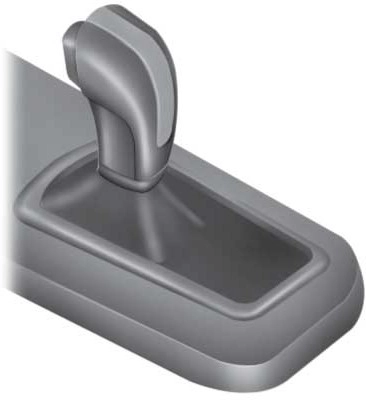 Move the gearshift lever and securely latch it in park (P).
E142628
This position locks the transmission and prevents the wheels from turning.
With the gearshift lever in reverse (R), your vehicle moves backward. Always come to a complete stop before shifting into and out of reverse (R).
With the gearshift lever in neutral (N), your vehicle can be started and is free to roll. Hold the brake pedal down while in this position.
Drive (D) is the normal driving position for the best fuel economy. The overdrive function allows automatic upshifts and downshifts through gears one through six.
Moving the gearshift lever to sport (S):
SelectShift Automatic™ Transmission (If Equipped)
Your vehicle is equipped with a SelectShift Automatic transmission gearshift lever.
The SelectShift Automatic transmission gives you the ability to change gears up or down (without a clutch) as desired.
143
In order to prevent the engine from running at too low an RPM, which may cause it to stall, SelectShift still automatically makes some downshifts if it has determined that you have not downshifted in time.
Although SelectShift makes some downshifts for you, it still allows you to downshift at any time as long as the SelectShift determines that damage will not be caused to the engine from
over-revving.
Note: Engine damage may occur if you maintain excessive engine revving without shifting.
SelectShift does not automatically upshift, even if the engine is approaching the RPM limit. It must be shifted manually by pressing the + button.
• Press the (+) button to upshift.
• Press the (-) button to downshift.
E142629
With your vehicle in drive (D), the paddle shifters provide temporary manual control. They allow you the ability to shift gears quickly, without taking your hands off the steering wheel.
You can achieve extensive manual control by moving the gearshift lever to the sport
(S) position.
• Pull the right paddle (+) to upshift.
• Pull the left paddle (-) to downshift.
E144821
The system determines when temporary manual control is no longer in use and returns to automatic control.
Upshift to the recommended shift speeds according to the following chart:
|
Upshifts when accelerating (recom- mended for best fuel economy) |
|
|
Shift from: |
|
|
1 - 2 |
15 mph (24 km/h) |
|
2 - 3 |
25 mph (40 km/h) |
|
3 - 4 |
40 mph (64 km/h) |
|
4 - 5 |
45 mph (72 km/h) |
|
5 - 6 |
50 mph (80 km/h) |
The instrument cluster displays your currently selected gear.
Note: The system stays in manual control until you make another shift selection (for example, drive [D]).
144
 Do not drive your vehicle until you verify that the brake lamps are working.
 When doing this procedure, you will be taking your vehicle out of park (P) which means your vehicle can roll
freely. To avoid unwanted vehicle movement, always fully set the parking brake prior to doing this procedure. Use wheel chocks if appropriate.
 If you fully release the parking brake and the brake warning lamp remains illuminated, the brakes may not be
working properly. See your authorized dealer.
Note: For some markets this feature will be disabled.
Your vehicle is equipped with a brake-shift interlock feature that prevents moving the gearshift lever from park (P) when the ignition is in the on position and the brake pedal is not pressed.
If you cannot move the gearshift lever out of park (P) position with the ignition in the on position and the brake pedal pressed, a malfunction may have occurred. It is possible that a fuse has blown or your vehicle’s brake lamps are not operating properly. See Fuse Specification Chart (page 200).
If the fuse is not blown and the brake lamps are working properly, the following procedure will allow you to move the gearshift lever from park (P):
E155984
E155983
145
This feature may increase durability and provide consistent shift feel over the life of your vehicle. A new vehicle or transmission may have firm shifts, soft shifts or both. This operation is considered normal and does not affect function or durability of the transmission. Over time, the adaptive learning process fully updates transmission operation.
Note: Do not rock the vehicle if the engine is not at normal operating temperature or damage to the transmission may occur.
Note: Do not rock the vehicle for more than a minute or damage to the transmission and tires may occur, or the engine may overheat.
If your vehicle gets stuck in mud or snow, you may rock it out by shifting between forward and reverse gears, stopping between shifts in a steady pattern. Press lightly on the accelerator in each gear.
146
Download Manual