Driving Aids
DRIVER ALERT (IF EQUIPPED)
|
|
 WARNING: The system is designed to aid the driver. It is not intended to replace your attention and judgment. You are still responsible to drive with due care and attention.
 WARNING: At all times, you are responsible for controlling your vehicle, supervising the system and intervening, if required. Failure to take care may result in the loss of control of your vehicle, serious personal injury or death.
 WARNING: The system may not function if the sensor is blocked.
 WARNING: Take regular rest breaks if you feel tired. Do not wait for the system to warn you.
 WARNING: Certain driving styles may result in the system warning you even if you are not feeling tired.
 WARNING: In cold and severe weather conditions the system may not function. Rain, snow and spray can all limit sensor performance.
 WARNING: The system will not operate if the sensor cannot track the road lane markings.
 WARNING: If damage occurs in the immediate area surrounding the sensor, have your vehicle checked as soon as possible.
 WARNING: The system may not correctly operate if your vehicle is fitted with a suspension kit not approved by us.
249
Note: Keep the windshield free from obstructions. For example, bird droppings, insects and snow or ice.
Note: If the camera is blocked or if the windshield is damaged, the system may not function.
Note: The system remembers the last setting when you start your vehicle, unless a MyKey™ is detected.
Note: If enabled in the menu, the system activates at speeds above 40 mph
(64 km/h).
E249505
The system automatically monitors your driving behavior using various inputs including the front camera sensor.
If the system detects that your driving alertness is reduced below a certain threshold, the system will alert you using a chime and a message in the information display.
You may switch the system on or off through the information display by selecting Settings then Driver Assist then Driver Alert in the menu. When activated, the system will monitor your alertness level based upon your driving behavior in relation to the lane markings, and other factors.
Note: The system will not issue warnings below approximately 40 mph (64 km/h).
The warning system is in two stages. At first the system issues a temporary warning that you need to take a rest. This message will only appear for a short time. If the system detects further reduction in driving alertness, another warning may be issued which will remain in the information display for a longer time. Press OK on the steering wheel control to clear the warning. When active the system will run automatically in the background and only issue a warning if required.
You can reset the system by either:
• Switching the ignition off and on.
• Stopping the vehicle and then opening and closing the driver’s door.
LANE KEEPING SYSTEM (IF EQUIPPED)


|
|
 WARNING: In cold and severe weather conditions the system may not function. Rain, snow and spray can all limit sensor performance.
 WARNING: The system will not operate if the sensor cannot track the road lane markings.
 WARNING: The sensor may incorrectly track lane markings as other structures or objects. This can result in a false or missed warning.
 WARNING: Large contrasts in outside lighting can limit sensor performance.
 WARNING: The system may not operate properly if the sensor is blocked. Keep the windshield free from obstruction.
 WARNING: If damage occurs in the immediate area surrounding the sensor, have your vehicle checked as soon as possible.
 WARNING: The system may not correctly operate if your vehicle is fitted with a suspension kit not approved by us.
Note: The system works as long as the camera can detect one lane marking at a speed above 40 mph (64 km/h).
Note: The system may not function with a blocked camera, or if the windshield is damaged or dirty.
250
Sensitivity: This setting allows you to select where in the lane a warning is provided. Increasing the sensitivity setting moves the warning zones in closer to your vehicle.
E249505
When you switch the system on and it detects an unintentional drift out of your lane is likely to occur, the system notifies or assists you to stay in your lane through the steering system and information display. The system provides an audible warning and by vibrating the steering wheel.
Note: The system on or off setting is stored until it is manually changed, unless a MyKey is detected. If the system detects a MyKey, it defaults to on and the mode is set to alert.
Note: If a MyKey is detected, pressing the button does not affect the on or off status of the system. You can only change the mode and intensity settings.
Press the button to switch the system on or off. The button is above the audio unit or on the
center console.
The system sensitivity and intensity can be adjusted through the display screen. See General Information (page 112). The system remembers the last selection. You do not need to readjust the setting each time you turn on your vehicle.
Note: The alert diagram illustrates general zone coverage. It does not provide exact zone parameters.
Intensity: This setting affects the intensity of the steering wheel vibration. Increasing the intensity causes a higher rate of haptic feedback.
• High.
• Normal.
• Low.
251
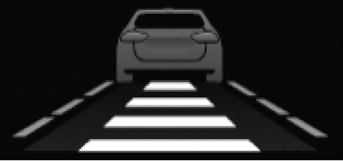
E233874
When you switch on the system, a graphic with lane markings appears in the display screen.
Note: The overhead vehicle graphic may still display if adaptive cruise control is enabled.
While the system is on, the color of the lane markings change to indicate the system status.
Gray: Indicates that the system is temporarily unable to provide a warning on the indicated side(s). This may be because:
• Your vehicle is under the activation speed.
• The direction indicator is active.
• Your vehicle is in a dynamic maneuver.
• The road has no or poor lane markings in the camera field-of-view.
• The camera is obscured or unable to detect the lane markings due to environmental, traffic or vehicle conditions. For example, significant sun angles, shadows, snow, heavy rain or fog, following a large vehicle that is blocking or shadowing the lane or poor headlamp illumination.
See Troubleshooting for additional information.
Green: Indicates that the system is available or ready to provide a warning on the indicated side(s).
Red: Indicates that the system is providing or has just provided a lane keeping alert warning.
You can temporarily disable the system at any time by doing the following:
• Quick braking.
• Fast acceleration.
• Using your direction indicator.
• Evasive steering maneuver.
• Driving too close to the lane markings.
|
Why is the feature not available (line markings are gray) when I can see the lane markings on the road? |
|
Your vehicle speed is outside the operational range of the feature. |
|
The sun is shining directly into the camera lens. |
|
A quick intentional lane change has occurred. |
|
Your vehicle stays too close to the lane markings. |
|
Driving at high speeds in curves. |
252
|
Why is the feature not available (line markings are gray) when I can see the lane markings on the road? |
|
The last feature activation occurred a short time ago. |
|
Ambiguous lane markings, for example in construction zones. |
|
Rapid transition from light to dark, or from dark to light. |
|
Sudden offset in lane markings. |
|
ABS or AdvanceTrac™ is active. |
|
There is a camera blockage due to dirt, grime, fog, frost or water on the windshield. |
|
You are driving too close to the vehicle in front of you. |
|
Transitioning between no lane markings to lane markings or vice versa. |
|
There is standing water on the road. |
|
Faint lane markings, for example partial yellow lane markings on concrete roads. |
|
Lane width is too narrow or too wide. |
|
The camera has not been calibrated after a windshield replacement. |
|
Driving on tight roads or on uneven roads. |
|
Vehicle accessories are blocking the camera, for example a snow plow. |
BLIND SPOT INFORMATION SYSTEM (IF EQUIPPED)
|
|
 WARNING: Do not use the blind spot information system as a replacement for using the interior and exterior mirrors or looking over your shoulder before changing lanes. The blind spot information system is not a replacement for careful driving.
253
E227388
The Blind Spot Information System is designed to aid you in detecting vehicles that may have entered the blind spot zone (A). The detection area is on both sides of your vehicle, extending rearward from the exterior mirrors to approximately 13 ft
(4 m) beyond the bumper. The system is designed to alert you if certain vehicles enter the blind spot zone while driving.
Note: The Blind Spot Information System does not prevent contact with other vehicles or objects; nor detect parked vehicles, people, animals or infrastructure (fences, guardrails, trees). It is only designed to alert you to moving vehicles in the blind spot zones.
Note: When a vehicle passes quickly through the blind spot zone, typically fewer than two seconds, the system does not trigger.
The Blind Spot Information System turns on when you start the engine and you drive your vehicle forward above 5 mph
(8 km/h).
For automatic transmissions, the Blind Spot Information System remains on while the transmission is in drive (D). If shifted into reverse (R) or park (P) the Blind Spot Information System turns off. Once shifted back into drive (D), the Blind Spot Information System turns back on when you drive your vehicle above 5 mph
(8 km/h).
Note: For automatic transmissions, the Blind Spot Information System does not function in reverse (R) or park (P).
For manual transmissions, the Blind Spot Information System is on for all gears except reverse (R).
E142442
The Blind Spot Information System illuminates an amber alert indicator in the outside mirror on the side of your vehicle the approaching vehicle is coming from. When the Blind Spot Information System is alerting on a vehicle and the corresponding turn signal is ON, the Blind Spot Information System alert indicator flashes as an increased warning level.
The alert indicator dims when the system detects nighttime darkness.
Note: The alert indicator flashes in case of an alert and the turn signal is set to that side at the same time.
254
The system uses radar sensors that are located inside the tail lamp on each side of your vehicle. Any dirt, mud and snow in front of the sensors or driving in heavy rain can cause system degradation. Also, other types of obstructions in front of the sensor can cause system degradation. This is referred to as a ‘blocked’ condition.
Note: Do not apply bumper stickers and/or repair compound to these areas, this can cause degraded system performance.
If the system detects a degraded performance condition, a message warning appears in the display screen. The alert indicators remain ON and the system no longer provides any warnings. You can clear the warning but the alert indicators remain illuminated.
A "blocked" condition can be cleared in two ways:
• After the blockage in front of the sensors is removed or the rainfall/snowfall rate decreases or stops, drive for a few minutes in traffic to allow the sensors to detect passing vehicles.
• By cycling the ignition from ON to OFF and then back ON.
Note: If your vehicle has a tow bar with a factory equipped trailer tow module and it is towing a trailer, the sensors will automatically turn the Blind Spot Information System off. If your vehicle has a tow bar but no factory equipped trailer tow module, it is recommended to turn the Blind Spot Information System off manually. Operating the Blind Spot Information System without the Blind Spot Trailer Tow package and a trailer attached will cause poor system performance.
The Blind Spot Information System with Trailer Tow is designed to aid you in detecting vehicles that may have entered the detection area zone (A). The detection area is on both sides of your vehicle and trailer, extending rearward from the exterior mirrors to the end of your trailer.
When a trailer is attached and the customer has set up a Blind Spot Trailer, the Blind Spot Information System with Trailer Tow becomes active when driving forward above 6 mph (10 km/h). See Trailer Reversing Aids (page 275).
The Blind Spot Information System with Trailer Tow can be turned off in the instrument cluster. If the Blind Spot Information System is turned off, then the Blind Spot Information System with Trailer Tow automatically turns off.
255
You can set-up any trailer to work with the Blind Spot Information System with Trailer Tow through the instrument cluster menu. See General Information (page 112).
While setting up a trailer, a sequence of screens appear asking for trailer information. The Blind Spot Information System with Trailer Tow specific screens are described below:
• Select type of trailer screen - Conventional, fifth wheel or gooseneck.
The Blind Spot Information System with Trailer Tow only supports conventional trailers. If fifth wheel or gooseneck is selected, the system automatically turns off.
• Do you want to set up BLIS with trailer screen?
If no, the Blind Spot Information System turns off.
If yes, the menu goes to the next screen.
• Is the width less than 9 ft (2.7 m) and length less than 33 ft (10.1 m)?
If no, the Blind Spot Information System turns off.
If yes, the menu goes to the next screen.
• Trailer width measurement:
The width of the trailer is measured at the front of the trailer. It is not measured at the widest point of the trailer. The maximum width at the front of the trailer that the Blind Spot Information System with Trailer Tow can support is 8.5 ft (2.6 m).
Note: You do not need to enter an exact trailer width measurement; just measure that it is 8.5 ft (2.6 m) or less.
• Trailer length measurement:
The trailer length is the distance between the trailer hitch ball and the rear of the trailer. The maximum length that the Blind Spot Information System with Trailer Tow can support is 33 ft (10.1 m).
• Enter length of trailer:
The default setting is 18 ft (5.5 m). Toggling up or down using the menu buttons will increase/decrease the measurement by 3 ft (1 m). Select the length so that the value is equal to or within 3 ft (1 m) of the actual measured length. For example, if the actual measured length is 25 ft (7.6 m), then toggle the length in the menu to 27 ft (8.2 m). When the length has been entered, the Blind Spot Information System with Trailer Tow setup is saved.
If you do not set up a Blind Spot Trailer, a warning appears in the instrument cluster when a trailer is connected stating that the system has been turned off due to a trailer connect.
Note: If the trailer is actually a bike rack or cargo rack with electrical lighting, then the length will be 3 ft (1 m). Cross Traffic Alert will remain on for trailers 3 ft (1 m) or less.
Note: Proper measurement and measurement entry is required for Blind Spot Information System with Trailer Tow to function as designed.
256
If you select a trailer in the display screen prior to connecting the trailer, the system will load that configuration and the information cluster displays a message when the trailer is connected. A second message appears stating Cross Traffic Alert has been turned off; the Blind Spot Information System with Trailer Tow still functions normally when driving forward.
If no trailer has been set up and a trailer is connected, the instrument cluster provides a message indicating a trailer is connected followed by a message asking to select a trailer from the existing list of trailers or to add a trailer. In order for the Blind Spot Information System with Trailer Tow to function, an existing trailer must be selected or a new trailer must be added. If the request is ignored or if you exit the screen, a message appears prompting you that the system has been turned off due to a trailer connect. This message may not appear until your vehicle speed reaches 22 mph (35 km/h).
The Blind Spot Information System with Trailer Tow activates when driving forward for that particular trailer set up. If the ignition is cycled, the Blind Spot Information System with Trailer Tow continues to function using the last trailer selected.
The Blind Spot Information System with Trailer Tow is designed to work with any trailer whose front width is 8.5 ft (2.6 m) or less and total length from the trailer hitch ball to the rear of the trailer is 33 ft (10.1 m) or less. Different trailers may cause a slight change in performance as outlined below.
Large box trailers may cause false alerts to trigger when driving next to buildings or near parking cars. A false alert may also occur while making a 90-degree turn.
Trailers that are 8.5 ft (2.6 m) wide at the front and have a total length greater than 20 ft (6 m) may have delayed alerts from passing vehicles when the vehicle is passing at high speed.
A box trailer whose front width is 8.5 ft (2.6 m) may cause early alerts when you are over taking a vehicle.
When towing a clam shell or V-Nose box trailer with a front width of 8.5 ft (2.6 m), delayed alerts on merging vehicles that are traveling the same speed as your vehicle may occur.
If the system senses a problem with the left or right sensor, the telltale illuminates and a message appears in the display screen. See Information Messages (page 128).
You can temporarily switch the Blind Spot Information System off in the display screen. See General Information (page 112). When the Blind Spot Information System switches off, you do not receive alerts and the display screen shows a system off message. The telltale in the cluster also illuminates. When you switch the Blind Spot Information System on or off, the alert indicators flash twice.
Note: The Blind Spot Information System remembers the last selected on or off setting.
You can also have the Blind Spot Information System switched off permanently at an authorized dealer. Once switched off permanently, the system can only be switched back on at an authorized dealer.
257
CROSS TRAFFIC ALERT (IF EQUIPPED)
|
|
 WARNING: Do not use the cross traffic alert system as a replacement for using the interior and exterior mirrors or looking over your shoulder before reversing out of a parking space. The cross traffic alert system is not a replacement for careful driving.
Note: When a trailer is detected, Cross Traffic Alert automatically turns off.
Cross Traffic Alert is designed to warn you of vehicles approaching from the sides when the transmission is in reverse (R).
Cross Traffic Alert turns on when you start the engine and you shift into reverse (R). Once shifted out of reverse (R), Cross Traffic Alert turns off.
Cross Traffic Alert is designed to detect vehicles that approach the rear of your vehicle with a speed up to 37 mph
(60 km/h). Coverage decreases when the sensors are partially, mostly or fully obstructed. Reversing slowly helps increase the coverage area and effectiveness.
In this first example, the left sensor is only partially obstructed; zone coverage to the right is nearly maximized.
E142440
Zone coverage also decreases when parking at shallow angles. Here, the left sensor is mostly obstructed; zone coverage on that side is severely limited.
258
E142442
The Cross Traffic Alert illuminates an amber alert indicator in the outside mirror on the side of your vehicle the approaching vehicle is coming from. Cross Traffic Alert also sounds an audible alert and a message appears in the display screen indicating a vehicle is coming from the right or left. Cross Traffic Alert works with the reverse sensing system that sounds its own series of tones. See Rear Parking Aid (page 233).
The system uses radar sensors that are located in the tail lamp on each side of your vehicle. Do not allow mud, snow or bumper stickers to obstruct these areas, this can cause degraded system performance. See Blind Spot Information System (page 253). If the Blind Spot Information System is blocked, Cross Traffic Alert is also blocked. A Cross Traffic Alert blocked message appears in the display screen when the transmission is shifted into reverse (R).
259
Cross Traffic Alert has its limitations; situations such as severe weather conditions or debris build-up on the sensor area may limit vehicle detection and cause false alerts.
The following are other situations that may limit the Cross Traffic Alert performance:
• Adjacently parked vehicles or objects obstructing the sensors.
• Approaching vehicles passing at speeds greater than 37 mph (60 km/h).
• Driving in reverse faster than 7 mph (12 km/h).
• Backing out of an angled parking spot.
Note: If your vehicle has a tow bar with a factory equipped trailer tow module and it is towing a trailer, the sensors will automatically turn the Cross Traffic Alert off. If your vehicle has a tow bar but no factory equipped trailer tow module, it is recommended to turn the Cross Traffic Alert off manually. Operating Cross Traffic Alert with a trailer attached will cause poor Cross Traffic Alert performance.
Note: The system may illuminate the amber alert indicator and sound the audible alert during heavy rain even though no vehicle is approaching from left or right.
There may be certain instances when there is a false alert by the Cross Traffic Alert system that illuminates the alert indicator with no vehicle in the coverage zone. Some amount of false alerts are normal; they are temporary and self-correct.
If Cross Traffic Alert senses a problem with the left or right sensor a message appears in the display screen. See Information Messages (page 128).
Note: The Cross Traffic Alert switches on whenever the ignition is switched on and ready to provide appropriate alerts when the transmission is in reverse (R). Cross Traffic Alert will not remember the last selected on or off setting.
You can temporarily switch Cross Traffic Alert off in the information display. See General Information (page 112). When you switch Cross Traffic Alert off, you do not receive alerts and the display screen shows a system off message.
You can also have Cross Traffic Alert switched off permanently at an authorized dealer. Once switched off permanently, the system can only be switched back on at an authorized dealer.
To help prevent damage to the power steering system:
• Do not hold the steering wheel at its furthest turning points for more than three to five seconds when the engine is running.
• Avoid continuously steering back and forth with elevated engine RPM as this may overheat the system. If trying to free a stuck vehicle, pause between attempts to allow the power steering system to cool or seek assistance. Typical steering and driving maneuvers allow the system to cool.
260
• Do not operate the vehicle if the power steering pump fluid level is below the MIN mark on the reservoir.
• Some noise is normal during operation. If excessive, check for low power steering pump fluid level before seeking service by your dealer.
• Heavy or uneven efforts may be caused by low power steering fluid. Check for low power steering pump fluid level before seeking service by your dealer.
• Do not fill the power steering pump reservoir above the MAX mark on the reservoir, as this may result in leaks from the reservoir.
If the power steering system breaks down or if you switch the engine off, you can steer the vehicle manually, but it takes more effort.
If you have any steering components serviced or replaced, install new fasteners. Many fasteners have coatings with thread adhesive, or have prevailing torque features you cannot reuse. Do not reuse a bolt or nut. Torque fasteners to specifications.
If the steering wanders or pulls, check for:
• An improperly inflated tire.
• Uneven tire wear.
• Loose or worn suspension components.
• Loose or worn steering components.
• Improper vehicle alignment.
Note: A high crown in the road or high crosswinds may also make the steering seem to wander or pull.
Electronic Variable Overlay Power Steering (If Equipped)
|
Switch the ignition off. After at least 10 seconds, switch the ignition on and watch the information display for a steering system warning message. If a steering system warning message returns, have the system checked as soon as possible.
|
 WARNING: The electric power steering system has diagnostic checks that continuously monitor the system. If a fault is detected, a message displays in the information display. Stop your vehicle as soon as it is safe to do so.
 WARNING: If the system detects an error, you may not feel a difference in the steering, however a serious condition may exist. Have your vehicle checked as soon as possible. Failure to do so may result in loss of steering control.
The electronic variable overlay power steering system adds supplemental steering assist to the hydraulic gear when needed, dependent on vehicle conditions such as vehicle speed, steering wheel angle, and steering wheel torque. The hydraulic steering system provides the majority of steering assistance. The electronic variable overlay torque enables features such as pro trailer backup assistance and lane departure warning.
If your vehicle loses electrical power while you are driving, your vehicle loses electric power steering assistance. The steering system still operates, and you can steer your vehicle with hydraulic assist. Steering your vehicle with only hydraulic assist requires more effort.
261
Extreme continuous steering may increase the effort required for you to steer your vehicle. This increased effort prevents overheating and permanent damage to the steering system. You do not lose the ability to steer your vehicle manually.
Typical steering and driving maneuvers allow the system to cool and return to normal operation.
The electronic power steering system adaptive learning helps correct road irregularities and improves overall handling and steering feel. It communicates with the brake system to help operate advanced stability control and accident avoidance systems. Whenever the battery is disconnected or a new battery installed, you must drive your vehicle a short distance before the system relearns the strategy and reactivates all systems.
Note: The adaptive steering system has diagnostic checks that continuously monitor the system. If the system detects a fault, a message displays in the information display. If a red warning message displays, stop your vehicle as soon as it is safe to do so. The message may clear if the fault is no longer present. If an adaptive steering system warning message appears each time you start your vehicle, have the system checked as soon as possible.
The adaptive steering system continually changes the steering ratio with changes to vehicle speed, optimizing the steering response in all conditions. The system also changes when you switch on the transmission tow/haul feature. When you select the tow/haul button, the adaptive steering system reduces vehicle sensitivity to steering inputs at higher vehicle speeds, while maintaining the ease of parking and maneuverability at low speeds.
Note: The adaptive steering system is designed with a locking device. With the lock engaged, the adaptive steering system remains mechanically locked at a fixed steering ratio. You may also notice a click when you switch the vehicle on or after you switch it off, as the lock disengages or engages.
Note: If your vehicle loses electrical power or detects a fault when you are driving, the system automatically shuts down and you retain normal steering function with a fixed steering ratio. During this time it is possible that the steering wheel may not be straight when the vehicle is driving straight ahead. In addition, the driver may notice that the steering wheel angle required to steer the vehicle may be different.
Note: During parking maneuvers, the adaptive steering system balances the driver work load for various steering wheel inputs and vehicle loading conditions. Under extreme operating conditions the system locking device may engage. This strategy prevents overheating and permanent damage to the adaptive steering system. Typical steering and driving maneuvers allow the system to cool and return to normal operation.
PRE-COLLISION ASSIST (IF EQUIPPED)

262
Download Manual