Off-road driving is driving your vehicle on unsurfaced roads or trails, made from dirt, rocks, sand and mud.
Before taking your vehicle off-roading, a basic vehicle inspection should be done to make sure that the vehicle is in top working condition. It is always recommended that at least two vehicles are used while
off-roading. The buddy system helps make sure that help is close at hand should a vehicle become stuck or damaged. It is also wise to take supplies such as a first aid kit, supply of water, tow strap, cell or satellite phone with you any time an off-road excursion is planned.
Grip the steering wheel with thumbs on the outside of the rim. This will reduce the risk of injury due to abrupt steering wheel motions that occur when negotiating rough terrain.
Throttle, brake and steering inputs should be made in a smooth and controlled manner. Sudden inputs to the controls can cause loss of traction or upset the vehicle, especially while on loose terrain or while crossing obstacles such as rocks or logs.
Look ahead on your route noting upcoming obstacles, or any other factors which may indicate a change in available traction, and adjust the vehicle speed and route accordingly.
When driving off-road, if the front or rear suspension is bottoming out and/or excessive contact with the skid-plates is encountered, reduce vehicle speed to avoid potential damage to the vehicle.
When with other vehicles, it is recommended that communication is used, and the lead vehicle notify other vehicles of obstacles that could cause potential vehicle damage.
Always keep available ground clearance in mind and pick a route that minimizes the risk of catching the underside of the vehicle on an obstacle.
When negotiating low speed obstacles, applying light brake pressure in conjunction with the throttle will help prevent the vehicle from jerking and will allow you to negotiate the obstacle in a more controlled manner. Using 4L will also help with this.
Off-roading requires a high degree of concentration. Even if your local law does not prohibit alcohol use while driving off-road, Ford strongly recommends against drinking if you plan to off-road.
Review the path ahead before attempting to cross any obstacle. It is best if the obstacle is reviewed from outside the vehicle so that there is a good understanding of terrain condition both in front of and behind the obstacle.
Approach obstacles slowly.
428
If a large obstacle such as a rock cannot be avoided, choose a path that places the rock directly under the tire rather than the undercarriage of the vehicle. This will help prevent damage to the vehicle.
Ditches and washouts should be crossed at a 45° angle, allowing each wheel to independently cross the obstacle.
WARNING: Extreme care should be used when steering the vehicle in reverse down a slope so as not to cause the vehicle to swerve out of control.
Always attempt to climb a steep hill along the fall line of the slope and not diagonally.
If the vehicle is unable to make it up the hill, DO NOT attempt to turn back down the slope. Place the vehicle in low range and slowly back down in reverse.
When descending a steep slope, select low gear and engage hill descent control. Use the throttle and brake pedals to control your descent speed.
Note: Hill descent control is functional in reverse and should be used in this situation.
WARNING: Do not attempt to cross a deep, fast flowing body of water. Failure to follow this instruction could result in the loss of control of your vehicle, personal injury or death.
As the water depth increases, you must reduce your vehicle speed to avoid potential vehicle damage.
E310941
Always determine the depth before attempting a water crossing. Never drive through water that is higher than the bottom of the wheel hubs.
Slowly proceed and avoid splashing water any more than is necessary.
Be aware that obstacles and debris may be beneath the water’s surface.
Keep the doors fully closed during the water crossing.
After driving through water and as soon as it is safe to do so check the brakes, horn, lights, and steering wheel to confirm those systems are functioning properly.
Note: Engine damage can occur if water enters the air filter.
WARNING: After off-road use, before returning to the road, check the wheels and tires for damage. Off-road use may cause damage to your wheels and tires that can lead to tire failure, loss of vehicle control, serious injury or death.
429
Driving off-road places more stress on your vehicle than most on-road driving. After driving off-road check for damage to your vehicle and, if necessary, have your vehicle fixed as soon as possible.
Inspect the underbody of your vehicle by checking tires, body structure, steering, suspension, and exhaust system for damage.
Check the radiator for mud and debris and clean as needed.
Remove accumulations of plants or brush. These things could be a fire hazard or hide damage to the fuel lines, brake hoses, and propeller shafts.
After extended operation in mud, sand, water, or similar dirty conditions, inspect the underbody and clean your vehicle as soon as possible.
If you experience unusual vibration after driving in mud, slush or similar conditions, check the wheels for impacted material. Impacted material can cause vibrations while driving and wheel imbalance.
Remove the material to resolve the problem.
The functional operation of some components and systems can be affected at temperatures below approximately
-13°F (-25°C).
You need to break in new tires for approximately 300 mi (480 km). During this time, your vehicle may exhibit some unusual driving characteristics.
Avoid heavy use of the brakes and clutch if possible for the first 100 mi (150 km) in town and for the first 1,000 mi (1,500 km) on freeways.
The following helps to improve fuel consumption:
There is no need to wait for your engine to warm up. The vehicle is ready to drive immediately after starting.
Your fuel consumption should improve throughout your hybrid's break-in period.
Accelerate and slow down in a smooth, moderate fashion.
Moderate braking is particularly important since it allows you to maximize the energy captured by the regenerative braking system.
Drive at steady speeds without stopping.
Anticipate stops; slowing down may eliminate the need to stop.
Driving on flat terrain.
Drive at reasonable speeds and observe posted speed limits.
Shut all windows when driving at high speeds.
Combine errands and minimize stop-and-go driving.
Drive with the tonneau cover installed if your vehicle comes with one.
Keep the tires properly inflated and use only the recommended size.
Use the recommended engine oil.
Follow the recommended maintenance schedule and carry out the recommended checks.
Perform all scheduled maintenance.
430
Note: Having your engine running is not always an indication of inefficiency. In some cases, it is actually more efficient than driving in electric mode.
Avoid these actions; they reduce your fuel consumption:
Revving the engine.
Aggressive driving increases the amount of energy required to move your vehicle.
Driving in lower temperatures during the first 5–10 mi (12–16 km) of driving.
Idle for periods longer than one minute.
Use the air conditioner or front defroster.
Adding certain accessories to your vehicle like bug deflectors, rollbars, light bars, running boards, ski racks or luggage racks.
Use the speed control in hilly terrain.
Using fuel blended with alcohol.
Drive a heavily loaded vehicle or tow a trailer.
Driving with the wheels out of alignment.
WARNING: Secure the floor mat to both retention devices so that it cannot slip out of position and interfere with the pedals. Failure to follow this instruction could result in the loss of control of your vehicle, personal injury or death.
WARNING: Do not place additional floor mats or any other covering on top of the original floor mats. This could result in the floor mat interfering with the operation of the pedals. Failure to follow this instruction could result in the loss of control of your vehicle, personal injury or death.
WARNING: Always make sure that objects cannot fall into the driver foot well while your vehicle is moving. Objects that are loose can become trapped under the pedals causing a loss of vehicle control.
To install the floor mats, position the floor mat eyelet over the retention post and press down to lock in position.
To remove the floor mat, reverse the installation procedure.
Note: Regularly check the floor mats to make sure they are secure.
 WARNING: Extreme care should be used when steering the vehicle in reverse down a slope so as not to cause the vehicle to swerve out of control.
 WARNING: Do not attempt to cross a deep, fast flowing body of water. Failure to follow this instruction could result in the loss of control of your vehicle, personal injury or death.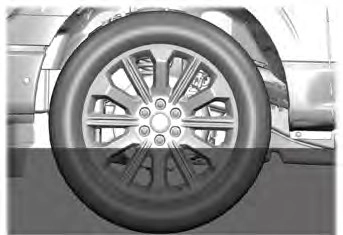
 WARNING: After off-road use, before returning to the road, check the wheels and tires for damage. Off-road use may cause damage to your wheels and tires that can lead to tire failure, loss of vehicle control, serious injury or death.

 WARNING: Secure the floor mat to both retention devices so that it cannot slip out of position and interfere with the pedals. Failure to follow this instruction could result in the loss of control of your vehicle, personal injury or death.
 WARNING: Do not place additional floor mats or any other covering on top of the original floor mats. This could result in the floor mat interfering with the operation of the pedals. Failure to follow this instruction could result in the loss of control of your vehicle, personal injury or death.
 WARNING: Always make sure that objects cannot fall into the driver foot well while your vehicle is moving. Objects that are loose can become trapped under the pedals causing a loss of vehicle control.