Tow N Go — If Equipped
Tow N Go combines the capabilities of the vehicle control systems, along with driver input, to provide optimum performance for road conditions.
Push any one of the four drive mode buttons to select the desired mode.
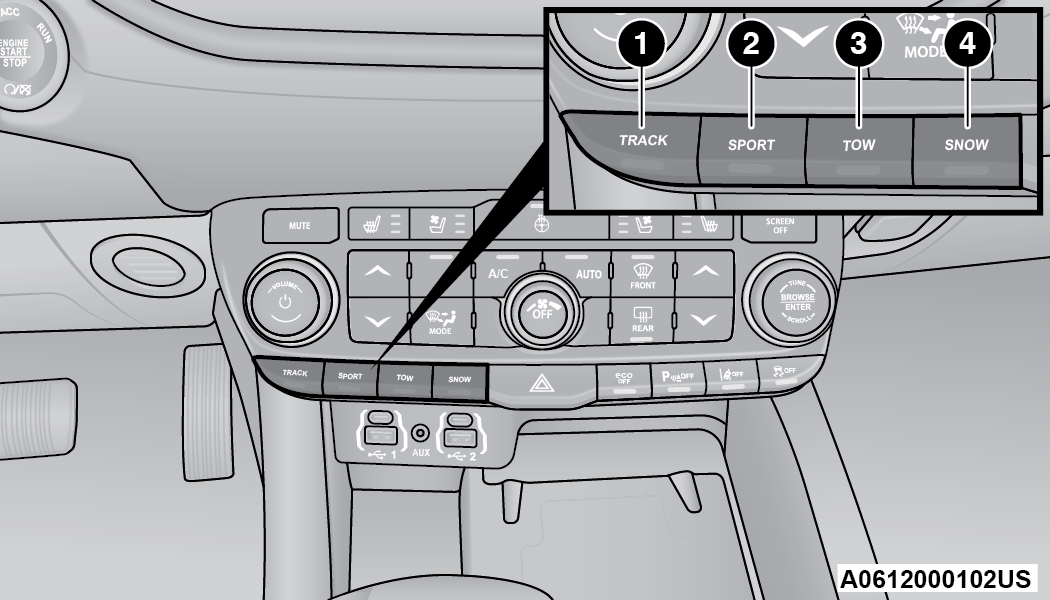
Drive Mode Buttons
|
1 — TRACK |
|
2 — SPORT |
|
3 — TOW |
|
4 — SNOW |
Tow N Go consists of the following positions:
-
TRACK – Optimizes settings for transmission, engine, driveline, and suspension in order to maximize vehicle performance. Also the electric power steering offers more feedback of the tire gripping the road. This feature will reset to AUTO upon an ignition cycle. To turn off Electronic Stability Control (ESC) "⇨ESC Operating Modes".
-
SPORT – Dry weather, on-road calibration. Performance based tuning that provides a rear-wheel drive feel but with improved handling and acceleration over a two-wheel drive vehicle. This feature will reset to AUTO upon an ignition cycle.
-
TOW – TOW drive mode also optimizes the transmission shifting for towing, as well as maximizing straight line traction by optimizing driveline settings on AWD system. Use this mode for towing/hauling. Vehicle suspension will go to SPORT mode. Trailer Sway Control (TSC) is always enabled in all drive modes provided that the ESC OFF indicator light is not illuminated. TSC is disabled when the ESC OFF lamp is illuminated. This feature will reset to AUTO upon an ignition cycle.
-
SNOW – Tuning set for additional stability in inclement weather. Use on and off-road on loose traction surfaces such as snow. This feature will reset to AUTO upon an ignition cycle.
GUIDELINES FOR TRACK USE
Note:
The standard Black Brembo Brake Pads are not recommended for track use. Only the Red Brembo Performance calipers are appropriate for track use.
-
If your vehicle is equipped with Drive Modes, they will alter the vehicle’s performance in various driving situations. It is recommended that your vehicle operates in SPORT or TRACK modes during the track event.
-
Prior to each track event, verify all fluids are at the correct levels.
-
Prior to each track event, verify the front and rear brake pads have more than half pad thickness remaining. If the brake pads require changing, complete a brake burnish procedure prior to track outing at full pace.
Note:
Use of DOT 4 brake fluid is suggested for extended track usage due to increased thermal capacity.
-
At the conclusion of each track event, it is recommended that a brake bleed procedure is performed to maintain the pedal feel and stopping capability of your Brembo High Performance brake system.
-
It is recommended that each track outing should end with a minimum of one cooldown lap using minimal braking.
-
It is recommended that the suspension system, brake system, prop shaft, and half shaft boots be checked for wear or damage after every track event.
-
Track usage results in increased operating temperatures of the engine, transmission, driveline and brake system. This may affect Noise Vibration Harshness (NVH) countermeasures designed into your vehicle. New components may need to be installed to return the system to the original NVH performance.
-
Tire pressure:
-
Recommended tire pressure of 33 psi (230 kPa) when tires are cold, or below 42 psi (290 kPa) when hot.
Note:
It is recommended that you target below 42 psi (290 kPa) when tires are hot at the conclusion of each track session. Starting at 33 psi (230 kPa) cold and adjusting based on ambient and track conditions is recommended. Tire pressure can be monitored via the instrument cluster display and can assist with adjustments.
-
Track burnishing your brakes
To avoid “green lining fade” during track use, the brake pads and rotors must have a thermal burnish for factory-installed components or when new brake friction components are installed:
-
Use one track session to burnish brakes by driving at 75% speed. Brake at approximately 0.60 - 0.80g max without Anti-Lock Brake System (ABS) intervention.
-
Complete one lap in this manner until you start smelling the brakes. Continue for another half lap at speed, then complete a two lap cooldown with minimal brake applications. Ensure the brakes are not smoking. If they are, complete another cooldown lap.
-
Getting the brakes to smoke is an indication that the brakes have overheated and may negatively affect future track usage.
-
Allow vehicle to sit and cool for at least 30 minutes. If an infrared thermal gun is available, allow rotors to cool to 200°F (93.3°C) before returning to the track.
-
There should be a thin layer of ash when inspecting the brake pads. Having the ash layer go more than half the thickness of the pad material is a sign of an overly aggressive burnish.
-
Occasionally, a second burnish session is required. If the brake pads begin to emit an odor during the next track session, reduce vehicle speed and braking deceleration rate to burnish targets and follow steps 2-4.
-
New brake pads installed on old rotors require a burnish. New rotors installed with old brake pads should be burnished at the track or driven for 300 miles (485 km) of city driving to develop an adequate lining transfer layer on the rotor surface prior to track use.
-
Rotors that pulsate during track use should be replaced.
Note:
Resurfacing of the rotors is not recommended, as it removes mass from the rotor, reducing its thermal capacity. Resurfacing also thins the rotor cheek, making it less robust and increasing the likelihood of pulsation in further track use.
Fuel Saver Technology 5.7L Only — If Equipped
This feature offers improved fuel economy by shutting off four of the engine's eight cylinders during light load and cruise conditions. The system is automatic with no driver inputs.
Note:
This system may take some time to return to full functionality after a battery disconnect.
Download Manual