TRAILER TOWING
In this section you will find safety tips and information on limits to the type of towing you can reasonably do with your vehicle. Before towing a trailer, carefully review this information to tow your load as efficiently and safely as possible.
To maintain the New Vehicle Limited Warranty coverage, follow the requirements and recommendations in this manual concerning vehicles used for trailer towing.
The following trailer towing related definitions will assist you in understanding the following information:
Gross Vehicle Weight Rating (GVWR)
The GVWR is the total allowable weight of your vehicle. This includes driver, passengers, cargo and tongue weight. The total load must be limited so that you do not exceed the GVWR. Refer to“Vehicle Loading/Vehicle Certification Label” in“Starting And Operating” for further information.
The GTW is the weight of the trailer plus the weight of all cargo, consumables, and equipment (permanent or temporary) loaded in or on the trailer in its "loaded and ready for operation" condition.
The recommended way to measure GTW is to put your fully loaded trailer on a vehicle scale. The entire weight of the trailer must be supported by the scale.
The GCWR is the total allowable weight of your
vehicle and trailer when weighed in combination.
The GAWR is the maximum capacity of the front and rear axles. Distribute the load over the front and rear axles evenly. Make sure that you do not exceed either front or rear GAWR. Refer to“Vehicle Loading/Vehicle Certification Label” in“Starting And Operating” for further information.
The tongue weight is the downward force exerted on the hitch ball by the trailer. You must consider this as part of the load on your vehicle.
The frontal area is the maximum height multiplied by the maximum width of the front of a trailer.
The Trailer Sway Control (TSC) can be a mechanical telescoping link that can be installed between the hitch receiver and the trailer tongue that typically provides adjustable friction associated with the telescoping motion to dampen any unwanted trailer swaying motions while traveling.
If equipped, the electronic TSC recognizes a swaying trailer and automatically applies individual wheel brakes and/or reduces engine power to attempt to eliminate the trailer sway.
A weight-carrying hitch supports the trailer tongue weight, just as if it were luggage located at a hitch ball or some other connecting point of the vehicle. These kinds of hitches are the most popular on the market today and they are commonly used to tow small and medium sized trailers.
A weight-distributing system works by applying leverage through spring (load) bars. They are typically used for heavier loads to distribute trailer tongue weight to the tow vehicle's front axle and the trailer axle(s). When used in accordance with the manufacturer's directions, it provides for a more level ride, offering more consistent steering and brake control thereby enhancing towing safety. The addition of a friction/hydraulic sway control also dampens
sway caused by traffic and crosswinds and contributes positively to tow vehicle and trailer stability. Trailer sway control and a weight distributing (load equalizing) hitch are recommended for heavier Tongue Weights (TW) and may be required depending on vehicle and trailer configuration/loading to comply with Gross Axle Weight Rating (GAWR) requirements.
The following chart provides the industry standard for the maximum trailer weight a given trailer hitch class can tow and should be used to assist you in selecting the correct trailer hitch for your intended towing condition.
5
|
Engine/Transmission |
Frontal Area |
Max. GTW (Gross Trailer Wt.) |
Max. Tongue Wt. |
|
3.6L Automatic |
12 sq ft (1.11 sq m) |
1,000 lbs (454 kg) |
100 lbs (45 kg) |
|
Refer to local laws for maximum trailer towing speeds. |
Trailer towing with the 5.7L, 6.4L or 6.2L Supercharged engine is not recommended.
Never exceed the maximum tongue weight stamped on your bumper or trailer hitch.
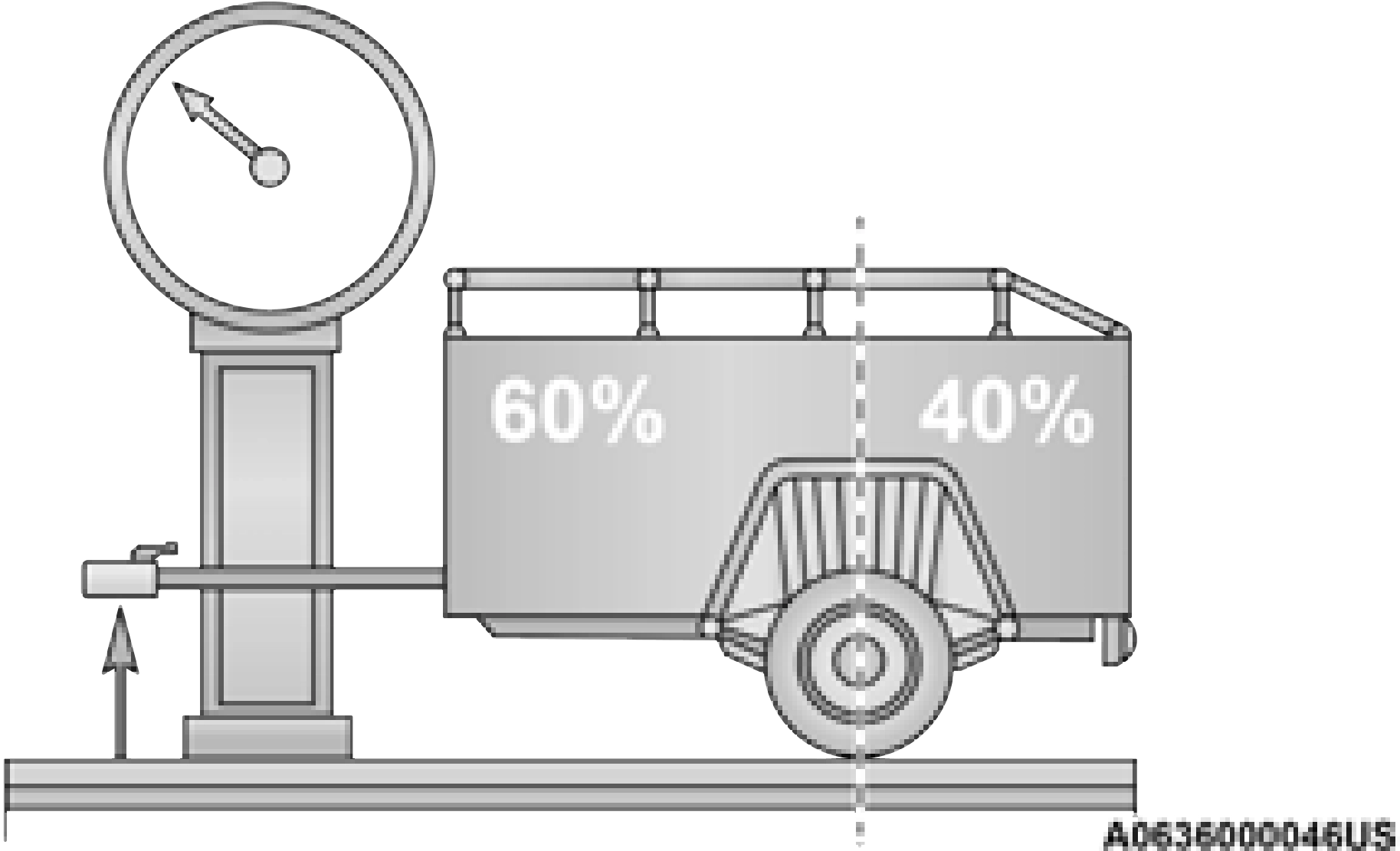
Weight Distribution
Consider the following items when computing the weight on the rear axle of the vehicle:
Remember that everything put into or on the
trailer adds to the load on your vehicle. Also, additional factory-installed options or
dealer-installed options must be considered as part of the total load on your vehicle. Refer to the“Tire And Loading Information” placard for the maximum combined weight of occupants and cargo for your vehicle.
To promote proper break-in of your new vehicle drivetrain components, the following guidelines are recommended.
(Continued)
Perform the maintenance listed in the“Scheduled Servicing”. Refer to“Scheduled Servicing” in“Servicing And Maintenance” for the proper maintenance intervals. When towing a trailer, never exceed the GAWR or GCWR ratings.
system or vacuum system of your vehicle with that of the trailer. This could cause inad- equate braking and possible personal injury.
(Continued)
Whenever you pull a trailer, regardless of the trailer size, stoplights and turn signals on the trailer are required for motoring safety.
The Trailer Tow Package may include a four- and seven-pin wiring harness. Use a factory approved trailer harness and connector.
Do not cut or splice wiring into the vehicle’s wiring harness.
The electrical connections are all complete to the vehicle but you must mate the harness to a trailer connector. Refer to the following illustrations.
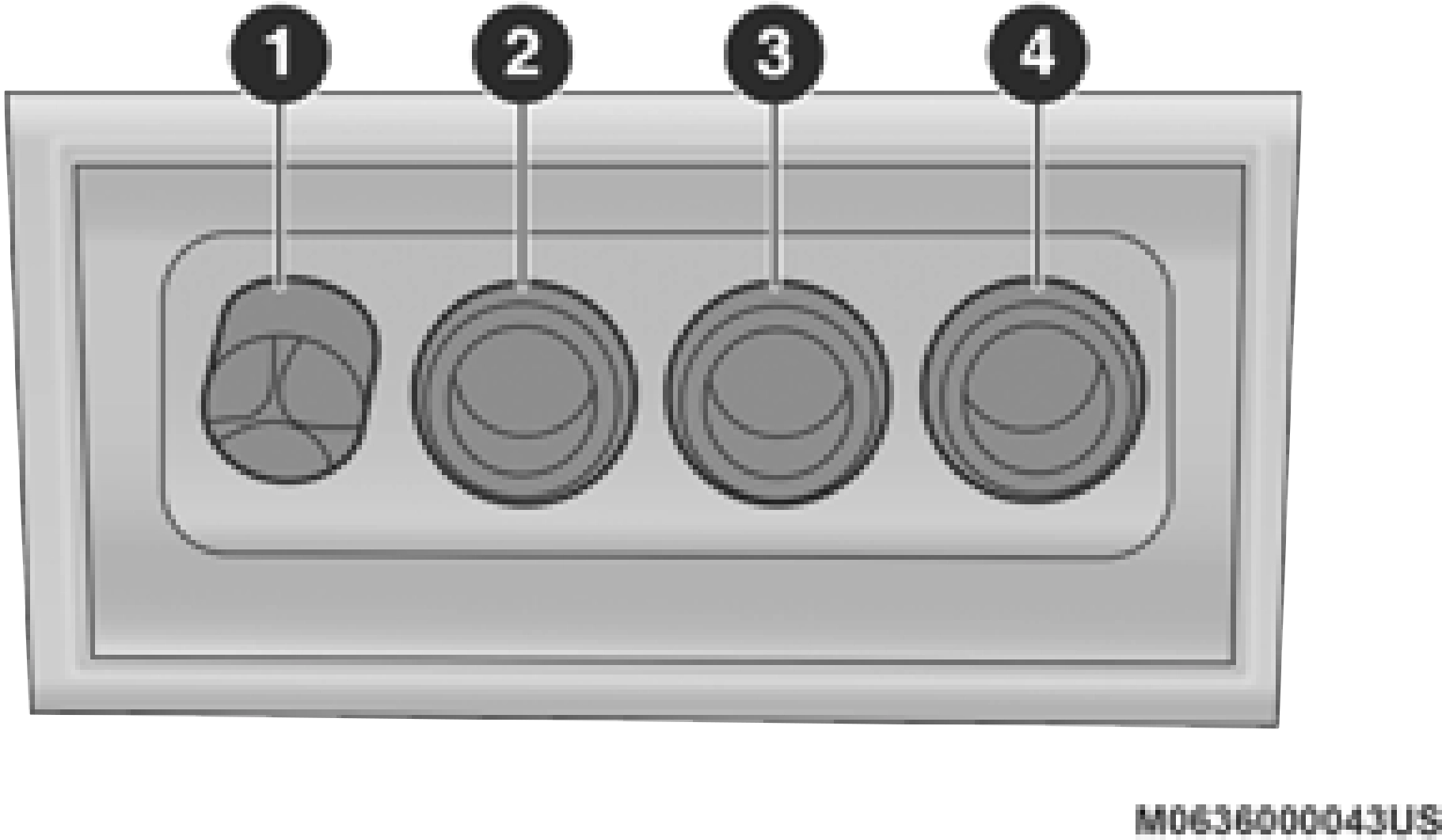
Four-Pin Connector
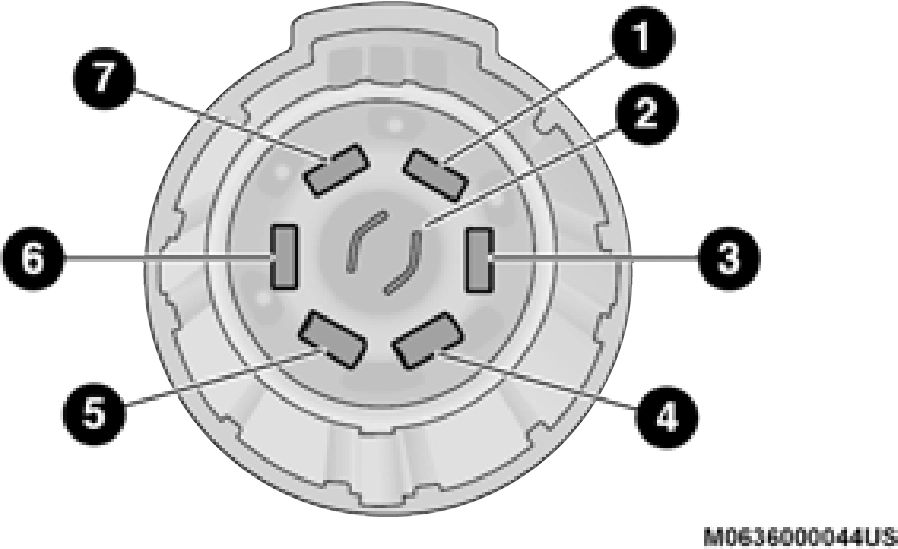
Seven-Pin Connector
6 — Left Stop/Turn 7 — Running Lamps
Before setting out on a trip, practice turning, stopping, and backing up the trailer in an area located away from heavy traffic.
Select the DRIVE range when towing. The transmission controls include a drive strategy to avoid frequent shifting when towing. However, if frequent shifting does occur while in DRIVE, you can use the AutoStick shift control to manually select a lower gear.
Using a lower gear while operating the vehicle under heavy loading conditions will improve performance and extend transmission life by reducing excessive shifting and heat buildup. This action will also provide better engine braking.
(16 km/h), disengage until you can get back to cruising speed.
higher gear or vehicle speed when grade and 5
road conditions allow.
To reduce potential for engine and transmission overheating, take the following actions:
Download Manual