INSTRUMENT CLUSTER DISPLAY
Your vehicle will be equipped with an instrument cluster display, which offers useful information to the driver. With the ignition in the OFF mode, opening/closing of a door will activate the display for viewing, and display the
total miles, or kilometers, in the odometer. Your 3
instrument cluster display is designed to display
important information about your vehicle’s systems and features. Using a driver interactive display located on the instrument panel, your instrument cluster display can show you how systems are working and give you warnings when they are not. The steering wheel mounted controls allow you to scroll through the main menus and submenus. You can access the specific information you want and make selections and adjustments.
to exceed the upper limits of the normal
operating range. NOTE:
The hard telltales will illuminate for a bulb check when the ignition is first cycled.
The instrument cluster display features an interactive display which is located in the instrument cluster.
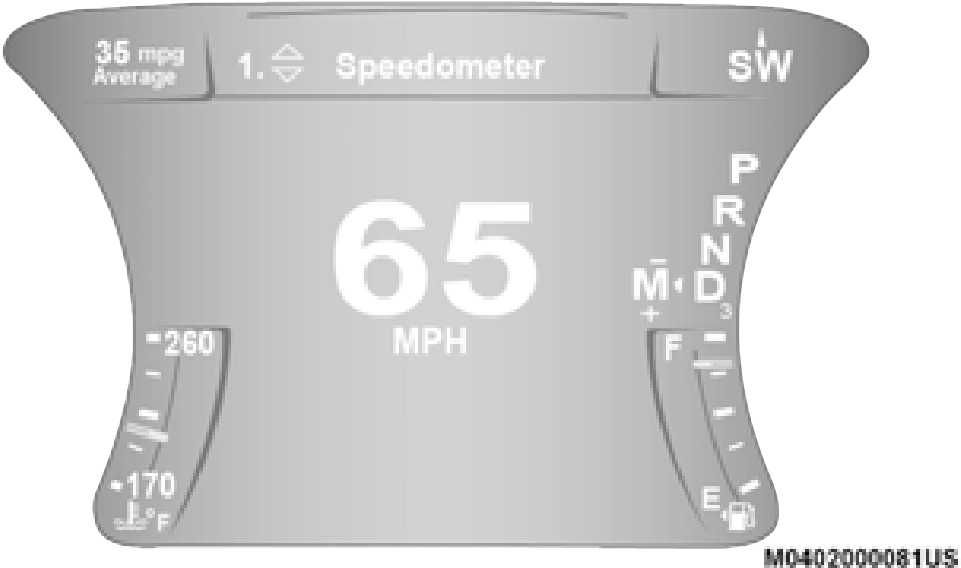
SRT Instrument Cluster Display
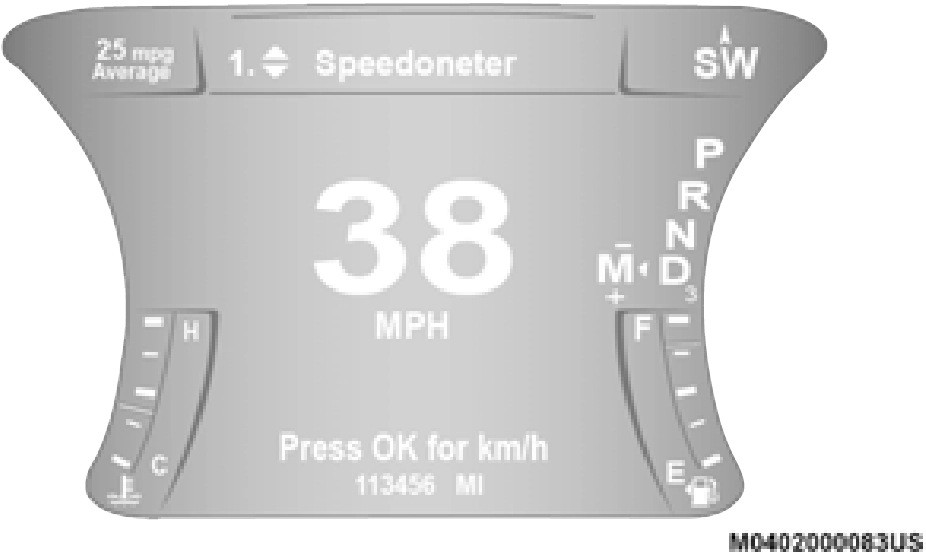
Instrument Cluster Display
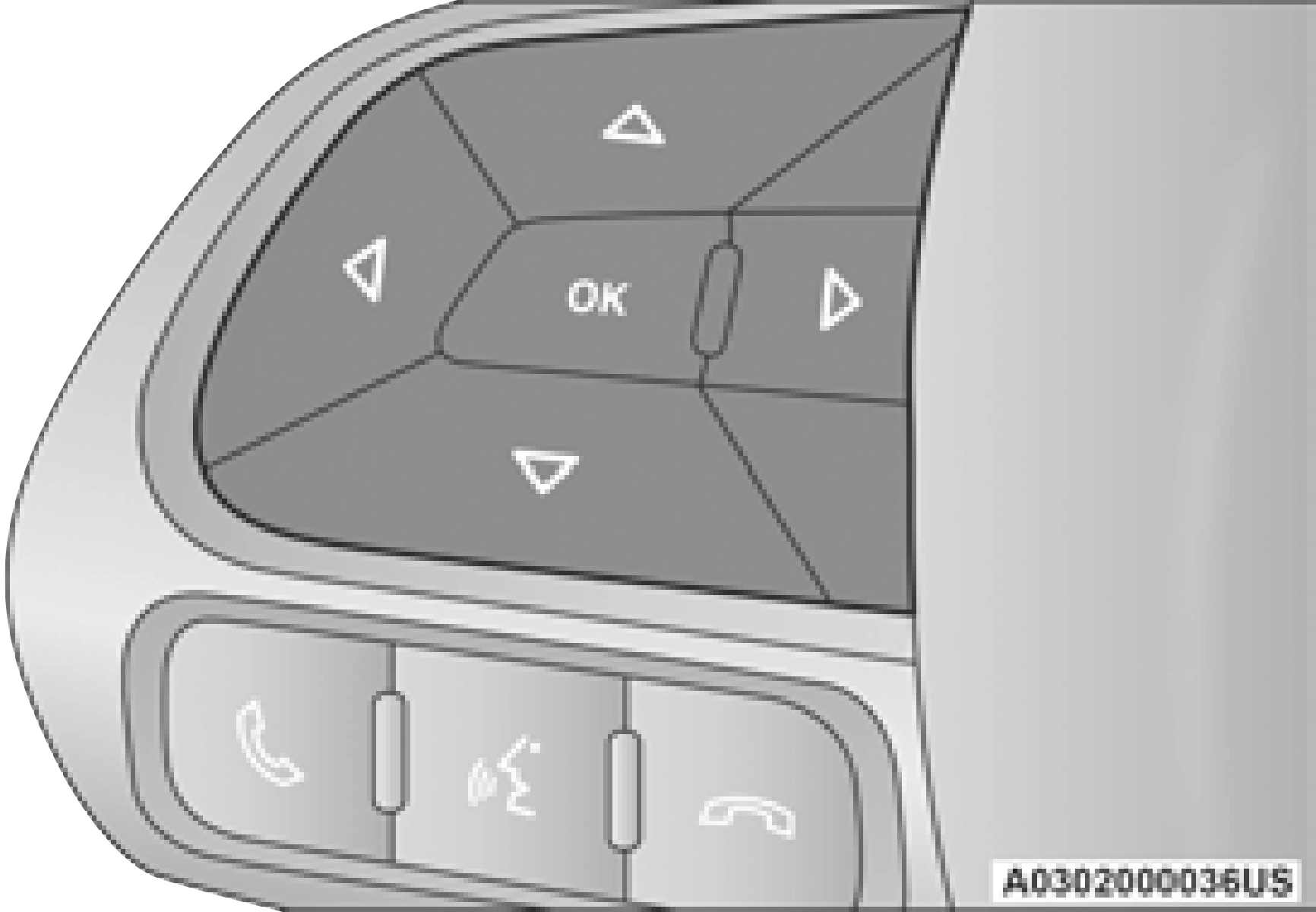
This system conveniently allows the driver to select a variety of useful information by pushing the arrow buttons located on the left side of the steering wheel. The instrument cluster display menu items consist of the following:
The system allows the driver to select information by pushing the following buttons mounted on the steering wheel:
Instrument Cluster Display Controls

 Using the up or down arrow button allows you to cycle through the Main Menu Items.
Changes the Main Screen area and Menu Title area.

 Using the left or right arrow button allows you to cycle through the submenu items of the Main menu item.
Holding the up or down or left or right arrow button will continuously loop through the currently selected menu oroptions presented on the screen.
For Digital Speedometer:
For Screen Setup:
Within each submenu layer, the up and down arrow buttons will allow the user to select the item of interest.Pushing the left arrow button will exit each submenu layer and return to the main menu.ENGINE OIL LIFE RESET
Your vehicle is equipped with an engine oil change indicator system. The“Oil Change Required” message will display in the instrument cluster display for five seconds after a single chime has sounded, to indicate the next scheduled oil change interval. The engine oil change indicator system is duty cycle based, which means the engine oil change interval may fluctuate, dependent upon your personal driving style.
Unless reset, this message will continue to display each time you place the ignition in the ON/RUN position. To turn off the message temporarily, push and release the OK or arrow buttons. To reset the oil change indicator system (after performing the scheduled maintenance), refer to the following procedure.
Use the steering wheel instrument cluster display controls for the following procedure(s):
Push and release the down arrow button to scroll downward through the main menuto“Vehicle Info.” 3
Push and release the right arrow button to access the ”Oil Life” screen.Push and release the up or down arrow button to exit the submenu screen.If the indicator message illuminates when you start the vehicle, the oil change indicator system did not reset. If necessary, repeat this procedure.
If the indicator message illuminates when you start the vehicle, the oil change indicator system did not reset. If necessary, repeat this procedure.
PERFORMANCE SHIFT INDICATOR (PSI)
— IF EQUIPPED
The Performance Shift Indicator (PSI) is enabled on vehicles with manual transmission, or when a vehicle with automatic transmission is in manual shift mode. The PSI provides the driver with a visual indication within the instrument cluster display when the driver configured gear shift point has been reached and the driver is
still accelerating. This indication notifies the driver to change gear corresponding to the configured RPMs in the head unit.
Push and release the up or down arrow button until the desired Selectable Menu item is displayed in the instrument cluster display.
Follow the Menu or submenu prompts as desired.
Speedometer
Push and release the up or down arrow button until the speedometer menu is displayed in the instrument cluster display. Push and release the OK button to toggle units (km/h or mph) of the speedometer.
Push and release the up or down arrow button until the“Vehicle Info” menu is displayed in the instrument cluster display. Push and
release the right or left arrow button to scroll through the submenus items of“Vehicle Info.” Follow the directional prompts to access
or reset any of the following“Vehicle Info” submenu items:
Push and release the up or down arrow button until the Performance menu is displayed in the instrument cluster display. Push the
right or left arrow button to enter the submenus.
The Performance Features include the following:
The following describes each feature and its operation:
The Driver Assist menu displays the status of the ACC and LaneSense systems.
Push and release the up or down arrow button until the Driver Assist menu is displayed in the instrument cluster display.
The instrument cluster displays the current ACC system settings. The information displayed depends on ACC system status.
Push the Adaptive Cruise Control (ACC) on/off button (located on the steering wheel) until one of the following displays in the instrument cluster display:
When ACC is deactivated, the display will read“Adaptive Cruise Control Off.”
When ACC is activated but the vehicle speed setting has not been selected, the display will read“Adaptive Cruise Control Ready.”
Push the SET + or the SET- button (located on the steering wheel) and the following will display in the instrument cluster display:
When ACC is set, the set speed will display in the instrument cluster.
The ACC screen may display once again if any ACC activity occurs, which may include any of the following:
For further information, refer to“Adaptive Cruise Control (ACC) — If Equipped” in“Starting And Operating.”
The instrument cluster displays the current LaneSense system settings. The information displayed depends on LaneSense system
status and the conditions that need to be met. For further information, refer to“LaneSense — If Equipped” in“Starting And Operating.”
Two submenu pages; one with Current Value (instantaneous calculation of the fuel economy) displayed and one without the Current Value

 displayed (toggle the left or right arrow button to select one):


 Push and release the up or down arrow button until the Trip Menu item is displayed in the instrument cluster display. Toggle the left
 or right arrow button to select Trip A or Trip B. The Trip information will display the following:
Hold the OK button to reset feature information.
This menu displays the Audio information of the currently playing audio source (e.g. FM radio).
 This feature shows the number of stored warning messages, if any. Pushing the right
or left arrow button will allow you to scroll through the stored messages.

 Push and release the up or down arrow button until the Screen Setup Menu displays in the instrument cluster display. Push and release the OK button to enter the submenus. The Screen Setup feature allows you to change what information is displayed in the instrument cluster as well as the location that information is displayed.
Push and release the up or down arrow button until the Speed Warning Menu icon/title is displayed in the instrument cluster display.
Push and release OK to enter speed warning. Use the up or down arrow button to select a desired speed, then push and release OK to set the speed. The white passive speed limiter telltale will light up with a notification text message (Speed Warning Set to XX, followed by the selected unit). When the set speed is just exceeded, a single chime will sound with a pop up message of“Speed Warning Exceeded”. If the set speed is exceeded by 1.5 mph (3 km/h), an audible chime will sound for up to 10 seconds or until the speed is no longer exceeded. The white passive speed limiter telltale will turn yellow and will flash, and a pop-up message of“Speed Warning Exceeded” will display.
You can turn the Speed Warning off by using the up/down arrow buttons to scroll through speed list and select OFF at the bottom of the list.
This feature allows the driver to view engine and emission vehicle faults.
BATTERY SAVER ON/BATTERY SAVER MODE MESSAGE — ELECTRICAL LOAD REDUCTION ACTIONS — IF EQUIPPED
This vehicle is equipped with an Intelligent Battery Sensor (IBS) to perform additional monitoring of the electrical system and status of the vehicle battery.
In cases when the IBS detects charging system failure, or the vehicle battery conditions are deteriorating, electrical load reduction actions will take place to extend the driving time and distance of the vehicle. This is done by reducing power to or turning off non-essential electrical loads.
Load reduction is only active when the engine is running. It will display a message if there is a risk of battery depletion to the point where the vehicle may stall due to lack of electrical supply, or will not restart after the current drive cycle.
When load reduction is activated, the message“Battery Saver On” or“Battery Saver Mode” will appear in the instrument cluster.
These messages indicate the vehicle battery has a low state of charge and continues to lose electrical charge at a rate that the charging system cannot sustain.
The electrical loads that may be switched off (if equipped), and vehicle functions which can be affected by load reduction:
Loss of the battery charge may indicate one or more of the following conditions:
+12 Volts, 115 Volts AC, USB ports) during certain driving conditions (city driving, towing, frequent stopping).
During a trip:
After a trip:
Download Manual