TIRE SERVICE KIT — IF EQUIPPED
Small punctures up to 1/4 inch (6 mm) in the tire tread can be sealed with Tire Service Kit. Foreign objects (e.g., screws or nails) should not be removed from the tire. Tire Service Kit can be used in outside temperatures down to approxi- mately -4 °F (-20 °C).
This kit will provide a temporary tire seal, allowing you todrive your vehicle up to 100 miles (160 km) with maximum speed of 50 mph (80 km/h).
Tire Service Kit Storage
The Tire Service Kit is located in the trunk.
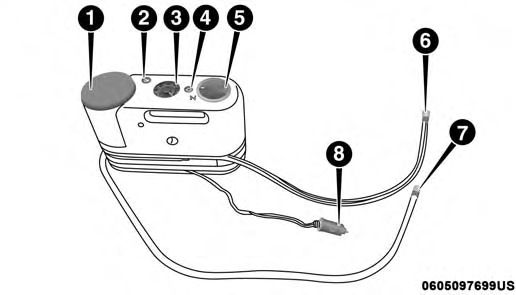
Tire Service Kit Components
- Sealant Bottle
- Deflation Button
- Pressure Gauge
- Power Button
- Mode Select Knob
- Sealant Hose (Clear)
- Air Pump Hose (Black)
- Power Plug (located on the bottom side of the Tire Service Kit)
Tire Service Kit Components And Operation Using The Mode Select Knob And Hoses
Your Tire Service Kit is equipped with the following symbols to indicate the air or sealant mode.
 Push in the Mode Select Knob (5) and turn to this position for air pump operation only. Use the Black Air Pump Hose (7) when selecting this mode.
 Push in the Mode Select Knob (5) and turn to this position to inject the Tire Service Kit Sealant and to inflate the tire. Use the Sealant Hose (clear hose) (6) when selecting this mode.
 Push and release the Power Button (4) once to turn on the Tire Service Kit. Push and release the Power Button again to turn Off the Tire Service Kit.
 Push the Deflation Button (2) to reduce the air pressure in the tire if it becomes over-inflated.
Tire Service Kit Usage Precautions
Replace the Tire Service Kit Sealant Bottle (1) and Sealant Hose (6) prior to the expiration date (printed at the lower right hand corner on the bottle label) to assure optimum operation of the system. Refer to “Sealing A Tire With Tire Service Kit” section (F) “Sealant Bottle And Hose Replacement”.
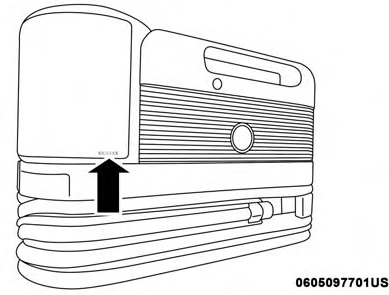
Tire Service Kit Expiration Date Location
The Sealant Bottle (1) and Sealant Hose (6) are a one tire application use and need to be replaced after each use. Always replace these components immediately at your original equipment vehicle dealer.
When the Tire Service Kit sealant is in a liquid form, clean water and a damp cloth will remove the material from the vehicle or tire and wheel components. Once the sealant dries, it can easily be peeled off and properly discarded.
For optimum performance, make sure the valve stem on the wheel is free of debris before connecting the Tire Service Kit.
You can use the Tire Service Kit air pump to inflate bicycle tires. The kit also comes with two needles,
located in the Accessory Storage Compartment (on the bottom of the air pump) for inflating sport balls, rafts, or similar inflatable items. However, use only the Air Pump Hose (7) and make sure the Mode Select Knob (5) is in the Air Mode when inflating such items to avoid inject- ing sealant into them. The Tire Service Kit Sealant is only intended to seal punctures less than 1/4 inch (6 mm) diameter in the tread of your tire.
Do not lift or carry the Tire Service Kit by the hoses.
(A) Whenever You Stop To Use Tire Service Kit:
- Pull over to a safe location and turn on the vehicle’s Hazard Warning flashers.
- Verify that the valve stem (on the wheel with the deflated tire) is in a position that is near to the ground. This will allow the Tire Service Kit Hoses (6) and (7) to reach the valve stem and keep the Tire Service Kit flat on the ground. This will provide the best positioning of the kit when injecting the sealant into the deflated tire and running the air pump. Move the vehicle as necessary to place the valve stem in this position before proceeding.
- Place the transmission in PARK (auto transmission) or in Gear (manual transmission) and place the ignition in the OFF position.
- Apply the parking brake.
(B) Setting Up To Use Tire Service Kit:
- Push in the Mode Select Knob (5) and turn to the Sealant Mode position.
- Uncoil the Sealant Hose (6) and then remove the cap from the fitting at the end of the hose.
- Place the Tire Service Kit flat on the ground next to the deflated tire.
- Remove the cap from the valve stem and then screw the fitting at the end of the Sealant Hose (6) onto the valve stem.
- Uncoil the Power Plug (8) and insert the plug into the vehicle’s 12 Volt power outlet.
NOTE: Do not remove foreign objects (e.g., screws or nails) from the tire.
(C) Injecting Tire Service Kit Sealant Into The Deflated Tire:
- Always start the engine before turning ON the Tire Service Kit.
NOTE: Manual transmission vehicles must have the park- ing brake engaged and the gear selector in NEUTRAL.
- Setting Up To Use Tire Service Kit:
- After pushing the Power Button (4), the sealant (white fluid) will flow from the Sealant Bottle (1) through the Sealant Hose (6) and into the tire.
NOTE: Sealant may leak out through the puncture in the tire.
If the sealant (white fluid) does not flow within 0 – 10 seconds through the Sealant Hose (6):
- Push the Power Button (4) to turn Off the Tire Service Kit. Disconnect the Sealant Hose (6) from the valve stem. Make sure the valve stem is free of debris. Reconnect the Sealant Hose (6) to the valve stem. Check that the Mode Select Knob (5) is in the Sealant Mode position and not Air Mode. Push the Power Button (4) to turn On the Tire Service Kit.
- Connect the Power Plug (8) to a different 12 Volt power outlet in your vehicle or another vehicle, if available. Make sure the engine is running before turning ON the Tire Service Kit.
- The Sealant Bottle (1) may be empty due to previous use. Call for assistance.
NOTE: If the Mode Select Knob (5) is on Air Mode and the pump is operating, air will dispense from the Air Pump Hose (7) only, not the Sealant Hose (6).
If the sealant (white fluid) does flow through the Sealant Hose (6):
- Continue to operate the pump until sealant is no longer flowing through the hose (typically takes 30 - 70 sec- onds). As the sealant flows through the Sealant Hose (6), the Pressure Gauge (3) can read as high as 70 psi (4.8 Bar). The Pressure Gauge (3) will decrease quickly from approximately 70 psi (4.8 Bar) to the actual tire pressure when the Sealant Bottle (1) is empty.
- The pump will start to inject air into the tire immedi- ately after the Sealant Bottle (1) is empty. Continue to operate the pump and inflate the tire to the pressure indicated on the tire pressure label on the driver-side latch pillar (recommended pressure). Check the tire pressure by looking at the Pressure Gauge (3).
If the tire does not inflate to at least 26 psi (1.8 Bar) pressure within 15 minutes:
The tire is too badly damaged. Do not attempt to drive the vehicle further. Call for assistance.
NOTE: If the tire becomes overinflated, push the Deflation Button (2) to reduce the tire pressure to the recommended inflation pressure before continuing.
If the tire inflates to the recommended pressure or is at least 26 psi (1.8 Bar) pressure within 15 minutes:
- Push the Power Button (4) to turn off the Tire Service Kit.
- Remove the Speed Limit sticker from the top of the Sealant Bottle (1) and place the sticker on the instrument panel.
- Immediately disconnect the Sealant Hose (6) from the valve stem, reinstall the cap on the fitting at the end of the
(D) Drive Vehicle:
Immediately after injecting sealant and inflating the tire, drive the vehicle 5 miles (8 km) or ten minutes to ensure distribution of the Tire Service Kit Sealant within the tire. Do not exceed 50 mph (80 km/h).
(E) After Driving:
Pull over to a safe location. Refer to “(A) Whenever You Stop To Use Tire Service Kit” before continuing.
- Push in the Mode Select Knob (5) and turn to the Air Mode position.
- Uncoil the power plug and insert the plug into the vehicle’s 12 Volt power outlet.
- Uncoil the Air Pump Hose (7) (black in color) and screw the fitting at the end of hose (7) onto the valve stem.
- Check the pressure in the tire by reading the Pressure Gauge (3).
Download Manual