JUMP STARTING
If your vehicle has a discharged battery, it can be jump started using a set of jumper cables and a battery in another vehicle, or by using a portable battery booster pack. Jump starting can be dangerous if done improperly, so please follow the procedures in this section carefully.
NOTE:
When using a portable battery booster pack, follow the manufacturer’s operating instructions and precautions.
PREPARATIONS FOR JUMP START
The battery is stored under an access cover in the trunk. Remote battery posts are located on the right side of the engine compartment for jump starting.
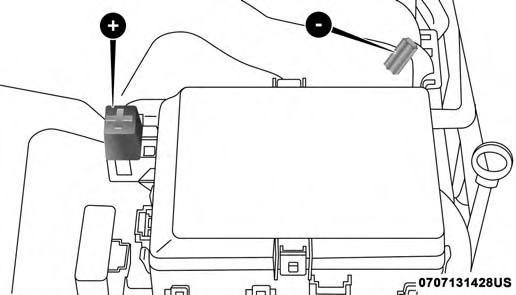
Jump Starting Locations
- (+) — Remote Positive Post
- (-) — Remote Negative Post
Do not jump off fuses. Only jump directly off positive post which has a positive (+) symbol on or around the post.
See below steps to prepare for jump starting:
- Apply the parking brake, shift the automatic transmission into PARK and place the ignition in the OFF position.
- Turn off the heater, radio, and all unnecessary electrical accessories.
- If using another vehicle to jump start the battery, park the vehicle within the jumper cable’s reach, apply the parking brake and make sure the ignition is OFF.
JUMP STARTING PROCEDURE
Connecting The Jumper Cables
- Connect the positive (+) end of the jumper cable to the remote positive (+) post of the vehicle with the dis- charged battery.
- Connect the opposite end of the positive (+) jumper cable to the positive (+) post of the booster battery.
- Connect the opposite end of the negative (-) jumper cable to the remote negative (-) post of the vehicle with the discharged battery.
- Connect the negative (-) end of the jumper cable to the negative (-) post of the booster battery.
- Connect the opposite end of the negative (-) jumper cable to the remote negative (-) post (exposed metallic/unpainted post of the discharge vehicle) located directly behind the under-hood fuse box
- Start the engine in the vehicle that has the booster battery, let the engine idle a few minutes, and then start the engine in the vehicle with the discharged battery.
- Once the engine is started, follow the disconnection procedure below.
Disconnecting The Jumper Cables
- Disconnect the negative (-) end of the jumper cable from the remote negative (-) post of the vehicle with the discharged battery.
- Disconnect the opposite end of the negative (-) jumper cable from the negative (-) post of the booster battery.
- Disconnect the positive (+) end of the jumper cable from the positive (+) post of the booster battery.
- Disconnect the opposite end of the positive (+) jumper cable from the remote positive (+) post of the vehicle with the discharged battery.
If frequent jump starting is required to start your vehicle you should have the battery and charging system in- spected at an authorized dealer.
IF YOUR ENGINE OVERHEATS
In any of the following situations, you can reduce the potential for overheating by taking the appropriate action
- On the highways — slow down
- In city traffic — while stopped, place the transmission in NEUTRAL, but do not increase the engine idle speed while preventing vehicle motion with the brakes.
- If your air conditioner (A/C) is on, turn it off. The A/C system adds heat to the engine cooling system and turning the A/C off can help remove this heat.
- You can also turn the temperature control to maximum heat, the mode control to floor and the blower control to high. This allows the heater core to act as a supplement to the radiator and aids in removing heat from the engine cooling system.
NOTE: There are steps that you can take to slow down an impending overheat condition:
Download Manual